The NCAA went down to Pittsboro; it was looking to avoid appeal

I thought I would break from my regular content and use the Trinidad Chambliss versus the NCAA lawsuit as an excuse to talk about interlocutory orders and appellate jurisdiction and practice. Note: I am not involved in that legal action and I have no information about it other than what is publicly available. Each case turns on its own facts. Nothing below should be construed as legal advice, but only general information about the rules applicable to appealing interlocutory orders. If you need to know how these rules apply to your case, I would love to speak with you about it.


As has been widely discussed, after getting no relief from the NCAA in its own arena, Trinidad Chambliss took his eligibility dispute to court. Specifically, Trinidad sued the NCAA in the Chancery Court of Lafayette County, Mississippi, of which Oxford is the county seat. Through his attorneys, Trinidad filed a Petition for Preliminary and Permanent Injunctive Relief and Declaratory Judgment on January 16, 2026, asking the court to enjoin the NCAA from prohibiting him from playing for the 2026-2027 season and to enter a declaratory judgment that he is eligible for the 2026-2027 season.

The wheels of justice do turn slowly, but there are some ways to make some of the wheels turn a little bit faster. To that end, Trinidad’s attorneys filed a Motion for Preliminary Injunction on January 28, 2026. Both sides filed briefs and a lengthy hearing was held on February 12, 2026, in Pittsboro, Mississippi (population 202, according to the 2010 census). Why Pittsboro? Because Pittsboro is the county seat of Calhoun County, which is in the same chancery court district as Lafayette County. At the conclusion of the hearing, Judge Robert Whitwell announced a ruling from the bench granting Trinidad the preliminary injunction he sought. A written order was entered the following day.

I will leave it to others to write about what this means for the 2026 football season, the grounds for the preliminary injunction, the court’s ruling, and the NCAA’s attorneys’ ill-advised decision to leave court before the hearing concluded. But in light of some bad information floating around about a potential appeal of the court’s order (does the NCAA have 30 days to appeal?), I thought I would talk about something much more interesting than football: appellate jurisdiction and procedure.

So, you Lost a preliminary injunction, what happens next?

Can you appeal? The answer to this question is the classic lawyer response: it depends. But there is no right to immediately appeal a preliminary injunction.

In general, Mississippi law only allows the appeal of final judgments. See Brown v. Collections, Inc., 188 So. 3d 1171, 1174 (Miss. 2016). A preliminary injunction is a temporary order that stands until the case can be fully resolved on the merits. See Sec’y of State v. Gunn, 75 So. 3d 1015, 1021 (Miss. 2011) (citations omitted). Because they are entered before a case has been fully resolved, preliminary injunctions are interlocutory orders that are not final and appealable. Carr v. Miss. Lottery Comm’n, 314 So. 3d 108, 112 (Miss. 2021). In short, there is no right to appeal a preliminary injunction. But that’s not the end of the line.

  • Petition for Interlocutory Appeal

Although preliminary injunctions are not automatically, immediately appealable, a litigant can petition the Mississippi Supreme Court to allow an appeal by filing a petition for interlocutory appeal. See, e.g., United Healthcare of Miss. Inc. v. Mississippi’s Cmty. Mental Health Comm’ns, 335 So. 3d 1055, 1060 (Miss. 2022). This is the procedure to ask the Court to allow you to appeal any order that does not resolve all claims asserted. The grounds and procedure for a petition for interlocutory appeal are established by Rule 5 of the Mississippi Rules of Civil Procedure. Under that rule, an appeal of an interlocutory order may be allowed “if a substantial basis exists for a difference of opinion on a question of law” and appellate resolution “may (1) Materially advance the termination of the litigation and avoid exceptional expense to the parties; or (2) Protect a party from substantial and irreparable injury; or (3) Resolve an issue of general importance in the administration of justice.” M.R.A.P. 5(a). Under this rule, a petition for interlocutory appeal has to be filed within 21 days of the entry of the order you want to appeal. The effect of this rule is that the Mississippi Supreme Court has discretion to grant or deny a petition for interlocutory appeal.

These petitions are specialized pleadings and must contain certain information required by Rule 5. This includes a brief, but it is not a full appellate brief. When I write a petition for interlocutory appeal, I am trying to persuade the Court to take the case more than I am trying to convince the Court that I should win the case. (That comes later, hopefully.) If I am responding, I am trying to convince the Court that there is nothing to see here.

Once a petition for interlocutory appeal is filed, the other side gets to file a response. The rules do not provide for a reply or rebuttal by the petitioner. The Supreme Court typically grants or denies a petition for interlocutory appeal with a one-page order. That order does not decide who wins the appeal. If it is denied, you carry on in the court below. If it is granted, it punches your ticket to the show and an appeal commences. Issues are designated, the record is designated, the record is reviewed, a briefing schedule is entered, etc. On rare occasions the Supreme Court will decide the merits based on the petition and response rather than proceeding with a full-bore appeal.

Importantly, the case is not stayed in the trial court when a petition for interlocutory appeal is filed. It is not even automatically stayed if the Supreme Court grants interloc. A stay has to be requested in the petition and then granted by the Supreme Court. Unless that happens, the lower court proceedings continue apace.

  • Rule 54(b) Final Judgment

Another way to appeal an order that resolves something less than all claims between all parties is to obtain an order from the lower court “certifying” it under Rule 54(b). That rule provides: “[T]he court may direct the entry of a final judgment as to one or more but fewer than all of the claims or parties only upon an expressed determination that there is no just reason for delay and upon an expressed direction for the entry of the judgment.” M.R.C.P. 54(b). If this rule is not strictly complied with, Mississippi’s appellate courts will dismiss an appeal without hesitation. E.g., Williams v. Williams, 347 So. 3d 178 (Miss. 2022) (dismissing an appeal because the “final judgment” did not resolve all claims and did not contain the magic words from Rule 54(b)). If a proper 54(b) judgment is entered, your right to appeal is triggered and you have thirty days to file your notice per M.R.A.P. 4(a).

  • My Take

As of the time publishing this post, the NCAA has not taken any steps toward an appeal on the record. I don’t expect them to try to appeal the preliminary injunction. I don’t expect our seven-member Supreme Court to be inclined to grant an interlocutory appeal in this case. And even if they did grant one, a successful interlocutory appeal would probably take a year or more which wouldn’t get the NCAA where it wants to go by the time it needs to get there. I also think it unlikely that the chancery court in this case would be amenable to certifying an appealable judgment under Rule 54(b). I could be wrong about all of this, of course.

As an appendix of sorts, here are a few of the key filings from the chancery court case:

Mississippi Supreme Court Decisions of August 21, August 28, and September 4

I have been swamped the last few weeks and find myself behind on summaries. One contributing factor is that my firm, Wilkins Patterson, relocated at the end of August. In one form or another, the firm has resided at One LeFleur’s Square on Old Canton Road in Jackson for decades. That location served the firm well, and it was not left without a heap of nostalgia and a tinge of sadness. But as Bob Dylan reminds us, “He not busy being born is busy dying.” This move marks an exciting chapter of growth and opportunity for the firm that we are immensely thankful for. You can find us at 690 Towne Center Boulevard in Ridgeland.

With this post, we are caught up on Mississippi Supreme Court decisions. We may not ever catch up on the Court of Appeals decisions from the past three weeks. This is due, in part, to the fact that over that period of time the Court of Appeals handed down twenty opinions and the Supreme Court handed down four. If you are so inclined, you can follow these links to the COA hand downs: August 19, August 26, and September 2. Read on for Supreme Court decisions…

August 21, 2025

No Opinions

Other Orders

  • Parker v. State, 2023-CT-00550-SCT (denying cert)
  • Mount v. State, 2023-CT-00807-SCT (denying cert)
  • Turner v. State, 2023-CT-01167-SCT (denying cert)
  • Lynch v. State, 2024-M-01275 (finding that the application for leave to proceed in the trial court was frivolous and warning that future frivolous filings may result in sanctions)
  • Priority One Bank v. Hall, 2025-IA-00939-SCT (granting emergency petition for interlocutory appeal)

Hand Down Page


August 28, 2025

Reyes v. State, 2024-KA-00590-SCT (Criminal- Felony)
Affirming conviction of capital murder and life sentence, holding that the trial court did not err in denying the defendant’s motion suppress statements he made to law enforcement, that the State did not vouch for a witness’s credibility, that the issue of whether it was error to allow the State to play portions of a witness’s interview with law enforcement was procedurally barred, and that the ineffective-assistance-of-counsel arguments did not require reversal.
(9-0: Griffis for the Court)


Busby Outdoor LLC v. Ditto, 2024-IA-00209-SCT, consolidated with No. 2024-CA-00258-SCT (Civil – Other)
Reversing the chancery court’s injunction enforcing the City’s sign ordinance on a billboard situated on state-owned land, holding that “[t]he zoning ordinances must yield in this case to state sovereignty.”
(9-0: King for the Court)

Note – I thought for a moment that the Mississippi Supreme Court was about to tackle some big theological issues.

Though it passed on the issue of God’s sovereignty, the Court did hold in this case that that the created could not regulate its creator.


Other Orders

  • Sims v. State, 2017-M-01379 (finding that the application for leave to proceed in the trial court was frivolous and warning that future frivolous filings may result in sanctions)
  • Chamberlin v. State, 2022-DR-00546-SCT (granting cert)
  • Boone v. State, 2023-CT-00684-SCT (denying cert)
  • Burnette v. State, 2023-SCT-01330-SCT (denying cert)

Hand Down Page


September 4, 2025

Smith v. State, 2024-KA-00675-SCT (Criminal – Felony)
Affirming conviction of aggravated assault, holding that the trial court did not err in admitting lay opinion testimony from the victim’s treating physicians and that trial counsel was not ineffective for failing to object to that testimony.
(9-0: Chamberlin for the Court)

Sunshine Mills, Inc. v. Nutra-Blend, LLC, 2023-CA-01208-SCT (Civil – Torts)
Reversing the trial court’s grant of summary judgment for the defendant, holding that the Mississippi Products Liability Act did not govern the claims for breach of contract and implied warranty because they sounded in contract and did not allege damage stemming from a defective product.
(9-1-0: Coleman for the Court; Randolph concurred in the result only without writing)


Other Orders

  • In Re: Rules of Discipline for the Mississippi Bar,  89-R-99010-SCT (appointing or reappointing Hon. Haydn J. Roberts, John G. Holaday, Amy K. Taylor, Hon. Jennifer T. Schloegel, David A. Pumford, Jeremy T. England, Hon. Kelly D. Mims, Jason D. Herring, and Rachel Pierce Waide to three-year terms (9/01/25 to 8/31/28) as members of the Complaint Tribunals.)
  • In Re: Commission on Continuing Legal Education, 89-R-99011-SCT (denying Petition of the Mississippi Commission on Continuing Legal Education to Amend Rule 1(d) of the Rules and Regulations for Mandatory Continuing Legal Education)
  • In Re: Rules Governing Admission to The Mississippi Bar, 89-R-99012-SCT (reappointing Pieter Teeuwissen, Marcie Fyke Baria, and Gwendolyn Baptist-Rucker to three-year terms (11/1/25 through 10/31/28) as members of the Mississippi Board of Bar Admissions)
  • Weatherly v. Weatherly, 2022-CT-00804-SCT (dismissing cert)
  • Star v. State, 2023-CT-00788-SCT (denying cert)
  • Haynes v. State, 2023-CT-00861-SCT (denying cert)
  • Brown v. Madison County Board of Supervisors, 2024-EC-01059-SCT (denying rehearing)

Hand Down Page

My Decision of June 1, 2024

My goal with each blog post is to make the appellate decisions the main characters. I aim to err on the side of dull and keep myself mostly out of the frame. I readily acknowledge that a blog about me would draw far less interest (from you and from me). Today, I am breaking character to share some news about me: I am excited to announce that I have joined Wilkins Patterson Smith Pumphrey & Stephenson, P.A. as a shareholder where I will continue my litigation and workers’ comp practice and lead the firm’s appellate practice.

My legal career started with most of the lawyers who are now at Wilkins Patterson, so this is somewhat of a return home. They hired me right out of law school and invested heavily in me as a brand-new lawyer. I am delighted to be back working with them in this new role.

There will not be any significant changes to my litigation or workers’ comp practices. The biggest adjustment I am making is a renewed emphasis on building up the appellate side of the ledger.

Please reach out if there is every anything I can do to help you. You can find my contact information on the firm’s website.

If you will forgive this personal indulgence, I will be back next week with regularly scheduled programming.

Mississippi Supreme Court Decisions of May 30, 2024

The Mississippi Supreme Court handed down five opinions today. There is an MTCA case, a premises liability case, an unpaid wages case against MDOC, an insurance coverage case, and a workers’ comp/third-party case.


Yazoo City, Mississippi v. Hampton, 2022-IA-01284-SCT (Civil – Property Damage)
Reversing denial of summary judgment in a case seeking to hold the City liable for alleged ineffective firefighting and alleged resulting cardiac stress, holding that the City was immune under the MTCA from both property damage and personal injury liability where the evidence did not support a finding of reckless disregard by the fire department.
(9-0)


St. Dominic-Jackson Memorial Hospital v. Martin, 2023-CA-00285-SCT (Civil – Personal Injury)
Reversing judgment on a jury verdict in case stemming from a fall in an emergency room parking lot, holding that the evidence did not require judgment in the defendant’s favor but that the trial court erred by granting a negligence per se instruction and remanded for a new trial.
(9-0)


Mississippi Department of Corrections v. McClure, 2022-IA-01201-SCT (Civil – State Boards and Agencies)
Affirming the circuit court’s denial of a motion to dismiss for lack of jurisdiction over a former probation officer’s claim for unpaid wages for work with the MDOC, holding that Mississippi courts have jurisdiction to hear state employees’ claims against their employers for breach of contract and that the exhaustion doctrine did not apply because there was not adequate administrative remedy.
(9-0)


VT Halter Marine, Inc. v. Certain Underwriters of Lloyd’s of London Subscribing to Policy Number B0507M17PH04660, 2023-CA-00019-SCT (Civil – Insurance)
Affirming summary judgment in favor of an insurer in a suit by an insured seeking coverage for costs incurred in repairing and replacing flange plates that failed due to faulty workmanship, holding the insurance policy unambiguously excluded the cost of replacing or repairing improper or defective materials.
(9-0)


Brent v. Mississippi Dept. of Human Services, 2022-CT-00529-SCT (Civil – Workers’ Compensation)
Reversing the decision of the Mississippi Court of Appeals that affirmed trial court’s decision allowing the intervening employer/carrier’s EME costs be included in the statutory lien, holding that the EME was not a “reasonable and necessary medical expense” and therefore not properly included in the lien amount.
(9-0)


Other Orders

  • DeJohnette v. State, 2022-CA-00249-SCT (denying cert)
  • Chambliss v. Chambliss, 2023-CT-00087-SCT (denying cert)

Hand Down Page

That’s a Wrap on 2023

The Mississippi Supreme Court and Mississippi Court of Appeals are not scheduled to hand down any more decisions until January. As with a newborn baby, I sleep when they sleep so I am shutting it down here until January.

This has been a great year for the blog. Traffic and subscribers nearly doubled from 2022 to 2023 and I continue to enjoy this project. I truly appreciate your interest, support, and encouragement.

I will be back in action here when the courts start handing decisions in the new year. I hope you are able slow down a between now and then. Until then, have a Merry Christmas and Happy New Year!

Mississippi Supreme Court Decisions of August 10, 2023

The Mississippi Supreme Court handed down two decisions today. Both are domestic relations cases involving with children (custody and visitation). Both are reversals (one reversed the Court of Appeals and affirmed the chancellor while the other reversed the chancellor). Both are authored by Justice Beam.


Blagodirova v. Schrock, 2020-CT-01162-SCT (Civil – Custody)
Reversing a 4-2-4 Court of Appeals decision and reinstating and affirming the chancellor’s ruling in a custody matter, holding that there was substantial evidence in the record to support the chancellor’s finding of a material, substantial, and adverse change in circumstances that warranted custody modification.
(9-0)

NOTE – Here is the Court’s recap of the circumstances at issue:


Brownlee v. Powell, 2022-CA-00196-SCT (Civil – Domestic Relations)
Reversing the chancellor’s decision on an unmarried, non-parent, former live-in partner’s petition for in loco parentis visitation rights, holding that the chancellor erred in finding that the petitioner lacked standing without citing Mississippi law and in disposing of the case under 12(b)(6); that there was no plain error in the chancellor considering text messages without allowing other evidence; and that the chancellor erred in finding the petition frivolous and awarding attorney’s fees.
(6-3-0: Kitchens concurred in result only, joined by King and Griffis, and joined in part by Ishee.)

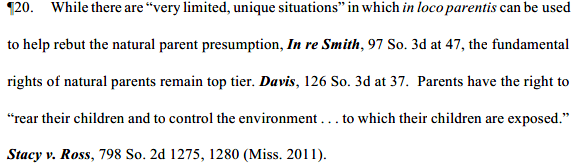
NOTE – The person seeking visitation won a trip back to the trial court, but I don’t read this opinion as blazing path to victory on the merits. Here are a few excerpts

and…

and…

and…


Other Orders

McPhail v. McPhail, 2020-CA-00739-SCT (denying petition construed by the Court as one for rehearing as untimely)

Moreland v. Spears, 2021-CT-00714-SCT (denying cert)

Norwood v. State, 2021-KA-00903-SCT (denying rehearing)

Brooks v. Jeffreys, 2021-CT-01113-SCT (denying cert)

Simoneaux v. State, 2022-CT-00532-SCT (dismissing cert petition)


Hand Down Page

Cyber Monday Deal – Free Subscription!

If you subscribe today,* you can get all Mississippi Appeals Blog posts delivered straight to your inbox for $0 per month. Just enter your email address below and click “Subscribe.” You can always unsubscribe if you later decide that you no longer wish to be on the cutting-edge of case law development in Mississippi.

* You can also get this deal tomorrow, or you could have gotten it a month ago, but don’t worry about that. Subscribe today!

Mississippi Supreme Court Decisions of October 6, 2022 (Rewind)

I did not post summaries from the first week of October because I was out of town with my family doing something much more fun that summarizing opinions. This is a catch-up post. There was not a whole lot from the Mississippi Supreme Court that week, unless you are a digital photographer in which case it appears to have been a good week for you.


Mississippi Department of Revenue v. EKB, Inc., 2021-SA-00441-SCT (Civil – State Boards and Agencies)
Affirming the chancery court’s order vacating the Mississippi Department of Revenue’s sales tax assessment against a wedding photography business, holding that photography is not a taxable business activity (unlike film development and photo finishing) and that still digital images are not taxable digital products.
(8-0: Justice Coleman did not participate.)

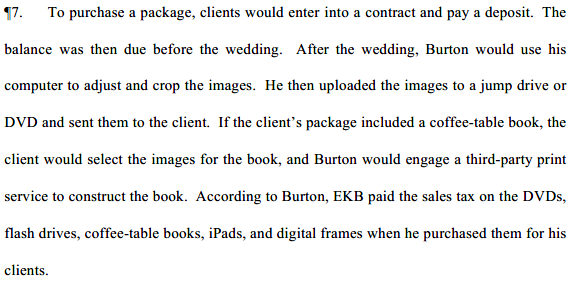
NOTE – I am neither a tax lawyer nor a photographer, but this seems like quite a win for digital photographers. Here are some particulars about the photography business at issue that gives context for the decision.


Other Orders

Johnson v. State, 2015-CT-01064-SCT (dismissing cert petition)

Wayne County Sch. Dist. v. Quitman Sch. Dist., 2020-CA-00499-SCT (denying rehearing)

Butler v. State, 2020-CT-00806-SCT (granting cert)

Haynes v. State, 2020-CT-01397-SCT (denying cert)

Fluker v. State, 2021-CT-00162-SCT (dismissing cert petition)

In Re: Hon. James McClure, III and Hon. Gerald W. Chatham, Sr.; 2022-IA-00319-SCT (denying petition for writ of prohibition)


Hand Down Page

Introduction to Mississippi Appeals

I recently started a Twitter account (@MS_Appeals) where I tweet short summaries of the opinions handed down by the Mississippi Court of Appeals on Tuesdays and by the Mississippi Supreme Court on Thursdays. The response to that effort has been kind, and I have been encouraged to post these summaries on a blog as well. This blog will make the summaries available to more people and it gives me space to write more detailed summaries of cases that strike me as interesting and to expound on other items if so inclined.

My goal is to post roughly tweet-length summaries of the Tuesday and Thursday hand downs. The idea is to provide a snapshot of each opinion to help you decide if you should go read the opinion for yourself. I will provide links to the opinions so, with apologies to LeVar Burton, you don’t have to take my word for it. In addition to regular blogging of the hand downs, I plan to provide occasional commentary and other content pending inspiration and motivation.

I hope this blog will be helpful. I have enjoyed and benefited from many of the great, but now “retired” Mississippi law blogs (Mississippi Litigation Review, Jane’s Law Blog, Mississippi Appellate Law & Commentary, and The Better Chancery Court Practice Blog, to name a few that come immediately to mind). Brushing aside this probative evidence that I am a fool, rushing in where angels fear to tread, my sense is that I am stepping into space that is no longer occupied to provide a service that may be useful to the bench, the bar, and others.

A little bit about me: For the past ten years and counting I have been practicing law in Mississippi, handling liability matters and workers’ compensation claims from as early as the date of the incident through resolution or final appeal. I am admitted to the bar in Mississippi (all state and federal courts), North Carolina (all state and federal courts), and Tennessee (all state courts). I am also admitted to the United States Courts of Appeals for the Fourth, Fifth, and Sixth Circuits. I have been practicing at the Baxter Law Firm, PLLC since 2018. I graduated from Ole Miss Law in 2011 and before that I graduated from Wheaton College (IL) with a biology degree. I am a native of Brookhaven and my wife and I live in Madison with our three wonderful boys.