The NCAA went down to Pittsboro; it was looking to avoid appeal

I thought I would break from my regular content and use the Trinidad Chambliss versus the NCAA lawsuit as an excuse to talk about interlocutory orders and appellate jurisdiction and practice. Note: I am not involved in that legal action and I have no information about it other than what is publicly available. Each case turns on its own facts. Nothing below should be construed as legal advice, but only general information about the rules applicable to appealing interlocutory orders. If you need to know how these rules apply to your case, I would love to speak with you about it.


As has been widely discussed, after getting no relief from the NCAA in its own arena, Trinidad Chambliss took his eligibility dispute to court. Specifically, Trinidad sued the NCAA in the Chancery Court of Lafayette County, Mississippi, of which Oxford is the county seat. Through his attorneys, Trinidad filed a Petition for Preliminary and Permanent Injunctive Relief and Declaratory Judgment on January 16, 2026, asking the court to enjoin the NCAA from prohibiting him from playing for the 2026-2027 season and to enter a declaratory judgment that he is eligible for the 2026-2027 season.

The wheels of justice do turn slowly, but there are some ways to make some of the wheels turn a little bit faster. To that end, Trinidad’s attorneys filed a Motion for Preliminary Injunction on January 28, 2026. Both sides filed briefs and a lengthy hearing was held on February 12, 2026, in Pittsboro, Mississippi (population 202, according to the 2010 census). Why Pittsboro? Because Pittsboro is the county seat of Calhoun County, which is in the same chancery court district as Lafayette County. At the conclusion of the hearing, Judge Robert Whitwell announced a ruling from the bench granting Trinidad the preliminary injunction he sought. A written order was entered the following day.

I will leave it to others to write about what this means for the 2026 football season, the grounds for the preliminary injunction, the court’s ruling, and the NCAA’s attorneys’ ill-advised decision to leave court before the hearing concluded. But in light of some bad information floating around about a potential appeal of the court’s order (does the NCAA have 30 days to appeal?), I thought I would talk about something much more interesting than football: appellate jurisdiction and procedure.

So, you Lost a preliminary injunction, what happens next?

Can you appeal? The answer to this question is the classic lawyer response: it depends. But there is no right to immediately appeal a preliminary injunction.

In general, Mississippi law only allows the appeal of final judgments. See Brown v. Collections, Inc., 188 So. 3d 1171, 1174 (Miss. 2016). A preliminary injunction is a temporary order that stands until the case can be fully resolved on the merits. See Sec’y of State v. Gunn, 75 So. 3d 1015, 1021 (Miss. 2011) (citations omitted). Because they are entered before a case has been fully resolved, preliminary injunctions are interlocutory orders that are not final and appealable. Carr v. Miss. Lottery Comm’n, 314 So. 3d 108, 112 (Miss. 2021). In short, there is no right to appeal a preliminary injunction. But that’s not the end of the line.

  • Petition for Interlocutory Appeal

Although preliminary injunctions are not automatically, immediately appealable, a litigant can petition the Mississippi Supreme Court to allow an appeal by filing a petition for interlocutory appeal. See, e.g., United Healthcare of Miss. Inc. v. Mississippi’s Cmty. Mental Health Comm’ns, 335 So. 3d 1055, 1060 (Miss. 2022). This is the procedure to ask the Court to allow you to appeal any order that does not resolve all claims asserted. The grounds and procedure for a petition for interlocutory appeal are established by Rule 5 of the Mississippi Rules of Appellate Procedure. Under that rule, an appeal of an interlocutory order may be allowed “if a substantial basis exists for a difference of opinion on a question of law” and appellate resolution “may (1) Materially advance the termination of the litigation and avoid exceptional expense to the parties; or (2) Protect a party from substantial and irreparable injury; or (3) Resolve an issue of general importance in the administration of justice.” M.R.A.P. 5(a). Under this rule, a petition for interlocutory appeal has to be filed within 21 days of the entry of the order you want to appeal. The effect of this rule is that the Mississippi Supreme Court has discretion to grant or deny a petition for interlocutory appeal.

These petitions are specialized pleadings and must contain certain information required by Rule 5. This includes a brief, but it is not a full appellate brief. When I write a petition for interlocutory appeal, I am trying to persuade the Court to take the case more than I am trying to convince the Court that I should win the case. (That comes later, hopefully.) If I am responding, I am trying to convince the Court that there is nothing to see here.

Once a petition for interlocutory appeal is filed, the other side gets to file a response. The rules do not provide for a reply or rebuttal by the petitioner. The Supreme Court typically grants or denies a petition for interlocutory appeal with a one-page order. That order does not decide who wins the appeal. If it is denied, you carry on in the court below. If it is granted, it punches your ticket to the show and an appeal commences. Issues are designated, the record is designated, the record is reviewed, a briefing schedule is entered, etc. On rare occasions the Supreme Court will decide the merits based on the petition and response rather than proceeding with a full-bore appeal.

Importantly, the case is not stayed in the trial court when a petition for interlocutory appeal is filed. It is not even automatically stayed if the Supreme Court grants interloc. A stay has to be requested in the petition and then granted by the Supreme Court. Unless that happens, the lower court proceedings continue apace.

  • Rule 54(b) Final Judgment

Another way to appeal an order that resolves something less than all claims between all parties is to obtain an order from the lower court “certifying” it under Rule 54(b). That rule provides: “[T]he court may direct the entry of a final judgment as to one or more but fewer than all of the claims or parties only upon an expressed determination that there is no just reason for delay and upon an expressed direction for the entry of the judgment.” M.R.C.P. 54(b). If this rule is not strictly complied with, Mississippi’s appellate courts will dismiss an appeal without hesitation. E.g., Williams v. Williams, 347 So. 3d 178 (Miss. 2022) (dismissing an appeal because the “final judgment” did not resolve all claims and did not contain the magic words from Rule 54(b)). If a proper 54(b) judgment is entered, your right to appeal is triggered and you have thirty days to file your notice per M.R.A.P. 4(a).

  • My Take

As of the time publishing this post, the NCAA has not taken any steps toward an appeal on the record. I don’t expect them to try to appeal the preliminary injunction. I don’t expect our seven-member Supreme Court to be inclined to grant an interlocutory appeal in this case. And even if they did grant one, a successful interlocutory appeal would probably take a year or more which wouldn’t get the NCAA where it wants to go by the time it needs to get there. I also think it unlikely that the chancery court in this case would be amenable to certifying an appealable judgment under Rule 54(b). I could be wrong about all of this, of course.

As an appendix of sorts, here are a few of the key filings from the chancery court case:

Mississippi Supreme Court Decisions of August 14, 2025

The Mississippi Supreme Court handed down three opinions yesterday. I can report that the “minutes rule” is alive and well and is not to be trifled with.


But before we jump into summaries, I should acknowledge that the biggest appellate news in Mississippi this week is the appointments of Justice Maxwell and Justice Chamberlin to the United States District Court for the Northern District of Mississippi. If they are confirmed, that will create two vacancies in the Supreme Court District 3. That district is comprised of Alcorn, Attala, Benton, Calhoun, Carroll, Chickasaw, Choctaw, Clay, Coahoma, Desoto, Grenada, Itawamba, Lafayette, Lee, Leflore, Lowndes, Marshall, Monroe, Montgomery, Oktibbeha, Panola, Pontotoc, Prentiss, Quitman, Tallahatchie, Tate, Tippah, Tishomingo, Tunica, Union, Webster, Winston, and Yalobusha Counties.

Since two new justices (Branning and Sullivan) joined the Mississippi Supreme Court this year, we could have four justices joining the nine-justice court within a year. This has court-reshaping potential and will be an interesting process to watch.


K.S. v. M.D., 2023-CA-01118-SCT, consolidated with No. 2024-CA-00707-SCT (Civil – Custody)
Affirming the chancellor’s decision terminating parental rights and denying a Rule 60(b) motion to set aside adoption, holding that the chancellor had jurisdiction to terminate parental rights and that the chancellor did not abuse his discretion in terminating parental rights, and that as a result the adoption did not have to be vacated for lack of jurisdiction.
(9-0: Ishee for the Court)


The Mississippi State Port Authority at Gulfport v. Yilport Holding A.S., 2024-IA-00140-SCT, consolidated with No. 2024-IA-00149-SCT (Civil – State Boards & Agencies)
Affirming in part and reversing in part the circuit court’s rulings in a case following failed negotiations after a letter of intent was signed concerning a port expansion, holding that the trial court did not err in applying the “minutes rule” and finding that the LOI was not properly spread upon the minutes of the board and was therefore unenforceable, that estoppel did not apply, that the circuit court did err in allowing the unjust enrichment claim to go forward, and that the trial court did not err in denying summary judgment on the misappropriation-of-trade-secrets claim under the MTCA.
(9-0: King for the Court)


Sardin v. State, 2024-KA-00319-SCT (Criminal – Felony)
Affirming conviction of trafficking a controlled substance, holding that there were no arguable issues after reviewing counsel’s Lindsey brief and the record.
(9-0: Randolph for the Court)


Other Orders

  • In Re: the Rules of Civil Procedure, 89-R-99001-SCT (granting motion to amend M.R.C.P. 3)
  • In Re: Commission on Continuing Legal Education, 89-R-99011-SCT (appointing Helen Morris, Amanda B. Seymour, and Katherine K. Farese to three-year terms as members of the Commission on Continuing Legal Education)
  • Frazier v. State, 2016-M-01363 (denying motion for reconsideration of denial of motion to recuse)
  • Armistad v. State, 2023-CT-00799-SCT (denying cert)
  • Young v. Martin, 2023-CT-00980-SCT (denying cert)
  • Doby v. South Park Village Apartments, 2023-CA-01095-SCT (denying rehearing)
  • Phillips v. State, 2023-KA-01218-SCT (denying cert)
  • Tucker v. State, 2024-KA-00255-SCT (dismissing appeal as moot)
  • Mississippi Methodist Hospital & Rehabilitation Center, Inc. v. Mississippi Department of Health, 2925-SA-01113-SCT (denying motion to award costs and attorneys’ fees)
  • Rogers v. The Mississippi Bar, 2025-BD-00833-SCT (accepting irrevocable resignation as a member of the Mississippi Bar, tendered under Rule 11(a) of the Rules of Discipline for the Mississippi Bar)

Hand Down Page

A Special Thanksgiving Edition of the Mississippi Appeals Blog

Happy Thanksgiving to you and yours from the Mississippi Appeals Blog! To mark the occasion, I did a little research and found a suitable throwback decision from the Mississippi Supreme Court to summarize for you.


Old Ladies Home Ass’n v. Hall, 52 So. 2d 650 (Miss. 1951) (Civil – Contracts)
Affirming the chancellor’s decision overruling special and general demurrers asserted by residual beneficiaries in an action brought by a devisee to enforce a contract between himself and the testatrix wherein the testatrix (an elderly widow at the time) agreed to devise her property to him if he would move his family into her home and provide her with room and board (which he did), holding that the bill of complaint was sufficient and that the statute of limitations began to run when the testatrix died, not when things went south due to the lack of butter at Thanksgiving dinner:

Complainant charged that, in fulfillment of the contract, he and his family lived in Mrs. Douglas’ residence, that he paid taxes on it and repaired it from time to time, and furnished her and her foster daughter with suitable and acceptable board and food, heat and lights and other comforts and necessities, until Thanksgiving Day of November, 1943, at which time Mrs. Douglas became enraged about complainant’s failure to have butter on the table, and ordered complainant and his family to get out of the house. It was averred that Mrs. Douglas at all times kept two loaded pistols and a dagger in her home, and threatened physical violence to complainant’s infant son and that complainant feared for the safety of himself and his family. Complainant told her that he wanted to remain in the home and carry out his part of the contract, as he had previously done, and as he thereafter remained ready, willing and able to do, but Mrs. Douglas drove them from her home and refused complainant’s services.

PRACTICE POINT – As we are not presently in the throes of World War II, there is really no excuse to run out of butter on Thanksgiving.

Expect Delays

Due to some “technical difficulties” here at the Mississippi Appeals blog, there will be a brief pause on case summaries.

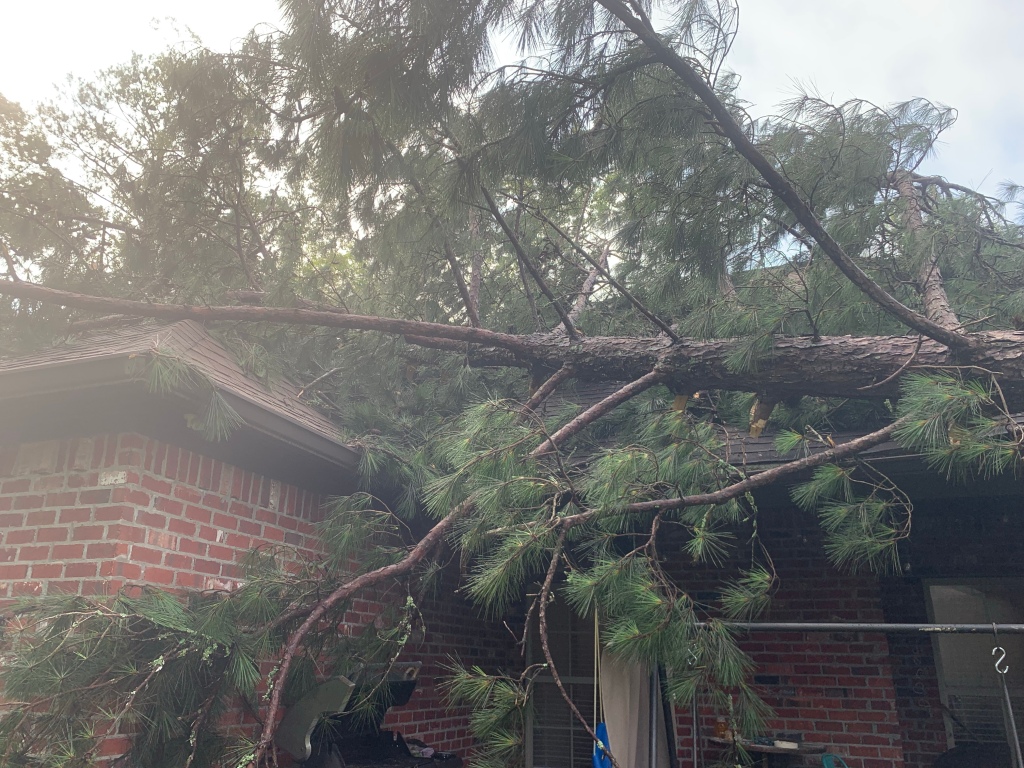
We were not at home when the tree fell on our house so we are all good from that standpoint. We are immensely thankful for family, friends, and neighbors who jumped right in and helped us out! Our church family at Pear Orchard Presbyterian Church has supported immeasurably. They showed up en masse to help on the night the tree fell and have been pouring out all manner of assistance ever since including housing, food, and compassion. We are so thankful for God’s provision through his people (Romans 12:13).

Nothing from the Mississippi Supreme Court on January 5, 2023

I was expecting opinions from the Mississippi Supreme Court today but the Court’s hand down page now says its next hand down is scheduled for January 12. Those will be the Supreme Court’s first opinions of the year, and its first since December 15. The Mississippi Court of Appeals is scheduled to hand down its second slate of the year on January 10. See you then!

Cyber Monday Deal – Free Subscription!

If you subscribe today,* you can get all Mississippi Appeals Blog posts delivered straight to your inbox for $0 per month. Just enter your email address below and click “Subscribe.” You can always unsubscribe if you later decide that you no longer wish to be on the cutting-edge of case law development in Mississippi.

* You can also get this deal tomorrow, or you could have gotten it a month ago, but don’t worry about that. Subscribe today!

Happy Thanksgiving!

Due to the Thanksgiving holiday, the Mississippi Supreme Court will not be handing down any opinions today. But I did not want to leave you empty-handed so here is a throwback opinion suitable for the season.


Revette v. State, 48 So. 2d 511 (Miss. 1950)
Reversing the circuit court in favor of the defendant accused of the unlawful possession of intoxicating liquors, holding that the “beaten path doctrine” did not apply where the beaten path at issue led from the defendant’s turkey pen to a wooded area where a one-gallon keg of whiskey was found but did not terminate at or near the whiskey.


Many thanks to all who have visited this blog on occasion! I truly appreciate the interest and the encouragement I have received in this endeavor.

Summaries of the Mississippi Supreme Court opinions of April 14, 2022

We will call the blog post title a belated April Fools’ Day joke because the Mississippi Supreme Court did not hand down any opinions today. In the absence of an opinion to summarize, I thought I would share some #AppellateTwitter cringe content that surfaced today.


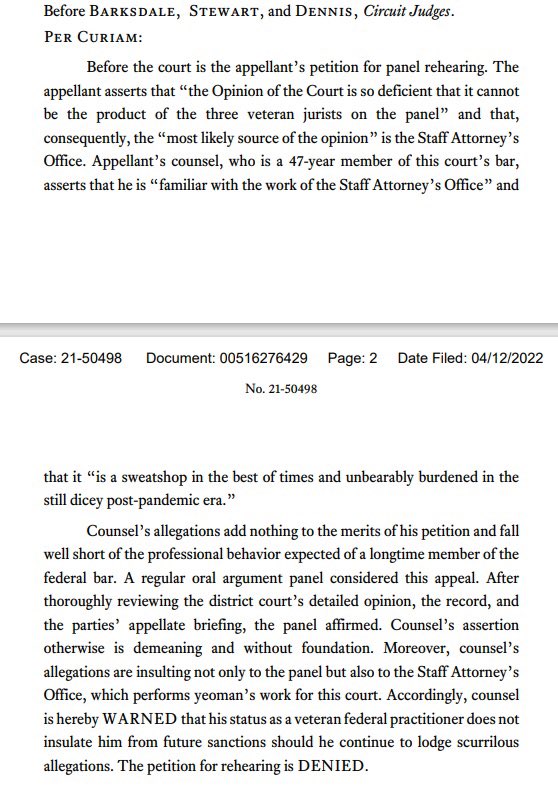
No litigator likes to lose. Some losses are more frustrating than others. Motions for reconsideration and motions for rehearing are difficult to write and they demand finesse. I would submit that the tack taken by the appellant’s counsel described in per curiam decision from the Fifth Circuit below did not supply the requisite measure of finesse. As tweeted by attorney David R. Fine (who is not the appellant’s counsel referred to in the order):

Well, that strategy didn’t go so well. #appellatetwitter

Originally tweeted by David R. Fine (@finedr1965) on April 14, 2022.

The road to a great motion for reconsideration/motion for rehearing is not the easiest, but overtly insulting the court and court staff is a relatively easy ditch to avoid.

But Twitter did what Twitter does and stirred up some good commentary on how to approach motions for reconsideration/rehearing.

Happy writing. Be careful out there.


Other Orders

Singing River MOB, LLC v. Jackson County, Mississippi, 2019-IA-10630-SCT (denying motion for rehearing)

Magee v. State, 2019-CT-01794-SCT (granting cert petition)

Johnson v. State, 2020-CT-01308-SCT (granting cert petition)


Hand Down List