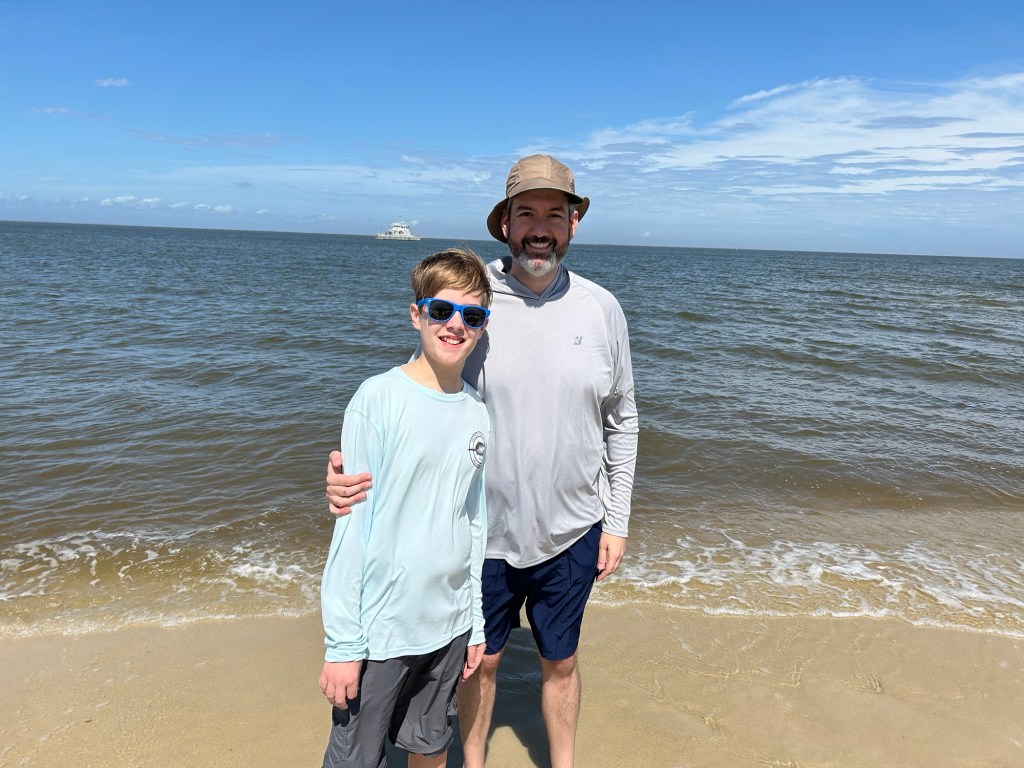
I was out of the office Thursday for an extended weekend camping trip on Horn Island with my oldest son, so hand downs were a bit lower on my priority list than usual. (Proof submitted below.)
While I was at sea, the Mississippi Supreme Court handed down three opinions and appellants went 2-1.
Tommy Brooks Oil Company v. Wilburn, 2022-CA-00551-SCT (Civil – Contract) Reversing on direct appeal and affirming on cross-appeal after judgments in favor of the defendants on open-account claims, holding that the defense verdict on the open-account was not supported by substantial evidence, and that the plaintiff was entitled to judgment in its favor on liability, and remanding for a new trial on damages and the enforceability of personal guaranty agreements while affirming the denial of the defendants’ claim for attorney’s fees. (8-0: Maxwell did not participate)
In Re: Death Investigation of Christian Andreacchio, 2023-CA-00060-SCT (Civil – Other) Affirming the circuit court’s denial of a petition to appoint an attorney to act as district attorney in an effort to spur prosecutions, holding that Mississippi’s victims’ rights statutes did not grant standing to the Estate and that there is no other basis in Mississippi law to allow a private citizen to direct the State’s prosecutorial powers. (8-1-0: King concurred in result only without separate written opinion)
Lindsey v. Butts, 2022-IA-00738-SCT, consolidated with 2022-IA-00882 (Civil – Wrongful Death) Reversing the circuit court’s denial of the doctor-defendant’s motion to dismiss for lack of process and denial of the hospital defendant’s motion for summary judgment, holding that the trial court erred by not dismissing the complaint against the doctor because he was never legally served with process which left the circuit court lacking jurisdiction over him and holding that the circuit court erred in denying the hospital’s “preemptive” motion for summary judgment because the plaintiff lacked medical-expert testimony even though the plaintiff’s expert designation deadline had not yet passed. (6-3: Maxwell concurred in part (as to medical causation SJ) and dissenting in part (as to service of process), joined by Kitchens and King, and joined in part by Beam)
Other Orders
SDBT Archives LLC v. Penn-Star Ins. Co., 2022-CT-00099-SCT (DIG-ed)
Boyington v. State, 2022-CT-00601-SCT (denying cert)
Walmart Stores East, LC v. Melton, 2022-IA-01028-SCT (dismissing interlocutory appeal)
Mathis v. The Mississippi Bar, 2023-BD-01255-SCT (granting leave to resign in good standing from the practice of law)
The Mississippi Supreme Court handed down five opinions today. I think Weber v. Estate of Hill will be a frequently cited case on the issue of medical expert causation testimony, especially in the medical malpractice context. There is also an insurance coverage decision (where the court granted interlocutory appeal and then affirmed the circuit court), another medical malpractice case dealing with a hospital’s lack of liability for treatment plans of independent physicians, a contempt of youth court case, and a Mississippi Bar disciplinary decision.
Donaldson v. Cotton, 2020–CA-00581-SCT (Civil – Other/Contempt) Vacating the a youth court judge’s order of contempt against a county prosecutor fining him for past and continuing refusal to draft youth court orders, holding that youth court judges have inherent authority to order a county prosecutor to prepare orders in youth court matters but that the alleged contempt was constructive criminal contempt and thus the attorney’s due process rights were violated. The order was vacated, the case was remanded, and the youth court judge was direct to recuse for further proceedings. (Justice Coleman dissented, joined by Chief Justice Randolph and Justice Beam.)
Weber v. Estate of Hill, 2020-CA-00293-SCT (Civil – Medical Malpractice/Causation/Experts) Denying rehearing and and modifying two paragraphs (¶ 37 and ¶ 38) of the original opinion. On direct appeal, the supreme court affirmed the circuit court’s denial of the defendants’ motion for JNOV that argued there was no admissible expert testimony on causation, holding that the testimony of one of the plaintiff’s medical experts provided a basis for a juror to reasonably conclude that a timely C-section delivery would have provided the baby with a greater-than-50-percent chance of a substantially better outcome even though that expert testified that he lacked the expertise necessary to quantify the degree to which the labor and delivery process aggravated the injury. On cross appeal, the supreme court reversed the circuit court’s reduction of the jury’s $2,538,322 award for non-economic damages, holding that this action filed in December 2002 was governed by Mississippi’s wrongful-death statute because the medical-malpractice noneconomic-damages cap was not in place until September 1, 2004. (Justice Griffis dissented, joined by Justice Coleman and Justice Maxwell. Chief Justice Randolph did not participate.)
NOTE: This was a big win for the plaintiff and it is a must-read case on medical expert causation testimony, especially in the medical malpractice context. I have not read the record, but my understanding from the majority opinion and the dissent is that no expert specifically testified that a timely C-section delivery would have provided the baby with a greater-than-50-percent chance of a substantially better outcome. Instead, the supreme court allowed the jury to “connect the dots” (the “dots” being other pieces of expert testimony) in determining that the plaintiff satisfied that causation standard even though the plaintiff’s obstetrics and maternal-fetal medicine expert testified he was not qualified to connect these dots and give an opinion as to the percentage aggravation would be.
Mississippi Farm Bureau Casualty Insurance Company v. Powell, 2020-IA-00432-SCT (Civil – Insurance/Coverage) On interlocutory appeal, affirming the circuit court’s denial of the insurance company’s motion for summary judgment seeking a declaratory judgment that it had no duty to provide coverage, no duty to defend/indemnify, and no duty to pay medpay benefits, holding that a fall from scaffolding that was erected on a trailer that was hitched to an insured pickup was an auto accident arising out of the use and ownership of the covered vehicles. (Justice Maxwell concurred in result only, joined by Justice Chamberlain and Justice Griffis, and joined by Justice Coleman in part.)
St. Dominic-Jackson Memorial Hospital v. Newton, 2020-IA-00494-SCT (Civil – Medical Malpractice) On interlocutory appeal, reversing the circuit court’s denial of the hospital’s motion for summary judgment, holding that the Mississippi law does not impose a duty on a hospital to require peer review of a treatment plan before allowing a doctor and patient to use its facilities. (Justice Kitchens dissented, joined by Justice King.)
PRACTICE POINT: This is less-than-ideal feedback to receive from the supreme court…
Other Orders
Howell v. State, 2020-CA-00868-SCT (directing the parties to file supplemental briefs on the following issue: Whether the Court should overrule Rowland v. State, 42 So. 3d 503 (Miss. 2010), and any other case in which, and to the extent that, we have held the fundamental rights exception to the procedural bars may be applied to the three-year statute of limitations codified by the Legislature in the Uniform Post-Conviction Collateral Relief Act)
Bryant v. Bryant, 2020-CT-00883-SCT (granting cert)
Newell v. State, 2020-CT-01137-SCT (denying cert)
Thornhill v. Walker-Hill Environmental, 2020-CT-01181-SCT (granting cert)
The Mississippi Bar v. Malone, 2021-BD-00467-SCT (suspending attorney Robert W. Malone for two years)


 Mississippi Appeals Blog