The Mississippi Supreme Court handed down four opinions today. There is a case dealing with an attempt to collect early termination fees after a new board of supervisors terminated a service contract, a case dealing with a thorny procedural issue after a default judgment was entered on a counterclaim in an appeal from justice court, a domestic case regarding the parent’s school choice with potentially broader implications, and a criminal case addressing the weight of the evidence and improper testimony about prior convictions.
Broadband Voice, LLC v. Jefferson County, Mississippi, 2021-CA-01082-SCT (Civil – Contract) Affirming the circuit court’s dismissal of a phone and internet company’s claim for early termination fees against the county after new slate of supervisors terminated the service contract, holding that under the plain language of the contract the fee was due on the termination date rather than the date of the notice of termination and that the early-termination-fee provision that was negotiated by the prior board was unenforceable against the subsequent board. (9-0)
Gordon v. Dickerson, 2020-CT-00601-SCT (Civil – Real Property) Reversing the Court of Appeals, the circuit court, and the county court for denying the landlord’s motion to set aside a default judgment in county court on the tenant’s counterclaim that she asserted on appeal from justice court, holding that the landlord was not in default for purposes of Rule 55 because the counterclaim was filed in violation of Rule 15(a) (re: amendment of pleadings) and Rule 13(k) (re: appeals from justice court) cannot be read to the exclusion of Rule 15(a). (5-4: Chief Justice Randolph dissented, joined by Justice Kitchens and Justice Ishee; Justice King dissented, joined by Justice Kitchens.)
Practice Point – There is a lot of explanation of the various rules in play in this decision. Bookmark this one and re-read it whenever you handle and appeal from justice court.
Bryant v. Bryant, 2020-CT-00883-SCT (Civil – Domestic Relations) Affirming the Court of Appeals and the chancellor in ordering that the three minor children attend a specific public school district over the wishes of their father who was made the “final decision maker” on such matters, holding that the language of the property settlement agreement authorized the chancellor use its powers “as superior guardian to make decisions that are in the best interest of children.” (6-3: Justice Coleman dissented, joined by Justice Maxwell and Justice Griffis; Justice Maxwell wrote a separate dissent joined by Justice Coleman.)
NOTE – The majority and the dissents disagree on a big-picture issue: the relationship between the government’s role in the relationship between parents and children. Take a few minutes and read the majority and both dissents.
Moore v. State, 2021-KA-00420-SCT (Criminal – Felony) Affirming conviction of aggravated assault, holding that the verdict was not against the overwhelming weight of the evidence because inconsistencies in testimony did not render the verdict implausible and holding that although it was improper for the prosecution to directly elicit testimony about past convictions the error was potentially waived and ultimately harmless. (6-3-0: Justice Maxwell concurred in part and in the result, joined by Chief Justice Randolph and Justice Beam.)
In Re: Rules Governing Admission to The Mississippi Bar, 89-R-99012-SCT (reappointing Pieter Teeuwissen, Marcie Fyke Baria, and Gwendolyn Baptist-Rucker to three-year terms (11/1/22 through 10/31/25) as members of the Mississippi Board of Bar Admissions) Millette v. Frazier, 2022-M-00451-SCT (denying petition for permission to appeal and lifting stay of trial court proceedings)
We are back in action! The Mississippi Court of Appeals handed down six opinions today after their summer break. These cover several appeals from criminal convictions, a termination of parental rights case, and an MTCA case with thorny statute of limitations computation, and PCR.
Bullock v. Mississippi Department of Child Protective Services, 2020-CA-00966-COA (Civil – Custody) Affirming the judgment of the youth court terminating the plaintiff’s parental rights to her four children, holding that that the youth court’s decision based upon multiple, independently-sufficient statutory grounds was supported by clear and convincing evidence including evidence that one of the children had suffered severe physical, emotional, and mental abuse, and that this abuse of the one child was sufficient to support the termination of parental rights as to all four children. The Court of Appeals also held that there was no evidence that the GAL was unfair or biased. (10-0)
Alvarado v. State, 2021-KA-00566-COA (Criminal – Felony/First-Degree Murder/Attempted First-Degree Murder) Affirming conviction of first-degree murder and attempted first-degree murder, holding that the evidence of first-degree murder (that included surveillance footage of the defendant gunning down the victim in a gas station) and evidence of attempted first-degree murder (video showing the defendant exchanging gunfire with a second person after shooting the victim) was sufficient and that the verdict was not against the weight of the evidence. (10-0)
Lopez v. State, 2021-CP-00331-COA (Civil – PCR) Affirming the circuit court’s denial of the plaintiff’s motion for PCR, holding that the plaintiff’s guilty plead waived the alleged violation of his constitutional rights and that the plaintiff’s claims of ineffective assistance were waived and meritless. (7-3-0: Judge Westbrooks concurred in part and in the result with separate written opinion, joined in part by Judge McDonald and Judge McCarty; Chief Judge Barnes concurred in result only without separate written opinion; Judge McDonald concurred in result only with separate written opinion, joined by Chief Judge Barnes.)
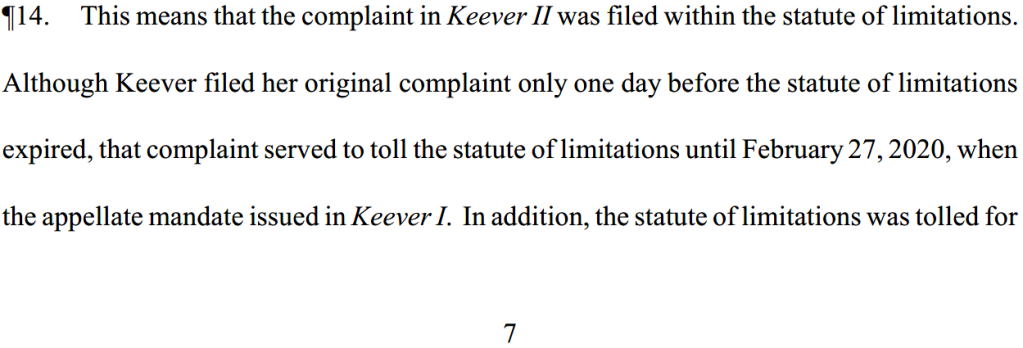
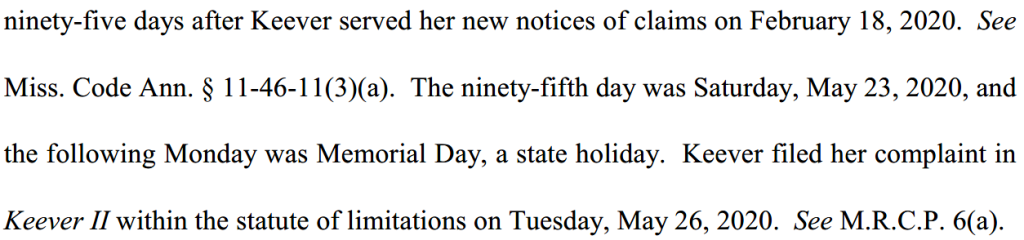
Keever v. The Board of Trustees for Mississippi Institutes of Higher Learning, 2021-SA-00036-COA (Civil – Personal Injury/MTCA/statute of limitations) Reversing the circuit court’s dismissal of the complaint on statute of limitations grounds, holding that this, the plaintiff’s second lawsuit asserting an MTCA claim, was not barred by the statute of limitations because the statute of limitations was tolled during the pendency of the first lawsuit that was dismissed without prejudice (from the filing of the complaint to the issuance of the appellate mandate) and for another 95 days after a notice of claim for the second lawsuit was served. The Court of Appeals also held that a “stipulation of voluntary dismissal” of the first complaint after the defendants had filed answers was of no effect, that the complaint could not be dismissed based on the discretionary-function exemption, and that IHL is not entitled to a dismissal at this early stage. (10-0)
Practice Point – Here is the timeline of key events, which my brain requires in order to process opinions like this:
March 8, 2013 – Alleged injury
March 3, 2014 – Plaintiff sent notice of claim
March 7, 2014 First Complaint filed (this complaint was dismissed by the circuit court for failure to comply with pre-suit requirements and the dismissal was appealed and affirmed by the MS Court of Appeals)
February 6, 2020 – MS Supreme Court denied cert
February 18, 2020 – Ineffective “Stipulation of Voluntary Dismissal” filed
February 18, 2020 – Notice of claim letters sent (this tolled the statute, which was already being tolled during the pendency of the first lawsuit, another 95 days)
February 27, 2020 – Appellate mandate issued
May 26, 2020 – Second lawsuit filed on the last possible day
And what would stressful, statute of limitations computation party be without the last day falling on a Saturday, followed by a legal holiday?
Garlington v. State, 2020-KA-00392-COA (Criminal – Felony/Sexual Battery) Affirming the conviction of one count of sexual battery against a minor, holding that the evidence was sufficient to support a finding that the elements of the crime were proven and to allow the jury to infer that the abuse occurred within the time frame stated in the indictment despite an alleged variance in the dates in the indictment and the proof at trial; there was no error in allowing the minor victim’s out-of-court statements under the tender years exception; no error in allowing the State to amend the indictment; no error in overruling the defendant’s Batson challenges; no error in failing to allow evidence of alleged sexual misconduct of the minor victim’s father; no Confrontation Clause violation by admitting lab results without a witness from the lab testifying at trial; no error in prohibiting Defendant’s expert from referring to certain materials that he had relied upon but had not produced to the State; no error in precluded testimony from Defendant’s would-be character witness; no Brady violation in allowing a rebuttal expert to testify; and there was no error in omitting the time frame of the abuse from the jury instructions setting forth the elements of the crime. (7-3-0: Judge Wilson, Judge McCarty, and Judge Emfinger concurred in part and in the result without separate written opinion.)
NOTE – This is a 58-page, fact-intensive majority opinion.
Jenkins v. State, 2021-KA-00145-COA (Criminal – Felony) Affirming conviction of trafficking at least 1kg of marijuana with intent to sell, holding that that was no Fourth Amendment violation in the circuit court’s denial of the defendant’s motion to suppress evidence obtained from search warrants for his house and vehicle or his motion and no error in denying the defendant’s motion to suppress his bank records even those records were improperly obtained via subpoena duces tecum. (8-2-0: Judge Westbrooks concurred specially with separate written opinion, joined by Judge McDonald; Judge McDonald concurred in part and in the result without separate written opinion.)
Other Orders
Fluker v. State, 2021-CP-00162-COA (denying rehearing)
The Mississippi Court of Appeals handed down eight opinions today covering a lot of territory without a single dissent. There is an appeal of summary judgment in a slip and fall case, the reversal of summary judgment in an MTCA case, a motion to compel arbitration case, two wills and estates cases, a criminal appeal, and a few PCR cases.
Siggers v. State, 2021-CP-00985-COA (Civil – PCR) Affirming the circuit court’s dismissal of the plaintiff’s PCR motion, holding that though it was not a barred successive motion but that it lacked merit. (10-0)
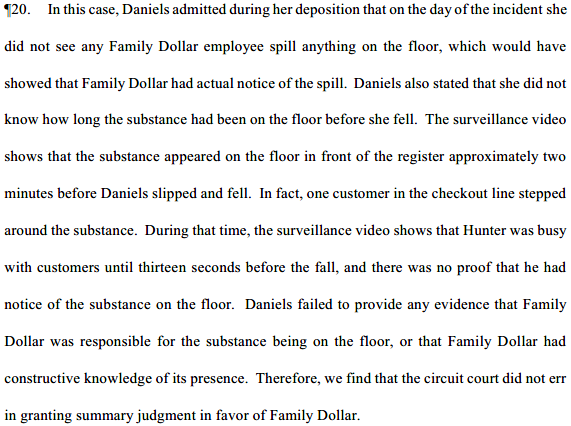
Daniels v. Family Dollar Stores of Mississippi, Inc., 2021-CA-00781-COA (Civil – Negligence/Premises Liability/Slip and Fall) Affirming summary judgment in a premises liability case, holding that the circuit court did not err in granting summary judgment on the issue of breach where the plaintiff slipped in a puddle on the floor of a store but did not know how long it had been there and failed to prove that the store was responsible for the substance or had actual knowledge of the substance on the floor, or that the two minutes the substance had been on the floor gave the store constructive knowledge. (10-0)
Practice Point – Here is the meat of the opinion’s reasoning on the constructive notice issue:
Towns v. Panola County Board of Supervisors, 2020-CA-01364-COA (Civil – Personal Injury/MTCA) Reversing the circuit court’s finding that the County was entitled to “premises immunity” and “weather immunity” under the MTCA in a case where the plaintiff was injured when he drove into a culvert that had washed out, holding (1) that weather immunity did not apply because there was evidence that the County had knowledge that the culvert had deteriorated and thus weather was not the “sole” cause of the culvert washout and (2) that premises immunity did not apply because there was evidence that the condition on the premises was caused by the County. (10-0) (Judge Emfinger concurred in part and in the result without separate written opinion)
Roberson v. State, 2020-CA-01208-COA (Civil – PCR) Affirming the circuit court’s denial of the plaintiff’s PCR motion, holding that the decision was supported by substantial evidence and was not clearly erroneous. (10-0) (Judge Westbrooks specially concurred, joined by Chief Judge Barnes, Judge McDonald, and joined by Judge McCarty in Part, urging more objective guidance for reevaluating recanted testimony.)
South Central Heating Inc. v. Clark Construction Inc., 2021-CA-00285-COA (Civil – Contract/Arbitration) Affirming the circuit court’s order granting arbitration, holding that the moving party did not waive arbitration by including an alternative complaint for damages in the same pleading in which it moved to compel arbitration and stay the proceedings, applying for a default, responding to a motion for summary judgment filed on the arbitration issue, and responding to motion to file a third-party complaint. (10-0) (Judge Westbrooks and Judge McDonald concurred in result only without separate written opinion.)
Practice Point – The Court of Appeals noted that at every turn the party seeking arbitration asserted and reserved the right to arbitration.
Additionally, if a party lets you off the mat on an entry of default after your answer to their motion to compel arbitration/complaint that they obtained after waiting six week, consider not fighting their motion to compel arbitration tooth-and-nail.
Taylor v. Tolbert, 2021-CA-00900-COA (Civil – Wills, Trusts, and Estates/Revocation by Destruction) Affirming the chancery court’s application of the presumption of revocation by destruction, holding that the beneficiary under the will who petitioned to probate a copy of the will had not rebutted the presumption of revocation by destruction by clear and convincing evidence. (10-0) (Judge Westbrooks concurred in result only without separate written opinion.)
McCarty v. State, 2021-KA-00418-COA (Criminal – Felony/Retroactive Joinder/Character Evidence) Affirming convictions of aggravated assault, kidnapping, and rape, and conviction as a habitual offender to life imprisonment on each count to be served consecutively, holding that the defendant was not entitled to a new trial under the doctrine of retroactive joinder and that the defendant was not unfairly prejudiced by the admission of character evidence related to prior incidents with the victim. In response to arguments raised in the defendant’s supplemental pro se brief, the Court of Appeals held that the defendant was not due a new trial because of actual innocence, judicial misconduct, prosecutorial misconduct, or ineffective assistance. (10-0)
Estate of Neill v. Earls, 2021-CA-00177-COA (Civil – Wills, Trusts, and Estates) Reversing the chancellor’s order instructing the executor to revise an “executor’s deed” providing the for the transfer of the decedent’s property, holding that the language of the devise at issue was ambiguous and that the chancellor’s construction of the distribution was not supported by substantial evidence, and further holding that evidentiary record was insufficient to determine the intent of the testator so the case was remanded to allow the parties to provide additional extrinsic evidence of intent. (9-0) (Judge Lawrence concurred in result only without separate written opinion. Chief Judge Barnes did not participate.)
Other Orders
Wall v. Wall, 2020-CA-01182-COA (denying rehearing) Pujol v. State, 2022-TS-00024-COA (dismissing appeal as untimely for lack of appealable judgment) Morgan v. State, 2022-TS-00298-COA (dismissing appeal as untimely for lack of appealable judgment)
The Mississippi Supreme Court handed down six opinions today. Topics include public project bidding, summary judgment in a property damage case, conversion by the owner of a collection agency, an appeal of a post summary judgment decision granting a Rule 60(b) motion based on fraud, a unanimous pro se PCR appeal win, and an election contest.
The Mississippi State Port Authority at Gulfport v. Eutaw Construction Company, Inc., 2020-IA-00881-SCT (Civil – State Boards and Agencies) Reversing the circuit court’s decision that reversed the MSPA’s award of a project to the lowest bidder whose bid contained multiple errors and awarded the project to the second lowest bidder, holding that the lowest bidder’s errors were minor, the intended correct bid was evident on the face of the bid, and the corrected bid by the lowest bidder was a decrease in price. (All justices concurred.)
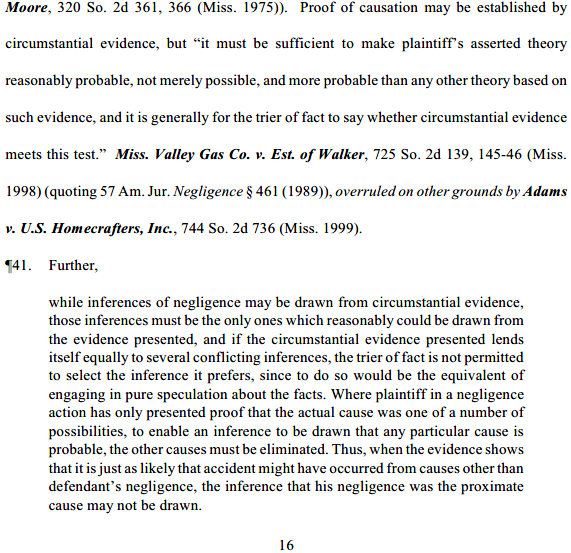
Hardin v. Town of Leakesville, Mississippi, 2020-CA-01164-SCT (Civil – Property Damages/Summary Judgment/Proximate Cause) Affirming summary judgment in favor of Leakesville, holding that the plaintiff failed to present sufficient evidence that water that had accumulated under her house was caused by an act or omission attributable to the town. (All justices concurred.)
Practice Point – This opinion contains a helpful discussion of the exacting standard that applies when a plaintiff seeks to prove causation by circumstantial evidence:
McGee v. Comprehensive Radiology Services, PLLC, 2021-CA-00666-SCT (Civil – Torts/Conversion/Fraud) Affirming the chancellor’s finding that the president of a collections agency was individually and personally liable for $785,549.71 that she directed her company to delay remitting to a radiology group while also billing for and receiving commissions for collecting that money, holding that while the tort of conversion cannot be used to recover a mere debt it can be used to recover identifiable money belonging to the plaintiff which is what occurred here. (All justices concurred.)
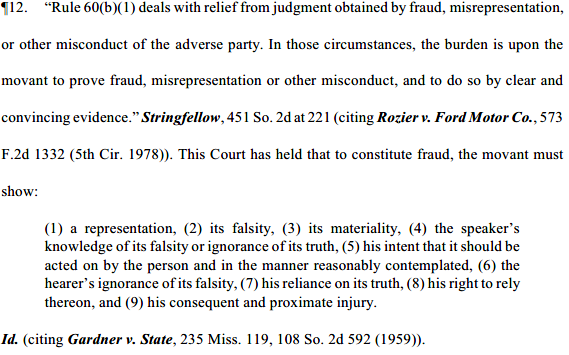
Riverboat Corporation of Mississippi v. Davis,2020-IA-01244-SCT (Civil – Personal Injury/Negligence/Rule 60(b)) The circuit court granted summary judgment in favor the casino in a personal injury case stemming from a fall from a casino chair due to the lack of evidence that the casino breached a duty. The plaintiff then filed a motion to reopen the case under Rule 60(b)(1) alleging that the defendant committed fraud in its 30(b)(6) deposition based upon information the plaintiff discovered in an unrelated case about another chair at the casino. The circuit court granted the motion to reopen based on fraud and the defendant petitioned for interloc which the Supreme Court granted. On appeal, the Supreme Court held that the trial court abused its discretion because the plaintiff “fell far short of satisfying all of the elements of fraud” and because this case did not present the requisite “exceptional circumstances” for relief under Rule 60(b). (All justices concurred.)
Practice Point – This opinion has a helpful summary of what is required to prove fraud under Rule 60(b)(1):
Magee v. State, 2019-CT-01794-SCT (Civil – PCR/Involuntary Guilty Plea) Reversing the circuit court’s denial of the plaintiff’s pro se PCR motion, holding that the circuit court granted an evidentiary hearing but failed to address the issue of whether the plaintiff’s guilty plead was involuntary because the plaintiff was affirmatively misinformed about the possibility of early release by his trial attorney and failed to allow the plaintiff to call witnesses or present evidence. (Chief Justice Randolph did not participate.)
Meredith v. Clarksdale Democratic Executive Committee, 2021-EC-00305-SCT (Civil – Election Contest) Affirming the trial court’s decision agreeing with the CDEC’s decision that a mayoral candidate resided at a lake house outside of the city limits rather than a funeral home apartment within the city limits, holding that the would-be candidate failed to prove by “absolute proof” that he met the residency requirement on or before the applicable deadline. (Justice Coleman concurred in part and in the result) (“It is not in the court’s bailiwick to impose its judgment for that of the Legislature.”)
Other Orders
Hutto v. State, 2017-DR-01207-SCT (granting response to order granting motion for appointment of counsel for representation for successive petition for post-conviction relief filed by the Circuit Court of Hinds County)
Havard v. State, 2018-CA-01709-SCT (granting motion to file motion for attorney fees and expenses under seal)
Walker v. State, 2020-CT-00228-SCT (denying cert)
McLemore v. State, 2016-M-00364 (denying application for leave to proceed in the trial court with a warning against future frivolous filings)
A deposition took me out of blogging service for most of the afternoon, so a little later than usual I give you summaries of the nine opinions handed down by the Mississippi Court of Appeals. These opinions cover the statute of frauds, trusts, appellate jurisdiction, youth court, authentication of text messages, equitable division and alimony in a divorce case, workers’ comp, PCR, and more.
SEL Business Services, LLC v. Lord, 2021-CA-00368-COA (Civil – Real Property/Statute of Frauds) Affirming the chancery court’s dismissal of a suit to reclaim property or alternatively for unjust enrichment, holding that a “handshake deal” for the purchase of a building that was sold before that deal came to fruition was subject to the statute of frauds, that the statute of frauds was not satisfied, and that the equitable remedy of unjust enrichment was therefore unavailable. (All judges concurred.)
Lennon v. Lowrey & Fortner, P.A., 2021-CA-00426-COA (Civil – Wills, Trusts & Estates/Appellate Procedure/Appellate Jurisdiction) Granting a motion to dismiss an appeal for lack of jurisdiction in a case of first impression, holding that the 30-day time period for perfecting an appeal began to run upon the entry of an order adjudicating a claim for attorney’s fees against a trust–not the final judgment terminating the trust. (All judges concurred.)
Smith v. Adams County Youth Court, 2021-CP-00196-COA (Civil – Juvenile Justice) Dismissing an appeal of the denial of a minor’s post-disposition motion for modification arguing that his guilty plea was the result of ineffective assistance of counsel, holding that the notice of appeal was prematurely filed because the youth court had not been given an opportunity to consider these arguments and any supporting evidence. (Judge Wilson concurred in result only without separate written opinion.)
Warner v. Warner, 2020-CA-01098-COA (Civil – Domestic Relations/Divorce/Valuation/Equitable Division/Alimony/Contempt) Reversing the chancellor’s judgment in a divorce case, holding that the chancellor erred in valuation and equitable division of marital assets, in the award of alimony, and in finding the ex-husband in contempt and awarding attorney’s fees as a result. (Judge Wilson concurred in part and in the result without separate written opinion.)
Simpson v. State, 2021-KA-00075-COA (Civil – Felony/Authentication) Affirming convictions of two counts of first-degree murder, first-degree arson, and possession of a deadly weapon by a felon, holding that there was no plain error with regard to the authentication of text messages and that there was no merit to the claim of ineffective assistance for not objecting to the properly-authenticated text messages. (Judge Emfinger did not participate.)
Carson v. State, 2021-KA-00436-COA (Criminal – Felony/Weight and Sufficiency) Affirming conviction of possession of cocaine, holding that the circuit court did not err in denying a motion for new trial challenging the weight and sufficiency of the evidence and finding no merit to the defendant’s pro se arguments that his rights under the Fourth Amendment and the Confrontation Clause were violated, that the State’s case hinged on “racial profiling,” that he had ineffective assistance of counsel, and that the circuit judge failed to comply with Sharplin. (All judges concurred.)
Ellis v. State, 2020-CP-00770-COA (Civil – PCR) Affirming the circuit court’s denial of the plaintiff’s PCR motion, holding that the motion was time-barred and that the plaintiff failed to raise any claims resulting in the deprivation of his fundamental constitutional rights that would defeat the time bar. (Judge Wilson and Judge Emfinger concurred in part and in the result without separate written opinion. Judge McDonald concurred in the result only without separate written opinion.)
Reardon v. State, 2020-CP-01259-COA (Civil – PCR) Affirming the circuit court’s denial of the plaintiff’s PCR motion, holding that the motion was procedurally barred and that his claims of ineffective assistance of counsel, deprivation of fundamental rights, and failure to recuse were without merit. (Chief Judge Barnes and Judge Wilson concurred in part and in the result without separate written opinion. Judge McDonald concurred in the result only without separate written opinion. Judge Greenlee and Judge McCarty did not participate.)
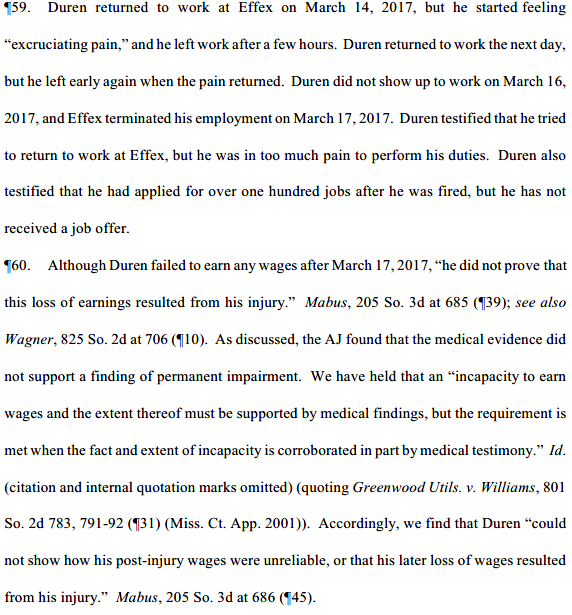
Duren v. Effex Management Solutions, LLC, 2021-WC-00337-COA (Civil – Workers’ Compensation) Affirming the Commission’s ruling, holding that there was substantial evidence to support the Commission’s decision that the claimant failed to prove that he suffered a permanent disability and the decision to award TTD through the date of MMI, but denying post-MMI medical treatment, prescription, and mileage reimbursements. (Judge Wilson concurred in part and in the result without separate written opinion. Judge Westbrooks and Judge McDonald concurred in the result only without separate written opinion.)
DEEPER DIVE: This case had an interesting post-MMI fact pattern where the claimant was released to return to work without restrictions, was offered to return to work for the Employer at his pre-injury wages, and returned to work there, but then quit working for the Employer due to complaints of pain. Under these facts, the Court of Appeals noted that there was a presumption of no loss of wage-earning capacity and held that the claimant did not overcome it:
Other Orders
Hammer v. State, 2019-KA-01633-COA (denying rehearing) Shannon v. Shannon, 2020-CA-00847-COA (denying rehearing)
The Mississippi Court of Appeals handed down ten opinions today. One is a medical malpractice case that ran afoul of RFAs. There are several criminal appeals, a claim against an estate by a judgment-lien holder, several PRC cases including one with competing opinions on Eighth Amendment issues, and more.
Cunningham v. Mississippi Department of Corrections, 2021-CP-00428-COA (Civil – State Boards and Agencies) Affirming circuit court’s denial of the plaintiff’s motion for judicial review of two ARP requests against MDOC, holding that the plaintiff failed to provide any documents to support his appeal and that, in any event, the plaintiff received sentencing credit for his pretrial detention. (All judges concurred.)
Pickle v. State, 2021-CP-00972-COA (Civil – PCR) Affirming the circuit court’s denial of the plaintiff’s motions for writ of mandamus, alternative sentencing, and a new trial or for JNOV regarding his 1978 conviction of capital murder and life imprisonment, holding that the motion was untimely, successive, and meritless. (All judges concurred.)
Thompson v. State, 2020-KA-01279-COA (Criminal – Felony) Affirming a conviction of drive-by-shooting that followed a domestic dispute between the defendant, the defendant’s boyfriend, and the defendant’s boyfriend’s ex-wife. The narrative in the opinion is gripping. In short, it was alleged that an Amber alert was issued for the formerly-married couple’s child when the child was with the defendant and her boyfriend (the child’s father). The couple had a physical altercation with the ex-wife at her work place in the midst of which the defendant instructed the ex-wife to “catch me outside.” Later, the ex-wife apparently inadvertently caught the defendant outside while driving and the defendant shot the ex-wife in the arm. A jury convicted the defendant of one count of drive-by-shooting and the court of appeal affirmed, holding that the conviction was not against the overwhelming weight of the evidence, the circuit court did not err in allowing the circuit clerk to testify as an authenticating witness even though she was present throughout the trial where the defendant’s counsel did not object, the circuit court did not err in refusing the defendant’s proposes “mere suspicion” instruction which would have been cumulative, and the defendant’s counsel was not ineffective. (All judges concurred.)
Unifund CCR Partners v. Estate of Jordan, 2021-CA-00761-COA (Civil – Wills, Trusts, and Estates/Judgment Liens) Reversing the chancery court’s ruling that claims against the estate were not timely, holding that the judgment liens against the decedent survive the time-bar of probate and were reasonably ascertainable to the executrices of the estate. (Chief Judge Barnes and Judge Lawrence concurred in part and in the result without separate written opinion. Judge McDonald concurred in part and dissented in part without separate written opinion. Judge Westbrooks concurred in part and dissented in part, joined by Judge McDonald.)
McLaughlin v. State, 2020-KA-00360-COA (Criminal – Felony) Affirming conviction of capital murder, third-degree arson, conspiracy, and possession of a firearm by a felon, holding that the evidence was sufficient for each of the convictions, that the defendants was procedurally barred on appeal from raising an alleged Miranda issue and that there was no plain error on this issue, that the circuit court did not err in admitting a photograph of the victim’s brain sitting on the autopsy table to show the bullet path, and that retroactive misjoinder did not apply. (All judges concurred.)
PRACTICE POINT – Seeking to exclude gruesome photographs of victims in criminal trials is an uphill climb:
Carter v. Total Foot Care, 2021-CA-00610-COA (Civil – Medical Malpractice/Requests for Admissions) Affirming summary judgment in favor of the defendants based on the plaintiff’s failure to respond to the defendants’ requests for admissions that were deemed admitted, holding that the trial court did not err in deeming the RFAs as admitted–including an admission that the standard of care was not breached–where the plaintiff did not respond until after the defendants filed their MSJ which was more than five months after the RFAs were served. Additionally, the Court of Appeals held that the plaintiff could not rely on responses served in a related federal court proceeding. (All judges concurred.)
MUSING– My experience is that RFAs are rarely used effectively. In the wild, they usually look like a cartoonish attempt to trick the other side. Something like a deadly CAPTCHA test. I think the best use of RFAs is to whittle down and actually define the contours of disputed issues. And, frankly, RFAs are a way to “shake” a lawsuit that is not being prosecuted and just needs to be dismissed.
Jolly v. State, 2021-KA-00318-COA (Criminal – Felony) Affirming conviction of four counts of statutory rape, holding that the circuit court did not err in denying the defendant’s motion to suppress his statement to law enforcement because there was no merit to the defendant’s claims that he lacked capacity to voluntarily waive his rights or that he was coerced into waiving his rights and giving a statement. (Judge Westbrooks concurred in part and in the result without separate written opinion.)
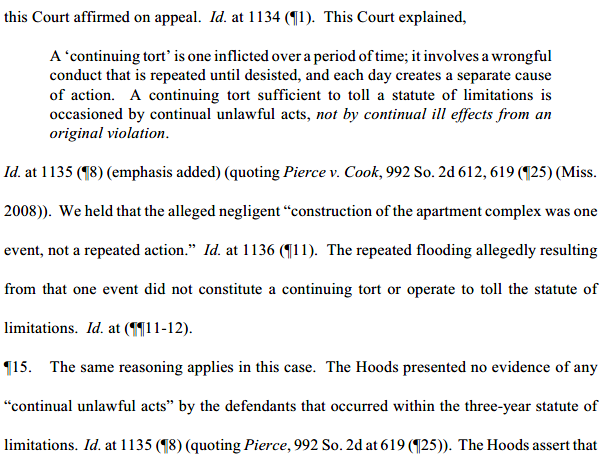
Hood v. A & A Excavating Contractors, Inc., 2021-CA-00207-COA (Civil – Property Damage/Statute of Limitations/Continuing Tort) Affirming summary judgment dismissing the plaintiffs’ residential flooding claims against a developer and the operator of a gravel pit based on the statute of limitations, holding that the “discovery rule” did not toll the statute of limitations which began to run upon notice of the injury not the cause of the injury and the “continuing tort doctrine” did not apply where there were no “continual unlawful acts” by the defendants. (McCarty concurred in part and dissented in part, joined by Judge Westbrooks and Judge Lawrence, and joined in part by Judge McDonald and Judge Smith. Judge McDonald dissented without separate written opinion. Judge Emfinger did not participate.)
NOTE– I though this was a helpful summary and application of the continuing tort doctrine:
Dortch v. State, 2021-CP-00103-COA (Civil – PCR) Affirming the circuit court’s dismissal of the plaintiff’s PCR motion and motion to vacate judgment and finding no error in the circuit’s revocation of the plaintiff’s PRS. (All judges concurred.)
Skinner v. State, 2021-CA-00080-COA (Civil – PCR) Affirming the circuit court’s denial of the plaintiff’s PCR motion related to the plaintiff’s 2011 conviction of felony evasion and sentence to life without parole as a habitual offender (with eight prior felony convictions), holding that the Eighth Amendment claim is barred by the doctrine of res judicata and without merit and that the circuit court did not err in refusing to consider mitigating circumstances surrounding Skinner’s juvenile convictions. (Judge McCarty concurred in part and dissented in part. Judge McDonald dissented, joined by Chief Judge Barnes and Judge Westbrook, and joined in part by Judge McCarty. Judge Emfinger did not participate.)
NOTE – The majority and the dissenting opinions contain robust discussions of the Eight Amendment analysis.
Other Order
Tallent v. State, 2020-CP-01077-COA (denying motion for rehearing)
After some sort of technical hiccup with the State’s web domain that knocked the Mississippi Supreme Court’s website offline for a spell, they are back in business. The Court handed down one hearty opinion in a wrongful death case that involves § 1983, qualified immunity, the MTCA, the appealability of summary judgment denials, and hearsay.
City of Jackson v. Johnson, 2020-CA-00318-SCT (Civil – Tort/Wrongful Death/1983/MTCA) Reversing and rendering a jury verdict holding the City liable under § 1983 and affirming the trial court’s judgment finding the City liable under the MTCA for the decedent’s wrongful death. The victim was murdered shortly after calling 911 to report a prowler. The dispatcher did not tell the victim to remain on the line, in violation of the City’s policies and procedure. Two JPD officers went to the victim’s house, did not detect that the prowler had entered a window, did not make contact with the victim, and left. The victim was found dead the next day. The victim’s family filed suit under § 1983 and under the MTCA.
The 911 operator and officers got out via qualified immunity on summary judgment. The § 1983 case was tried by a jury and the MTCA case was tried “simultaneously” before the bench. The jury found that the City violated the victim’s constitutional rights to due process and awarded $1M in damages. The trial court awarded $500,000 (i.e. the statutory maximum) under the MTCA.
On appeal, the Mississippi Supreme Court held that the City was entitled to a directed verdict on the § 1983 claim, reasoning that our constitutional due process rights do not include the right to be protected by the state from acts of private violence. Regarding the MTCA claim, the Supreme Court held that the 911 dispatcher’s conduct in responding to the victim’s call did not involve an element of choice or judgment and the City was therefore not protected by discretionary function immunity from liability under the MTCA.
There was a hearsay issue involving the defendant’s statement contained in the police report that warrants a brief discussion. The trial court admitted the police report, but with the assailant’s statement to police redacted, finding that the assailant could not be compelled to testify against himself and that hearsay exception in Rule 804(b)(3) did not apply because the statement was not being used against the assailant/declarant. Later in the trial, the court allowed the plaintiff’s expert to reply on the assailant’s statement in forming his opinions over the City’s objection that the expert had relied on inadmissible hearsay. The Mississippi Supreme Court did not have to address the argument that the expert’s testimony was a “conduit for otherwise inadmissible hearsay” because it held that that the assailant’s statement to police was admissible under the Rule 804(b)(3) exception after all, so there was no error in admitting the expert testimony that relied upon it.
(Chief Justice Randolph wrote a special concurrence, joined in part by Justice Maxwell, Justice Chamberlin, Justice Ishee, and Justice Griffis. Justice Griffis also wrote a special concurrence.)
Practice Point – I found it remarkable that the Mississippi Supreme Court heretofore had not addressed the issue of whether the denial of a motion for summary judgment can be appealed after a trial. They did here, and now we know:
One More Thing – We were this close (maybe) to the Mississippi Supreme Court addressing one of my pet issues: When a case involves an MTCA defendant and a non-MTCA defendant how, exactly, should a hybrid bench/jury trial proceed?
Hutto v. State, 2017-DR-01207-SCT (granting the plaintiff’s Motion for Leave to File Rebuttal to Opposition to Motion for Appointment of Counsel for Representation for Successive Petition for Post-Conviction Relief and the State’s Motion for Leave to File Surrebuttal in Opposition to Motion for Appointment of Counsel for Representation for Successive Petition for Post-Conviction Relief)
Randle v. Randle, 2020-CT-0033-SCT (granting cert)
McPhail v. McPhail, 2020-CA-00739-SCT (denying Motion Pursuant to Rule 8 and Rule 27 of the Rules of Appellate Procedure is hereby denied and remanding to the chancery court of Grenada County for an adjudication of a request for release on bond pending appeal in light of his child support payment subsequent to the February 24, 2022 denial of his prior motion)
The Mississippi Court of Appeals dropped eight nine opinions today and there is a lot to sort through. Two divorce cases (one involving equitable distribution of a marital residence and the other a life estate via constructive trust for a mother-in-law), a PCR case, a workers’ comp case involving medical causation, an adverse possession/tax sale case, a personal injury via falling through a roof case, an appeal of an estate case dismissed for lack of final order, and two criminal cases. One of the criminal cases is the second “should the indictment for attempt have alleged an overt act” case we have gotten in a row and it sees a dissenting Judge Westbrooks align herself with Justice Coleman’s dissent last week.
I am always balancing the desire to post these summaries quickly and the need to get back to paying work with the desire to provide a reasonably polished [free] product. Due to the number of cases and the fact that I have to leave the office a little early to coach a little league baseball game, there is extra weight on the “speed” side of the balance today. Thanks, Management
Archie v. Archie, 2020-CA-01370-COA (Civil – Domestic Relations/Equitable Distribution/Marital Residence) Affirming the chancellor’s modification of a final judgment of divorce as to equitable distribution of the marital residence, holding that there was no error in the chancellor ordering the ex-wife to sell the paid-off martial home in order to satisfy the ex-wife’s obligation to pay her ex-husband his share of the equity where the ex-wife had been unable to secure a loan on the paid-off house, even though the ex-husband had not pleaded a request for an order requiring the ex-wife to sell the residence. The court repeatedly noted that the chancellor had broad discretion to “fashion an equitable remedy” and held that the chancellor’s remedy here was appropriate. (Judge Wilson concurred in part and the in the result without separate written opinion.)
Bevalaque v. State, 2021-CP-00150-COA (Civil – PCR) Affirming dismissal of a pro se plaintiff’s third PCR motion, holding that the motion was time-barred and successive-writ barred and that no exceptions applied. (All judges concurred.)
Bowdry v. City of Tupelo, 2021-WC-00390-COA (Civil – Workers’ Compensation/Medical Causation) Affirming the MWCC’s finding that the claimant’s neck claim was not related to his compensable work-injury, holding that the Commission’s finding that the claimant failed to prove causation was supported by substantial evidence. (All judges concurred.)
PRACTICE POINT: The Court of Appeals noted that on appeal they do not review the AJ’s findings, but the Commission’s findings and did not address the claimant’s arguments about the AJ’s findings:
This is because the Commission does not function as an appellate court reviewing the AJs’ findings. This is because the Commission, not the AJ, is the ultimate trier and finder of fact for workers’ comp claims. See, e.g., Hugh Dancy Co. Inc. v. Mooneyham, 68 So. 3d 76 (Miss. Ct. App. 2011)
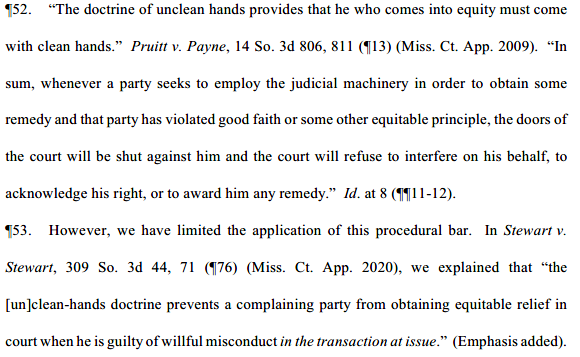
Anderson v. Jackson, 2019-CA-01773-COA (Civil – Real Property/Adverse Possession/Unclean Hands/Tax Sale) Reversing the chancellor’s findings granting title of real property to one party (Levon) based on findings that Levon had obtained title by adverse possession or by tax sale and that the opposing party (Rosie) had unclean hands, holding that the chancellor erred in granting title to Levon because he failed to prove the elements of adverse possession by clear and convincing evidence, that the tax sale was void due to flawed notice of redemption, and that the doctrine of unclean hands was erroneously applied to bar Rosie’s challenge because Rosie’s conduct was related to a forty-year-old estate case, not the transaction at issue. (All judges concurred.)
Since accusations of “unclean hands” get thrown around in litigation on occasion, I thought this summary of the equitable doctrine of unclean hands is a useful refresher:
NOTE – As always, but only more so here, if this case applies to your practice you need to read it yourself. There are many details in this forty-page opinion that I have not even attempted to tease apart.
Herron v. Herron, 2021-CA-00090-COA (Civil – Domestic Relations/Constructive Trust/Property Valuation) Affirming the chancellor’s findings in a divorce action granting a life estate via constructive trust in a home on the marital property to the ex-wife’s mother in assigning value to property awarded to the ex-husband, holding that there was clear and convincing proof that the house was intended to be owned by the mother in a life estate and that there was substantial credible evidence supporting the chancellor’s valuations of the personal property in question. (All judges concurred.)
Gillespie v. Lamey, 2021-CA-00076-COA (Civil – Personal Injury/Summary Judgment/Duty to Warn) Affirming summary judgment in favor of a defendant dismissing the plaintiff’s claim for personal injuries sustained when the plaintiff fell through a roof while working on a skylight on the defendant’s property, holding that (1) the plaintiff presented no evidence that the defendant failed to warn the plaintiff of any dangerous condition of which the defendant had actual or constructive knowledge and (2) the allegedly dangerous condition was “intimately connected” to the work he was hired to do. (Judge Smith did not participate, all other judges concurred.)
Smith v. Richmond, 2020-CP-01064-COA (Civil – Wills, Trusts, and Estates/Civil Procedure) Dismissing the appeal, holding that the pro se appellant’s attempted appeal of the chancery court’s denial of a Rule 60(b) motion to set aside an interim order, a motion to recuse, and a “motion to change jurisdiction” must be dismissed because each of these motions was an interlocutory order not appealable as of right. (All judges concurred.)
Wayne v. State, 2021-KA-00084-COA (Criminal – Felony/Rebuttal Evidence/Sufficiency and Weight of Evidence) Affirming murder conviction, holding that there was no error (1) in allowing the State to recall a State’s witness and introduce and play the defendant’s recorded statement in rebuttal because the recorded statement contradicted the defendant’s trial testimony, (2) in introducing the defendant’s entire statement because it was proper impeachment evidence, or (3) in denying the defendant’s post-trial motion because the evidence was sufficient to support the conviction and that the conviction was not against the weight of the evidence. (All judges concurred.)
Beale v. State, 2020-KA-00614-COA (Criminal – Felony/Overt Act) Affirming conviction two counts of attempted murder of two police officers, holding (1) an indictment for the crime of attempted murder does not require the description of an overt act, (2) that two jury instructions did not constitute a constructive amendment to the indictment, and (3) testimony from an officer about what a witness told him at the crime scene was not hearsay because they were not offered to prove the truth of the matter asserted but to explain the next steps in the course of his investigation. (Judge Westbrooks dissented, joined in part by Judge McDonald. Judge McDonald concurred in part and dissented in part without separate written opinion. Judge Emfinger concurred in part and in the result without separate written opinion. Judge Wilson concurred in result only without separate written opinion. All other judges concurred.)
NOTE – We have gotten an “is the indictment missing an alleged overt act” case in back-to-back hand-down days. In her dissent, Judge Westbrooks’s argues that she is taking a position consistent with the position that Justice Coleman took just last week in Brady v. State (my post here) (opinion link here).
Other Opinions
Durrant Inc. v. Lee County, Mississippi, 2019-CA-01826-COA (denying motion for rehearing) Bell v. State, 2020-CT-00592-COA (denying motion for rehearing)
The Mississippi Court of Appeals dropped nine opinions today including upheld convictions, dismissal of a civil case for discovery violations, a workers’ comp appeal, petitions for custody modification, and a couple of of PCR motions.
Davis v. State, 2020-CP-00283-COA (Civil – PCR) Affirming the circuit court’s denial of a pro se motion for PCR, holding that the circuit court did not err in finding that the claim of ineffective assistance of counsel was procedurally barred. (All judges concurred)
Fluker v. State, 2021-CP-00162-COA (Civil – PCR) Affirming the circuit court’s denial of a pro se motion for PCR (the plaintiff’s fourth such effort), holding that the plaintiff waived any procedural defects in his indictment when he pleaded guilty and that his claim based on the circuit clerk’s failure to stamp “filed” on the indictment was therefore procedurally barred. (All judges concurred)
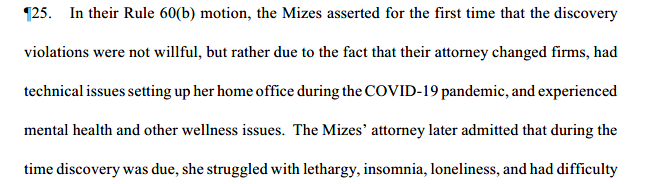
Mize v. Shiloh Market, Inc., 2020-CP-01119-COA (Civil – Personal Injury/Rule 37/Rule 60(b)) Affirming the dismissal of a trip-and-fall lawsuit based upon the plaintiffs’ failure to cooperate in discovery, holding that it was within the circuit court’s discretion to dismiss the claims after the plaintiffs’ failed to respond to the defendant’s discovery after the deadline set by a consent order granting the defendant’s motion to compel discovery responses and to deny the plaintiffs’ Rule 60(b) motion. (Judge Westbrooks and Judge McDonald concurred in result only without separate written opinion).
Addendum – COVID and the Law: Neither the circuit court nor the court of appeals was persuaded by the plaintiffs’ Rule 60(b) motion argument that their discovery responses were not served because of attorney was having issues, including some COVID-related, constituted “exceptional circumstances”:
Kreppner v. Kreppner, 2021-CA-00006-COA (Civil – Domestic Relations/Child Custody Modification) Affirming the chancellor’s denial of the mother’s motion to modify the terms of an agreed custody order, holding that the father’s remarriage and the resulting changes in the minor’s life did not constitute a “material change in circumstances” and that the Riley test did not apply because there was no evidence of genuinely adverse circumstances.” (Judge Westbrooks concurred in result only without separate written opinion)
Butler v. State, 2020-KA-00806-COA (Criminal – Felony/Culpable Negligence Manslaughter) Affirming conviction of culpable negligence manslaughter stemming from a boat collision, holding (1) that the circuit court did not err in granting the State’s motion in limine excluding evidence about the other driver’s prior drug use, (2) that the State presented sufficient evidence for the conviction without regarding to any intoxication argument because there was evidence that the defendant violated five boating rules leading up to the collision, and (3) that the weight-of-the-evidence argument was procedurally barred and meritless. (Judge Lawrence wrote a special concurrence joined by Judge Greenlee, Judge McDonald, and Judge McCarty)
Wall v. Wall, 2020-CA-01182-COA (Civil – Domestic Relations/Child Custody Modification) Affirming the chancery court’s involuntary dismissal of the father’s petition for child custody modification, holding that the chancellor did not err in dismissing the petition under Rule 41(b) at the conclusion of the hearing because the father did not prove a material change in circumstances and that the lack of specific discussion of the father’s concerns about the mother’s alcohol use did not mean the issue was overlooked such that the chancellor failed to consider the totality of the circumstances. (Judge Lawrence concurred in result only without separate written opinion)
Hawkins v. State, 2020-KA-01263-COA (Criminal – Felony/DUI) Affirming conviction of two counts of aggravated DUI after the defendant’s appellate counsel filed a Lindsey brief and the defendant elected not to file a supplemental brief pro se. (All judges concurred)
Texas Mutual Insurance Company v. Vaughters, 2021-WC-00364-COA (Civil – Workers’ Compensation/Jurisdiction) Dismissing an appeal from the MWCC, holding that the Commission’s order vacating the AJ’s order and remanding for a determination as to compensability, coverage, and jurisdiction was not a final, appealable judgment. (All judges concurred)
Manuel v. State, 2020-KA-00711-COA (Criminal – Felony/Excited Utterance) Affirming convictions and sentences for second-degree murder and aggravated assault, holding that the circuit court did not abuse its discretion by (1) admitting testimony under the excited-utterance hearsay exception, (2) excusing a juror mid-trial for failure to disclose information during voir dire, (3) collecting the parties’ jury panel information sheets following jury selection and placing them under seal, or (4) sentencing the defendant as a habitual offender. (Judge Westbrooks concurred in part and dissented in part, joined by Judge McDonald and Judge McCarty; Judge McDonald and Judge McCarty concurred in part and dissented in part without separate written opinion; and Judge Emfinger concurred in part and in the result without separate written opinion)
Other Orders
Robertson v. Houston, Mississippi Public School District, 2020-CA-931-COA (denying motion for rehearing) Hardin v. Hardin, 2020-CA-1314-COA (denying motion for rehearing) Butler v. State, 2021-CA-337-COA (granting State’s motion to dismiss for lack of appealable judgment) Evans v. State, 2021-TS-1423-COA (allowing appeal to proceed without prejudice to State’s ability to rebut presumption that notice of appeal was timely)
The folks publishing the hand down lists are not on spring break. There were four opinions today that are must-reads for anyone whose law practice these opinions touch. There is a medical malpractice/expert testimony decision, a dismissal for failure to prosecute decision that is more about the abuse-of-discretion standard of review, a breach of commercial lease opinion, and a will probate opinion.
Claiborne County Hospital v. Truitt, 2020-IA-01017-SCT (Civil – Medical Malpractice/Summary Judgment/Experts) The plaintiff fell while walking to the restroom to give a urine sample. The plaintiff filed a negligence claim against the hospital, alleging that a nurse failed to assist him to the restroom. The hospital filed a motion for summary judgment on the grounds that the plaintiff lacked medical expert testimony. The plaintiff argued that the layman’s exception applied or, alternatively, that the plaintiff had identified the requisite expert testimony in an interrogatory answer. The circuit court denied the hospital’s motion for summary judgment and the Supreme Court granted interlocutory appeal. The Supreme Court reversed the circuit court and rendered judgment in favor of the hospital, holding that “the layman’s exception does not apply to the facts of this case because Truitt’s claim involves the rendering of medical services and a nurse’s professional judgment for which expert testimony is required.” The Supreme Court also held that the designation via interrogatory answer was insufficient because the “designation does not provide sworn expert testimony” and noting that the plaintiff “only provided the name of his expert and a brief description of the anticipated testimony.” (All justices concurred)
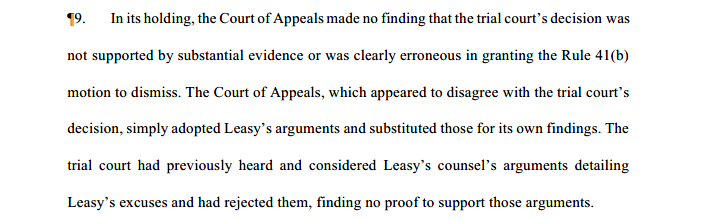
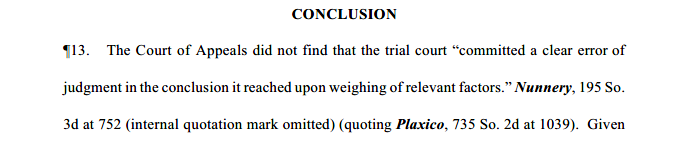
Leasy v. SW Gaming, LLC, 2019-CT-01505-SCT (Civil – Personal Injury/Failure to Prosecute/Standard of Review) Reversing the Court of Appeals and reinstating the circuit court’s judgment dismissing the plaintiff’s claim for failure to prosecute, holding that the Court of Appeals improperly reweighed the evidence and reaffirming the controlling abuse-of-discretion standard. (Justice King dissented, joined by Justice Kitchens. Justice Beam did not participate in the decision) (Note: At the Court of Appeals level, Judge Carlton wrote a dissent that was joined by Judge Wilson)
Practice Point – Standards of review matter! The Mississippi Supreme Court has shown a renewed interest in standards of review. This opinion is more about the standard of review than it is about the failure to prosecute. The Supreme Court described the Court of Appeals’ incorrect application of the standard of review as follows:
The Supreme Court bluntly concluded:
Holcomb, Dunbar, Watts, Best, Masters & Golmon, P.A. v. 400 South Lamar Oxford Mad Hatter Partners, LLC, 2019-CT-01702-SCT (Civil – Real Property/Landlord-Tenant Law/Commercial Real Estate) Affirming the circuit court’s denial of the tenant’s motion for partial summary judgment seeking a dismissal of the landlord’s claims for back rent, holding that the landlord’s demand for possession and the tenant’s departure from the premises did not prevent the landlord from recovering back rent; affirming the circuit court’s grant of summary judgment to the landlord based upon material breaches by the tenant; affirming the Court of Appeals’ finding that the tenant’s mitigation argument was waived because it was not raised prior to the appeal; affirming the Court of Appeals’ decision granting the landlord’s motion to quash the tenant’s request for records related to a news story a spat between the landlord’s principal and another developer because those records were not relevant to the appeal; and affirming the circuit court’s denial of the tenant’s untimely motion to amend to add claims of libel and libel per se because they were delayed and barred by the one-year statute of limitations. (All participating justices concurred.)
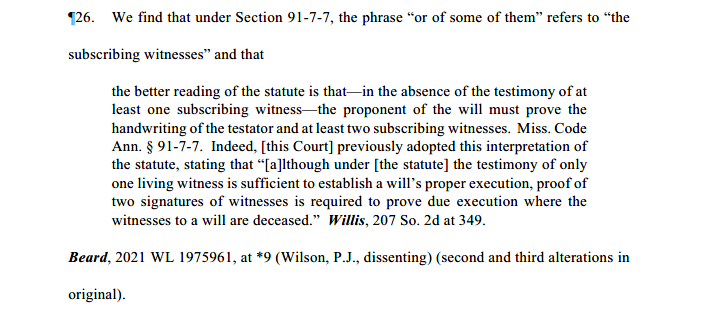
In the Matter of the Last Will and Testament of Luke Beard, Deceased: Antonio Christmas v. Diane Christmas, 2019-CT-01821-SCT (Civil – Wills, Trusts, and Estates/Probate) Reversing the court of appeals and reinstating the chancery court’s dismissal of a petition to probate a purported will, holding that in the absence of the testimony of at least one subscribing witness, a proponent of a will must prove the handwriting of the testator and at least two subscribing witnesses. This unanimous, textualist decision centered around whether the phrase “or some of them” in section 91-7-7 referred to the subscribing witnesses or collectively to the testator and the subscribing witnesses. Ultimately, the Supreme Court adopted Judge Wilson’s analysis of the textual quandary from his dissent at the Court of Appeals, holding:
The Mississippi Bar v. Henderson, 2021-BD-01141-SCT (Civil – Bar Matters) Imposing a reciprocal public censure to an attorney publicly censured in Tennessee and assessing costs.
Other Orders
Dille v. State, 2019-CT-00855-SCT (denying petitions for cert) Lairy v. Chandler, 2019-CT-01423-SCT (granting petition for cert) Cork v. State, 2020-KA-00060-SCT (denying pro se motion for rehearing) Magnolia Health Plan, Inc. v. Mississippi’s Community Health Commissions, 2020-CA-00167-SCT (denying motion for rehearing)








 Mississippi Appeals Blog