
Summaries of the Mississippi Court of Appeals opinions of March 15, 2022

The Mississippi Court of Appeals handed down six opinions today with a little something for everybody. There are two real-property decisions, two PCR denials, one criminal conviction affirmed, and an MTCA/12(b)(6) decision.


DeSoto County v. Vinson,  2021-CA-00122-COA (Civil – Real Property/Division of Subdivision Lot)
Affirming the circuit court’s decision reversing a DeSoto County Board of Supervisors decision regarding the division of a subdivision lot into two separate residential lots, holding that the circuit court did not err in ruling that the properly owner should resubmit an application to divide property with written approval of “adversely affected” and “directly interested” parties or proceed under section 19-27-31 in chancery court.
(All judges concurred)


Land v. Land, 2021-CA-00402-COA (Civil – Real Property/Partition of Property)
Affirming the chancellor’s denial of complaint for partition, holding that chancellor did not err in ruling that the residential property claimed as homestead property by one party could only be partitioned by written agreement of the parties and could not be involuntarily partitioned by chancery court decree.
(All judges concurred)


Bridges v. State, 2020-CA-00816-COA (Civil – PCR)
Affirming the circuit court’s denial of a motion for post-conviction relief, holding that the circuit court did not err in finding that there was insufficient evidence to prove that the second PCR motion satisfied a statutory exemption to procedural bars and that the evidence did not show good cause for failing to provide additional affidavits.
(Judge Westbrooks concurred in part and in result, joined by Judge McDonald and Judge Lawrence, and joined in part by Judge McCarty)


Jackson v. State, 2021-KA-00292-COA (Criminal – Felony)
Affirming conviction of sexual battery and filming a minor engaging in sexually explicit conduct and a sentence to serve consecutive terms of thirty years and forty years, holding that there were no arguable issues for appeal based upon a Lindsey brief and the Court’s independent review of the record.
(All judges concurred)


Horton v. State, 2021-CP-00383-COA (Civil – PCR)
Affirming the circuit court’s denial of a PCR motion, holding that the circuit court did not err in ruling that the sentence was not unconstitutional and that his confession was voluntary.
(All judges concurred)


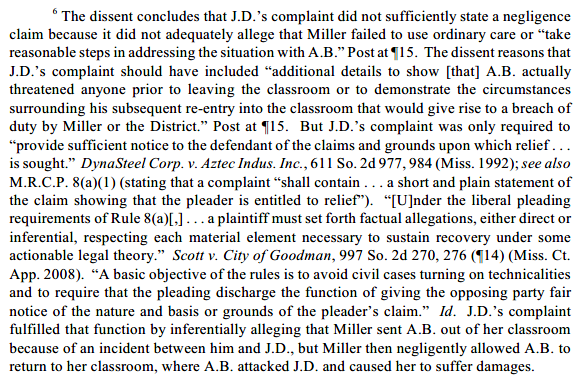
J.D. v. McComb School District, 2020-CA-00022-COA (Civil – Personal injury/Civil Procedure/12(b)(6))
Reversing the circuit court’s ruling granting the defendant’s motion to dismiss for failure to state a claim upon which relief can be granted, holding that the plaintiff’s allegations that a minor was attacked at school and that the school district had knowledge of similar conduct by the attacker and breached its ministerial duty to use ordinary care and to take reasonable steps to minimize foreseeable risk to the plaintiff.
(Judge Smith dissented, joined by Judge Greenlee and Judge Lawrence and joined in part by Judge Emfinger)

Practice Point: In footnote 6, the majority opinion addressed and rejected the dissent’s argument that the plaintiff should have included additional details regarding the alleged prior conduct of the attacker, summarizing the liberal pleading requirements of Rule 8:

Other Orders

None


Hand Down List Page

Summaries of the Mississippi Court of Appeals opinions of March 8, 2022

There are six opinions from the Mississippi Court of Appeals today on a wide range of topics, including a holding that a defendant’s failure to respond to a complaint filed on March 6, 2020, until thirty-one days after service of process constituted “excusable neglect” in light of the COVID shutdowns at the time.

Hamer v. State, 2019-KA-01633-COA (Criminal – Felony/Evidence/Rule 403/Golden Rule)
Affirming conviction on two counts of capital murder and armed robbery and sentence to life in prison without parole, holding primarily that (1) wiretapped phone calls between the convicted and his father, whose drug trafficking enterprise the convicted had worked for, were admissible to show motive and tell “the complete story” to the jury, (2) the evidence was sufficient to establish nexus between the killing and the underlying felony to constitute capital murder, (3) and there was no impermissible Golden Rule argument at closing.
(Judge Westbrooks wrote an opinion concurring in part and dissenting in part, joined by Judge McDonald.)


Crockett v. State, 2021-CP-00022-COA (Civil – PCR/Time Bar)
Affirming circuit court’s denial of a pro se motion for post-conviction collateral relief, holding that the claim of an involuntary guilty plea was both time-barred and meritless.
(All judges concurred, Chief Judge Barnes and Judge Wilson concurred in part and in the result without separate written opinion.)


Erves v. Hosemann, 2020-CA-00467-COA (Civil – Property/Daubert)
Affirming chancellor’s decision denying relief in an action for an injunction to stop the use of a driveway and for monetary damages, holding that the petitioners failed to establish legal title to the subject property and specifically holding that the defendants’ expert witnesses were qualified and that the chancellor’s ruling was not against the overwhelming weight of the evidence.

Practice Point: Appellants got dinged on their Daubert challenge for arguing reliability on appeal when the only issue raised at the trial court was the experts’ qualifications:


(All judges concurred, Judge McCarty concurred in part and in the result without separate written opinion.)


Archer v. Harlow’s Casino Resort & Spa, 2020-CP-00930-COA (Civil – Other/Default/Excusable Neglect)
Affirming in part and reversing in part the circuit court’s grant of the defendant’s motion to dismiss, holding that the circuit court did not abuse its discretion in finding that the defendant showed excusable neglect when it sought an extension of time to answer the complaint thirty-one days after being served and holding that the circuit clerk did not err by correcting a mistake and removing an entry of default, but holding that the trial court should have dismissed the complaint without prejudice and allowed the plaintiff an opportunity to amend her complaint under Rule 15(a).

ADDENDUM – COVID AND THE LAW: The defendant casino blamed the COVID-19 pandemic for being late to respond to the complaint. The casino was served with process on March 9, 2020, three days before the governor of Kentucky (where the casino’s counsel is located) issued a state of emergency and one week before Governor Reeves entered an order in Mississippi closing the casino. The casino asserted that these restrictions made it difficult to gather information from the closed casino in order to prepare and answer. The circuit court granted the late-filed extension request “in light of the current pandemic and government orders restricting operations and travel.” The court of appeals held that this was not an abuse of the circuit court’s broad discretion in this realm. In this case: COVID shutdown in March 2020 = “excusable neglect.”
(All judges concurred, Judge Wilson concurred in part and in the result without written opinion.)


Everett v. Dykes, 2020-CP-01331-COA (Civil – Property Damage/Recusal/Rule 48B)
Dismissing a pro se appeal of an order denying a motion for recusal of the circuit judge, holding that the appellant failed to comply with the procedure required by Rule 48B of the Mississippi Rules of Appellate Procedure for an interlocutory appeal of the denial of a recusal motion.
(Judge Lawrence dissented without separate written opinion.)


Rives v. Ishee, 2020-CA-01328-COA (Civil – Contract/Statute of Limitations)
Affirming the chancellor’s dismissal of a breach of contract lawsuit, holding that the plaintiffs’ second lawsuit was time-barred because they did not file suit until more than three years after they learned they would receive no money from the restaurant and the statute of limitations was not tolled during the first lawsuit because it was dismissed for want of prosecution. The court of appeals also held that the remedy of quantum meruit was inapplicable because there was a contract between the parties.
(Judge Westbrooks concurred in part and dissented in part, joined by Judge Greenlee.)


Other Orders

Westmoreland v. State, 2020-KA-00509-COA (denying motion for rehearing)
Winters v. State, 2020-KA-00809-COA (denying motion for rehearing)


Complete Hand Down List

Summaries of the Mississippi Supreme Court opinions of February 24, 2022

The Mississippi Supreme Court handed down four opinions today: one civil procedure decision on interlocutory appeal, one MDES decision, and two decisions affirming criminal convictions.


University of Mississippi Medical Center v. Jensen, 2020-IA-872-SCT (Civil – Personal Injury/Statute of Limitations/Service of Process)
Reversing, on interlocutory appeal, the county court’s ruling granting the plaintiff’s motion for extension of time to serve process, holding that the plaintiff did not show good cause where the plaintiff attempted to serve process on an administrative assistant, who accepted service on behalf of UMMC’s CEO, instead of the attorney general. Because the statute of limitations had expired, judgment was rendered in favor of UMMC.

“As neither inadvertence, mistake of counsel, or ignorance of the rules suffice to establish good cause, the county court lacked substantial evidence to support its finding that Jensen had shown good cause for an extension of time to serve process under Rule 4(h).”

Univ. of Miss. Med. Ctr v. Jensen, 2020-IA-827-SCT (Miss. 2022) (citation omitted).

Mississippi Department of Employment Security v. Dover Trucking, LLC, 2020-CC-1267-SCT (Civil – State Boards and Agency/Employment)
Reversing the circuit court’s order that reversed the MDES Board of Review’s decision that the claimant was an “employee” of a trucking company, holding that that the agency’s decision was supported by substantial evidence and was not arbitrary or capricious.


Williams v. State, 2020-KA-772-SCT (Criminal – Felony/Rebuttal Evidence)
Affirming conviction of one count of sexual battery, holding that the circuit court did not err in admitting State’s rebuttal evidence related to the defendant’s ankle monitor that had not been disclosed prior to trial because that evidence was not within the State’s due diligence/disclosure obligations prior to trial based on the defendant’s pre-trial representations. The supreme court also held that the circuit court did not err in excluding evidence that the minor victim had previously twerked on the school bus and that the defendant’s sufficiency of the evidence claim was meritless.


Williams v. State, 2019-CT-1007-SCT (en banc) (Criminal – Felony/Accomplice Liability)
Affirming, on writ of certiorari, convictions for two counts of conspiracy and two counts of possession with intent to distribute, holding that the evidence was sufficient to convict on accomplice liability rather than constructive possession where an inmate was directing a drug-trafficking ring from prison over the phone and whose home was found to have large amounts of cocaine and marijuana, as well as $93,259 in cash.


Other Orders

Ward v. Cranford, 2020-CT-410-SCT (denying petition for writ of certiorari)
Brown v. State, 2020-M-630 (denying petition for leave to proceed in trial court and for permission to file successive petition for post-conviction collateral relief)
State v. Corrothers, 2021-IA-836-SCT (denying motion for rehearing)
Cooper v. State, 2021-CT-1012-SCT (dismissing pro se “writ of certiorari”)


Hand Down List for February 24, 2022

Summaries of the Mississippi Court of Appeals opinions of Feb. 15, 2022

Anderson v. S&S Properties, LLC, 2021-CA-33-COA (Civil – Real Property/Summary Judgment/Tax Sale)
Affirming summary judgment granted by the chancery court setting aside a tax sale and ordering the county to refund the purchase price to the purchaser, holding that the purchaser had standing and that the county failed to serve proper notice of the tax sale to the assessed property owners. Note: The COA held that the purchaser had standing to sue in this particular case because the amended version of Miss. Code Ann. § 27-25-27(2) did not apply retroactively. The amended statute provides: “No purchaser of land at any tax sale, nor holder of the legal title under him by descent or distribution, shall have any right of action to challenge the validity of the tax sale.”

Ford v. State, 2020-KA-278-COA (Criminal – Felony/Criminal Procedure)
Affirming conviction of first-degree murder, holding:
1. The defendant was not entitled to a directed verdict under Weathersby because the Weathersby issue was procedurally barred and because Weathersby did not apply in this case where there was contradicting.
2. The circuit court did not err by not allowing the defendant to represent himself because the defendant did not expressly make such a request.
3. The circuit court did not err in allowing an investigator to testify about his recollection of a verbal statement the defendant gave to law enforcement.
4. The defendant’s counsel was not constitutionally ineffective for not proposing a “stand your ground” instruction (trial strategy), not filing a motion for new trial or JNOV (this was deficient, but not “prejudicial” in that there is no reasonable probability that, but for counsel’s unprofessional errors, the result of the trial would have been different), not arguing the Weathersby rule (Weathersby was already held to be inapplicable), and not subpoenaing eyewitness testimony (trial strategy).
5. There was no prosecutorial misconduct during closing argument when the prosecutor argued that the trajectory of the bullet showed that the defendant and the victim were not fighting for the gun.
6. The defendant’s should not be reversed as a result of cumulative error because the other issues on appeal were without merit.

Diversicare of Meridian, LLC v. Shelton, 2020-CA-1362-COA (Civil – Contract/Arbitration Agreement)
Affirming the circuit court’s denial of a motion to compel arbitration in a wrongful death nursing-home case, holding that the nursing home failed to provide sufficient proof that the resident gave her daughter, who signed admissions paperwork including an arbitration agreement, authority to bind the resident to arbitrate any future disputes arising from her stay.
NOTE: Although the court of appeals affirmed the denial of the motion to compel arbitration, it held that the circuit court erred in ruling that written authority was required. Specifically, the court of appeals held: “[A] mentally competent individual may orally grant authority to another person to sign documents required for admission to a nursing home.”

Rutland v. Burroughs, 2020-CA-1100-COA (Civil – Torts/Civil Procedure)
Affirming the circuit court’s grant of summary judgment dismissing a malicious prosecution and intentional infliction of emotional distress lawsuit after the plaintiff’s attorney withdrew, the 60-day period given to the plaintiff to retain new counsel or proceed pro se passed without any such action taken by the plaintiff and the plaintiff did not file a timely response to the motion for summary judgment.

Robinson v. Smith, 2020-CA-1249-COA (Civil – Personal Injury/Counter-Claim/Civil Procedure)
Reversing the circuit court’s grant of summary judgment that was based on a default judgment on a counter-claim, holding based on the plain language of Rules 7, 12, and 13, the counter-claim was procedurally improper because it was not asserted in the answer and the plaintiff therefore has no obligation to respond to it.

Lambes v. Lambes, 2020-CA-95-COA (Civil – Domestic Relations/Custody)
Affirming the chancery court’s ruling that it was in the best interest and welfare of the children to place them in the father’s custody, holding that the father was not precluded from being awarded custody after he admitted to the ground of habitual cruel and inhuman treatment when that admission was based on the chancellor’s statement that all rights regarding custody etc would be preserved, and that there were not misrepresentations in the GAL report warranting reversal when the record showed the chancellor made his decision based upon independent findings of fact.

Tillman v. KLLM Transport, 2021-WC-57-COA (Civil – Workers’ Comp/One-Year Limitations Period)
Affirming the MWCC’s dismissal of a workers’ comp claim based on the one-year limitations period, holding that the dismissal of the workers’ comp claim for the claimant’s failure to file a pre-hearing statement is a “rejection of the claim” sufficient to start the one-year limitations period under section 71-3-53 regardless of when or if a B-31 was filed.

Shannon v. Shannon, 2020-CA-847-COA (en banc) (Civil – Domestic Relations)
Affirming the chancery court’s rulings granting divorce on the ground of habitual cruel and inhuman treatment, granting a permanent restraining order against and divesting title from the at-fault party, applying the Ferguson factors, and denying a motion to continue or to allow remote participation.

Williams v. State, 2020-CP-950-COA (en banc) (Civil – PCR)
Reversing the circuit court’s denial of a pro se motion for post-conviction collateral relief, holding that the circuit court did not have sufficient evidence to revoke the defendant’s post-release supervision because (1) the defendant was not convicted of the crime that prompted the revocation of his PRS and (2) there was insufficient evidence in the record that the defendant had failed to pay fees, fines, and restitution. This case was remanded to the circuit court for further proceedings.

Other Orders
4 Denials of Motions for Rehearing


Enter your email address to have the opinion summaries and other posts emailed to you as soon as they are published.
(You can always unsubscribe later.)