The Mississippi Court of Appeals handed down six opinions today. Five were direct appeals of felony convictions. The sixth opinion is a constructive trust case.
Longs v. State, 2022-KA-00750-COA (Criminal – Felony) Affirming bench trial convictions of manslaughter and simple assault, holding that the defendant had been properly questioned by the trial court about waiving her right to a jury trial and that her waiver was knowing, intelligent, and voluntary. (9-0: Smith did not participate.)
Williams v. Williams, 2023-CA-00360-COA (Civil – Wills, Trusts & Estates) Affirming the chancery court’s dismissal of a petition for constructive trust regarding real property owned by the petitioner’s mother who allowed the petitioner to live there rent-free in exchange for assistance with repairs and upkeep, holding that the petitioner failed to prove a confidential relationship or, alternatively, an abuse of such a relationship and holding that the chancellor did not err in refusing to impose a constructive trust based on equity and good conscience. (9-1-0: Barnes concurred in part and in the result without writing.)
Jackson v. State, 2023-KA-00224-COA (Criminal – Felony) Affirming conviction of shooting into a motor vehicle, holding that after a review of counsel’s Lindsey brief and the record, that there were no issues warranting reversal. (10-0)
Baucom v. State, 2023-KA-00516-COA (Criminal – Felony) Affirming conviction of one count of sexual battery and two counts of fondling, holding that the evidence was sufficient to support the convictions and, specifically, that the criminal conduct in this case was sufficiently near the charged time from to sustain the conviction. (10-0)
Page v. State, 2023-KA-01078-COA (Criminal – Felony) Affirming conviction of rape, sexual battery, and burglary of a dwelling, holding that the trial court did not err in admitting evidence of two prior bad acts to prove identity and explain how the defendant became a suspect where a limiting instruction was also given. (10-0)
Black v. State, 2022-KA-01223-COA (Criminal – Felony) Affirming conviction of four types of drugs with intent to distribute, holding that the trial court did not abuse its discretion in admitting the defendant’s statement to police or in allowing a witness to be recalled to testify to the defendant’s inculpatory statement, and holding that the evidence was sufficient to prove intent to distribute. (8-2: McDonald dissented without writing; Westbrooks dissented, joined by McDonald.)
Other Orders
Wilbourn v. Wilbourn, 2018-CA-01653-COA (denying rehearing)
White v. White, 2022-CP-00823-COA (denying rehearing)
Toney v. State, 2023-CP-00151-COA (denying rehearing)
The Mississippi Court of Appeals handed down seven opinions today. There are three criminal cases that address jury instructions, improper prosecutorial argument, and the admissibility of a letter aimed at the credibility of a State’s witness. There is also a divorce case addressing issues several issues related to alimony, a case deciding whether the right to arbitration was waived, a case seeking to impose a constructive trust on land, and an unemployment case.
Vector Transportation Co. v. Mississippi Department of Employment Security, 2021-CC-00574-COA (Civil – State Board and Agencies) Affirming the circuit court and MDES Board of Review’s finding that the claimant was entitled to unemployment benefits, holding that the circuit court’s determination that the employer failed to prove that the claimant was discharged for misconduct was not contrary to law, arbitrary or capricious, or not supported by substantial evidence. (9-0: Chief Judge Barnes did not participate.)
Clay v. State, 2021-KA-00790-COA (Criminal – Felony) Affirming conviction of uttering a forgery and sentence as a nonviolent habitual offender, holding that the circuit court did not err in refusing the defendant’s mistake-of-fact jury instruction considering all jury instructions read together. (9-1-0: Judge Westbrooks concurred in part and in the result without separate written opinion.)
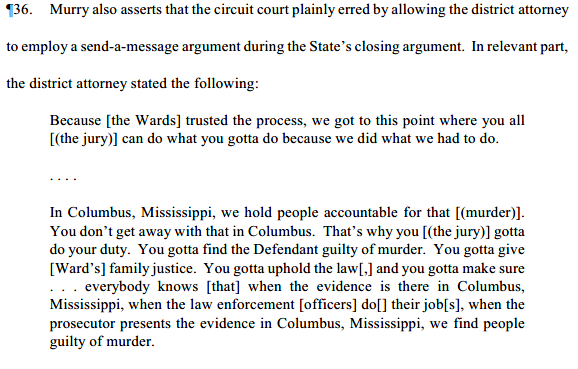
Murry v. State, 2020-KA-01363-COA (Criminal – Felony) Affirming conviction of first-degree murder, holding (1) that that the prosecutor made an improper “send-a-message” argument during closing but that absent the prosecutor’s improper argument the jury would have found the defendant guilty and (2) that the circuit court did not commit plain error in admitting photographs that the defendant did not object to. The Court of Appeals also declined to decide the defendant’s ineffective assistance of counsel claim and recognized that it was preserved for PCR. (10-0)
NOTE – Here are the “send-a-message” comments that the Court of Appeals held “[w]ithout question . . . run afoul of the clear direction given by the highest appellate courts in our state and nation” and that the defendant’s attorney did not object to at trial:
Lewis v. State, 2021-KA-00736-COA (Criminal – Felony) Affirming convictions of conspiracy and armed robbery, holding that the trial court did not err by excluding a letter the defendant sought to introduce that accused a witness of past instances of false accusations because it was hearsay and did not fall within an exception to the inadmissibility of hearsay. (9-1-0: Judge Emfinger concurred in part and in the result without separate written opinion.)
Phang v. Phang, 2021-CA-00752-COA (Civil – Domestic Relations) Affirming in part and reversing in part several aspects of the chancery court’s judgment of divorce, holding that the chancellor (1) did not err in the award of permanent alimony, (2) erred in not specifying what happened to the alimony obligation if the ex-husband predeceased the ex-wife, (3) erred in requiring the ex-husband to maintain an excessive life insurance policy naming the ex-wife as the beneficiary, (4) erred in ordering the ex-husband to provide annual proof of income to his ex-wife. (10-0)
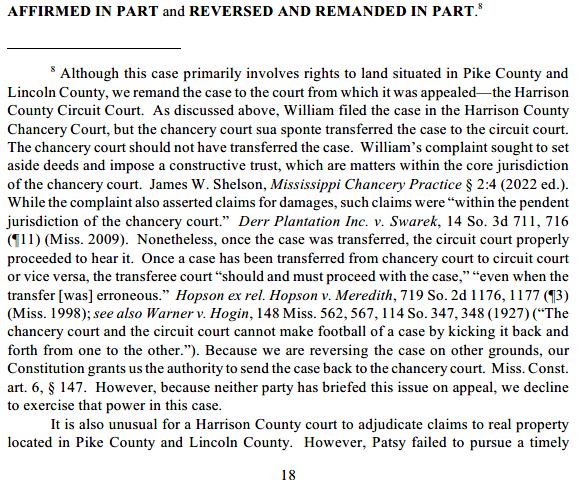
White v. White, 2021-CP-00333-COA (Civil – Contract) Affirming in part and reversing in part the circuit court’s dismissal of a son’s complaint against his mother seeking damages and to impose a constructive trust on land he had deeded his mother, holding that the circuit court did not err in ruling that the claim for damages was barred by the statute of limitations but did err to the extent it dismissed the claim to recover and impose a constructive trust because the 10-year statute of limitations had not run on those claims when the complaint was filed. (10-0)
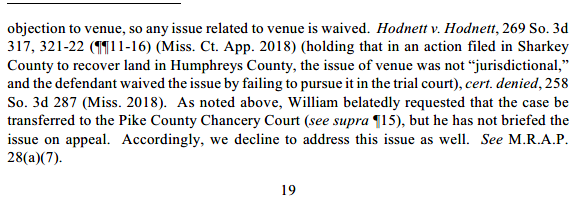
Note – There was a lengthy footnote to remand declaration, discussing the odd situation presented where the Court of Appeals was remanding to the Harrison County Circuit Court a claim seeking to impose a trust on land located in Pike and Lincoln County.
Purvis v. Mar-Jac Poultry MS, LLC, 2021-CA-00039-COA (Civil – Contract) Affirming the circuit court’s decision granting the defendant’s motion to compel arbitration, holding that the defendant did not waive arbitration by refusing the plaintiff’s pre-suit arbitration demand or by filing a counterclaim contemporaneously with its motion to compel arbitration and holding that the arbitration provision requiring an arbitration demand within 120 days after notice of a claim did not and could not alter the three-year statute of limitations. (6-1-2: Judge Westbrooks dissented, joined by Judge McDonald and joined in part by Judge McCarty; Judge Smith did not participate.)
Other Orders
Wofford v. State, 2020-KA-01341-COA (denying rehearing)
Adams v. State, 2020-KA-01383-COA (denying rehearing)
Smith v. Mississippi Department of Public Safety, 2021-SA-00020-COA (denying rehearing)
Frost v. State, 2021-CA-00152-COA (denying rehearing)
Edwards v. State, 2021-KA-00259-COA (denying rehearing)
Carter v. Total Foot Care, 2021-CA-00610-COA (denying rehearing)
In five opinions handed down today, the Mississippi Court of Appeals tackled implied trusts, trespass to timber, hearsay exceptions, and more.
Bays v. State, 2021-KA-00244-COA (Criminal – Felony) Affirming a conviction of one count of sexual battery by a person in a position of trust or authority, holding that it was error to admit testimony containing a hearsay statement by the 12-year-old victim under the 801(d)(1)(C) statement of identification hearsay exception but that the error was harmless in light of the overwhelming evidence supporting the guilty verdict and holding that the trial court did not abuse its discretion in denying the defendant’s untimely request to submit evidence of another perpetrator or in denying the defendant’s request to re-call the victim. (9-1-0: no separate opinion)
Ainsworth v. Plunk, 2021-CA-00488-COA (Civil – Wills, Trusts, and Estates) Affirming the chancery court’s order requiring a father to transfer title of real property back to his two daughters, holding that the chancery court properly applied the remedy of an implied trust under the peculiar facts of this case where (1) the father deeded land to his daughters and reserved a life estate for himself prior to his upcoming marriage in case the marriage ended in divorce, which it did, (2) the father then told the daughters to deed the land back to him and he would execute a new deed where the daughters would be tenants in common with full rights to devise their half interest, (3) the daughters quitclaimed their interest back to the father, (4) and the father then said he would only deed back the land if one of the daughters gave up an African-American baby she had adopted. (8-2-0: no separate opinions)
NOTE – In addition to its startling facts that would make a compelling movie, this opinion contains a helpful discussion of constructive trusts and resulting trusts, and the differences between the two that would not necessarily make a compelling movie.
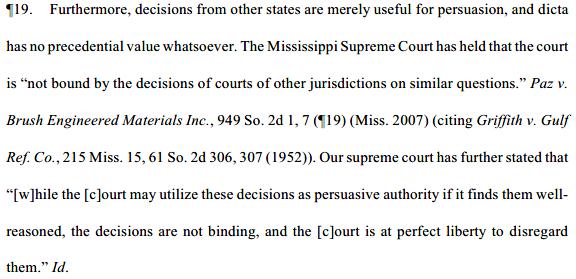
Terpening v. F.L. Crane & Sons, Inc., 2021-CA-00544-COA (Civil – Personal Injury) Affirming summary judgment in a wrongful death action against an employer stemming from a fatal collision involving its employee, holding that the employer was not vicariously liable for the employee’s negligence because the employee was driving home from a week at a remote job site in a personal vehicle when the accident occurred and thus was not in the course and scope of his employment. (10-0)
NOTES – The Court of Appeals held that the circuit court did not err in declining to apply the workers’ comp “traveling employee doctrine” outside of the workers’ comp arena. Additionally, the Court of Appeals dropped this handy paragraph to cite when the opposing party’s argument relies on out-of-state authorities:
(Please disregard this if I am ever the opposing party citing out-of-state authorities.)
Nalls v. State, 2021-KA-00592-COA (Criminal – Felony) Affirming convictions of attempted murder and possession of a firearm by a felon, holding that the trial court did not err in denying the defendant’s motion for JNOV because the verdict was not against the overwhelming weight of the evidence and then rejecting several arguments made in the defendant’s additional, pro se brief. (10-0)
Green v. Poirrier Properties, L.L.C., 2021-CP-00704-COA (Civil – Real Property) Affirming the chancellor’s decision in a timber-trespass case, holding that the chancellor’s finding that the defendant’s removal of timber constituted a willful act and the chancellor’s award of damages were supported by substantial evidence. (8-2-0: no separate opinions)
Other Orders
Booker v. State, 2018-CA-00664-COA (denying rehearing)
Manuel v. State, 2020-KA-00711-COA (denying rehearing)
Bridges v. State, 2020-CA-00816-COA (denying rehearing)
The Mississippi Court of Appeals dropped eight nine opinions today and there is a lot to sort through. Two divorce cases (one involving equitable distribution of a marital residence and the other a life estate via constructive trust for a mother-in-law), a PCR case, a workers’ comp case involving medical causation, an adverse possession/tax sale case, a personal injury via falling through a roof case, an appeal of an estate case dismissed for lack of final order, and two criminal cases. One of the criminal cases is the second “should the indictment for attempt have alleged an overt act” case we have gotten in a row and it sees a dissenting Judge Westbrooks align herself with Justice Coleman’s dissent last week.
I am always balancing the desire to post these summaries quickly and the need to get back to paying work with the desire to provide a reasonably polished [free] product. Due to the number of cases and the fact that I have to leave the office a little early to coach a little league baseball game, there is extra weight on the “speed” side of the balance today. Thanks, Management
Archie v. Archie, 2020-CA-01370-COA (Civil – Domestic Relations/Equitable Distribution/Marital Residence) Affirming the chancellor’s modification of a final judgment of divorce as to equitable distribution of the marital residence, holding that there was no error in the chancellor ordering the ex-wife to sell the paid-off martial home in order to satisfy the ex-wife’s obligation to pay her ex-husband his share of the equity where the ex-wife had been unable to secure a loan on the paid-off house, even though the ex-husband had not pleaded a request for an order requiring the ex-wife to sell the residence. The court repeatedly noted that the chancellor had broad discretion to “fashion an equitable remedy” and held that the chancellor’s remedy here was appropriate. (Judge Wilson concurred in part and the in the result without separate written opinion.)
Bevalaque v. State, 2021-CP-00150-COA (Civil – PCR) Affirming dismissal of a pro se plaintiff’s third PCR motion, holding that the motion was time-barred and successive-writ barred and that no exceptions applied. (All judges concurred.)
Bowdry v. City of Tupelo, 2021-WC-00390-COA (Civil – Workers’ Compensation/Medical Causation) Affirming the MWCC’s finding that the claimant’s neck claim was not related to his compensable work-injury, holding that the Commission’s finding that the claimant failed to prove causation was supported by substantial evidence. (All judges concurred.)
PRACTICE POINT: The Court of Appeals noted that on appeal they do not review the AJ’s findings, but the Commission’s findings and did not address the claimant’s arguments about the AJ’s findings:
This is because the Commission does not function as an appellate court reviewing the AJs’ findings. This is because the Commission, not the AJ, is the ultimate trier and finder of fact for workers’ comp claims. See, e.g., Hugh Dancy Co. Inc. v. Mooneyham, 68 So. 3d 76 (Miss. Ct. App. 2011)
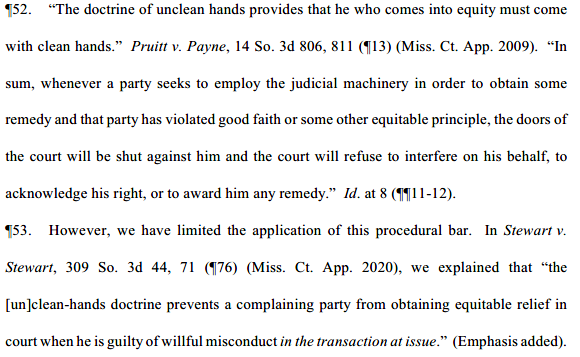
Anderson v. Jackson, 2019-CA-01773-COA (Civil – Real Property/Adverse Possession/Unclean Hands/Tax Sale) Reversing the chancellor’s findings granting title of real property to one party (Levon) based on findings that Levon had obtained title by adverse possession or by tax sale and that the opposing party (Rosie) had unclean hands, holding that the chancellor erred in granting title to Levon because he failed to prove the elements of adverse possession by clear and convincing evidence, that the tax sale was void due to flawed notice of redemption, and that the doctrine of unclean hands was erroneously applied to bar Rosie’s challenge because Rosie’s conduct was related to a forty-year-old estate case, not the transaction at issue. (All judges concurred.)
Since accusations of “unclean hands” get thrown around in litigation on occasion, I thought this summary of the equitable doctrine of unclean hands is a useful refresher:
NOTE – As always, but only more so here, if this case applies to your practice you need to read it yourself. There are many details in this forty-page opinion that I have not even attempted to tease apart.
Herron v. Herron, 2021-CA-00090-COA (Civil – Domestic Relations/Constructive Trust/Property Valuation) Affirming the chancellor’s findings in a divorce action granting a life estate via constructive trust in a home on the marital property to the ex-wife’s mother in assigning value to property awarded to the ex-husband, holding that there was clear and convincing proof that the house was intended to be owned by the mother in a life estate and that there was substantial credible evidence supporting the chancellor’s valuations of the personal property in question. (All judges concurred.)
Gillespie v. Lamey, 2021-CA-00076-COA (Civil – Personal Injury/Summary Judgment/Duty to Warn) Affirming summary judgment in favor of a defendant dismissing the plaintiff’s claim for personal injuries sustained when the plaintiff fell through a roof while working on a skylight on the defendant’s property, holding that (1) the plaintiff presented no evidence that the defendant failed to warn the plaintiff of any dangerous condition of which the defendant had actual or constructive knowledge and (2) the allegedly dangerous condition was “intimately connected” to the work he was hired to do. (Judge Smith did not participate, all other judges concurred.)
Smith v. Richmond, 2020-CP-01064-COA (Civil – Wills, Trusts, and Estates/Civil Procedure) Dismissing the appeal, holding that the pro se appellant’s attempted appeal of the chancery court’s denial of a Rule 60(b) motion to set aside an interim order, a motion to recuse, and a “motion to change jurisdiction” must be dismissed because each of these motions was an interlocutory order not appealable as of right. (All judges concurred.)
Wayne v. State, 2021-KA-00084-COA (Criminal – Felony/Rebuttal Evidence/Sufficiency and Weight of Evidence) Affirming murder conviction, holding that there was no error (1) in allowing the State to recall a State’s witness and introduce and play the defendant’s recorded statement in rebuttal because the recorded statement contradicted the defendant’s trial testimony, (2) in introducing the defendant’s entire statement because it was proper impeachment evidence, or (3) in denying the defendant’s post-trial motion because the evidence was sufficient to support the conviction and that the conviction was not against the weight of the evidence. (All judges concurred.)
Beale v. State, 2020-KA-00614-COA (Criminal – Felony/Overt Act) Affirming conviction two counts of attempted murder of two police officers, holding (1) an indictment for the crime of attempted murder does not require the description of an overt act, (2) that two jury instructions did not constitute a constructive amendment to the indictment, and (3) testimony from an officer about what a witness told him at the crime scene was not hearsay because they were not offered to prove the truth of the matter asserted but to explain the next steps in the course of his investigation. (Judge Westbrooks dissented, joined in part by Judge McDonald. Judge McDonald concurred in part and dissented in part without separate written opinion. Judge Emfinger concurred in part and in the result without separate written opinion. Judge Wilson concurred in result only without separate written opinion. All other judges concurred.)
NOTE – We have gotten an “is the indictment missing an alleged overt act” case in back-to-back hand-down days. In her dissent, Judge Westbrooks’s argues that she is taking a position consistent with the position that Justice Coleman took just last week in Brady v. State (my post here) (opinion link here).
Other Opinions
Durrant Inc. v. Lee County, Mississippi, 2019-CA-01826-COA (denying motion for rehearing) Bell v. State, 2020-CT-00592-COA (denying motion for rehearing)



 Mississippi Appeals Blog