
The Mississippi Court of Appeals handed down nine opinions today and only one was PCR! There are three criminal cases (one of which reversed a conviction as to one count on a jury instruction issue). There are two MTCA cases (one reversing summary judgment in a med mal case and one reversing a bench trial judgment finding police-protection immunity), two divorce cases, and an involuntary commitment case.
Johnson v. State, 2021-KA-00571-COA (Criminal – Felony)
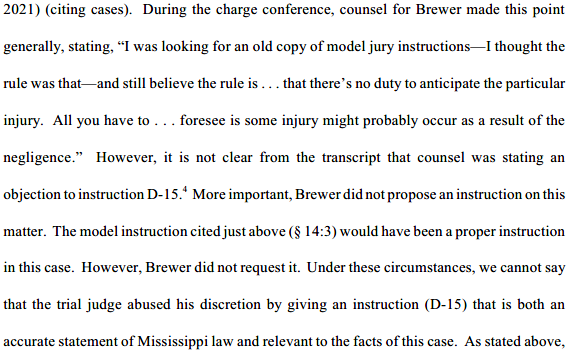
Affirming and part and reversing in part a conviction for burglary and automobile theft, holding that the conviction of burglary was supported by sufficient evidence and was not against the overwhelming weight of the evidence but reversing the conviction for auto theft because the jury was not properly instructed as to the value of the stolen vehicle. The case was remanded for retrial on the auto theft count.
(10-0)
Brock v. State, 2021-KA-00739-COA (Criminal – Felony)
Affirming conviction of possession of methamphetamine, holding that even if the defendant could prove that her counsel was ineffective she had not proven that but for such professional errors the result would have been different.
(10-0)
Guinn v. Claiborne, 2021-CP-00997-COA (Civil – Domestic Relations)
Affirming the chancellor’s decision denying husband’s amended complaint for divorce, holding that the chancellor did not commit clear error in determining that the husband had failed to prove the elements for a divorce based on adultery or irreconcilable differences.
(10-0)
W.C. v. J.C., 2021-CA-00237-COA (Civil – Other)
Affirming chancellor’s decision setting aside an agreed order of involuntary commitment and dismissing the action after treatment was completed, holding (1) the agreed order was properly dismissed because the motion to set aside was not untimely, (2) the chancery court did not abuse its discretion in determining that the terms of the order had been substantively complied with, (3) evidence from an professional organization monitoring the treatment for professional licensure was admissible, (4) the chancellor did not err in ruling that the petitioner had no standing to object to the motion to set aside the agreed order, and (5) there was no ground for the chancellor to convene a hearing to “protect the interests of the minor children.”
(9-1-0: Judge Wilson concurred in result only without separate written opinion.)
Smith v. State, 2021-CP-00915-COA (Civil – PCR)
Affirming the circuit court’s dismissal of a PCR motion, holding that the plaintiff did not prove an exception to the statute of limitations, that the sentence was not illegal, and that the indictment was not defective.
(8-2: Judge McCarty and Judge Emfinger concurred in part and in the result without separate written opinion.)
German v. State, 2021-KA-00933-COA (Criminal – Felony)
Affirming conviction of aggravated assault, holding that the circuit court’s finding that the defendant was sane when the crime was committed was supported by substantial evidence and the jury’s finding was not against the overwhelming weight of the evidence, and that the defendant waived issues related to the reliability of a medical expert’s testimony by failing to object at trial.
(9-0: Judge Westbrooks did not participate.)
Moss v. Moss, 2021-CA-00452-COA (Civil – Domestic Relations)
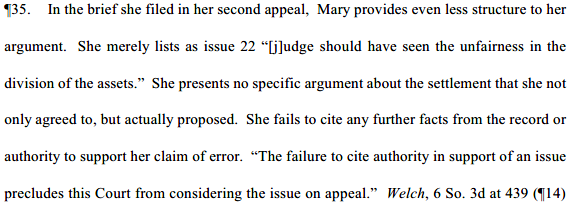
Affirming the chancellor’s decision granting the wife divorce on the ground of habitual cruel and inhuman treatment, holding that there was substantial evidence to support that finding (read the facts for yourself if you have doubts), that the subject matter of wife’s expert’s opinions was adequately disclosed and was not even a basis for the chancellor’s decision, and the husband’s claim for separate maintenance was moot since the divorce was affirmed.
(10-0)
St. Andrie v. Singing River Health System, 2021-CA-00042-COA (Civil – Medical Malpractice/MTCA)
Reversing the circuit court’s grant of summary judgment dismissing the plaintiff’s independent negligence claim against the hospital on statute of limitations grounds, holding that the plaintiff’s claim that the hospital failed to protect the plaintiff from the doctor’s negligence arose out of the same conduct, transaction, or occurrence as the doctor’s negligence and therefore the independent negligence claims against the hospital related back to the date of the original complaint that asserted an independent negligence claim against the doctor and a vicarious liability claim against the hospital.
(7-2-0: Judge Greenlee concurred in result only, joined by Judge Emfinger and joined in part by Judge McDonald and Judge McCarty; Judge Lawrence did not participate.)
Phillips v. City of Oxford, 2021-CA-00639-COA (Civil – Personal Injury/MTCA)
Reversing the circuit court’s finding after a bench trial that the City was protected by police-protection immunity after an officer’s vehicle crossed an intersection against a red light and struck the plaintiff’s vehicle while the officer was responding to an emergency, holding that the facts of this case met the “exceptional circumstances” requirement for finding reckless disregard and that the officer acted with conscious indifference to the safety of the public and the certain parts of the police chief’s testimony were not credible.
( 5-4: Judge Lawrence dissented, joined by Judge Wilson, Judge Smith, and Judge Emfinger; Judge Greenlee did not participate.)
NOTE– The Court of Appeals declined the appellant’s invitation to adopt a “reckless disregard per se” rule and maintained the totality-of-the-circumstances analysis.
Other Orders
Ellis v. State, 2020-CP-00770-COA (denying rehearing)
Camphor v. State, 2021-CP-00048-COA (denying rehearing)
 Mississippi Appeals Blog