The Mississippi Supreme Court handed down four opinions today. Three are direct criminal appeals and one is an interlocutory appeal of a tort suit that a litigant filed against counsel for the opposing party. One of the criminal cases was taken up so the Supreme Court could address for the first time the issue of whether the crime of attempted murder requires an “overt act” under the amended 97-1-7. The Supreme Court also granted cert in a child custody modification case.
Anderson v. State, 2022-KA-00530-SCT (Criminal – Felony) Affirming conviction of first-degree murder and life sentence, holding that the trial court did not err in refusing a heat-of-passion instruction or in allowing the defendant’s confession to be presented to the jury, and that the verdict was supported by sufficient evidence and not against the overwhelming weight of it. (9-0)
Beale v. State, 2020-CT-00614-SCT (Criminal – Felony) Affirming conviction of attempted murder on cert, holding that the indictment correctly stated the necessary elements of the crime and that two jury instructions did not constructively amend the indictment. (6-3: King dissented, joined by Kitchens and Coleman.)
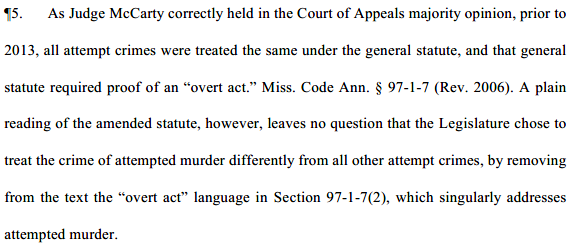
NOTE – The Mississippi Supreme Court granted cert to address for the first time the issue of whether the crime of attempted murder requires an “overt act” under the amended Miss. Code Ann. § 97-1-7:
Henley, Lotterhos & Henley, PLLC v. Bryant, 2021-IA-00994-SCT (Civil – Torts) Reversing the circuit court’s denial of a law firm’s motion to dismiss/summary judgment in a lawsuit asserting a slew of intentional torts stemming from the handing of a subrogation claim, holding that attorneys do not owe duties to adverse parties that can give rise to tort liability and remanding for litigation of the claims against the insurance company. (5-2-1: Randolph and Griffis concurred in result only without separate written opinion; King dissented; Kitchens did not participate.)
Spiers v. State, 2022-KA-00038-SCT (Criminal – Felony) Affirming conviction of burglary of a dwelling and attempted sexual battery, holding that the defendant waived the issue of whether the trial court erred by granting a jury instruction requiring the defendant to prove consent by clear and convincing evidence and that the plain error doctrine did not apply, that the defendant failed to establish a case of ineffective assistance as to the instruction, and that the trial court did not commit plain error with regard to alleged prosecutorial misconduct during closing. (5-1-3: Maxwell concurred in part and in result without separate written opinion; King dissented, joined by Kitchens and Coleman)
Other Orders
Price v. State, 2019-CT–01890-SCT (denying cert)
Blagodirova v. Schrock, 2020-CT-01162-SCT (granting cert) (You can read my summary of the 4-2-4 COA decision by clicking here.)
Davis v. Davis, 2020-CA-01304-SCT (denying rehearing)
Bowman v. State, 2020-CT-01371-COA (denying cert)
Tennesen v. City of Hattiesburg, 2021-CT-00137-SCT (denying cert)
The Mississippi Court of Appeals handed down nine opinions today. Today’s offerings include a divorce case, a DUI/marijuana case, a personal injury case, a malicious mischief case, a jurisdiction case with Rule 54(b) claiming more victims, and a handful of PCR cases.
Camphor v. State, 2021-CP-00048-COA (Civil – PCR) Affirming denial of PCR motion asserting ineffective assistance of counsel, holding that the circuit court’s decision was not clearly erroneous. (All judges concurred.)
Powell v. Nationstar Mortgage LLC, 2021-CA-00055-COA (Civil – Real Property/Appellate Jurisdiction/Rule 54(b)) Dismissing appeal of the chancery court’s order dismissing the debtor’s complaint with prejudice and granting the lender’s counterclaim seeking to proceed with a judicial foreclosure, holding that (1) because the counterclaim for judicial foreclosure was still pending the chancery court’s order did not adjudicate all claims against all parties and (2) the chancery court’s order did not contain the certification required by Rule 54(b). (All judges concurred.)
Klis v. State, 2021-CA-00349-COA (Civil – PCR) Affirming the circuit court’s denial of the PCR motion, holding that the circuit court did not err in determining that the motion was time-barred and that his ineffective-assistance of counsel claim did not provide an exception to the bar. (Judge Smith did not participate.)
Short v. State, 2021-KA-00499-COA (Criminal – Felony/Jury Instructions) Affirming conviction of malicious mischief, holding that a jury instruction setting forth the elements of malicious mischief did not constructively amend the indictment because the record failed to show the alleged variance and, in light of the lack of objection by the defendant at trial, there was no plain error by the circuit judge. (All judges concurred.)
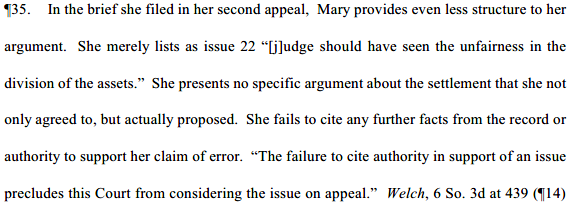
Montgomery v. Montgomery, 2020-CP-01135-COA (Civil – Domestic Relations/Divorce/Habitual Cruel and Inhuman Treatment) Affirming the chancery court’s judgment of divorce and final judgment regarding division of property and other financial matters, holding that the chancery court did not err in granting the husband a divorce on the ground of habitual cruel and inhuman treatment which included throwing items, death threats, and behavior that caused the wife’s family to try to get her to seek medical or psychiatric help. Regarding division of property, the Court of Appeals held that the chancery court did not err in dividing the property as the parties had agreed to. The Court of Appeals handled this case graciously, but appropriately noted that the pro se appellant had “waived consideration of the issues she raises on appeal.” (All judges concurred.)
NOTE – Hiring an attorney to handle your appeal is generally a good idea. Relatedly, if you can’t find one to take your case, it might be a sign. The appellant in this case represented herself and it did not go well. For example:
Frost v. State, 2021-CA-00152-COA (Civil – PCR) Affirming the circuit court’s denial of the plaintiff’s petition for expungement, holding that the circuit court did not err in ruling that it had no jurisdiction. (Judge Wilson and Judge Emfinger concurred in part and in result without separate written opinion. Judge Smith did not participate.)
Pipkin v. State, 2021-CA-00517-COA (Civil – PCR) Affirming the circuit court’s denial of the plaintiff’s second motion for PCR, holding that the plaintiff failed to show that he had a procedurally-viable claim or an applicable exception to the procedural bar. (Judge Wilson and Judge Lawrence concurred in part and in the result without separate written opinion)
Borsi v. State, 2021-KM-00643-COA (Criminal – Misdemeanor/DUI/Marijuana) Affirming a conviction of DUI of marijuana, holding that the roadblock that led to the defendant’s arrest was for a proper purpose and conducted consistent with MHP’s general practice so there was no Fourth Amendment violation, that the defendant was not under custodial interrogation when he admitted to smoking marijuana so there was no Miranda violation, that the law was properly applied based upon “influence” rather than “impairment,” and that the trial court (in a bench trial) properly relied upon witness testimony and the evidence presented at trial. The defendant did not leave empty-handed, as the Court of Appeals reversed the assessment of an $85.00 transfer fee by the circuit clerk. (Chief JUdge Barnes and Judge Wilson concurred in part and in the result without separate written opinion.)
NOTE – This is the second opinion in the last few weeks where the defendant argued that he might have partaken of marijuana, but he was not impaired by it. And it is the second opinion where the Court of Appeals has held that “influence” is not synonymous with “impairment” in this context. (The other opinion was Briggs v. State summarized here.)
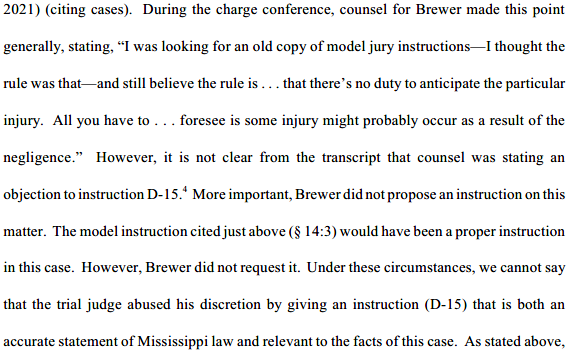
Brewer v. Bush, 2020-CA-00214-COA (Civil – Personal Injury/Jury Instructions) Affirming a defense verdict in a personal injury lawsuit where the plaintiff was helping the defendant put up a barbed wire fence and a bungee cord snapped and struck the plaintiff in the eye, holding that (1) a rational jury could have found that there was no master-servant relationship or that the tools provided were reasonably safe and that the defendant did not breach any duty owed to the plaintiff, (2) the jury was fairly instructed on the issue of proximate causation, (3) the trial judge did not abuse his discretion by giving the defendant’s instruction on “simple tools,” (4) submitting four verdict forms was not reversible error, and (5) the fact that defendant offered fifteen instructions did not result in prejudice to the plaintiff. (All judges concurred.)
Practice Point – Fight jury instructions with jury instructions. If you don’t like something about opposing counsel’s jury instructions, propose one that fixes it:
Other Orders
Ladner v. State, 2020-KA-00299-COA (denying rehearing) Denham v. Denham, 2020-CA-00675-COA (denying rehearing) Dew v. Harris, 2020-CA-01261-COA (denying rehearing) Miller v. State, 2021-TS-01412-COA (denying motion to reinstate appeal) Nelson v. State, 2022-TS-00413-COA (denying appellant’s motion to stay appeal and dismissing appeal without prejudice for lack of final judgment
The Mississippi Court of Appeals dropped eight nine opinions today and there is a lot to sort through. Two divorce cases (one involving equitable distribution of a marital residence and the other a life estate via constructive trust for a mother-in-law), a PCR case, a workers’ comp case involving medical causation, an adverse possession/tax sale case, a personal injury via falling through a roof case, an appeal of an estate case dismissed for lack of final order, and two criminal cases. One of the criminal cases is the second “should the indictment for attempt have alleged an overt act” case we have gotten in a row and it sees a dissenting Judge Westbrooks align herself with Justice Coleman’s dissent last week.
I am always balancing the desire to post these summaries quickly and the need to get back to paying work with the desire to provide a reasonably polished [free] product. Due to the number of cases and the fact that I have to leave the office a little early to coach a little league baseball game, there is extra weight on the “speed” side of the balance today. Thanks, Management
Archie v. Archie, 2020-CA-01370-COA (Civil – Domestic Relations/Equitable Distribution/Marital Residence) Affirming the chancellor’s modification of a final judgment of divorce as to equitable distribution of the marital residence, holding that there was no error in the chancellor ordering the ex-wife to sell the paid-off martial home in order to satisfy the ex-wife’s obligation to pay her ex-husband his share of the equity where the ex-wife had been unable to secure a loan on the paid-off house, even though the ex-husband had not pleaded a request for an order requiring the ex-wife to sell the residence. The court repeatedly noted that the chancellor had broad discretion to “fashion an equitable remedy” and held that the chancellor’s remedy here was appropriate. (Judge Wilson concurred in part and the in the result without separate written opinion.)
Bevalaque v. State, 2021-CP-00150-COA (Civil – PCR) Affirming dismissal of a pro se plaintiff’s third PCR motion, holding that the motion was time-barred and successive-writ barred and that no exceptions applied. (All judges concurred.)
Bowdry v. City of Tupelo, 2021-WC-00390-COA (Civil – Workers’ Compensation/Medical Causation) Affirming the MWCC’s finding that the claimant’s neck claim was not related to his compensable work-injury, holding that the Commission’s finding that the claimant failed to prove causation was supported by substantial evidence. (All judges concurred.)
PRACTICE POINT: The Court of Appeals noted that on appeal they do not review the AJ’s findings, but the Commission’s findings and did not address the claimant’s arguments about the AJ’s findings:
This is because the Commission does not function as an appellate court reviewing the AJs’ findings. This is because the Commission, not the AJ, is the ultimate trier and finder of fact for workers’ comp claims. See, e.g., Hugh Dancy Co. Inc. v. Mooneyham, 68 So. 3d 76 (Miss. Ct. App. 2011)
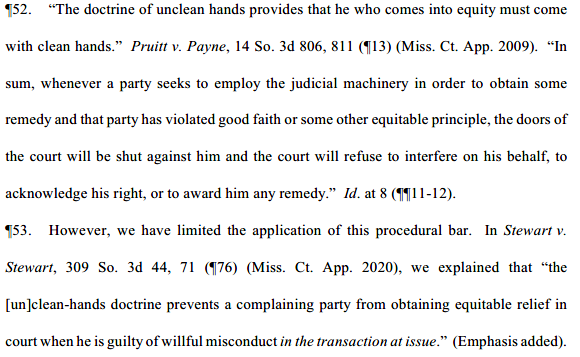
Anderson v. Jackson, 2019-CA-01773-COA (Civil – Real Property/Adverse Possession/Unclean Hands/Tax Sale) Reversing the chancellor’s findings granting title of real property to one party (Levon) based on findings that Levon had obtained title by adverse possession or by tax sale and that the opposing party (Rosie) had unclean hands, holding that the chancellor erred in granting title to Levon because he failed to prove the elements of adverse possession by clear and convincing evidence, that the tax sale was void due to flawed notice of redemption, and that the doctrine of unclean hands was erroneously applied to bar Rosie’s challenge because Rosie’s conduct was related to a forty-year-old estate case, not the transaction at issue. (All judges concurred.)
Since accusations of “unclean hands” get thrown around in litigation on occasion, I thought this summary of the equitable doctrine of unclean hands is a useful refresher:
NOTE – As always, but only more so here, if this case applies to your practice you need to read it yourself. There are many details in this forty-page opinion that I have not even attempted to tease apart.
Herron v. Herron, 2021-CA-00090-COA (Civil – Domestic Relations/Constructive Trust/Property Valuation) Affirming the chancellor’s findings in a divorce action granting a life estate via constructive trust in a home on the marital property to the ex-wife’s mother in assigning value to property awarded to the ex-husband, holding that there was clear and convincing proof that the house was intended to be owned by the mother in a life estate and that there was substantial credible evidence supporting the chancellor’s valuations of the personal property in question. (All judges concurred.)
Gillespie v. Lamey, 2021-CA-00076-COA (Civil – Personal Injury/Summary Judgment/Duty to Warn) Affirming summary judgment in favor of a defendant dismissing the plaintiff’s claim for personal injuries sustained when the plaintiff fell through a roof while working on a skylight on the defendant’s property, holding that (1) the plaintiff presented no evidence that the defendant failed to warn the plaintiff of any dangerous condition of which the defendant had actual or constructive knowledge and (2) the allegedly dangerous condition was “intimately connected” to the work he was hired to do. (Judge Smith did not participate, all other judges concurred.)
Smith v. Richmond, 2020-CP-01064-COA (Civil – Wills, Trusts, and Estates/Civil Procedure) Dismissing the appeal, holding that the pro se appellant’s attempted appeal of the chancery court’s denial of a Rule 60(b) motion to set aside an interim order, a motion to recuse, and a “motion to change jurisdiction” must be dismissed because each of these motions was an interlocutory order not appealable as of right. (All judges concurred.)
Wayne v. State, 2021-KA-00084-COA (Criminal – Felony/Rebuttal Evidence/Sufficiency and Weight of Evidence) Affirming murder conviction, holding that there was no error (1) in allowing the State to recall a State’s witness and introduce and play the defendant’s recorded statement in rebuttal because the recorded statement contradicted the defendant’s trial testimony, (2) in introducing the defendant’s entire statement because it was proper impeachment evidence, or (3) in denying the defendant’s post-trial motion because the evidence was sufficient to support the conviction and that the conviction was not against the weight of the evidence. (All judges concurred.)
Beale v. State, 2020-KA-00614-COA (Criminal – Felony/Overt Act) Affirming conviction two counts of attempted murder of two police officers, holding (1) an indictment for the crime of attempted murder does not require the description of an overt act, (2) that two jury instructions did not constitute a constructive amendment to the indictment, and (3) testimony from an officer about what a witness told him at the crime scene was not hearsay because they were not offered to prove the truth of the matter asserted but to explain the next steps in the course of his investigation. (Judge Westbrooks dissented, joined in part by Judge McDonald. Judge McDonald concurred in part and dissented in part without separate written opinion. Judge Emfinger concurred in part and in the result without separate written opinion. Judge Wilson concurred in result only without separate written opinion. All other judges concurred.)
NOTE – We have gotten an “is the indictment missing an alleged overt act” case in back-to-back hand-down days. In her dissent, Judge Westbrooks’s argues that she is taking a position consistent with the position that Justice Coleman took just last week in Brady v. State (my post here) (opinion link here).
Other Opinions
Durrant Inc. v. Lee County, Mississippi, 2019-CA-01826-COA (denying motion for rehearing) Bell v. State, 2020-CT-00592-COA (denying motion for rehearing)