Mississippi Court of Appeals Decisions of June 14, 2022

The Mississippi Court of Appeals handed down two opinions today. One addresses a custody award against a backdrop of abuse. The other case involves a remainderman’s claim for damages for timber that was clear cut by the holder of a life estate.


Taylor v. Mississippi Department of Child Protective Services, 2020-CA-01194-COA (Civil – Custody)
Affirming the youth court’s decision awarding durable legal custody of a child to his paternal grandparents, holding that the youth court complied with section 43-21-557(1)(c) and (e) and did not err in bypassing reunification between the mother and her children where there was proof of abuse.
(Judge Westbrooks concurred in the result only without separate written opinion.)


Breeland v. Turnage, 2021-CA-00698-COA (Civil – Real Property)
Affirming the chancery court’s decision awarding the remainderman damages for timer that was cut from the property by the holder of a life estate, holding that the plaintiff had standing because he owned the land at the time of the lawsuit and his subsequent sale of the land did not disturb standing, that the landowner was entitled to collect damages for the profit obtained by devaluing his interested in the property via clear cut, and that the chancellor did not err in refusing to admit testimony about a witness’s prior conviction because the appellant did not argue any of the exceptions to Rule 404 to the trial court.
(Judge Wilson concurred in part and in the result without separate written opinion. Judge Carlton did not participate.)


Other Orders

Nowell v. Stewart, 2020-CA-00728-COA (denying rehearing)

Kreppner v. Kreppner, 2021-CA-00006-COA (denying rehearing)


Hand Down List

Mississippi Supreme Court Decisions of June 9, 2022

The Mississippi Supreme Court handed down six opinions today. Topics include public project bidding, summary judgment in a property damage case, conversion by the owner of a collection agency, an appeal of a post summary judgment decision granting a Rule 60(b) motion based on fraud, a unanimous pro se PCR appeal win, and an election contest.


The Mississippi State Port Authority at Gulfport v. Eutaw Construction Company, Inc., 2020-IA-00881-SCT (Civil – State Boards and Agencies)
Reversing the circuit court’s decision that reversed the MSPA’s award of a project to the lowest bidder whose bid contained multiple errors and awarded the project to the second lowest bidder, holding that the lowest bidder’s errors were minor, the intended correct bid was evident on the face of the bid, and the corrected bid by the lowest bidder was a decrease in price.
(All justices concurred.)


Hardin v. Town of Leakesville, Mississippi, 2020-CA-01164-SCT (Civil – Property Damages/Summary Judgment/Proximate Cause)
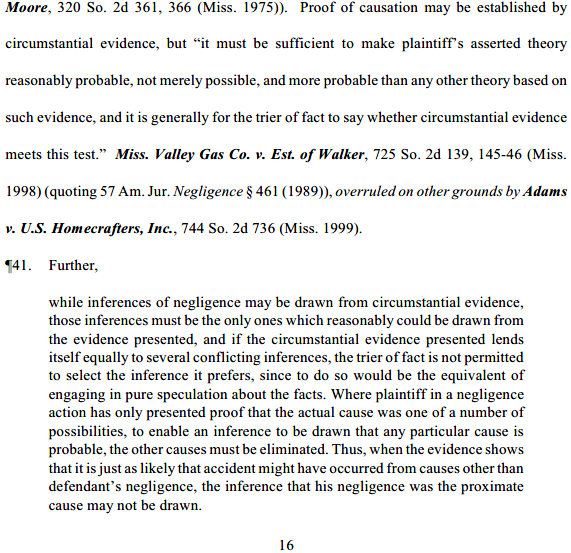
Affirming summary judgment in favor of Leakesville, holding that the plaintiff failed to present sufficient evidence that water that had accumulated under her house was caused by an act or omission attributable to the town.
(All justices concurred.)

Practice Point – This opinion contains a helpful discussion of the exacting standard that applies when a plaintiff seeks to prove causation by circumstantial evidence:


McGee v. Comprehensive Radiology Services, PLLC, 2021-CA-00666-SCT (Civil – Torts/Conversion/Fraud)
Affirming the chancellor’s finding that the president of a collections agency was individually and personally liable for $785,549.71 that she directed her company to delay remitting to a radiology group while also billing for and receiving commissions for collecting that money, holding that while the tort of conversion cannot be used to recover a mere debt it can be used to recover identifiable money belonging to the plaintiff which is what occurred here.
(All justices concurred.)


Riverboat Corporation of Mississippi v. Davis, 2020-IA-01244-SCT (Civil – Personal Injury/Negligence/Rule 60(b))
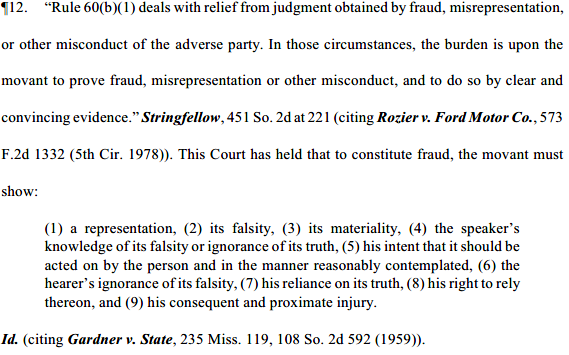
The circuit court granted summary judgment in favor the casino in a personal injury case stemming from a fall from a casino chair due to the lack of evidence that the casino breached a duty. The plaintiff then filed a motion to reopen the case under Rule 60(b)(1) alleging that the defendant committed fraud in its 30(b)(6) deposition based upon information the plaintiff discovered in an unrelated case about another chair at the casino. The circuit court granted the motion to reopen based on fraud and the defendant petitioned for interloc which the Supreme Court granted. On appeal, the Supreme Court held that the trial court abused its discretion because the plaintiff “fell far short of satisfying all of the elements of fraud” and because this case did not present the requisite “exceptional circumstances” for relief under Rule 60(b).
(All justices concurred.)

Practice Point – This opinion has a helpful summary of what is required to prove fraud under Rule 60(b)(1):


Magee v. State, 2019-CT-01794-SCT (Civil – PCR/Involuntary Guilty Plea)
Reversing the circuit court’s denial of the plaintiff’s pro se PCR motion, holding that the circuit court granted an evidentiary hearing but failed to address the issue of whether the plaintiff’s guilty plead was involuntary because the plaintiff was affirmatively misinformed about the possibility of early release by his trial attorney and failed to allow the plaintiff to call witnesses or present evidence.
(Chief Justice Randolph did not participate.)


Meredith v. Clarksdale Democratic Executive Committee, 2021-EC-00305-SCT (Civil – Election Contest)
Affirming the trial court’s decision agreeing with the CDEC’s decision that a mayoral candidate resided at a lake house outside of the city limits rather than a funeral home apartment within the city limits, holding that the would-be candidate failed to prove by “absolute proof” that he met the residency requirement on or before the applicable deadline.
(Justice Coleman concurred in part and in the result) (“It is not in the court’s bailiwick to impose its judgment for that of the Legislature.”)


Other Orders

Hutto v. State, 2017-DR-01207-SCT (granting response to order granting motion for appointment of counsel for representation for successive petition for post-conviction relief filed by the Circuit Court of Hinds County)

Havard v. State, 2018-CA-01709-SCT (granting motion to file motion for attorney fees and expenses under seal)

Walker v. State, 2020-CT-00228-SCT (denying cert)

McLemore v. State, 2016-M-00364 (denying application for leave to proceed in the trial court with a warning against future frivolous filings)


Hand Down List

Mississippi Court of Appeals Decisions of June 7, 2022

A deposition took me out of blogging service for most of the afternoon, so a little later than usual I give you summaries of the nine opinions handed down by the Mississippi Court of Appeals. These opinions cover the statute of frauds, trusts, appellate jurisdiction, youth court, authentication of text messages, equitable division and alimony in a divorce case, workers’ comp, PCR, and more.


SEL Business Services, LLC v. Lord, 2021-CA-00368-COA (Civil – Real Property/Statute of Frauds)
Affirming the chancery court’s dismissal of a suit to reclaim property or alternatively for unjust enrichment, holding that a “handshake deal” for the purchase of a building that was sold before that deal came to fruition was subject to the statute of frauds, that the statute of frauds was not satisfied, and that the equitable remedy of unjust enrichment was therefore unavailable.
(All judges concurred.)


Lennon v. Lowrey & Fortner, P.A., 2021-CA-00426-COA (Civil – Wills, Trusts & Estates/Appellate Procedure/Appellate Jurisdiction)
Granting a motion to dismiss an appeal for lack of jurisdiction in a case of first impression, holding that the 30-day time period for perfecting an appeal began to run upon the entry of an order adjudicating a claim for attorney’s fees against a trust–not the final judgment terminating the trust.
(All judges concurred.)


Smith v. Adams County Youth Court, 2021-CP-00196-COA (Civil – Juvenile Justice)
Dismissing an appeal of the denial of a minor’s post-disposition motion for modification arguing that his guilty plea was the result of ineffective assistance of counsel, holding that the notice of appeal was prematurely filed because the youth court had not been given an opportunity to consider these arguments and any supporting evidence.
(Judge Wilson concurred in result only without separate written opinion.)


Warner v. Warner, 2020-CA-01098-COA (Civil – Domestic Relations/Divorce/Valuation/Equitable Division/Alimony/Contempt)
Reversing the chancellor’s judgment in a divorce case, holding that the chancellor erred in valuation and equitable division of marital assets, in the award of alimony, and in finding the ex-husband in contempt and awarding attorney’s fees as a result.
(Judge Wilson concurred in part and in the result without separate written opinion.)

Simpson v. State, 2021-KA-00075-COA (Civil – Felony/Authentication)
Affirming convictions of two counts of first-degree murder, first-degree arson, and possession of a deadly weapon by a felon, holding that there was no plain error with regard to the authentication of text messages and that there was no merit to the claim of ineffective assistance for not objecting to the properly-authenticated text messages.
(Judge Emfinger did not participate.)


Carson v. State, 2021-KA-00436-COA (Criminal – Felony/Weight and Sufficiency)
Affirming conviction of possession of cocaine, holding that the circuit court did not err in denying a motion for new trial challenging the weight and sufficiency of the evidence and finding no merit to the defendant’s pro se arguments that his rights under the Fourth Amendment and the Confrontation Clause were violated, that the State’s case hinged on “racial profiling,” that he had ineffective assistance of counsel, and that the circuit judge failed to comply with Sharplin.
(All judges concurred.)


Ellis v. State, 2020-CP-00770-COA (Civil – PCR)
Affirming the circuit court’s denial of the plaintiff’s PCR motion, holding that the motion was time-barred and that the plaintiff failed to raise any claims resulting in the deprivation of his fundamental constitutional rights that would defeat the time bar.
(Judge Wilson and Judge Emfinger concurred in part and in the result without separate written opinion. Judge McDonald concurred in the result only without separate written opinion.)


Reardon v. State, 2020-CP-01259-COA (Civil – PCR)
Affirming the circuit court’s denial of the plaintiff’s PCR motion, holding that the motion was procedurally barred and that his claims of ineffective assistance of counsel, deprivation of fundamental rights, and failure to recuse were without merit.
(Chief Judge Barnes and Judge Wilson concurred in part and in the result without separate written opinion. Judge McDonald concurred in the result only without separate written opinion. Judge Greenlee and Judge McCarty did not participate.)


Duren v. Effex Management Solutions, LLC, 2021-WC-00337-COA (Civil – Workers’ Compensation)
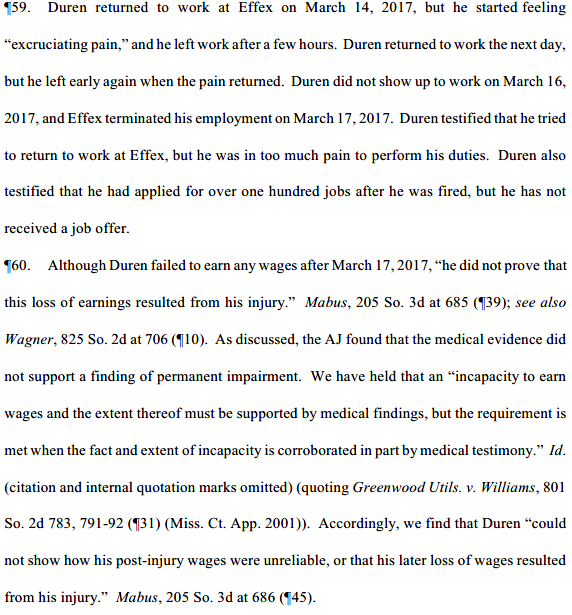
Affirming the Commission’s ruling, holding that there was substantial evidence to support the Commission’s decision that the claimant failed to prove that he suffered a permanent disability and the decision to award TTD through the date of MMI, but denying post-MMI medical treatment, prescription, and mileage reimbursements.
(Judge Wilson concurred in part and in the result without separate written opinion. Judge Westbrooks and Judge McDonald concurred in the result only without separate written opinion.)

DEEPER DIVE: This case had an interesting post-MMI fact pattern where the claimant was released to return to work without restrictions, was offered to return to work for the Employer at his pre-injury wages, and returned to work there, but then quit working for the Employer due to complaints of pain. Under these facts, the Court of Appeals noted that there was a presumption of no loss of wage-earning capacity and held that the claimant did not overcome it:


Other Orders

Hammer v. State, 2019-KA-01633-COA (denying rehearing)
Shannon v. Shannon, 2020-CA-00847-COA (denying rehearing)


Hand Down List

Mississippi Court of Appeals Decisions of May 31, 2022

The Mississippi Court of Appeals handed down five opinions today. Topics include the fate of a living trust that included a languishing cattle farm, unemployment benefits, alleged bolstering of the testimony of a minor who was the victim of sexual battery, alleged MDEQ violations by a lessee, and a PCR motion.


Stapp v. Stapp, 2020-CA-01282-COA (Civil – Wills, Trusts, and Estates)
Affirming the chancery court’s rulings in an action asking the court to divide the corpus of a living trust or, in the alternative, to make a distribution to the beneficiaries, holding that the chancellor did not err in (1) requiring that all the farm equipment be auctioned because the beneficiaries were not able to run the farm at issue and the farm had not been profitable since their father’s death, (2) requiring $50,000 to be maintained in an account for unforeseen expenses since real property remained in the trust, (3) not requiring one beneficiary to reimburse the trust for rent and utilities during her occupancy of the farmhouse in the trust and allowing her to live there indefinitely, or (4) not requiring one beneficiary to reimburse the trust for funds she received from cattle sales and not requiring the trust to reimburse the other beneficiary for expenses allegedly incurred for management of the cattle.
(Judge McCarty dissented, arguing that since the documents creating the trusts were not in the record, the trial court modified two trusts without having the terms of the trust or knowing the settlor’s intent.)


Mitchell v. Mississippi Department of Employment Security, 2021-CC-00794-COA (Civil – State Boards and Agencies/MDES)
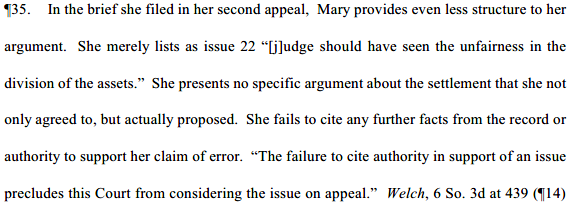
Affirming the denial of unemployment benefits, holding that there was substantial evidence to support the ALJ’s determination that the claimant’s work-search requirement was not satisfied and declining to review other arguments that were not supported by citations to any authority.
(Judge Westbrooks concurred in part and in the result without separate written opinion.)

Note – I understand why appellate courts often handle arguments not supported by citations to authority by stating that they are waived, but then analyzing them anyway and explaining that they are meritless. In this case, it was refreshing to see the Court of Appeals simply hold that the arguments were waived and leave it at that.


Trotter v. State, 2020-CA-00094-COA (Civil – PCR)
Affirming the circuit court’s denial of the plaintiff’s PCR motion, holding that the circuit court did not err in finding that the plaintiff failed to prove his ineffective assistance of counsel claim and that the circuit court did not abuse its discretion in denying the plaintiff’s request to be resentenced to life without the possibility of parole.
(Judge Wilson concurred in part and in the result without separate written opinion; Judge McCarty concurred in result only without separate written opinion.)


Blocton v. State, 2021-KA-00197-COA (Criminal – Felony/Sexual Battery)
Affirming a conviction of sexual battery of a small child, holding (1) the circuit court did not abuse its discretion in allowing the victim’s foster mother, the forensic interviewer, and an investigator to testify about what the victim disclosed to them over the defendant’s argument that this testimony improperly bolstered the victim’s testimony and (2) the circuit court did not commit plain error in allowing the investigator to testify and that there was no merit to the defendant’s claim that his lawyer rendered constitutionally ineffective assistance.
(Judge McCarty concurred in part and in the result without separate written opinion. Judge Smith did not participate.)


Biloxi Dock & Ice, LLC v. Back Bay Fuel and Ice, LLC,  2021-CA-00701-COA (Civil – Contract/Lease)
Affirming the circuit court’s decision upholding the county court’s findings in a case arising out of a lease dispute, holding that the county court, as fact-finder, had sufficient evidence to conclude that the purchaser/landowner failed to establish that the lessee had violated MDEQ regulations that would render the lessee in default of the lease.
(All participating judges concurred.)

NOTE – A lessor in this case was named Lesso. Lesso was sometimes referred to as Lessor in the opinion. Had Lesso been the lessee we could have met calamity.


Other Orders

Lambes v. Lambes, 2020-CA-00095-COA (denying rehearing)


Hand Down List

Mississippi Court of Appeals Decisions of May 24, 2022

The Mississippi Court of Appeals handed down nine opinions today. Today’s offerings include a divorce case, a DUI/marijuana case, a personal injury case, a malicious mischief case, a jurisdiction case with Rule 54(b) claiming more victims, and a handful of PCR cases.


Camphor v. State, 2021-CP-00048-COA (Civil – PCR)
Affirming denial of PCR motion asserting ineffective assistance of counsel, holding that the circuit court’s decision was not clearly erroneous.
(All judges concurred.)


Powell v. Nationstar Mortgage LLC, 2021-CA-00055-COA (Civil – Real Property/Appellate Jurisdiction/Rule 54(b))
Dismissing appeal of the chancery court’s order dismissing the debtor’s complaint with prejudice and granting the lender’s counterclaim seeking to proceed with a judicial foreclosure, holding that (1) because the counterclaim for judicial foreclosure was still pending the chancery court’s order did not adjudicate all claims against all parties and (2) the chancery court’s order did not contain the certification required by Rule 54(b).
(All judges concurred.)


Klis v. State, 2021-CA-00349-COA (Civil – PCR)
Affirming the circuit court’s denial of the PCR motion, holding that the circuit court did not err in determining that the motion was time-barred and that his ineffective-assistance of counsel claim did not provide an exception to the bar.
(Judge Smith did not participate.)


Short v. State, 2021-KA-00499-COA (Criminal – Felony/Jury Instructions)
Affirming conviction of malicious mischief, holding that a jury instruction setting forth the elements of malicious mischief did not constructively amend the indictment because the record failed to show the alleged variance and, in light of the lack of objection by the defendant at trial, there was no plain error by the circuit judge.
(All judges concurred.)


Montgomery v. Montgomery, 2020-CP-01135-COA (Civil – Domestic Relations/Divorce/Habitual Cruel and Inhuman Treatment)
Affirming the chancery court’s judgment of divorce and final judgment regarding division of property and other financial matters, holding that the chancery court did not err in granting the husband a divorce on the ground of habitual cruel and inhuman treatment which included throwing items, death threats, and behavior that caused the wife’s family to try to get her to seek medical or psychiatric help. Regarding division of property, the Court of Appeals held that the chancery court did not err in dividing the property as the parties had agreed to. The Court of Appeals handled this case graciously, but appropriately noted that the pro se appellant had “waived consideration of the issues she raises on appeal.”
(All judges concurred.)

NOTE – Hiring an attorney to handle your appeal is generally a good idea. Relatedly, if you can’t find one to take your case, it might be a sign. The appellant in this case represented herself and it did not go well. For example:


Frost v. State, 2021-CA-00152-COA (Civil – PCR)
Affirming the circuit court’s denial of the plaintiff’s petition for expungement, holding that the circuit court did not err in ruling that it had no jurisdiction.
(Judge Wilson and Judge Emfinger concurred in part and in result without separate written opinion. Judge Smith did not participate.)


Pipkin v. State, 2021-CA-00517-COA (Civil – PCR)
Affirming the circuit court’s denial of the plaintiff’s second motion for PCR, holding that the plaintiff failed to show that he had a procedurally-viable claim or an applicable exception to the procedural bar.
(Judge Wilson and Judge Lawrence concurred in part and in the result without separate written opinion)


Borsi v. State, 2021-KM-00643-COA (Criminal – Misdemeanor/DUI/Marijuana)
Affirming a conviction of DUI of marijuana, holding that the roadblock that led to the defendant’s arrest was for a proper purpose and conducted consistent with MHP’s general practice so there was no Fourth Amendment violation, that the defendant was not under custodial interrogation when he admitted to smoking marijuana so there was no Miranda violation, that the law was properly applied based upon “influence” rather than “impairment,” and that the trial court (in a bench trial) properly relied upon witness testimony and the evidence presented at trial. The defendant did not leave empty-handed, as the Court of Appeals reversed the assessment of an $85.00 transfer fee by the circuit clerk.
(Chief JUdge Barnes and Judge Wilson concurred in part and in the result without separate written opinion.)

NOTE – This is the second opinion in the last few weeks where the defendant argued that he might have partaken of marijuana, but he was not impaired by it. And it is the second opinion where the Court of Appeals has held that “influence” is not synonymous with “impairment” in this context. (The other opinion was Briggs v. State summarized here.)


Brewer v. Bush, 2020-CA-00214-COA (Civil – Personal Injury/Jury Instructions)
Affirming a defense verdict in a personal injury lawsuit where the plaintiff was helping the defendant put up a barbed wire fence and a bungee cord snapped and struck the plaintiff in the eye, holding that (1) a rational jury could have found that there was no master-servant relationship or that the tools provided were reasonably safe and that the defendant did not breach any duty owed to the plaintiff, (2) the jury was fairly instructed on the issue of proximate causation, (3) the trial judge did not abuse his discretion by giving the defendant’s instruction on “simple tools,” (4) submitting four verdict forms was not reversible error, and (5) the fact that defendant offered fifteen instructions did not result in prejudice to the plaintiff.
(All judges concurred.)

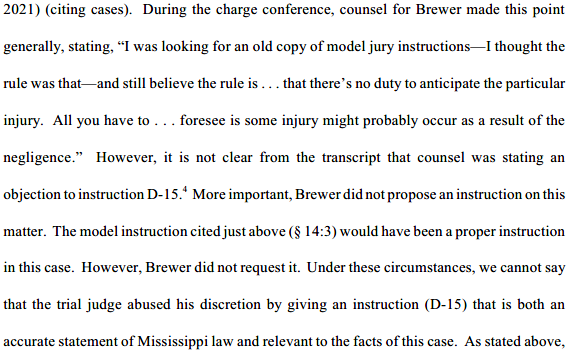
Practice Point – Fight jury instructions with jury instructions. If you don’t like something about opposing counsel’s jury instructions, propose one that fixes it:


Other Orders

Ladner v. State, 2020-KA-00299-COA (denying rehearing)
Denham v. Denham, 2020-CA-00675-COA (denying rehearing)
Dew v. Harris, 2020-CA-01261-COA (denying rehearing)
Miller v. State, 2021-TS-01412-COA (denying motion to reinstate appeal)
Nelson v. State, 2022-TS-00413-COA (denying appellant’s motion to stay appeal and dismissing appeal without prejudice for lack of final judgment


Hand Down List

Mississippi Court of Appeals Decisions of May 17, 2022

The Mississippi Court of Appeals handed down ten opinions today. One is a medical malpractice case that ran afoul of RFAs. There are several criminal appeals, a claim against an estate by a judgment-lien holder, several PRC cases including one with competing opinions on Eighth Amendment issues, and more.


Cunningham v. Mississippi Department of Corrections, 2021-CP-00428-COA (Civil – State Boards and Agencies)
Affirming circuit court’s denial of the plaintiff’s motion for judicial review of two ARP requests against MDOC, holding that the plaintiff failed to provide any documents to support his appeal and that, in any event, the plaintiff received sentencing credit for his pretrial detention.
(All judges concurred.)


Pickle v. State, 2021-CP-00972-COA (Civil – PCR)
Affirming the circuit court’s denial of the plaintiff’s motions for writ of mandamus, alternative sentencing, and a new trial or for JNOV regarding his 1978 conviction of capital murder and life imprisonment, holding that the motion was untimely, successive, and meritless.
(All judges concurred.)


Thompson v. State, 2020-KA-01279-COA (Criminal – Felony)
Affirming a conviction of drive-by-shooting that followed a domestic dispute between the defendant, the defendant’s boyfriend, and the defendant’s boyfriend’s ex-wife. The narrative in the opinion is gripping. In short, it was alleged that an Amber alert was issued for the formerly-married couple’s child when the child was with the defendant and her boyfriend (the child’s father). The couple had a physical altercation with the ex-wife at her work place in the midst of which the defendant instructed the ex-wife to “catch me outside.” Later, the ex-wife apparently inadvertently caught the defendant outside while driving and the defendant shot the ex-wife in the arm. A jury convicted the defendant of one count of drive-by-shooting and the court of appeal affirmed, holding that the conviction was not against the overwhelming weight of the evidence, the circuit court did not err in allowing the circuit clerk to testify as an authenticating witness even though she was present throughout the trial where the defendant’s counsel did not object, the circuit court did not err in refusing the defendant’s proposes “mere suspicion” instruction which would have been cumulative, and the defendant’s counsel was not ineffective.
(All judges concurred.)


Unifund CCR Partners v. Estate of Jordan, 2021-CA-00761-COA (Civil – Wills, Trusts, and Estates/Judgment Liens)
Reversing the chancery court’s ruling that claims against the estate were not timely, holding that the judgment liens against the decedent survive the time-bar of probate and were reasonably ascertainable to the executrices of the estate.
(Chief Judge Barnes and Judge Lawrence concurred in part and in the result without separate written opinion. Judge McDonald concurred in part and dissented in part without separate written opinion. Judge Westbrooks concurred in part and dissented in part, joined by Judge McDonald.)


McLaughlin v. State, 2020-KA-00360-COA (Criminal – Felony)
Affirming conviction of capital murder, third-degree arson, conspiracy, and possession of a firearm by a felon, holding that the evidence was sufficient for each of the convictions, that the defendants was procedurally barred on appeal from raising an alleged Miranda issue and that there was no plain error on this issue, that the circuit court did not err in admitting a photograph of the victim’s brain sitting on the autopsy table to show the bullet path, and that retroactive misjoinder did not apply.
(All judges concurred.)

PRACTICE POINT – Seeking to exclude gruesome photographs of victims in criminal trials is an uphill climb:


Carter v. Total Foot Care, 2021-CA-00610-COA (Civil – Medical Malpractice/Requests for Admissions)
Affirming summary judgment in favor of the defendants based on the plaintiff’s failure to respond to the defendants’ requests for admissions that were deemed admitted, holding that the trial court did not err in deeming the RFAs as admitted–including an admission that the standard of care was not breached–where the plaintiff did not respond until after the defendants filed their MSJ which was more than five months after the RFAs were served. Additionally, the Court of Appeals held that the plaintiff could not rely on responses served in a related federal court proceeding.
(All judges concurred.)

MUSING– My experience is that RFAs are rarely used effectively. In the wild, they usually look like a cartoonish attempt to trick the other side. Something like a deadly CAPTCHA test. I think the best use of RFAs is to whittle down and actually define the contours of disputed issues. And, frankly, RFAs are a way to “shake” a lawsuit that is not being prosecuted and just needs to be dismissed.


Jolly v. State, 2021-KA-00318-COA (Criminal – Felony)
Affirming conviction of four counts of statutory rape, holding that the circuit court did not err in denying the defendant’s motion to suppress his statement to law enforcement because there was no merit to the defendant’s claims that he lacked capacity to voluntarily waive his rights or that he was coerced into waiving his rights and giving a statement.
(Judge Westbrooks concurred in part and in the result without separate written opinion.)


Hood v. A & A Excavating Contractors, Inc., 2021-CA-00207-COA (Civil – Property Damage/Statute of Limitations/Continuing Tort)
Affirming summary judgment dismissing the plaintiffs’ residential flooding claims against a developer and the operator of a gravel pit based on the statute of limitations, holding that the “discovery rule” did not toll the statute of limitations which began to run upon notice of the injury not the cause of the injury and the “continuing tort doctrine” did not apply where there were no “continual unlawful acts” by the defendants.
(McCarty concurred in part and dissented in part, joined by Judge Westbrooks and Judge Lawrence, and joined in part by Judge McDonald and Judge Smith. Judge McDonald dissented without separate written opinion. Judge Emfinger did not participate.)

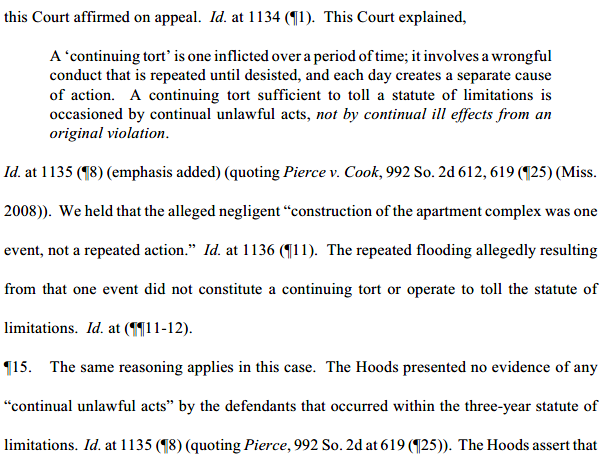
NOTE– I though this was a helpful summary and application of the continuing tort doctrine:


Dortch v. State, 2021-CP-00103-COA (Civil – PCR)
Affirming the circuit court’s dismissal of the plaintiff’s PCR motion and motion to vacate judgment and finding no error in the circuit’s revocation of the plaintiff’s PRS.
(All judges concurred.)


Skinner v. State, 2021-CA-00080-COA (Civil – PCR)
Affirming the circuit court’s denial of the plaintiff’s PCR motion related to the plaintiff’s 2011 conviction of felony evasion and sentence to life without parole as a habitual offender (with eight prior felony convictions), holding that the Eighth Amendment claim is barred by the doctrine of res judicata and without merit and that the circuit court did not err in refusing to consider mitigating circumstances surrounding Skinner’s juvenile convictions.
(Judge McCarty concurred in part and dissented in part. Judge McDonald dissented, joined by Chief Judge Barnes and Judge Westbrook, and joined in part by Judge McCarty. Judge Emfinger did not participate.)

NOTE – The majority and the dissenting opinions contain robust discussions of the Eight Amendment analysis.


Other Order

 Tallent v. State, 2020-CP-01077-COA (denying motion for rehearing)


Hand Down List Page

Mississippi Court of Appeals opinions of May 10, 2022

The Mississippi Court of Appeals set a new record since the launch of this blog by handing down fourteen opinions. After briefly contemplating a dash to the exit, I decided to slog through all of them so you don’t necessarily have to. Needless to say, there is something for everybody today!

(Apologies for the all-but-certain uptick in typos)


Fugler v. Bank of Brookhaven, 2021-CA-00303-COA (Civil – Personal Injury/Premises Liability)
Affirming summary judgment in favor of the defendant in a slip and fall case, holding that the plaintiff, who allegedly tripped on a floor mat but testified she did not see the mat before tripping, failed rebut the defendant’s summary judgment motion and supporting affidavit stating that the bank had no knowledge of prior incidents with its floor mats or any issues with the mat involved, that around 300 customers entered the bank daily and the bank was not aware of any prior mat-related trips or complaints, that the mat was heavy-duty commercial grade and was replaced annually to prevent wear, and that bank employees constantly monitored the floors.
(All judges concurred.)


Keys v. Military Department Gulfport, 2021-WC-00352-COA (Civil – Workers’ Comp)
Reversing the Commission’s finding that the Employer/Carrier was entitled to a credit for indemnity payments that the claimant received but assigned back to the employer during the time the claimant was receiving paid sick leave, holding that since the claimant was awarded permanent total disability benefits, section 25-3-95(2)(b) (prohibiting a state employee from using accrued personal and/or medical leave and receiving workers’ comp to earn more than 100% of his state-employment wages) did not apply.
(Judge Wilson specially concurred, joined in part by Judge McCarty.)

NOTE – I think Judge Wilson’s special concurrence provides a clearer path forward in workers’ comp cases: Regardless of whether the indemnity benefits during the time in question were classified as TTD or PTD, the claimant was entitled to a total of 450 weeks of indemnity benefits (however classified) and since the claimant did not receive any indemnity benefits during the period he was assigning benefits back to the Employer, the Employer/Carrier were not entitled to a credit for those weeks.


Smith v. State, 2021-CP-00099-COA (Civil – PCR)
Affirming the circuit court’s denial of a pro se plaintiff’s PCR petition, holding that the plaintiff presented no evidence to show a reasonable ground for the trial court to believe he was incompetent to plead guilty.
(All judges concurred.)


Prystupa v. Rankin County Board of Supervisors, 2020-CA-01049-COA (Civil – MTCA/Statute of Limitations/Latent Injury)
Affirming the dismissal of a flooding damage MTCA claim based on the running of the statute of limitations, holding that this claim was an MTCA negligence claim subject to a one-year statute of limitations that began to run when the plaintiff knew or should have known of both the injury and its probable cause. In this case, the Court of Appeals held that the statute of limitations began to run when the plaintiff knew of the flooding (the injury) and knew it was due to a blocked drain (the cause) as opposed to when he found out that crushed pipe caused the blocked drain (i.e. caused the cause). The Court of Appeals also affirmed the circuit court’s denial of the plaintiff’s Rule 59(e) motion to aleter or amend based on fraudulent concealment and the circuit court’s denial of the plaintiff’s motion for leave to amend his complaint to add claims of nuisance and trespass.
(Judge McCarty concurred in part and in the result without separate written opinion. Judge Emfinger did not participate.)

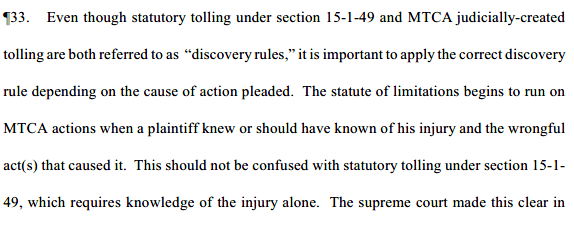
TAKE HEED, lest you fall victim to the distinction between “statutory tolling” and “MTCA tolling”:


Schmidt v. Schmidt, 2020-CA-01253-COA (Civil – Custody)
Affirming the chancellor’s decision granting sole physical custody to the mother, holding that there was no error in finding that the deterioration of the parties’ ability to co-parent constituted a material change in circumstances entitling the mother to sole physical custody and no error in the application of the Albright factors.
(Judge Wilson concurred in part and in the result without separate written opinion.)


Smith v. Mississippi Department of Public Safety, 2021-SA-00020-COA (Civil – State Boards and Agencies)
Affirming the circuit court’s judgment affirming the Mississippi Employee Appeals Board’s decision upholding the claimant’s termination, holding that the claimant’s procedural due process rights were not violated because he was provided notice of the charges and an opportunity to be heard, that his substantive due process rights and rights under the MS State Personnel Board rules were not violated because the MEAB’s decision was supported by substantial evidence and was not arbitrary, and that the claim that the claimant was terminated because of communications with his wife and that the MEAB’s decision was based on uncorroborated hearsay was without merit.
(All judges concurred.)


McIntosh Transport, LLC v. Love’s Travel Stop & Country Stores, Inc., 2021-CA-00154-COA (Civil – Contract/Arbitration)
Reversing the circuit court’s order granting the defendants’ motion to compel arbitration, holding that the contract containing the contract was not binding on the plaintiff because it was signed by a 19-year-old who signed his grandfather’s name and whose only authority was the actual authority to retrieve the truck following repairs that did not include the authority to bind the company to arbitration.
(Chief Judge Barnes concurred in part and in the result without separate written opinion. Judge Carlton concurred in the result only without separate written opinion.)


Case v. Case, 2020-CA-01047-COA (Civil – Custody/Equitable Distribution of Marital Property/Albright Factors/Ferguson Factors)
Affirming the chancellor’s decision on child custody, but reversing the chancellor’s decision on the equitable distribution of marital property. Regarding custody, the Court of Appeals held that the chancellor’s application of the Albright factors was supported by substantial evidence. Regarding equitable distribution, the Court of Appeals affirmed all of the chancellor’s findings except his valuation of the marital property which it reversed and rendered due to a calculation error.
(Judge Wilson and Judge Westbrooks concur in part and in the result without separate written opinion.)

MY TAKE – Few, if any, of us are in the legal field because of a proclivity for math yet it still haunts us all.


Wadley v. Hubbs, 2021-CA-00866-COA (Civil – Real Property/Notice of Appeal)
Reversing the circuit court’s dismissal of the plaintiff’s appeal from a county court judgment as untimely, holding that the plaintiff’s notice of appeal that was stamped “Filed” after the county court’s judgment but before disposition of the plaintiff’s motion to set aside the judgment was effective and timely even though the header of the notice said “IN THE COUNTY COURT” because the body of the notice made it clear the plaintiff was appealing to the circuit court and the notice was stamped “Filed” by the circuit clerk.
(All judges concurred.)


Murray v. State, 2021-KA-00264-COA (Criminal – Felony/Hearsay/Rule 412)
Affirming conviction of statutory rape, holding that the circuit court erred in allowing the victim’s mother’s to testify about a neighbor’s out-of-court statement, but that it was harmless and “essentially cumulative evidence of non-criminal activity that [the defendant] admitted.” The Court of Appeals also held that the circuit court did not err in denying the defendant’s ore tenus request to compel the victim’s counseling records because even though a determination of whether the records were privileged could not be made until the records were examined, the defendant did not comply with Rule 412 of the Mississippi Rules of Evidence. The Court of Appeals also held that the plaintiff’s claims of ineffective assistance of counsel for failure to request an alibi instruction, failure to object to hearsay, failure to request a limiting instruction regarding the hearsay testimony, and failure to make a timely request for the victim’s counseling records did not entitled him to relief on this appeal.
(All judges concurred.)


Bailey v. State, 2021-KA-00281-COA (Criminal – Felony/Lindsey Brief)
Affirming conviction of fondling of a six-year-old and sentence to life imprisonment as a violent habitual offender, noting that the defendant’s appointed appellate counsel filed a Lindsey brief and holding that the defendant’s pro se brief arguing that the trial court lacked jurisdiction and that his indictment was not marked “filed” was factually mistaken and without merit.
(Judge Smith did not participate.)


Finley v. PERS, 2021-SA-00089-COA (Civil – State Boards and Agencies/PERS/Disability)
Reversing the circuit court’s judgment affirming PERS Medical Board’s denial of the plaintiff’s claim for non-duty-related disability retirement benefits, holding that PERS’s assessment of the plaintiff’s job requirements and ability to perform her job was arbitrary and capricious. The case was remanded for PERS to determine if the plaintiff could perform the true duties of registrar with her disability and the support staff, if any, she had at the time.
(Judge Wilson concurred in part and in result without separate written opinion.)


Boyd v. MDOC, 2021-CC-00459-COA (Civil – State Boards and Agencies/MDOC)
Affirming the MDOC’s disciplinary actions against the plaintiff whose oversight led to MDOC’s failure to issue an arrest warrant for a probationer who did not report to his assigned probation office upon release from MDOC custody who then killed two Brookhaven police officers in the line of duty, holding that the plaintiff failed to meet her burdens of proof and persuasion to overcome the presumption of correctness due MDOC’s decision.
(All judges concurred.)


Parker v. Ross, 2020-CA-01055-COA (Civil – Wills, Trusts, and Estates)
Affirming in part and reversing in part the chancery court’s grant of summary judgment in a claim alleging mismanagement of a trust and to recover real property that was allegedly improperly sold. The Court of Appeals affirmed the chancellor’s judgment in part, holding that any claims governed by the three-year statute of limitations were time-barred. The Court of Appeals also reversed the chancellor’s judgment in part, holding that the allegations related to the mismanagement of the trust were subject to a ten-year statute of limitations and that one of the plaintiffs had created a genuine issue of material fact as to his unsoundness of mind and remanded this matter to the chancery court for further proceedings.
(Judge Emfinger dissented, joined by Judge Wilson and Judge Greenlee and joined in part by Judge McDonald.)


Other Orders

Lawrence v. State, 2021-TS-1324-COA (providing, on the court’s own motion, the appellant and his attorney, Wayne Dowdy, one final opportunity to show cause why this appeal should not be dismissed as untimely)


Phew…

Mississippi Court of Appeals decisions of May 3, 2022

There is no peddling of leaked drafts on this blog, folks. Just genuine, final opinions from the Mississippi Court of Appeals and Mississippi Supreme Court, locally sourced and responsibly harvested from the Court’s official hand down page. Today, we have eight opinions from the Mississippi Court of Appeals including several criminal cases (one involving the admissibility of social media messages), an auto liability/road construction case with another MTCA-related hybrid bench/jury trial, a will contest, and PERS disability case.


Simmons v. Jackson County, Mississippi, 2020-CA-01014-COA (Civil – Wrongful Death/MTCA/Auto Liability/Hybrid Trial)
Affirming circuit court’s ruling that the county bore no responsibility for a driver’s fatal accident that occurred when his vehicle left the road and struck a culvert, holding that there was sufficient evidence to support the circuit court’s finding that the driver’s negligence in failing to exercise vigilant caution as he drove through a work zone was the sole proximate cause of the accident.
(Judge Westbrooks dissented, joined by Judge Carlton and Judge McDonald.)

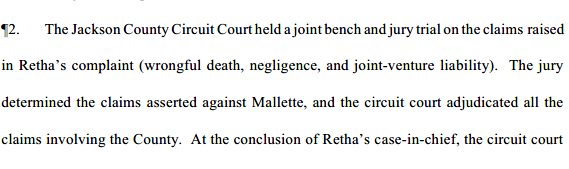
NOTE – This was another was with an MTCA defendant and a non-MTCA defendant. In addition to the county, the plaintiff sued Mallette, a construction company that had repaved the road prior to the acccident. The trial court held a hybrid jury/bench trial:

At the conclusion of the plaintiff’s case-in-chief, the circuit involuntarily dismissed the joint venture claim against the County and Mallette. At the conclusion of the trial, the jury returned a verdict in favor of Mallette. The circuit court then entered findings of fact and conclusions of law concluding that the county created a dangerous condition but that the driver’s negligence was the sole proximate cause of the accident and therefore held that the county was not liable.


Dyer v. State, 2021-KA-00016-COA (Criminal – Felony/Sexual Battery)
Affirming conviction of sexual battery of a teenage girl, noting that the defendant’s appointed counsel had filed a Lindsey brief, the defendant had not filed his own brief, and that the Court’s review of the record yielded no arguable issues of appeal.
(All judges concurred.)


Smith v. Public Employees Retirement System of Mississippi, 2021-SA-00051-COA (Civil – State Boards and Agencies/PERS)
Affirming denial of a correctional offer’s application for duty-related benefits, holding that the PERS decision was not clearly erroneous, contrary to law and not supported by substantial evidence.
(All judges concurred.)


Wofford v. State, 2020-KA-01341-COA (Criminal – Felony/Burglary/Accomplice Liability)
Affirming convictions of and sentences for two counts of burglary of a dwelling, holding that the circuit court did not err when it denied the defendant’s motion for directed verdict, his request for a peremptory instruction, or his motion for JNOV arguing that he could not be convicted of burglary because there was no evidence that he had broken, entered, or stolen, because the Court reasoned the defendant was indicated for burglary as a principal based on his actions as an accessory before the fact; the circuit court did not err in giving an accomplice-liability instruction; and the circuit court did not err in granting the State’s motion in limine excluding testimony about the amount of money that was taken in the burglary.
(Judge McDonald concurred in result only without separate written opinion. Judge Smith did not participate.)


Adams v. State, 2020-KA-01383-COA (Criminal – Felony/Armed Robbery/Indictment)
Affirming conviction of armed robbery, holding that the jury’s verdict was not against the overwhelming weight of the evidence; that the circuit court did not err by not sua sponte preventing a former associate of the defendant from testifying that he had pleaded guilty to the armed robbery in question in response to a question that was not objected to; that the circuit court did not err by allowing the defendant’s former associate’s recorded interview to be played at trial; that although the State’s attempts to amend the indictment were ineffective because the State failed to procure a written order allowing the indictment, the original indictment was not fatally defective; and that the defendant was not entitled to a new trial under the cumulative error doctrine.
(Judge Westbrooks concurred in result only without separate written opinion.)


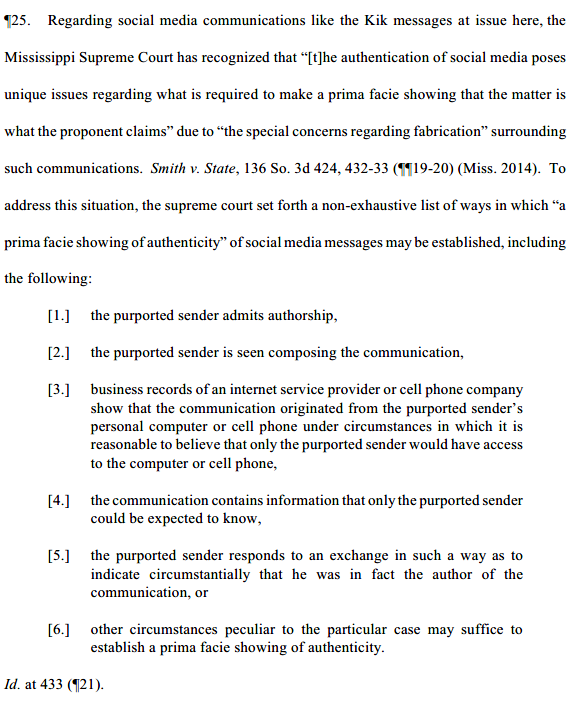
Smart v. State, 2020-KA-00835-COA (Criminal – Felony/Exploitation of a Child/Social Media)
Affirming conviction of exploitation of a child and a twenty-year sentence, holding that there was no error in the admission of Kik messages because they had been sufficiently authenticated and that there was no prosecutorial misconduct in stating that the Kik messages were from the defendant and correlated with a printout of the defendant’s phone records.
(Judge Wilson concurred in part and in the result without separate written opinion.)

Practice Point – If you need to get social media communications admitted (or if you are trying to keep them out) here is the Mississippi Supreme Court’s guidance, as stated by the Court of Appeals in this opinion:


Briggs v. State, 2020-KM-01350-COA (Criminal – Misdemeanor)
Affirming conviction of driving under the influence of marijuana and simple possession of marijuana in a motor vehicle, holding that the evidence was sufficient to support his conviction and that the conviction was not against the overwhelming weight of the evidence.

NOTE – The defendant argued that the State failed to prove he was “influenced” by the marijuana because the State Trooper testified that he never saw the defendant operate the vehicle except to pull the vehicle to the side of the road. The unimpressed Court noted that the State does not have the burden of proving impaired driving, and that the Trooper’s testimony that he smelled strong marijuana odor from the vehicle and observed the defendant’s watery and bloodshot eyes was sufficient.


Dunn v. Hart, 2020-CA-01229-COA (Civil – Wills, Trusts, and Estates)
Affirming the chancery court’s findings that the testator/mother had mental capacity to execute a 2015 will but that one of her children (who happened to be the recipient of the mother’s entire estate in the will) failed to rebut the presumption of undue influence by clear and convincing evidence.

NOTE – This is a fact-bound opinion and I do not think any summary I could write of the facts would be particularly helpful, and it would certainly not be a substitute for reading this opinion if it applies to your practice.


Other Orders

Manhattan Nursing and Rehabilitation Center, LLC v. Hollinshed, 2020-CA-00882-COA (denying rehearing)


Hand Down Page

Summaries of the Mississippi Court of Appeals opinions of April 26, 2022

The Mississippi Court of Appeals dropped eight nine opinions today and there is a lot to sort through. Two divorce cases (one involving equitable distribution of a marital residence and the other a life estate via constructive trust for a mother-in-law), a PCR case, a workers’ comp case involving medical causation, an adverse possession/tax sale case, a personal injury via falling through a roof case, an appeal of an estate case dismissed for lack of final order, and two criminal cases. One of the criminal cases is the second “should the indictment for attempt have alleged an overt act” case we have gotten in a row and it sees a dissenting Judge Westbrooks align herself with Justice Coleman’s dissent last week.

I am always balancing the desire to post these summaries quickly and the need to get back to paying work with the desire to provide a reasonably polished [free] product. Due to the number of cases and the fact that I have to leave the office a little early to coach a little league baseball game, there is extra weight on the “speed” side of the balance today.
Thanks,
Management


Archie v. Archie, 2020-CA-01370-COA (Civil – Domestic Relations/Equitable Distribution/Marital Residence)
Affirming the chancellor’s modification of a final judgment of divorce as to equitable distribution of the marital residence, holding that there was no error in the chancellor ordering the ex-wife to sell the paid-off martial home in order to satisfy the ex-wife’s obligation to pay her ex-husband his share of the equity where the ex-wife had been unable to secure a loan on the paid-off house, even though the ex-husband had not pleaded a request for an order requiring the ex-wife to sell the residence. The court repeatedly noted that the chancellor had broad discretion to “fashion an equitable remedy” and held that the chancellor’s remedy here was appropriate.
(Judge Wilson concurred in part and the in the result without separate written opinion.)


Bevalaque v. State, 2021-CP-00150-COA (Civil – PCR)
Affirming dismissal of a pro se plaintiff’s third PCR motion, holding that the motion was time-barred and successive-writ barred and that no exceptions applied.
(All judges concurred.)


Bowdry v. City of Tupelo, 2021-WC-00390-COA (Civil – Workers’ Compensation/Medical Causation)
Affirming the MWCC’s finding that the claimant’s neck claim was not related to his compensable work-injury, holding that the Commission’s finding that the claimant failed to prove causation was supported by substantial evidence.
(All judges concurred.)

PRACTICE POINT: The Court of Appeals noted that on appeal they do not review the AJ’s findings, but the Commission’s findings and did not address the claimant’s arguments about the AJ’s findings:

This is because the Commission does not function as an appellate court reviewing the AJs’ findings. This is because the Commission, not the AJ, is the ultimate trier and finder of fact for workers’ comp claims. See, e.g., Hugh Dancy Co. Inc. v. Mooneyham, 68 So. 3d 76 (Miss. Ct. App. 2011)


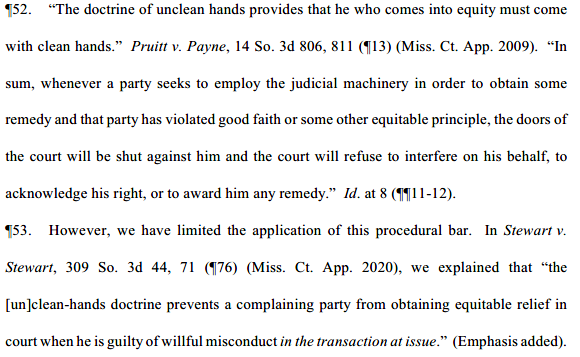
Anderson v. Jackson, 2019-CA-01773-COA (Civil – Real Property/Adverse Possession/Unclean Hands/Tax Sale)
Reversing the chancellor’s findings granting title of real property to one party (Levon) based on findings that Levon had obtained title by adverse possession or by tax sale and that the opposing party (Rosie) had unclean hands, holding that the chancellor erred in granting title to Levon because he failed to prove the elements of adverse possession by clear and convincing evidence, that the tax sale was void due to flawed notice of redemption, and that the doctrine of unclean hands was erroneously applied to bar Rosie’s challenge because Rosie’s conduct was related to a forty-year-old estate case, not the transaction at issue.
(All judges concurred.)

Since accusations of “unclean hands” get thrown around in litigation on occasion, I thought this summary of the equitable doctrine of unclean hands is a useful refresher:

NOTE – As always, but only more so here, if this case applies to your practice you need to read it yourself. There are many details in this forty-page opinion that I have not even attempted to tease apart.


Herron v. Herron, 2021-CA-00090-COA (Civil – Domestic Relations/Constructive Trust/Property Valuation)
Affirming the chancellor’s findings in a divorce action granting a life estate via constructive trust in a home on the marital property to the ex-wife’s mother in assigning value to property awarded to the ex-husband, holding that there was clear and convincing proof that the house was intended to be owned by the mother in a life estate and that there was substantial credible evidence supporting the chancellor’s valuations of the personal property in question.
(All judges concurred.)


Gillespie v. Lamey, 2021-CA-00076-COA (Civil – Personal Injury/Summary Judgment/Duty to Warn)
Affirming summary judgment in favor of a defendant dismissing the plaintiff’s claim for personal injuries sustained when the plaintiff fell through a roof while working on a skylight on the defendant’s property, holding that (1) the plaintiff presented no evidence that the defendant failed to warn the plaintiff of any dangerous condition of which the defendant had actual or constructive knowledge and (2) the allegedly dangerous condition was “intimately connected” to the work he was hired to do.
(Judge Smith did not participate, all other judges concurred.)


Smith v. Richmond, 2020-CP-01064-COA (Civil – Wills, Trusts, and Estates/Civil Procedure)
Dismissing the appeal, holding that the pro se appellant’s attempted appeal of the chancery court’s denial of a Rule 60(b) motion to set aside an interim order, a motion to recuse, and a “motion to change jurisdiction” must be dismissed because each of these motions was an interlocutory order not appealable as of right.
(All judges concurred.)


Wayne v. State, 2021-KA-00084-COA (Criminal – Felony/Rebuttal Evidence/Sufficiency and Weight of Evidence)
Affirming murder conviction, holding that there was no error (1) in allowing the State to recall a State’s witness and introduce and play the defendant’s recorded statement in rebuttal because the recorded statement contradicted the defendant’s trial testimony, (2) in introducing the defendant’s entire statement because it was proper impeachment evidence, or (3) in denying the defendant’s post-trial motion because the evidence was sufficient to support the conviction and that the conviction was not against the weight of the evidence.
(All judges concurred.)


Beale v. State, 2020-KA-00614-COA (Criminal – Felony/Overt Act)
Affirming conviction two counts of attempted murder of two police officers, holding (1) an indictment for the crime of attempted murder does not require the description of an overt act, (2) that two jury instructions did not constitute a constructive amendment to the indictment, and (3) testimony from an officer about what a witness told him at the crime scene was not hearsay because they were not offered to prove the truth of the matter asserted but to explain the next steps in the course of his investigation.
(Judge Westbrooks dissented, joined in part by Judge McDonald. Judge McDonald concurred in part and dissented in part without separate written opinion. Judge Emfinger concurred in part and in the result without separate written opinion. Judge Wilson concurred in result only without separate written opinion. All other judges concurred.)

NOTE – We have gotten an “is the indictment missing an alleged overt act” case in back-to-back hand-down days. In her dissent, Judge Westbrooks’s argues that she is taking a position consistent with the position that Justice Coleman took just last week in Brady v. State (my post here) (opinion link here).


Other Opinions

Durrant Inc. v. Lee County, Mississippi, 2019-CA-01826-COA (denying motion for rehearing)
Bell v. State, 2020-CT-00592-COA (denying motion for rehearing)


Hand Down List

Summaries of the Mississippi Court of Appeals opinions of April 19, 2022

The Court of Appeals handed down four opinions today. One case addresses the chancery court’s jurisdiction to hear an appeal challenging cost adjustments from the Department of Medicaid. There is one PCR case with an interesting concurrence regarding the State’s immunity from default judgments. The other two cases are criminal cases: one involving assault of a police officer and the other involving a trial that did not go well for the one co-conspirator who opted not to plead guilty.


Poplar Springs Nursing Center v. Mississippi Division of Medicaid, 2020-SA-01333-COA (Civil – Boards and Agencies)
Affirming the chancery court’s ruling that it did not have subject matter jurisdiction to review a series of cost adjustments by the Department of Medicaid, holding that the nursing home failed to exhaust its administrative remedies by failing to seek timely review of cost adjuster letters.
(Judge Emfinger did not not participate, all participating judges concurred.)


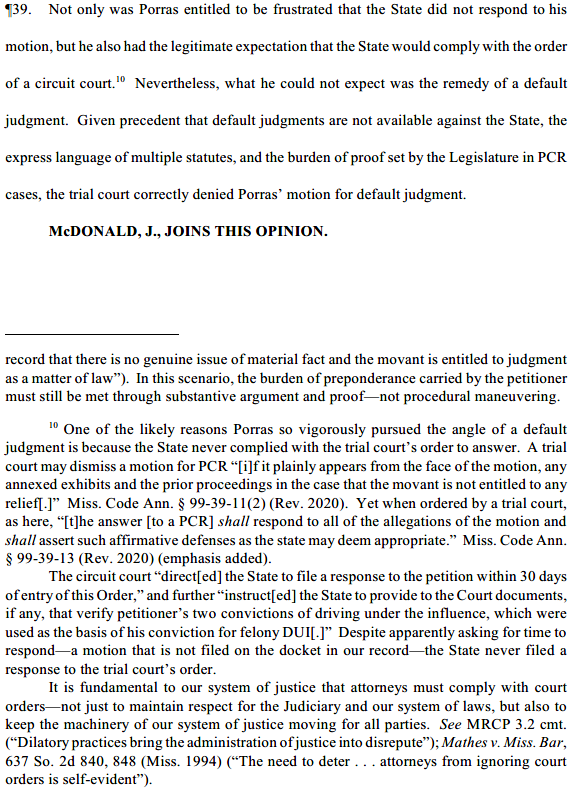
Porras v. State, 2021-CP-00052-COA (Civil – PCR)
Affirming the circuit court’s denial of a PCR motion, holding that there was no error in denying the request for appointed counsel for the PCR hearing, no error in failing to require the State to file a written response to the PCR motion, and, ultimately, no error in denying the PCR motion.
(Judge McCarty wrote special concurrence, joined by Judge McDonald

NOTE: Judge McCarty’s special concurrence thoughtfully addressed the argument that the petitioner was entitled to a default judgment because the State failed to respond the PCR motion in violation of an order of the circuit court. McCarty first set out the law and policy behind establishing a broad prohibition of default judgments against the State. He then wrote that the petitioner had a right to expect the State to comply with the circuit court and had other possible remedies, but that default judgment was not an available remedy.


Bradford v. State, 2021-KA-00509-COA (Criminal – Felony/Simple Assault)
Affirming conviction and sentence for simple assault of a police officer, holding that the evidence was sufficient to establish lawful arrest and that the officer sustained a bodily injury including, but not limited to, evidence of an attempted biting that was thwarted by the officer’s jacket and a kick to the groin that found its mark.
(Judge McDonald concurred in part and in the result without separate written opinion and Judge Westbrooks concurred in result only without separate written opinion.)


Edwards v. State, 2021-KA-00259-COA (Criminal – Felony/Armed Robbery)
Affirmed conviction and sentence for armed robbery and conspiracy to commit armed robbery, holding that the evidence (including evidence from co-conspirators turned State’s witnesses) was sufficient for a reasonable jury to find the elements of a conspiracy to rob a GameStop were proved beyond a reasonable doubt and that the convictions of armed robbery and conspiracy to commit armed robbery were not against the weight of the evidence.
(All participating judges concurred.)


Other Orders

None


Hand Down List Link