Mississippi Supreme Court Decisions of August 4, 2022

The Mississippi Supreme Court handed down two opinions today and in both it reversed the Court of Appeals. One involves a judgment lienholder’s plight after a tax sale of which it was not given notice. The other is an appellate procedure case addressing whether there was a final, appealable order.


HL&C Marion, LLC v. DIMA Homes, Inc., 2020-CT-00750-SCT (Civil – Real Property)
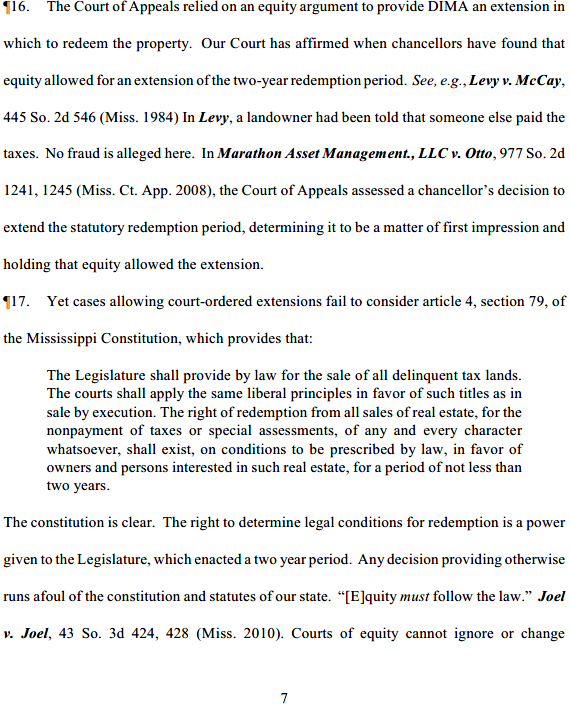
Reversing the Court of Appeals and the chancellor in suit to conform and quiet title, holding that in this case where a home builder obtained and enrolled a judgment against the property owners for an unpaid construction balance, the property was sold at a tax sale and then sold again, that no legal authority required notice of the tax sale to the home builder/judgment lienholder prior to the expiration of the two-year redemption period and that the chancery clerk had no duty to conduct a search of the judgment roll. Judgment was rendered in favor of the purchaser.
(6-0: Chief Justice Randolph, Justice Beam, and Justice Griffis did not participate)

OVERRULE ALERT – This decision overruled at least two prior decisions where it was held that equity allowed for an extension of the two-year, statutory redemption period because such decisions run afoul of the Mississippi Constitution which gives the Legislature the exclusive right to set the conditions for redemption:


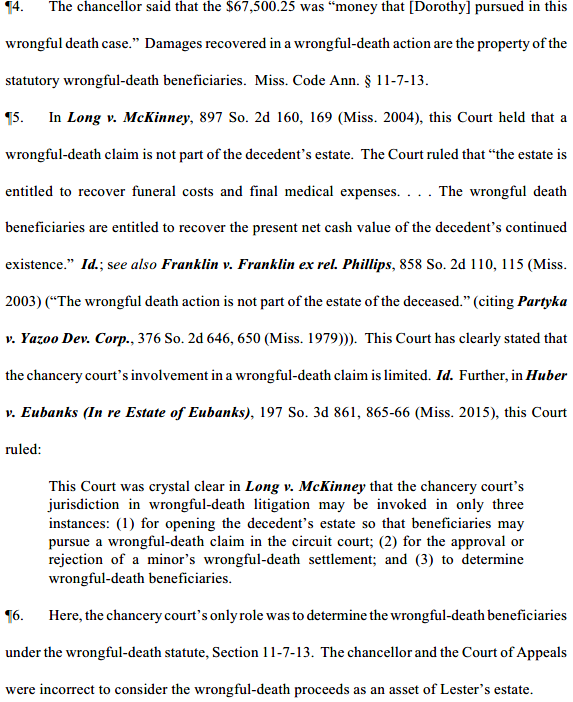
Humphrey v. Holts, 2021-CT-00046-SCT (Civil – Other)
Reversing the Court of Appeals’ decision dismissing the appeal for lack of a final, appealable order, holding that the chancery court’s order dismissing the complaint upon the motion of one of two defendants left no claims to be adjudicated and it was therefore a final, appealable judgment.
(9-0: Justice King specially concurred, joined by Justice Kitchens)

PRACTICE POINT – Mississippi’s appellate courts dismiss a significant number of appeals for lack of final, appealable judgment by strictly applying Miss. R. Civ. P. 54(b). This opinion does not reference Rule 54(b) but it appears that the chancellor’s order in this case did not contain the magic words in 54(b). The Supreme Court essentially held that 54(b) did not apply here because the chancellor’s order disposed of the entire complaint (i.e. it did not dispute of fewer than all claims/parties) so the magic words were not required. My takeaway: When Rule 54(b) applies it must be strictly complied with, but don’t assume it applies.


In Re: Commission on Mandatory Continuing Legal Education, 89-R-99011-SCT (Order appointing Helen Morris, Marcus A. McLelland, and Katherine K. Farese to three-year terms as members of the Commission on Mandatory Continuing Legal Education effective August 1, 2022)

In Re: Advisory Committee on Rules, 89-R-99016-SCT (Order authorizing and directing the disbursement of $15,000.00 from the Court’s Judicial System Operation Fund to the Mississippi Supreme Court Advisory Committee on Rules for its necessary work through September 30, 2022)

City of Jackson, Mississippi v. Johnson, 2020-CA-00318-SCT (denying rehearing)

Nelson v. State, 2020-M-01417 (denying application for Leave to Proceed in the Trial Court filed pro se and warning petitioner against further frivolous filings)

In Re: Administrative Orders of the Supreme Court of Mississippi, 2022-AD-00001-SCT (En banc order directing the disbursement of $177,295.27 in civil legal assistance funds among the MS Volunteer Lawyers Project, North MS Rural Legal Services, and MS Center for Legal Services)


Hand Down List

Mississippi Supreme Court Decisions of July 28, 2022

The Mississippi Supreme Court handed down two opinions today. One untangles a web of statutes governing sixteenth section land to determine whether a noncustodial school district could recover past revenue from the custodial school district. The other considered whether a conviction in a second trial violated double jeopardy after the first trial ended in a mistrial.


Wayne County School District v. Quitman School District, 2020-CA-00499-SCT (Civil – Other)
Reversing and rendering on direct appeal and affirming on cross-appeal in a dispute between to school districts about whether revenue generated from sixteenth section land received by the custodial district should have been shared with the noncustodial district, holding that the noncustodial district could not recover past revenue that might have been owed because the noncustodial district did not satisfy Section 29-3-119(4) which places a time limit on when a noncustodial district can make a claim with a custodial district.
(6-3: Justice Griffis dissented, joined by Justice Kitchens and Justice King.)

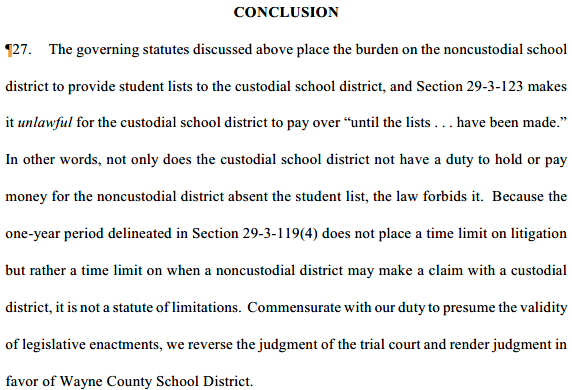
NOTE – This opinion takes a deep dive to interpret the statutes governing revenue generated by sixteenth section land. At stake was $1,101,413 in funds that the Wayne County School District collected and kept, but that the Quitman School District but could have had a claim to. Here is the Supreme Court’s conclusion:


Wilson v. State, 2021-KA-00473-SCT (Criminal – Felony)
Affirming conviction of aggravated assault, holding that double jeopardy was not violated because the trial court did not abuse its discretion when it found manifest necessity for a mistrial when the defendant’s first trial ended in a mistrial after the defense referenced the victim was incarcerated during opening and holding that the the weight of the evidence was such that allowing the verdict to stand was not an unconscionable injustice.
(7-2: Justice King dissented, joined by Justice Kitchens.)


Other Orders

Jackson v. State, 2014-M-00623 (denying petition for PCR and restricting the plaintiff from filing further PCR applications in forma pauperis)

Ladner v. State, 2020-CT-00299-SCT (denying cert)

Dew v. Harris, 2020-CT-01261-SCT (denying cert)

Kirk v. State, 2022-M-00044 (denying petition for PCR and restricting the plaintiff from filing further PCR applications in forma pauperis)


Hand Down List

Mississippi Supreme Court Decisions of July 21, 2022

The Mississippi Supreme Court handed down five opinions today after its two-week break. This eclectic array of cases covers a refused jury instructions on the right to stand your ground, medical malpractice, an election contest, a real property purchase, and a request by the AG to be heard on a nonexistent request for litigation expenses.


Williams v. State, 2021-KA-00336-SCT (Criminal – Felony/Self Defense)
Reversing manslaughter conviction in a case where the defendant killed her father by stabbing him during an altercation he initiated, holding that the trial court erroneously refused the defendant’s proposed jury instructions related to her right to stand her ground.
(9-0)

NOTE – Instructions that the defendant had a right to defend herself were held insufficient. Here are the two instructions that the trial court erred by refusing:


Taylor v. Premier Women’s Health, PLLC, 2021-CA-00493-SCT (Civil – Medical Malpractice)
Affirming judgment for the defendants following a unanimous jury verdict for the defendants in a med mal case, holding that the trial court did not err in refusing to grant challenges for cause of jurors who were patients of the defendant doctor and did not err in denying the plaintiff’s motion for JNOV that sought a finding that there was a breach of the standard of care.
(8-0: Chief Justice Randolph did not participate.)


Simmons v. Town of Goodman, 2021-EC-00563-SCT (Civil – Election Contest)
Affirming trial court’s decision upholding the municipal election commission’s finding that the plaintiff did not qualify to run for mayor, holding that the plaintiff did not provide sufficient evidence that he was domiciled in Goodman for the amount of time statutorily required to run for mayor.
(9-0)


SRHS Ambulatory Services, Inc. v. Pinehaven Group, LLC, 2020-CA-01355-SCT (Civil – Contract)
Affirming summary judgment in favor of the defendant/seller of real property and its title insurance carrier, holding that the plaintiff’s purchase of real property was valid and enforceable because ratification of the purchase by the county board of supervisors was not required.
(5-1-3: Justice King concurred in result only without separate written opinion; Justice Griffis dissented, joined by Justice Kitchens and Justice Maxwell.)


Garcia v. State, 2021-IA-00632-SCT (Civil – Death Penalty – Post Conviction)
Vacating the trial court’s order granting the Attorney General’s “Motion for Notice of and an Opportunity to Be Heard on Requests for Litigation Expenses,” holding that the AG’s request was not only premature, but inapplicable because the defendant was represented by attorneys working for the Office of Capital Post-Conviction Counsel who are employed by the state and do not receive compensation or expenses for representing the defendant.
(9-0)


Hand Down List

Mississippi Supreme Court Decisions of June 30, 2022

The Mississippi Supreme Court handed down three opinions today: a case that resolved a fight over the Mississippi Division of Medicaid’s efforts to recoup overpayments to a senior care facility, an MTCA issue that wasn’t, and a post-conviction death penalty decision regarding a request to transfer DNA evidence.


Wilkinson County Senior Care, LLC v. Mississippi Division of Medicaid, 2020-SA-01332-SCT (Civil – State Boards and Agencies)
Affirming the chancery court’s order allowing the Mississippi Division of Medicaid to recoup a substantial overpayment made to a senior care facility for the years 2002-2003 that the DOM did not demand until 2011, holding that the delay did not bar DOM’s recover because (1) neither equitable estoppel nor any other legal or equitable principles barred the claim; (2) the decision was not arbitrary and capricious, clearly erroneous, or unsupported by substantial evidence; and (3) the delay did not violate the facility’s due process rights.
(9-0)


Strickland v. Rankin County School District, 2019-CT-01669-SCT (Civil – Personal Injury/MTCA/Negligence)
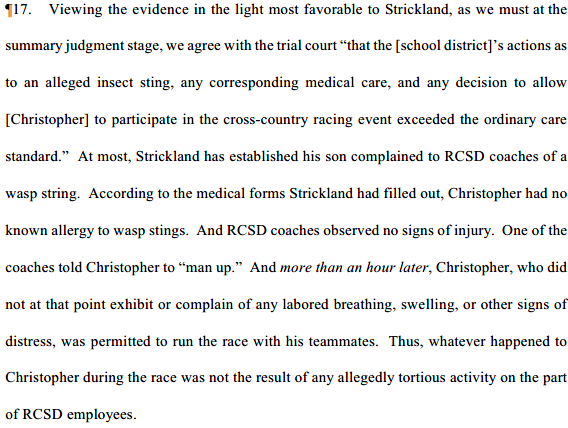
Affirming the trial court’s grant of summary judgment in favor of the school district, juking the question of whether the defendant was entitled to discretionary function immunity (that split the COA 5-5) and holding that the plaintiff had not established the basic element of negligence where the evidence provided by the plaintiff–a cross-country runner for the school–was stung by a wasp, was examined by at least one coach, was told to “man up” and run the race, began running, felt dizzy just after the mile marker, and fell and hit his head.
(5-1-2) (Justice Ishee concurred in result only, joined in part by Chief Justice Randolph. Justice Kitchens dissented, joined by Justice King. Justice Beam did not participate.)

NOTE – Here is a summary of the Court’s analysis of the element of breach:


Manning v. State, 2020-CA-01096-SCT (Civil – Death Penalty – Post Conviction)
Affirming the circuit court’s denial of a request to transfer DNA evidence to a different facility for additional DNA testing after the Court previously granted PCR to allow testing but six years of testing had allegedly yielded inconclusive results, holding that the circuit court had authority to decide the motion to transfer the evidence and that the circuit court did not abuse its discretion by denying the motion.
(7-2) (Justice King dissented, joined by Justice King)


Other Orders

Rules for Court Reporters, 89-R-99021-SCT (appointing Hon. Leslie D. King, Kati Vogt, Julie Mims, and Latanya Allen as members of the Board of Certified Court Reporters for two-year terms from July 1, 2022, through June 30, 2024)

Bolton v. John Lee, P.A., 2020-CA-00344-SCT (assigning appeal to Court of Appeals for a decision within 270 days of the entry of this order)

Doe v. Doe, 2020-CT-00853-SCT (denying cert)

Manhattan Nursing and Rehabilitation Center, LLC v. Barbara Hollinshed, 2020-CT-00882-SCT (denying cert)

Jiles v. State, 2021-CT-00034-SCT (denying cert)

The Mississippi Bar v. Mayers, 2021-BD-00268-SCT (suspending Urura W. Mayers from the practice of law pending final resolution of the petition for discipline filed by The Mississippi Bar)

Longo v. City of Waveland, Mississippi, 2021-CA-00735-SCT (consolidating two appeals)

Johnson v. State, 2022-M-00303 (denying reconsideration)


Hand Down List

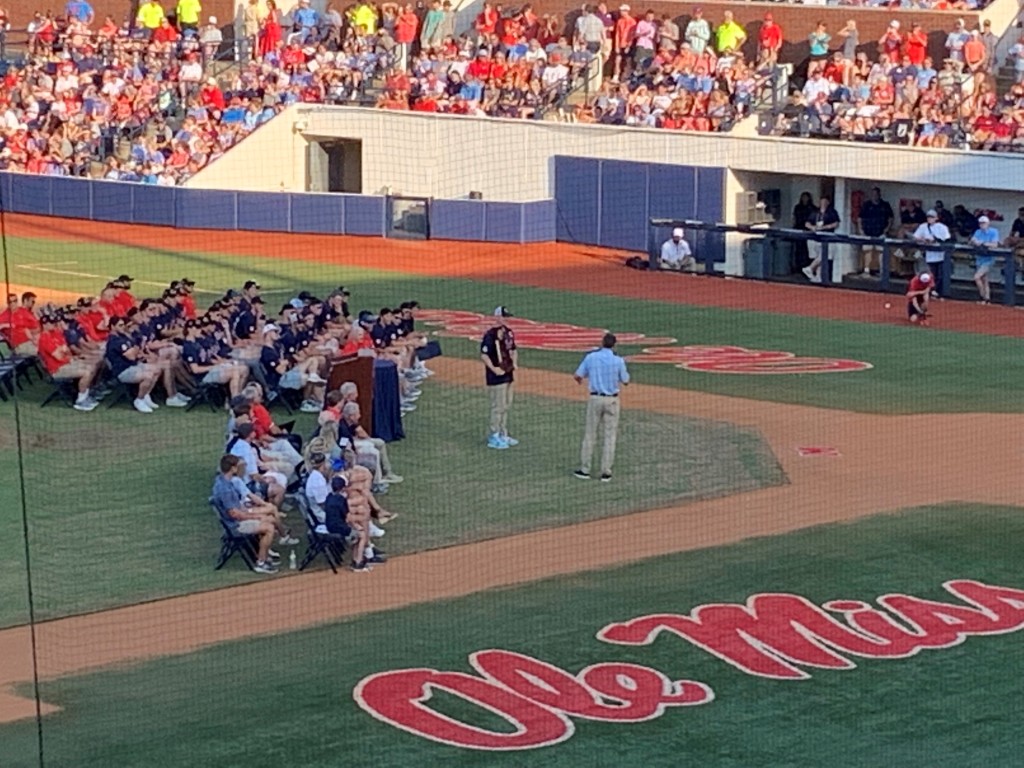
I try to keep things apolitical around here, but my two older boys and I went to Oxford yesterday and we can confirm that the Ole Miss Rebels did in fact win the 2022 College World Series. The boys obtained autographs from the gracious and patient Dylan DeLucia, Peyton Chatagnier, and Coach Bianco as evidence.

Mississippi Supreme Court Decisions of June 23, 2022

The Mississippi Supreme Court handed down two opinions today in criminal cases. One is an appeal of a DUI conviction where the defendant refused a breathalyzer test. The other was certiorari review of the Court of Appeals’ remedy for a Batson error by the trial court. The Supreme Court also published an en banc order that garnered some national attention when it was entered on Tuesday.


Bullen v. State, 2021-KM-01081-SCT (Criminal – Misdemeanor/DUI)
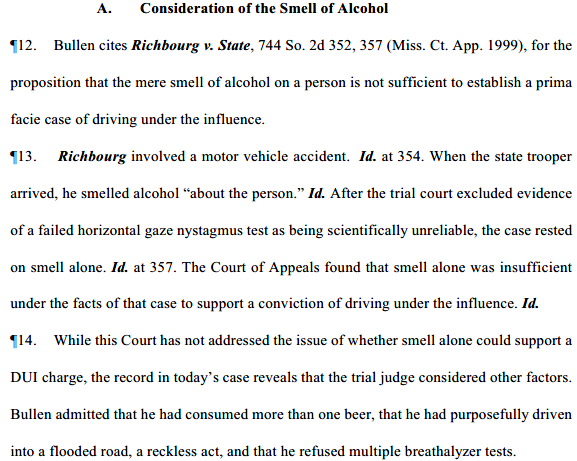
Affirming a conviction of DUI (second offense), holding that substantial evidence supported the conviction despite the defendant’s refusal to submit to a breathalyzer test because there was also testimony that the defendant’s pupils were contracted (after some confusion by the officer who initially testified that they were dilated), his truck smelled of alcohol, and he admitted to consuming more than one beer and intentionally driving into a flooded area requiring extraction by the fire department. The Supreme Court also held that the circuit judge did not err in considering the defendant’s refusal to submit to breathalyzer tests.
(9-0.)

NOTE – The Supreme Court has never addressed the issue of whether “smell alone could support a DUI charge.” The Court declined to do so in this case because this conviction was based on other evidence. The right case may be set up for cert on this issue.


Miles v. State, 2019-CT-00895-SCT (Criminal – Felony)
Affirming the Court of Appeals affirming in part and reversing in part the circuit court’s judgment, holding that the Court of Appeals applied the appropriate remedy for the circuit court’s “imprecise and incomplete” Batson analysis (specifically, the burden-shifting process after challenge of a peremptory strike) which was to remand to the trial court to conduct a hearing to complete the second and third steps of the Batson analysis for three of the challenged members of the venire.
(Justice King concurred in the result only without separate written opinion.)


Other Orders

Powers v. State, 2017-DR-00696-SCT (holding that the plaintiff has no right to competency in post-conviction proceedings and denying his motion to stay his execution without prejudice)

Mississippi Department of Economic and Community Development v. General Reinsurance Corp., 2020-CT-00761-SCT (denying cert)


Hand Down List

Mississippi Supreme Court Decisions of June 16, 2022

The Mississippi Supreme Court took advantage of a slow inning from the Mississippi Court of Appeals and plated five opinions today to answer the COA’s two. These are big cases. There is an inverse condemnation decision, a legal malpractice decision stemming from a workers’ comp claim, a decision on whether Eight Amendment was violated by a life sentence without the possibility of parole for possession of marijuana by a habitual offender, and a case deciding whether Mississippi courts have subject-matter jurisdiction to hear claims stemming from the termination of a former employee of the Catholic Diocese of Jackson in light of the ecclesiastical abstention doctrine of the First Amendment.


City of Gulfport, Mississippi v. Cowan Road & Highway 90, LLC, 2020-CA-01286-SCT (Real Property)
Affirming on direct appeal and affirming in part/reversing in part on cross-appeal of an inverse condemnation ruling, holding that (1) the landowners were entitled to reasonable fees and costs because they fell within the purview of section 43-37-9, (2) the trial court did not abuse its discretion in awarding attorney’s fees or in reducing the attorney’s hourly rate, (3) the trial court did not abuse its discretion by not awarding prejudgement interest under section 75-17-7, and (4) the circuit court did abuse its discretion by not awarding post judgment interest.
(7-0: Chief Justice Randolph and Justice Beam did not participate.)


Lairy v. Chandler, 2019-CT-01423-SCT (Civil – Legal Malpractice)
Affirming in part and reversing in part the judgment of the Court of Appeals in a legal malpractice claim stemming from a workers’ compensation, holding that the trial court’s award for damages was sufficiently supported by the evidence and that while the plaintiff had to “pass the trial-within-a-trial test” she did not have to satisfy the “exacting statutory requirements” of the Mississippi Workers’ Compensation Act that would have applied to her workers’ compensation claim to pass that test.
(7-2: Justice Coleman dissented, joined by Justice King.)


Russell v. State, 2019-CT-01670-SCT (Criminal – Felony)
Affirming a life sentence without the possibility of parole for possession of marijuana as a habitual offender, holding that “the trial judge followed the letter of the law” and did not have sentencing discretion and that the defendant presented no evidence related to the Solem factors for an Eighth Amendment analysis.
(5-1-3: Chief Justice Randolph specially concurred with separate written opinion, joined by Justice Beam and Justice Ishee, but the Chief did not join the majority opinion. Justice Coleman dissented, joined by Justice Kitchens and Justice King.)

NOTE – This is a heavy case in terms of public policy, legal analysis, and outcome. The Court of Appeals below split 5-5. Judge Wilson wrote the main dissent, joined by Judge Westbrooks, Just McDonald, Judge Lawrence, and Judge McCarty. The grouping of judges and justices in majority and dissent is interesting as well.


Eubanks v. State, 2020-KM-00110-SCT (Criminal – Misdemeanor)
Affirming conviction of simple assault domestic violence, holding that there was no violation of the defendant’s constitutional right to speedy trial or statutory right to speedy trial, that an objection to testimony was waived because it was not asserted at trial, that the defendant did not receive ineffective assistance of counsel, that there was no error in denying his motion for judgment of acquittal notwithstanding the verdict, that the jury’s finding that the victim suffered bodily harm was not against the overwhelming weight of the evidence, that the State did not violate the defendant’s due process rights by failing to investigate and preserve exculpatory evidence, and that the trial court did not err by giving the State’s simple assault domestic violence jury instruction.
(5-4: Justice Coleman, with his white-hot dissenting pen, wrote a dissent that was joined by Justice Kitchens, Justice King, and Justice Ishee.)


Catholic Diocese of Jackson, Mississippi v. De Lange, 2021-IA-00159-SCT (Civil – Torts)
Reversing and rendering the circuit court’s denial of the defendant’s motion to dismiss claims stemming from the termination of the plaintiff, holding that the court lacked subject-matter jurisdiction under the ecclesiastical abstention doctrine of the First Amendment to the U.S. Constitution to hear the plaintiff’s claims of wrongful termination, defamation, and negligent and intentional infliction of emotional distress.
(9-0)

NOTE – I watched the oral arguments in this case and found it fascinating. It was argued well by both sides, and the bench was thoughtful and fully engaged.


Other Order

Knox v. State, 2014-DR-00849-SCT (denying rehearing)


Hand Down List


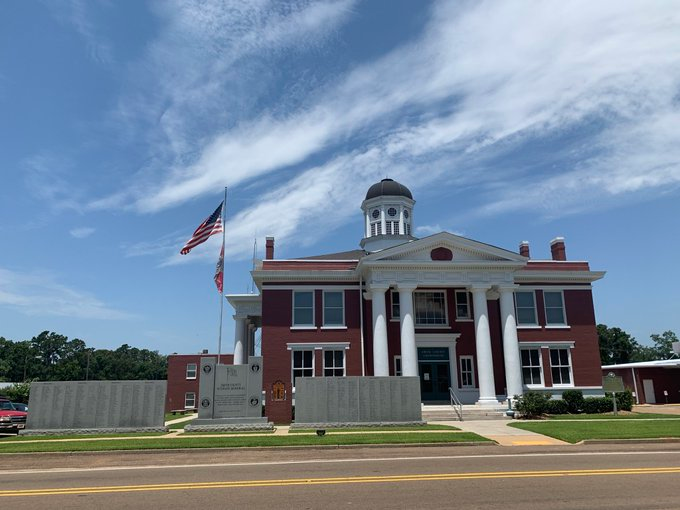
My summaries are late because I spent much of the day lawyering in Smith County this morning.

Mississippi Supreme Court Decisions of June 2, 2022

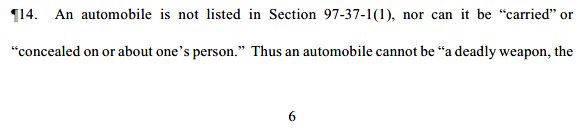
The Mississippi Supreme Court gave us one opinion today holding that an automobile is not a deadly weapon that is illegal to concealed-carry under section 97-37-1. Read on for context…


Altman v. State, 2021-IA-00419-SCT (Criminal – Felony/Youth Court/Jurisdiction/Concealed Carry?)
Reversing the circuit court’s denial of the defendant’s motion to dismiss for lack of jurisdiction, holding that because an automobile cannot be “carried” or “concealed on or about one’s person,” the youth court has exclusive jurisdiction over a juvenile offender who commits a felony using an automobile.
(All justices concurred).

CONTEXT – The youth court has exclusive original jurisdiction in all proceedings concerning a delinquent child, subject to some exceptions. One exception applies when a child commits a felony with a deadly weapon that is illegal, under section 97-37-1, to carry in a concealed manner. The defendant was seventeen when he allegedly drove his car intentionally into a car carrying his mother, siblings, and step father. The defendant was indicted for four counts of aggravated assault. He filed a motion to dismiss the indictment, arguing that the youth court had exclusive jurisdiction. The circuit court denied the motion. The Mississippi Supreme Court granted interlocutory appeal and reversed the circuit court, reasoning:


Other Orders

Godbolt v. State, 2020-DP-00440-SCT (denying pro se motion for the appointment of new counsel by defendant convicted of multiple counts of capital murder and sentenced to death stemming from a killing rampage in Lincoln County in 2017)

Arrington v. State, 2020-M-00571 (denying pro se application for leave to proceed in the trial court and restricting the petitioner from filing further such applications in forma pauperis)

Varner v. Anderson, 2021-M-01390-SCT (denying motion to reconsider order denying petition for interlocutory appeal and denying motion to dismiss said motion for reconsideration)


Hand Down List

Mississippi Supreme Court Decisions of May 26, 2022

The Mississippi Supreme Court handed down two opinions today and each packs a punch. Webb v. State has a thorough and concise analysis of issues surrounding the authentication of screenshots of Snapchat messages. Ware v. Ware is a multifaceted, chancery court battle-royale among family of the decedent involving primarily the fate of the decedent’s shares of family corporations.


Webb v. State, 2021-KA-00082-SCT (Criminal – Felony/Authentication of Social Media)
Affirming conviction of one count of fondling and three counts of sexual battery of two underage girls, holding that the circuit court did not abuse its discretion in a slew of evidentiary rulings including (1) the admission of prior sexual abuse by the defendant; (2) the admission of a photo of an entry from a diary belonging to one of the victims; (3) the admission of screenshots of Snapchat messages over an authentication and unfair prejudice challenges; and (4) the admission of text messages between the defendant and one victim’s mother. The Supreme Court was unpersuaded by the defendant’s final argument that his conviction was against the weight of the evidence.
(All justices concurred.)

Practice PointThis is a case to bookmark for authenticating social media content or other screenshot material. The Supreme Court took a deep dive into the issue of authenticating the Snapchat screenshots at issue in this case. The screenshots at issue were taken by one victim’s mother, but the mother did not provide authenticating testimony. The Court analogized screenshots to photos, and held that screenshots do not have to be authenticated by the person who took the screenshot:

[Legal writing sidebar: I like Justice Maxwell’s use of “And” to start the third sentence. We were all told at some point that one should never begin a sentence with a conjunction. But I think doing so here effectively added clarity and concision to the opinion.]

The defendant also asserted that the State failed to offer an adequate foundation for the screenshots because they did not prove that he was on the “other side” of the Snapchat communications with one of the victims. The Supreme Court noted that something more than a profile photo and an account name is required, but that “something more” can be established in many ways including circumstantial evidence:


Ware v. Ware, 2020-CA-00702-SCT (Civil – Wills, Trusts, and Estates)
Affirming in part and reversing/remanding in part a direct appeal and affirming in part and dismissing as moot in part a cross-appeal of a messy, consolidated estate case and corporate dissolution case between and among a surviving wife and the three children (a son and two daughters) she had with the decedent. The decedent owned 25% each of four family corporations. His will placed most of his assets including these shares into testamentary trusts for which his wife and three children were trustees, and the primary beneficiary was the wife with limited distribution potential to the children. Unsurprisingly, litigation ensued over how to manage the corporations and dispersion of the decedent’s assets.

The son filed for dissolution of the corporation, the chancellor denied the daughters’ motions to join/intervene, the chancellor appointed a receiver by agreed order, and the chancellor ultimately ordered that the shares by offered for sale to the corporations and then the dissolution of the corporations. The daughters appealed the denial of their motions to join/intervene and the wife appealed “a multitude of issues.” The son cross-appealed the chancellor’s net asset value determination date and methodology.

The Mississippi Supreme Court (1) reversed the chancellor’s ruling that the estate must offer the shares to the corporation prior to transferring them to the trusts, (2) affirmed the chancellor’s denial of the motions to intervene, (3) affirmed the chancellor’s decision to dissolve the corporations, and (4) reversed the dissolution judgment to the extent that it allowed the corporations to purchase shares from the estate. Accordingly, the Court remanded the case back to the chancery court to determine how to distribute the money from the sales of the corporations in which the estate holds 25% of the corporate shares.
(Chief Justice Randolph did not participate.)

Note – There is a lot more happening in the details of this opinion that I am not going to wade into here. If something mentioned above touches your practice areas, you will need to dive in yourself.


Other Orders

Grayson v. State, 1998-DP-01782-SCT (dismissing pro se motion to carry out execution forthwith)

Sims v. Sims, 2020-CT-00327 (denying cert) (grandparents, if you want to spend a lot of money to accomplish little more than firebombing your family, suing your children for grandparent visitation may be right for you)

Westmoreland v. State, 2020-CT-00509-SCT (denying cert)

Wilson v. State, 2020-CT-00762-SCT (denying cert)

Flechas v. The Mississippi Bar, 2021-BA-01051-SCT (granting motion to accept the irrevocable resignation of Eduardo A. Flechas)

In Re: Hon. James McClure, III and Hon. Gerald W. Chatham, Sr., 2022-IA-00319-SCT (treating petition for writ of prohibition filed by Circuit Court Judges James McClure, III, and Gerald W. Chatham, Sr., as a petition for interlocutory appeal pursuant to M.R.A.P. 5; granting permission to appeal, and directing all judges of the Circuit Court of the Seventeenth Judicial District are hereby to appear before Mississippi Judicial College Director Randy G. Pierce for a conference to consider the simplification of the issues and such other matters as may aid in the disposition of the proceeding by the Court, including settlement)


Hand Down List

Mississippi Supreme Court Decisions of May 12, 2022

The Mississippi Supreme Court handed down six opinions today with subject matter covering capital murder conviction and death penalty, UM/UMI coverage, election contests, appellate procedure, wills, and judicial estoppel.


Johnson v. Brock, 2020-EC-00982-SCT (Civil – Election Contest/Summary Judgment)
Affirming summary judgment dismissing the plaintiffs’ contest the results of a city counsel election, holding that the plaintiffs failed to satisfy their burden in opposing summary judgment where the plaintiffs’ briefs relied upon affidavits that were not in the record and they otherwise failed to come forward with evidence that there were voting irregularities that led to their election losses.
(Justice King did not participate.)


Bufkin v. Geico Insurance Agency, Inc., 2021-CA-00251-SCT (Civil – Insurance/UM/UIM)
Affirming summary judgment in favor of the UM carrier, declining to overrule precedent holding that an employee is not legally entitled to make a claim under their employers’ underinsured motorist coverage.
(All justices concurred.)

Note – The plaintiff argued Mississippi’s law on this question of statutory interpretation was the minority approach and urged the Supreme Court to adopt the majority view. The Supreme Court declined to do so:


McRae v. Mitchell, 2021-IA-00101-SCT (Civil – Other/Interlocutory Appeal/Appellate Procedure)
Dismissing an appeal from a non-final judgment of the chancery court, explaining that the Mississippi Supreme Court treated the notice of appeal as a petition for interlocutory appeal and granted the petition, but held that it lacked jurisdiction since the notice of appeal was not filed within 21 days of after the entry of the non-final judgment.
(Chief Justice Randolph did not participate.)


Clark v. State, 2019-DP-00689-SCT (Criminal – Death Penalty – Direct Appeal)
Affirming conviction of capital murder and sentence to death by lethal injection for the slaying of a convenience store clerk in Canton, Mississippi. The issues raised on appeal that the Mississippi Supreme Court addressed were:


(Justice Kitchens dissented, joined by Justice King and Justice Ishee. Justice King dissented, joined by Justice Kitchens and Justice Ishee.)

NOTE – The majority opinion is 99 pages long plus 13 pages of appendices. There are 34 pages of dissents. The curt summary above does not do this opinion justice because I simply do not have the bandwidth to tackle the details of this opinion at this moment.


Estate of Bakarich v. Bakarich, 2020-IA-00339-SCT (Civil – Wills, Trusts, and Estates/Interlocutory Appeal)
Affirming the chancellor’s denial of the co-executrices’ request based on a fee-shifting provision in the will seeking to make a challenger pay the estate’s attorney’s fees in defending challenges to the co-executrices’ actions, but reversing the the chancellor’s decision directing the co-executrices to personally pay the estate’s costs and attorney’s fees associated with the underlying motions and petitions.
(Justice King concurred in part and dissented in part, joined by Justice Kitchens. Justice Beam did not participate.)


Jones v. Alcorn State University, 2020-CA-01238-SCT (Civil – Other/Judicial Estoppel)
Affirming the dismissal of the plaintiff’s breach of contract lawsuit, holding that the plaintiff’s lawsuit was barred by the doctrine of judicial estoppel because the plaintiff failed to reveal his lawsuit in two bankruptcy filings.
(Justice Maxwell [1] wrote a special concurrence, joined by Chief Justice Randolph (who wrote the majority opinion)[2], Justice Coleman [3], Justice Beam [4], and Justice Chamberlin [5], and by Justice Griffis in part. Justice Griffis concurred in part and dissented in part, joined by justice Kitchens.)

Question – What is the effect of a five-justice special concurrence from a nine-member court? Anything other than letting future litigants know that a majority of the court agrees whatever propositions are in the special concurrence? I will look into it later, but I do not know the answer off the top of my head.


Other Orders

Augustine v. State, 2019-CT-01467-SCT (denying motion for rehearing)
Johnson v. State, 2019-CT-01801-SCT (dismissing cert petition)
Figueroa v. State, 2020-CT-00114-SCT (denying cert petition)
Piccaluga v. State, 2020-CT-00346-SCT (denying cert petition)


Hand Down List Page


One more thing – At some point early this morning this blog had its 1,000th unique visit and passed 1,800 total hits in the three months since I launched it. Many thanks to those who have visited, subscribed, and shared the blog and to those who have provided encouragement and helpful feedback. I hope that it has been and continues to be a useful resource.

Mississippi Supreme Court decisions of May 5, 2022

The Mississippi Supreme Court handed down two opinions today. One addresses whether additional discovery may be had or the record supplemented at the circuit court level on appeal from a decision of a governing authority of a municipality or county. The other is a circuit clerk v. drug court dispute over the collection of drug court participation fees.


Board of Supervisors of Jackson County, Mississippi v. Qualite Sports Lighting, LLC, 2020-IA-01301-SCT (Civil – State Boards and Agencies)
Reversing and remanding circuit court’s order directing the supplementation of the record in an appeal of a decision of the Jackson County Board of Supervisors, holding that the 2018 amendments to the process of appealing a decision of the governing authority of a municipality or county as laid out in section 11-51-75 (Rev. 2018) of the Mississippi Code Annotated did not allow Qualite, who was appealing the board’s decision to the circuit court, to conduct discovery or go beyond the record that was originally before the board.
(All justices concurred.)


Thompson v. DeSoto County Intervention Court, 2020-CA-00956-SCT (Civil – Other/Drug Court)
The circuit court entered an order directing that drug court fees be paid to the circuit clerk’s office. The circuit clerk filed a petition to set aside or rescind that order, arguing that the drug court participation fee was not a criminal fine or fee and that the circuit clerk’s office was not compensated for processing the participation fee, and want not able to take a cut of it, since she had no statutory duty to do collect the participation fee. The circuit court denied the motion and the circuit clerk appealed. The Mississippi Supreme Court affirmed, holding that the drug court is a criminal court and that fees obtained during its proceedings are criminal fees. Therefore, it is the circuit clerk’s duty to collect drug/intervention court fees under section 9-1-43(5) of the Mississippi Code Annotated.
(Justice King concurred in result only without separate written opinion. Justice Chamberlin did not participate.)


NOTE – The circuit clerk asked for compensation on appeal. The supreme court addressed that request, but did not award compensation because the scope of review was limited to the clerk’s petition which did not seek compensation and the circuit court’s order on that petition:


Other Orders

Hartzler v. Bosarge, 2019-CT-01606-SCT (lifting the suspension of certiorari proceedings and granting the Rule 42 (MRAP) Joint Motion to Dismiss Appeal insofar as the petition for a writ of certiorari is dismissed as moot)

Belk v. State, 2020-CT-00465-SCT (denying cert)

Watson v. State, 2020-CT-00789-SCT (denying cert)

Sutton v. State, 2020-CP-01322-SCT (denying rehearing)

Humphrey v. Steve Holts, 2021-CT-00046-SCT (granting cert)


Hand Down Page