Mississippi Court of Appeals decisions of May 3, 2022

There is no peddling of leaked drafts on this blog, folks. Just genuine, final opinions from the Mississippi Court of Appeals and Mississippi Supreme Court, locally sourced and responsibly harvested from the Court’s official hand down page. Today, we have eight opinions from the Mississippi Court of Appeals including several criminal cases (one involving the admissibility of social media messages), an auto liability/road construction case with another MTCA-related hybrid bench/jury trial, a will contest, and PERS disability case.


Simmons v. Jackson County, Mississippi, 2020-CA-01014-COA (Civil – Wrongful Death/MTCA/Auto Liability/Hybrid Trial)
Affirming circuit court’s ruling that the county bore no responsibility for a driver’s fatal accident that occurred when his vehicle left the road and struck a culvert, holding that there was sufficient evidence to support the circuit court’s finding that the driver’s negligence in failing to exercise vigilant caution as he drove through a work zone was the sole proximate cause of the accident.
(Judge Westbrooks dissented, joined by Judge Carlton and Judge McDonald.)

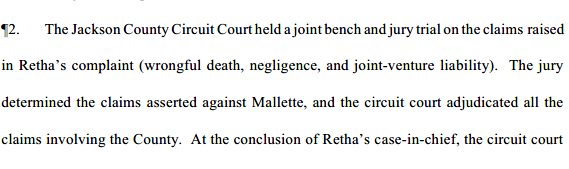
NOTE – This was another was with an MTCA defendant and a non-MTCA defendant. In addition to the county, the plaintiff sued Mallette, a construction company that had repaved the road prior to the acccident. The trial court held a hybrid jury/bench trial:

At the conclusion of the plaintiff’s case-in-chief, the circuit involuntarily dismissed the joint venture claim against the County and Mallette. At the conclusion of the trial, the jury returned a verdict in favor of Mallette. The circuit court then entered findings of fact and conclusions of law concluding that the county created a dangerous condition but that the driver’s negligence was the sole proximate cause of the accident and therefore held that the county was not liable.


Dyer v. State, 2021-KA-00016-COA (Criminal – Felony/Sexual Battery)
Affirming conviction of sexual battery of a teenage girl, noting that the defendant’s appointed counsel had filed a Lindsey brief, the defendant had not filed his own brief, and that the Court’s review of the record yielded no arguable issues of appeal.
(All judges concurred.)


Smith v. Public Employees Retirement System of Mississippi, 2021-SA-00051-COA (Civil – State Boards and Agencies/PERS)
Affirming denial of a correctional offer’s application for duty-related benefits, holding that the PERS decision was not clearly erroneous, contrary to law and not supported by substantial evidence.
(All judges concurred.)


Wofford v. State, 2020-KA-01341-COA (Criminal – Felony/Burglary/Accomplice Liability)
Affirming convictions of and sentences for two counts of burglary of a dwelling, holding that the circuit court did not err when it denied the defendant’s motion for directed verdict, his request for a peremptory instruction, or his motion for JNOV arguing that he could not be convicted of burglary because there was no evidence that he had broken, entered, or stolen, because the Court reasoned the defendant was indicated for burglary as a principal based on his actions as an accessory before the fact; the circuit court did not err in giving an accomplice-liability instruction; and the circuit court did not err in granting the State’s motion in limine excluding testimony about the amount of money that was taken in the burglary.
(Judge McDonald concurred in result only without separate written opinion. Judge Smith did not participate.)


Adams v. State, 2020-KA-01383-COA (Criminal – Felony/Armed Robbery/Indictment)
Affirming conviction of armed robbery, holding that the jury’s verdict was not against the overwhelming weight of the evidence; that the circuit court did not err by not sua sponte preventing a former associate of the defendant from testifying that he had pleaded guilty to the armed robbery in question in response to a question that was not objected to; that the circuit court did not err by allowing the defendant’s former associate’s recorded interview to be played at trial; that although the State’s attempts to amend the indictment were ineffective because the State failed to procure a written order allowing the indictment, the original indictment was not fatally defective; and that the defendant was not entitled to a new trial under the cumulative error doctrine.
(Judge Westbrooks concurred in result only without separate written opinion.)


Smart v. State, 2020-KA-00835-COA (Criminal – Felony/Exploitation of a Child/Social Media)
Affirming conviction of exploitation of a child and a twenty-year sentence, holding that there was no error in the admission of Kik messages because they had been sufficiently authenticated and that there was no prosecutorial misconduct in stating that the Kik messages were from the defendant and correlated with a printout of the defendant’s phone records.
(Judge Wilson concurred in part and in the result without separate written opinion.)

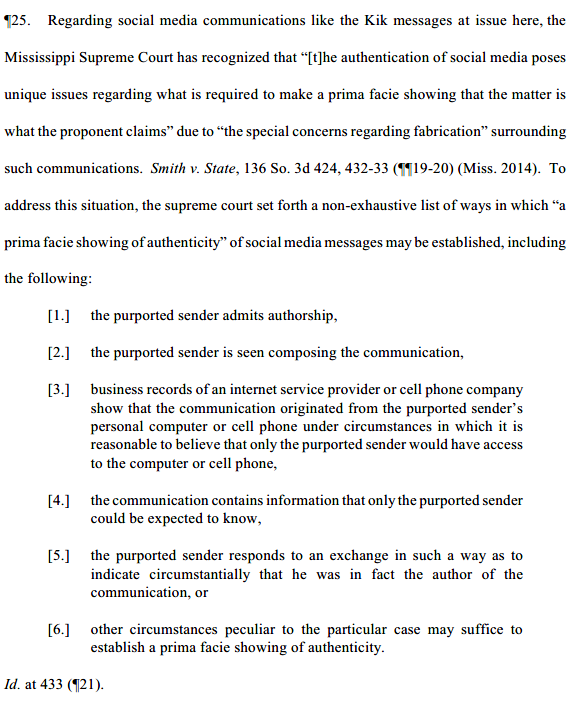
Practice Point – If you need to get social media communications admitted (or if you are trying to keep them out) here is the Mississippi Supreme Court’s guidance, as stated by the Court of Appeals in this opinion:


Briggs v. State, 2020-KM-01350-COA (Criminal – Misdemeanor)
Affirming conviction of driving under the influence of marijuana and simple possession of marijuana in a motor vehicle, holding that the evidence was sufficient to support his conviction and that the conviction was not against the overwhelming weight of the evidence.

NOTE – The defendant argued that the State failed to prove he was “influenced” by the marijuana because the State Trooper testified that he never saw the defendant operate the vehicle except to pull the vehicle to the side of the road. The unimpressed Court noted that the State does not have the burden of proving impaired driving, and that the Trooper’s testimony that he smelled strong marijuana odor from the vehicle and observed the defendant’s watery and bloodshot eyes was sufficient.


Dunn v. Hart, 2020-CA-01229-COA (Civil – Wills, Trusts, and Estates)
Affirming the chancery court’s findings that the testator/mother had mental capacity to execute a 2015 will but that one of her children (who happened to be the recipient of the mother’s entire estate in the will) failed to rebut the presumption of undue influence by clear and convincing evidence.

NOTE – This is a fact-bound opinion and I do not think any summary I could write of the facts would be particularly helpful, and it would certainly not be a substitute for reading this opinion if it applies to your practice.


Other Orders

Manhattan Nursing and Rehabilitation Center, LLC v. Hollinshed, 2020-CA-00882-COA (denying rehearing)


Hand Down Page

Mississippi Supreme Court decisions of April 28, 2022

After some sort of technical hiccup with the State’s web domain that knocked the Mississippi Supreme Court’s website offline for a spell, they are back in business. The Court handed down one hearty opinion in a wrongful death case that involves § 1983, qualified immunity, the MTCA, the appealability of summary judgment denials, and hearsay.


City of Jackson v. Johnson, 2020-CA-00318-SCT (Civil – Tort/Wrongful Death/1983/MTCA)
Reversing and rendering a jury verdict holding the City liable under § 1983 and affirming the trial court’s judgment finding the City liable under the MTCA for the decedent’s wrongful death. The victim was murdered shortly after calling 911 to report a prowler. The dispatcher did not tell the victim to remain on the line, in violation of the City’s policies and procedure. Two JPD officers went to the victim’s house, did not detect that the prowler had entered a window, did not make contact with the victim, and left. The victim was found dead the next day. The victim’s family filed suit under § 1983 and under the MTCA.

The 911 operator and officers got out via qualified immunity on summary judgment. The § 1983 case was tried by a jury and the MTCA case was tried “simultaneously” before the bench. The jury found that the City violated the victim’s constitutional rights to due process and awarded $1M in damages. The trial court awarded $500,000 (i.e. the statutory maximum) under the MTCA.

On appeal, the Mississippi Supreme Court held that the City was entitled to a directed verdict on the § 1983 claim, reasoning that our constitutional due process rights do not include the right to be protected by the state from acts of private violence. Regarding the MTCA claim, the Supreme Court held that the 911 dispatcher’s conduct in responding to the victim’s call did not involve an element of choice or judgment and the City was therefore not protected by discretionary function immunity from liability under the MTCA.

There was a hearsay issue involving the defendant’s statement contained in the police report that warrants a brief discussion. The trial court admitted the police report, but with the assailant’s statement to police redacted, finding that the assailant could not be compelled to testify against himself and that hearsay exception in Rule 804(b)(3) did not apply because the statement was not being used against the assailant/declarant. Later in the trial, the court allowed the plaintiff’s expert to reply on the assailant’s statement in forming his opinions over the City’s objection that the expert had relied on inadmissible hearsay. The Mississippi Supreme Court did not have to address the argument that the expert’s testimony was a “conduit for otherwise inadmissible hearsay” because it held that that the assailant’s statement to police was admissible under the Rule 804(b)(3) exception after all, so there was no error in admitting the expert testimony that relied upon it.

(Chief Justice Randolph wrote a special concurrence, joined in part by Justice Maxwell, Justice Chamberlin, Justice Ishee, and Justice Griffis. Justice Griffis also wrote a special concurrence.)

Practice Point – I found it remarkable that the Mississippi Supreme Court heretofore had not addressed the issue of whether the denial of a motion for summary judgment can be appealed after a trial. They did here, and now we know:

One More Thing – We were this close (maybe) to the Mississippi Supreme Court addressing one of my pet issues: When a case involves an MTCA defendant and a non-MTCA defendant how, exactly, should a hybrid bench/jury trial proceed?


Other Orders

Hutto v. State, 2017-DR-01207-SCT (granting the plaintiff’s Motion for Leave to File Rebuttal to Opposition to Motion for Appointment of Counsel for Representation for Successive Petition for Post-Conviction Relief and the State’s Motion for Leave to File Surrebuttal in Opposition to Motion for Appointment of Counsel for Representation for Successive Petition for Post-Conviction Relief)

Randle v. Randle, 2020-CT-0033-SCT (granting cert)

McPhail v. McPhail, 2020-CA-00739-SCT (denying Motion Pursuant to Rule 8 and Rule 27 of the Rules of Appellate Procedure is hereby denied and remanding to the chancery court of Grenada County for an adjudication of a request for release on bond pending appeal in light of his child support payment subsequent to the February 24, 2022 denial of his prior motion)

HL&C Marion, LLC v. DIMA Homes, Inc., 2020-CT-00750-SCT (CORRECTION: granting cert 6-0)

Williams v. State, 2020-KA-772-SCT (denying rehearing)

Morningstar v. Perkins Law Firm, 2020-CT-1203-SCT (denying cert)

Embrey v. Young, 2021-CT-91-SCT (denying cert)


Hand Down Page

Summaries of the Mississippi Court of Appeals opinions of March 29, 2022

The Court of Appeals handed down one opinion today that is part MTCA decision on the open and obvious defense and part cautionary tale about the hazards of, and interplay among, Rules 54(b), 59(b), and 60(b) of the Mississippi Rules of Civil Procedure and Rule 3 of the Mississippi Rules of Appellate Procedure. Since I just had one opinion to wrestle with today I took a deeper dive into the timeline and the motions filed at the trial court level.


McGee v. Neel Schaffer Engineers and Planners Inc., 2020-CA-01277-COA (Civil – Wrongful Death)
Affirming in part the circuit court’s order granting summary judgment as to some defendants and dismissing the appeal as to the other defendants. The plaintiff’s decedent died of electrocution while moving a water pump on a State-aid culvert reinforcement project due a conflict with a utility line. The plaintiff filed suit against Pike County, Toles (the County’s State-aid engineer), Neel Schaffer (the engineer’s employer), and others not relevant to this appeal. The timeline is key to unpacking this opinion:

  • July 27, 2018: Summary judgment granted to Neel Schaffer’s because Toles was acting as a county employee and immune under the MTCA and that as a corollary Neel Schaffer, as Toles’s employer, was entitled to MTCA immunity. Final judgment entered as to the claims against Neel Schaffer using the magic words of Rule 54(b) (i.e. “final judgment” and “no just reason for delay”).
  • August 1, 2019: Summary judgment granted in favor of Toles on the claims against him in his individual capacity because it had previously determined Toles was entitled to MTCA immunity. Final judgment entered as to these claims.
  • June 18, 2020: The plaintiff filed a “motion to reconsider” the July 27, 2018, and August 1, 2019, summary judgments.
  • September 21, 2020: Plaintiff’s motion to reconsider was properly treated as a Rule 60(b) motion rather than a Rule 59(b) motion because it was filed more than ten days after the judgments had been entered, found to be untimely and meritless under Rule 60(b), and therefore denied.
  • October 28, 2020: Summary judgment granted as to the claims against Pike County and Toles in his official capacity, finding that they were entitled to immunity under the MTCA.
  • November 17, 2020: The plaintiff appealed from the summary judgments of July 27, 2018; August 1, 2019; and October 28, 2020, but not the September 21, 2020 denial of the motion to reconsider.
  • November 24, 2020: Neel Schaffer and Toles in his individual capacity filed a motion to dismiss the appeal as untimely.
  • November 25, 2020: The circuit court entered a final judgment as to the claims against Pike County and Toles in his official capacity.
  • December 4, 2020: Plaintiff filed an amended notice of appeal, again appealing only the summary judgments.
  • December 8, 2020: Neel Schaffer and Toles filed a second joint motion to dismiss the appeal as untimely.

The Court of Appeals first addressed the July 27, 2018, and the August 1, 2019, final judgments, and held that because the plaintiff did not file a motion to reconsider within ten days of either judgment or a notice of appeal within thirty days of either judgment, the plaintiff’s appeal of those judgments was untimely.

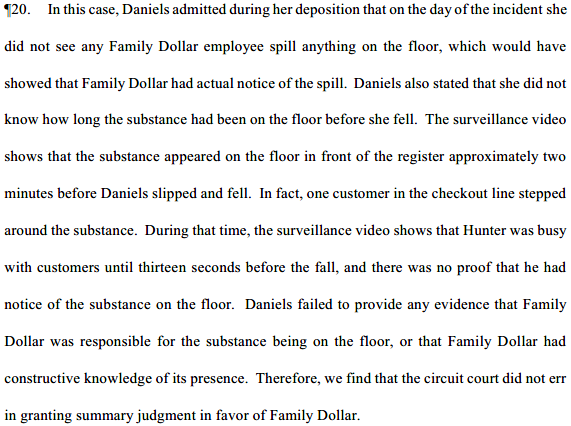
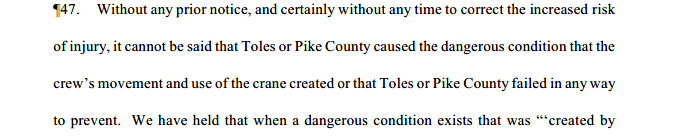
The Court of Appeals then addressed the dismissal of the claims against Pike County and Toles, holding that the circuit court did not err in finding that the dangerous condition was open and obvious, was not created by the government’s negligent maintenance or repair and it, and was not caused by Toles. The Court noted that the issue of whether a danger is open and obvious is usually a question for the trier of fact, but that there are cases where conditions are so clearly dangerous that the issue can be decided as a matter of law. The Court also held that neither Pike County nor Toles could be liable for causing a dangerous condition created by a third-party without notice and sufficient time to correct the dangerous condition:

(All judges concurred)

PRACTICE POINT: If you win summary judgment as to fewer than all claims/parties, request a 54(b) final judgment like the defendants did here. If the other side wins summary judgment as to fewer than all claims/parties, beware of a 54(b) final judgment that starts your appeal shot clock.


Other Orders

Wilson v. State, 2020-CP-00762-COA (denying motion for rehearing)
Hardin v. Hardin, 2020-CA-1314-COA (denying appellee’s motion for appellate attorney’s fees)
Jiles v. State, 2021-CP-34-COA (denying motion for rehearing)


Hand Down List

Summaries of the Mississippi Court of Appeals opinions of March 15, 2022

The Mississippi Court of Appeals handed down six opinions today with a little something for everybody. There are two real-property decisions, two PCR denials, one criminal conviction affirmed, and an MTCA/12(b)(6) decision.


DeSoto County v. Vinson,  2021-CA-00122-COA (Civil – Real Property/Division of Subdivision Lot)
Affirming the circuit court’s decision reversing a DeSoto County Board of Supervisors decision regarding the division of a subdivision lot into two separate residential lots, holding that the circuit court did not err in ruling that the properly owner should resubmit an application to divide property with written approval of “adversely affected” and “directly interested” parties or proceed under section 19-27-31 in chancery court.
(All judges concurred)


Land v. Land, 2021-CA-00402-COA (Civil – Real Property/Partition of Property)
Affirming the chancellor’s denial of complaint for partition, holding that chancellor did not err in ruling that the residential property claimed as homestead property by one party could only be partitioned by written agreement of the parties and could not be involuntarily partitioned by chancery court decree.
(All judges concurred)


Bridges v. State, 2020-CA-00816-COA (Civil – PCR)
Affirming the circuit court’s denial of a motion for post-conviction relief, holding that the circuit court did not err in finding that there was insufficient evidence to prove that the second PCR motion satisfied a statutory exemption to procedural bars and that the evidence did not show good cause for failing to provide additional affidavits.
(Judge Westbrooks concurred in part and in result, joined by Judge McDonald and Judge Lawrence, and joined in part by Judge McCarty)


Jackson v. State, 2021-KA-00292-COA (Criminal – Felony)
Affirming conviction of sexual battery and filming a minor engaging in sexually explicit conduct and a sentence to serve consecutive terms of thirty years and forty years, holding that there were no arguable issues for appeal based upon a Lindsey brief and the Court’s independent review of the record.
(All judges concurred)


Horton v. State, 2021-CP-00383-COA (Civil – PCR)
Affirming the circuit court’s denial of a PCR motion, holding that the circuit court did not err in ruling that the sentence was not unconstitutional and that his confession was voluntary.
(All judges concurred)


J.D. v. McComb School District, 2020-CA-00022-COA (Civil – Personal injury/Civil Procedure/12(b)(6))
Reversing the circuit court’s ruling granting the defendant’s motion to dismiss for failure to state a claim upon which relief can be granted, holding that the plaintiff’s allegations that a minor was attacked at school and that the school district had knowledge of similar conduct by the attacker and breached its ministerial duty to use ordinary care and to take reasonable steps to minimize foreseeable risk to the plaintiff.
(Judge Smith dissented, joined by Judge Greenlee and Judge Lawrence and joined in part by Judge Emfinger)

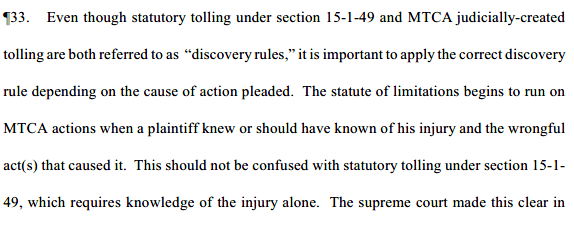
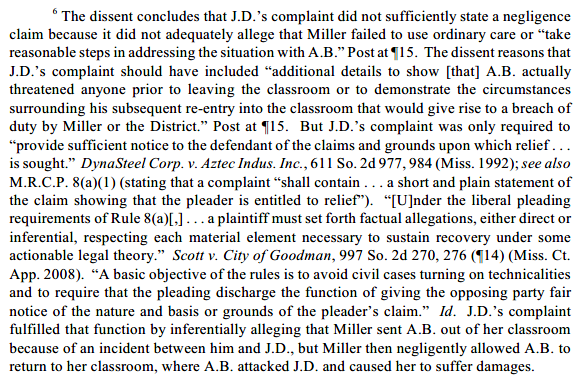
Practice Point: In footnote 6, the majority opinion addressed and rejected the dissent’s argument that the plaintiff should have included additional details regarding the alleged prior conduct of the attacker, summarizing the liberal pleading requirements of Rule 8:


Other Orders

None


Hand Down List Page