Mississippi Supreme Court Decisions of March 7, 2024

The Mississippi Supreme Court handed down four opinions last Thursday. There is an appeal of the dismissal of an MTCA claim on summary judgment, an appeal of a Medicaid reimbursement-rate decision, and an appeal by a victorious pro se party. The headliner, however, is the appeal of Willie Godbolt’s convictions for the infamous 2017 shooting of eight people in Lincoln County.


Federinko v. Forrest County, Mississippi, 2023-CA-00204-SCT (Civil – MTCA)
Affirming the trial court’s grant of summary judgment for the defendant, holding that the plaintiff failed to allege a tortious or negligent act with respect to the MTCA defendants’ decision not to conduct an autopsy or obtain postmortem blood and fluids.
(9-0)


Mississippi Division of Medicaid v. Women’s Pavilion of South Mississippi, PLLC, 2023-SA-00098-SCT (Civil – State Boards & Agencies)
Affirming the chancery court’s decision vacating Medicaid’s reimbursement-rate decision, holding that the administrative officer did not have to defer to Medicaid’s initial decision but was to make findings of fact and a determination of the issues presented.
(8-0: Beam did not participate)


Stratton v. McKey, 2023-CP-00451-SCT (Civil – Other)
Affirming the circuit court’s denial of the pro se plaintiff’s Rule 60 motion to vacate a judgment in his favor that awarded him possession of his classic truck and monetary damages.
(9-0)


Godbolt v. State, 2020-DP-00440-SCT (Criminal – Death Penalty – Direct Appeal)
Affirming conviction of four counts of capital murder, four counts of first-degree murder, two counts of kidnapping, one count of attempted murder, and one count of armed robbery garnering four death sentences, six life sentences, and two twenty-year terms, holding that the trial court did not err in (1) denying a motion to server; (2) transferring venue to a neighboring county (with a jury drawn from a distant county); (3) “limiting” voir dire where the process lasted four days and produced nearly 800-pages of transcript; (4) denying a motion to suppress statements made to media and law enforcement; (5) denying a motion to suppress evidence obtained from the defendant’s home, vehicle, cell phone, other electronic devices; (6) allowing the defendant’s wife to testify under Rule 601(b)(2); (7) admitting evidence of prior bad acts; (8) admitting 911 calls; (9) not ordering a psychiatric evaluation that the defendant opposed; (10) admitting Facebook messages over an authentication objection; (11) only allowing the defendant (who exercised his right not to testify) limited time for allocution during closing arguments; (12) denying motion to exclude victim impact evidence; and the Supreme Court also (13) deferred the ineffective assistance claim to the PCR phase; (14) held that there was no Brady violation regarding the destruction of the defendant’s phone after all data and information from the phone were given to the defendant; (15) that the defendant’s right to an impartial jury was not violated; (16) held that there was no evidence of prosecutorial misconduct; (17) that the “heinous, atrocious or cruel” aggravator was not unconstitutional; (18) that the death penalty was not unconstitutional; (19) that the death penalty was not disproportional; (20) and that there was no error, so the cumulative error argument was without merit.
(7-2: King dissented, joined by Kitchens)

NOTE– You should never treat my summaries as a substitute for reading cases that you intend to rely on. This is especially true in a case like this one. This is probably the longest summary I have posted, but I have only scratched the surface.


Other Orders

Love v. State, 2021-CT-01101-SCT (granting pro se cert petition)

Norwood v. Smith, 2021-IA-01404-SCT (dismissing interlocutory appeal)

Rehabilitation Centers, Inc. v. Williams, 2023-CT-00453-SCT (denying in part and dismissing in part petition for cert and reverse and stay of mandate or in the alternative petition for interlocutory appeal)
Hand Down Page

Mississippi Supreme Court Decisions of May 26, 2022

The Mississippi Supreme Court handed down two opinions today and each packs a punch. Webb v. State has a thorough and concise analysis of issues surrounding the authentication of screenshots of Snapchat messages. Ware v. Ware is a multifaceted, chancery court battle-royale among family of the decedent involving primarily the fate of the decedent’s shares of family corporations.


Webb v. State, 2021-KA-00082-SCT (Criminal – Felony/Authentication of Social Media)
Affirming conviction of one count of fondling and three counts of sexual battery of two underage girls, holding that the circuit court did not abuse its discretion in a slew of evidentiary rulings including (1) the admission of prior sexual abuse by the defendant; (2) the admission of a photo of an entry from a diary belonging to one of the victims; (3) the admission of screenshots of Snapchat messages over an authentication and unfair prejudice challenges; and (4) the admission of text messages between the defendant and one victim’s mother. The Supreme Court was unpersuaded by the defendant’s final argument that his conviction was against the weight of the evidence.
(All justices concurred.)

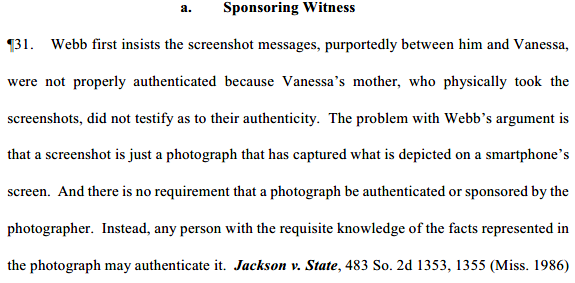
Practice PointThis is a case to bookmark for authenticating social media content or other screenshot material. The Supreme Court took a deep dive into the issue of authenticating the Snapchat screenshots at issue in this case. The screenshots at issue were taken by one victim’s mother, but the mother did not provide authenticating testimony. The Court analogized screenshots to photos, and held that screenshots do not have to be authenticated by the person who took the screenshot:

[Legal writing sidebar: I like Justice Maxwell’s use of “And” to start the third sentence. We were all told at some point that one should never begin a sentence with a conjunction. But I think doing so here effectively added clarity and concision to the opinion.]

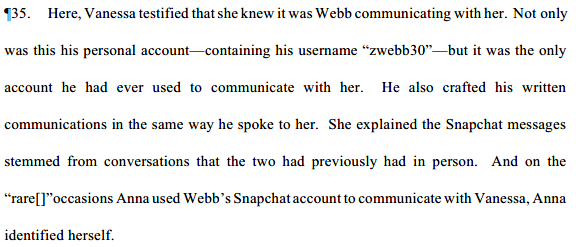
The defendant also asserted that the State failed to offer an adequate foundation for the screenshots because they did not prove that he was on the “other side” of the Snapchat communications with one of the victims. The Supreme Court noted that something more than a profile photo and an account name is required, but that “something more” can be established in many ways including circumstantial evidence:


Ware v. Ware, 2020-CA-00702-SCT (Civil – Wills, Trusts, and Estates)
Affirming in part and reversing/remanding in part a direct appeal and affirming in part and dismissing as moot in part a cross-appeal of a messy, consolidated estate case and corporate dissolution case between and among a surviving wife and the three children (a son and two daughters) she had with the decedent. The decedent owned 25% each of four family corporations. His will placed most of his assets including these shares into testamentary trusts for which his wife and three children were trustees, and the primary beneficiary was the wife with limited distribution potential to the children. Unsurprisingly, litigation ensued over how to manage the corporations and dispersion of the decedent’s assets.

The son filed for dissolution of the corporation, the chancellor denied the daughters’ motions to join/intervene, the chancellor appointed a receiver by agreed order, and the chancellor ultimately ordered that the shares by offered for sale to the corporations and then the dissolution of the corporations. The daughters appealed the denial of their motions to join/intervene and the wife appealed “a multitude of issues.” The son cross-appealed the chancellor’s net asset value determination date and methodology.

The Mississippi Supreme Court (1) reversed the chancellor’s ruling that the estate must offer the shares to the corporation prior to transferring them to the trusts, (2) affirmed the chancellor’s denial of the motions to intervene, (3) affirmed the chancellor’s decision to dissolve the corporations, and (4) reversed the dissolution judgment to the extent that it allowed the corporations to purchase shares from the estate. Accordingly, the Court remanded the case back to the chancery court to determine how to distribute the money from the sales of the corporations in which the estate holds 25% of the corporate shares.
(Chief Justice Randolph did not participate.)

Note – There is a lot more happening in the details of this opinion that I am not going to wade into here. If something mentioned above touches your practice areas, you will need to dive in yourself.


Other Orders

Grayson v. State, 1998-DP-01782-SCT (dismissing pro se motion to carry out execution forthwith)

Sims v. Sims, 2020-CT-00327 (denying cert) (grandparents, if you want to spend a lot of money to accomplish little more than firebombing your family, suing your children for grandparent visitation may be right for you)

Westmoreland v. State, 2020-CT-00509-SCT (denying cert)

Wilson v. State, 2020-CT-00762-SCT (denying cert)

Flechas v. The Mississippi Bar, 2021-BA-01051-SCT (granting motion to accept the irrevocable resignation of Eduardo A. Flechas)

In Re: Hon. James McClure, III and Hon. Gerald W. Chatham, Sr., 2022-IA-00319-SCT (treating petition for writ of prohibition filed by Circuit Court Judges James McClure, III, and Gerald W. Chatham, Sr., as a petition for interlocutory appeal pursuant to M.R.A.P. 5; granting permission to appeal, and directing all judges of the Circuit Court of the Seventeenth Judicial District are hereby to appear before Mississippi Judicial College Director Randy G. Pierce for a conference to consider the simplification of the issues and such other matters as may aid in the disposition of the proceeding by the Court, including settlement)


Hand Down List

Mississippi Court of Appeals decisions of May 3, 2022

There is no peddling of leaked drafts on this blog, folks. Just genuine, final opinions from the Mississippi Court of Appeals and Mississippi Supreme Court, locally sourced and responsibly harvested from the Court’s official hand down page. Today, we have eight opinions from the Mississippi Court of Appeals including several criminal cases (one involving the admissibility of social media messages), an auto liability/road construction case with another MTCA-related hybrid bench/jury trial, a will contest, and PERS disability case.


Simmons v. Jackson County, Mississippi, 2020-CA-01014-COA (Civil – Wrongful Death/MTCA/Auto Liability/Hybrid Trial)
Affirming circuit court’s ruling that the county bore no responsibility for a driver’s fatal accident that occurred when his vehicle left the road and struck a culvert, holding that there was sufficient evidence to support the circuit court’s finding that the driver’s negligence in failing to exercise vigilant caution as he drove through a work zone was the sole proximate cause of the accident.
(Judge Westbrooks dissented, joined by Judge Carlton and Judge McDonald.)

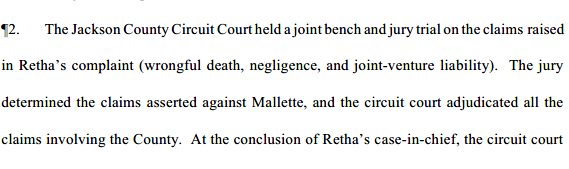
NOTE – This was another was with an MTCA defendant and a non-MTCA defendant. In addition to the county, the plaintiff sued Mallette, a construction company that had repaved the road prior to the acccident. The trial court held a hybrid jury/bench trial:

At the conclusion of the plaintiff’s case-in-chief, the circuit involuntarily dismissed the joint venture claim against the County and Mallette. At the conclusion of the trial, the jury returned a verdict in favor of Mallette. The circuit court then entered findings of fact and conclusions of law concluding that the county created a dangerous condition but that the driver’s negligence was the sole proximate cause of the accident and therefore held that the county was not liable.


Dyer v. State, 2021-KA-00016-COA (Criminal – Felony/Sexual Battery)
Affirming conviction of sexual battery of a teenage girl, noting that the defendant’s appointed counsel had filed a Lindsey brief, the defendant had not filed his own brief, and that the Court’s review of the record yielded no arguable issues of appeal.
(All judges concurred.)


Smith v. Public Employees Retirement System of Mississippi, 2021-SA-00051-COA (Civil – State Boards and Agencies/PERS)
Affirming denial of a correctional offer’s application for duty-related benefits, holding that the PERS decision was not clearly erroneous, contrary to law and not supported by substantial evidence.
(All judges concurred.)


Wofford v. State, 2020-KA-01341-COA (Criminal – Felony/Burglary/Accomplice Liability)
Affirming convictions of and sentences for two counts of burglary of a dwelling, holding that the circuit court did not err when it denied the defendant’s motion for directed verdict, his request for a peremptory instruction, or his motion for JNOV arguing that he could not be convicted of burglary because there was no evidence that he had broken, entered, or stolen, because the Court reasoned the defendant was indicated for burglary as a principal based on his actions as an accessory before the fact; the circuit court did not err in giving an accomplice-liability instruction; and the circuit court did not err in granting the State’s motion in limine excluding testimony about the amount of money that was taken in the burglary.
(Judge McDonald concurred in result only without separate written opinion. Judge Smith did not participate.)


Adams v. State, 2020-KA-01383-COA (Criminal – Felony/Armed Robbery/Indictment)
Affirming conviction of armed robbery, holding that the jury’s verdict was not against the overwhelming weight of the evidence; that the circuit court did not err by not sua sponte preventing a former associate of the defendant from testifying that he had pleaded guilty to the armed robbery in question in response to a question that was not objected to; that the circuit court did not err by allowing the defendant’s former associate’s recorded interview to be played at trial; that although the State’s attempts to amend the indictment were ineffective because the State failed to procure a written order allowing the indictment, the original indictment was not fatally defective; and that the defendant was not entitled to a new trial under the cumulative error doctrine.
(Judge Westbrooks concurred in result only without separate written opinion.)


Smart v. State, 2020-KA-00835-COA (Criminal – Felony/Exploitation of a Child/Social Media)
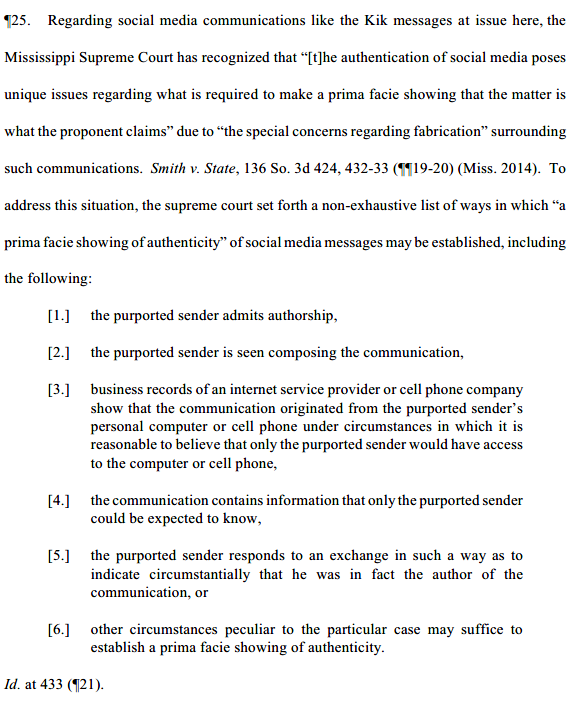
Affirming conviction of exploitation of a child and a twenty-year sentence, holding that there was no error in the admission of Kik messages because they had been sufficiently authenticated and that there was no prosecutorial misconduct in stating that the Kik messages were from the defendant and correlated with a printout of the defendant’s phone records.
(Judge Wilson concurred in part and in the result without separate written opinion.)

Practice Point – If you need to get social media communications admitted (or if you are trying to keep them out) here is the Mississippi Supreme Court’s guidance, as stated by the Court of Appeals in this opinion:


Briggs v. State, 2020-KM-01350-COA (Criminal – Misdemeanor)
Affirming conviction of driving under the influence of marijuana and simple possession of marijuana in a motor vehicle, holding that the evidence was sufficient to support his conviction and that the conviction was not against the overwhelming weight of the evidence.

NOTE – The defendant argued that the State failed to prove he was “influenced” by the marijuana because the State Trooper testified that he never saw the defendant operate the vehicle except to pull the vehicle to the side of the road. The unimpressed Court noted that the State does not have the burden of proving impaired driving, and that the Trooper’s testimony that he smelled strong marijuana odor from the vehicle and observed the defendant’s watery and bloodshot eyes was sufficient.


Dunn v. Hart, 2020-CA-01229-COA (Civil – Wills, Trusts, and Estates)
Affirming the chancery court’s findings that the testator/mother had mental capacity to execute a 2015 will but that one of her children (who happened to be the recipient of the mother’s entire estate in the will) failed to rebut the presumption of undue influence by clear and convincing evidence.

NOTE – This is a fact-bound opinion and I do not think any summary I could write of the facts would be particularly helpful, and it would certainly not be a substitute for reading this opinion if it applies to your practice.


Other Orders

Manhattan Nursing and Rehabilitation Center, LLC v. Hollinshed, 2020-CA-00882-COA (denying rehearing)


Hand Down Page