Mississippi Court of Appeals Decisions of September 27, 2022

The Mississippi Court of Appeals handed down nine opinions today (and one off-cycle opinion last Thursday). There are several criminal cases (including one with a “marijuana made me do it” defense), a real property case, a lawyer money-fight case, a workers’ comp case, a domestic case, and a couple of PCR cases.


Clemts v. State, 2021-KA-01013-COA (Criminal – Felony)
Affirming conviction of aggravated assault, holding that the verdict was not against the overwhelming weight of the evidence which included testimony that the defendant, the victim, and others were in an argument and the victim grabbed the defendant in an effort to get the defendant to leave the house and the defendant “wheeled around” and stabbed the victim in the abdomen.
(10-0)


Edwards v. State, 2021-KA-00261-COA (Criminal – Felony)
Affirming conviction of second-degree murder and the circuit court’s denial of the defendant’s post-trial motion, holding that there was no error in denying the defendant’s lesser-included culpable negligence manslaughter instruction because there was “no evidence in the record that ingesting marijuana caused the defendant to stab a man eight times.”
(10-0)

NOTE – Might need to consider keeping the reefer madness defense on the shelf.


Loblolly Properties LLC v. Le Papillon Homeowner’s Association Inc., 2021-CA-00767-COA (Civil – Real Property)
Affirming the chancery court’s grant of summary judgment in favor of a HOA over restrictive covenants on lots that were purchased after a foreclosure sale, holding that the bank that purchased the properties after foreclosure agreed that the property was bound by the covenants and the subsequent purchaser then obtained the property by warranty deed that provided that the conveyance was subject to restrictive covenants of record.
(3-3-4: Chief Judge Barnes, Judge McCarty, and Judge Emfinger concurred in part and in the result without separate written opinion; Judge Wilson dissented, joined by Judge Greenlee, Judge Lawrence, and Judge Smith)

NOTE – Put this one on your cert watch list. A fractured, 3-3 majority in favor of affirming carried the day, but the four-judge dissent raised some big-picture issues with the majority opinion.


Hollis v. Acoustics, Inc., 2021-WC-01261-COA (Civil – Workers’ Compensation)
Affirming the MWCC’s ruling that the claimant did not sustain a compensable injury, holding that a injuries from a physical fight with racial slurs stemming from a disagreement regarding the relative merits of playing Christian rap versus country music at the worksite was not a work-related injury where the claimant also admitted that he willfully shoved the other person in a manner not necessary for self-defense.
(10-0)


Scott v. Rouse, 2021-CP-01029-COA (Civil – Domestic Relations)
Affirming the chancery court’s rulings on several divorce enforcement matters after the ex-husband faked his own death, was apprehended, and then (with the help of his mother) claimed his ex-wife had wrongful retained his property, holding that all issues were procedurally barred because they were either the subject of a prior timely judgment that had not been timely appealed or the pro se appellants had failed to designated an adequate record for their appeal.
(9-0: Judge Lawrence did not participate.)


Wess v. State, 2020-CP-00704-COA (Civil – PCR)
Affirming the circuit court’s denial of the PCR motion asserting an illegal sentence, holding that the plaintiff’s argument that his sentence was illegal because he was not given the opportunity to withdraw his guilty plea was without merit.
(6-3-0: Chief Judge Barnes and Judge Emfinger concurred in part and in the result without separate written opinion; Judge Wilson concurred in the result only without separate written opinion; Judge Lawrence did not participate.)


Cooper v. State, 2021-CP-01004-COA (Civil – PCR)
Affirming the circuit court’s denial of the plaintiff’s PCR motion, holding that the “writ of habeas corpus” should have been denied because the plaintiff filed it in the circuit court of the county of incarceration (instead of the county of conviction) which lacked jurisdiction to hear the PCR motion.
(10-0)


Wooten v. State, 2021-KA-00737-COA (Criminal – Felony)
Affirming conviction of aggravated domestic violence for shooting her boyfriend, holding that the trial court did not abuse its discretion in allowing evidence that the defendant had previously stabbed her ex-husband because it was admissible to show that the shooting of her boyfriend was not an accident or mistake and that the trial court did not err in (1) denying a motion to continue because the defendant had not availed herself of the court’s “considerable powers” to compel the witness’s attendance, (2) sustaining the State’s objection to some of the defendant’s testimony about alleged threats the victim made a month before the shooting, and (3) not sending law enforcement to obtain a witness’s presence after defense counsel declined the trial court’s offer to issue a bench warrant.
(7-3-0: Judge Wilson and Judge Westbrooks concurred in part and in the result; Judge McDonald concurred in result only without separate written opinion.)


Virden v. Campbell Delong, LLP, 2021-CA-00478-COA (Civil – Contract)
Affirming the trial court’s grant of the defendant’s motion for declaratory judgment, holding that a former partner’s claim for a greater share of proceeds from a settlement he obtained while working for the firm was barred by a written agreement governing the withdrawal, termination, or retirement of any partner from the firm.
(5-5: Judge Wilson dissented, joined by Chief Judge Barnes, Judge Greenlee, Judge Lawrence, and Judge Emfinger.)

NOTE – Here is another one for cert-watch: a lawyer-fight over money and a 5-5 decision that leaves the trial court’s ruling in place.


Davis v. State, 2021-KA-00416-COA (Sept. 22, 2022) (Criminal – Felony)
Affirming conviction of felonious abuse of a vulnerable person, holding that the sufficiency and weight of the evidence was adequate to support the conviction and that the trial court did not err in refusing the defendant’s proposed jury instruction for the offense of simple domestic violence.
(4-1-5: Judge Greenlee concurred in part and in the result without separate written opinion; Chief Judge Barnes concurred in part and dissented in part, joined by Judge Wilson, Judge Westbrooks, Judge McDonald, and Judge Emfinger.)


Other Orders

Trotter v. State, 2020-CA-00094-COA (denying rehearing)
Thomas v. Boyd Biloxi, LLC, 2021-CA-00265-COA (denying rehearing)
McCarty v. State, 2021-KA-00418-COA (dismissing untimely pro se motion for rehearing)
Lennon v. Lowrey & Fortner, P.A., 2021-CA-00426-COA (denying appellee’s motion for appellate fees; denying motion for rehearing)
Avery v. The University of Mississippi, 2021-CA-00471-COA (granting motion for correction or modification of the Court’s opinion)
Gilmer v. State, 2022-TS-00257-COA (denying State’s motion to strike notice of appeal as untimely)
Morgan v. State, 2022-TS-00287-COA (dismissing appeal as untimely)
Rutledge v. State, 2022-TS-00677-COA (finding good cause to suspend the appeal deadline so the appeal can proceed on the merits)


Hand Down List

Mississippi Supreme Court Decisions of August 25, 2022

After a full day of lawyering on the road, here are my summaries of today’s decisions from the Mississippi Supreme Court. There is a decision in a dispute between a report and the Secretary of State over use and development of tidelands, a decision in a reimbursement dispute between the Division of Medicaid and a nursing home, and a decision in a workers’ comp bad faith case analyzing whether a compromise settlement of a comp claim on a denied basis constituted an exhaustion of administrative remedies.


State v. Long Beach Harbor Resort, LLC, 2021-CA-00430-SCT (Civil – State Boards and Agencies)
Affirming the chancery court’s grant of summary judgment in favor of the resort, holding that the Secretary of State’s lease with the city related to development and use of tidelands had ratified a prior lease between the city and the resort and therefore the State had no right to require the resort to enter into a separate tidelands lease.
(9-0)


Mississippi Division of Medicaid v. Yalobusha County, 2021-SA-00030-SCT (Civil – State Boards and Agencies)
Reversing the chancery court’s ruling in a dispute between the DOM and a nursing home over costs the facility submitted for reimbursement on its Medicaid cost report, holding that the DOM correctly interpreted statutes and its decisions denying the costs at issue were supported by substantial evidence.
(7-2: Justice Griffis dissented, joined by Justice Maxwell)


Thornhill v. Walker-Hill Environmental, 2020-CT-01181-SCT (Civil – Torts/Bad Faith)
Affirming the Court of Appeals’ decision reversing the circuit court’s dismissal of the plaintiff’s workers’ comp bad faith suit, holding that the plaintiff’s 9(I) settlement of his workers’ comp claim without a finding of compensability constituted an exhaustion of his administrative remedies and the circuit court therefore had jurisdiction to hear the bad faith claim.
(9-0)

ADDENDUM – A point of contention in Thornhill was the Supreme Court’s prior holding in Miss. Power & Light Co. v. Cook, 832 So. 2d 474 (Miss. 2002). In Cook, the Supreme Court held that a 13(j) indemnity-only settlement under Miss. Code Ann. § 71-3-37(10) constituted exhaustion of administrative remedies. The Employer/Carrier in Thornhill argued that Cook did not apply in this case because the plaintiff in Thornhill had settled on a compromise basis and compensability was never admitted or determined by the Commission. But the Court of Appeals dug into the record in Cook and determined that the Supreme Court in Cook mislabeled the settlement in that case. The Cook settlement was actually a 9(i) settlement under § 71-3-29 (i.e. full and final settlement), but the Supreme Court mistakenly labeled it as a 13(j) indemnity settlement. The Supreme Court in Thornhill agreed that it erred when it labeled the settlement in Cook a 13(j) settlement under Miss. Code Ann. § 71-3-37(10) but found that this mislabeling did not disturb the findings in Cook or affect the outcome in this case. Ultimately, the Supreme Court in Thornhill held that a 9(i) compromise settlement constituted an exhaustion of administrative remedies because the parties “had no further business with the Commission.”


Hutto v. State, 2017-DR-01207-SCT (dismissing motion for appointment of counsel for representation for successive petition for PCR)

Lambes v. Lambes, 2020-CT-00095-SCT (denying cert)

Denham v. Denham, 2020-CT-00675-SCT (granting cert)

Tallant v. State, 2020-CT-01077-SCT (denying cert)


Hand Down List

Mississippi Court of Appeals Decisions of August 9, 2022

The Mississippi Court of Appeals handed down five opinions today. There is one decision that turns on an appellate procedure issue, a workers’ comp decision, a real property decision addressing the lack of findings of fact and conclusions of law when a request was made under Rule 52, and two PCR cases.


Jones v. State, 2021-CP-01088-COA (Civil – PCR)
Affirming the circuit court’s denial of a PCR motion because it was barred as a successive motion and time-barred, holding that the plaintiff did not show that these bars did not apply to his claim.
(10-0)


Townsend v. State, 2021-CP-01091-COA (Civil – PCR)
Affirming denial of the plaintiff’s PCR motion, holding that the plaintiff had waived his ineffective assistance of counsel claim when he pleaded guilty, that the indictment was not facially defective, that a pre-sentence report was not required, that the plaintiff’s due process rights were not violated because of his guilty plea, and that the plaintiff’s rights were not violated for sentencing him as a habitual offender.
(10-0)


Thompson v. AAA Cooper Transportation, 2021-CP-00658-COA (Civil – Property Damage)
Affirming the circuit court’s judgment dismissing an appeal from county court for lack of appellate jurisdiction, holding that because the appellant failed to file a notice of appeal and pay the cost bond within the time provided he had not timely perfected his appeal.
(10-0)


Darty v. Gulfport-Biloxi Regional Authority, 2021-WC-00986-COA (Civil – Workers’ Compensation)
Affirming the MWCC’s decision denying the claimant’s motion to reinstate his claim as time-barred, holding that the claimant’s failure to timely request review of the AJ’s dismissal of the claim due to the claimant’s failure to respond to a status request barred the claim.
(10-0)

PRACTICE POINT – This result is not as harsh as it seems from this short summary. The status request was issued on January 24, 2017, which was apparently more than a year after prehearing statements were filed. The order of dismissal for failing to respond to the status request was entered on March 2, 2017. The twenty days to file a written request for review of that order passed, and then another three years passed before the claimant hired a new attorney who filed a motion to reinstate the claim.


Rebuild America, Inc. v. Colomb, 2021CA-00213-COA (Civil – Real Property)
Reversing the circuit court’s judgment that had affirmed both the county court’s dismissal of an action for unlawful entry and detainer and denial of the plaintiff’s motion for findings of fact and conclusions of law, holding that the county court committed reversible error when it did not provide findings of fact and conclusions of law after a request was made under Miss. R. Civ. P. 52.
(4-2-4: Judge Westbrooks and Judge McDonald concurred in part and in the result without separate written opinion. Judge Emfinger dissented, joined by Chief Judge Barnes, Judge Carlton, and Judge Wilson, and in part by Judge McDonald)

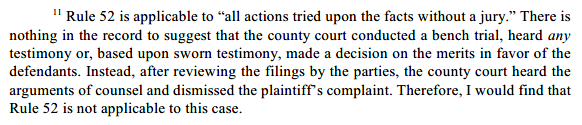
NOTE – Today’s unanimity streak was shattered in dramatic fashion with this decision. The disagreement between the majority and the dissent that interests me the most is whether Rule 52 applies at all. The majority held that it does and reversed because the county court did not make findings of fact and conclusions of law when it was asked to. The dissent argues in a footnote that Rule 52 does not apply:

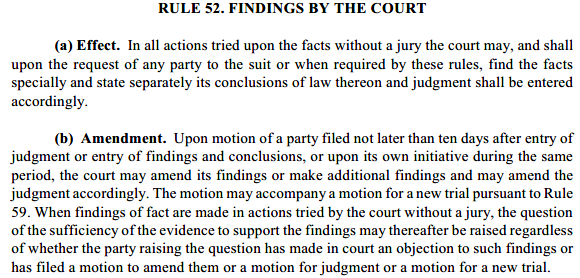
Rule 52 states:

Maybe the dissent will bolster a cert petition and the Mississippi Supreme Court will weigh-in on this issue.


Other Orders

Beale v. State, 2020-KA-00614-COA (denying rehearing)

Devine v. Cardinal Health 110, LLC, 2020-CA-01101-COA (denying rehearing)

Thompson v. State, 2020-CP-01236-COA (denying rehearing)

Stribling v. Youth Court of Washington County, Mississippi, 2021-CA-00007-COA (dismissing appeal sua sponte for lack of appealable judgment)

Porras v. State, 2021-CP-00052-COA (denying rehearing)

Barnes v. State, 2021-KA-00404-COA (denying rehearing)


Hand Down List

Mississippi Court of Appeals Decisions of June 7, 2022

A deposition took me out of blogging service for most of the afternoon, so a little later than usual I give you summaries of the nine opinions handed down by the Mississippi Court of Appeals. These opinions cover the statute of frauds, trusts, appellate jurisdiction, youth court, authentication of text messages, equitable division and alimony in a divorce case, workers’ comp, PCR, and more.


SEL Business Services, LLC v. Lord, 2021-CA-00368-COA (Civil – Real Property/Statute of Frauds)
Affirming the chancery court’s dismissal of a suit to reclaim property or alternatively for unjust enrichment, holding that a “handshake deal” for the purchase of a building that was sold before that deal came to fruition was subject to the statute of frauds, that the statute of frauds was not satisfied, and that the equitable remedy of unjust enrichment was therefore unavailable.
(All judges concurred.)


Lennon v. Lowrey & Fortner, P.A., 2021-CA-00426-COA (Civil – Wills, Trusts & Estates/Appellate Procedure/Appellate Jurisdiction)
Granting a motion to dismiss an appeal for lack of jurisdiction in a case of first impression, holding that the 30-day time period for perfecting an appeal began to run upon the entry of an order adjudicating a claim for attorney’s fees against a trust–not the final judgment terminating the trust.
(All judges concurred.)


Smith v. Adams County Youth Court, 2021-CP-00196-COA (Civil – Juvenile Justice)
Dismissing an appeal of the denial of a minor’s post-disposition motion for modification arguing that his guilty plea was the result of ineffective assistance of counsel, holding that the notice of appeal was prematurely filed because the youth court had not been given an opportunity to consider these arguments and any supporting evidence.
(Judge Wilson concurred in result only without separate written opinion.)


Warner v. Warner, 2020-CA-01098-COA (Civil – Domestic Relations/Divorce/Valuation/Equitable Division/Alimony/Contempt)
Reversing the chancellor’s judgment in a divorce case, holding that the chancellor erred in valuation and equitable division of marital assets, in the award of alimony, and in finding the ex-husband in contempt and awarding attorney’s fees as a result.
(Judge Wilson concurred in part and in the result without separate written opinion.)

Simpson v. State, 2021-KA-00075-COA (Civil – Felony/Authentication)
Affirming convictions of two counts of first-degree murder, first-degree arson, and possession of a deadly weapon by a felon, holding that there was no plain error with regard to the authentication of text messages and that there was no merit to the claim of ineffective assistance for not objecting to the properly-authenticated text messages.
(Judge Emfinger did not participate.)


Carson v. State, 2021-KA-00436-COA (Criminal – Felony/Weight and Sufficiency)
Affirming conviction of possession of cocaine, holding that the circuit court did not err in denying a motion for new trial challenging the weight and sufficiency of the evidence and finding no merit to the defendant’s pro se arguments that his rights under the Fourth Amendment and the Confrontation Clause were violated, that the State’s case hinged on “racial profiling,” that he had ineffective assistance of counsel, and that the circuit judge failed to comply with Sharplin.
(All judges concurred.)


Ellis v. State, 2020-CP-00770-COA (Civil – PCR)
Affirming the circuit court’s denial of the plaintiff’s PCR motion, holding that the motion was time-barred and that the plaintiff failed to raise any claims resulting in the deprivation of his fundamental constitutional rights that would defeat the time bar.
(Judge Wilson and Judge Emfinger concurred in part and in the result without separate written opinion. Judge McDonald concurred in the result only without separate written opinion.)


Reardon v. State, 2020-CP-01259-COA (Civil – PCR)
Affirming the circuit court’s denial of the plaintiff’s PCR motion, holding that the motion was procedurally barred and that his claims of ineffective assistance of counsel, deprivation of fundamental rights, and failure to recuse were without merit.
(Chief Judge Barnes and Judge Wilson concurred in part and in the result without separate written opinion. Judge McDonald concurred in the result only without separate written opinion. Judge Greenlee and Judge McCarty did not participate.)


Duren v. Effex Management Solutions, LLC, 2021-WC-00337-COA (Civil – Workers’ Compensation)
Affirming the Commission’s ruling, holding that there was substantial evidence to support the Commission’s decision that the claimant failed to prove that he suffered a permanent disability and the decision to award TTD through the date of MMI, but denying post-MMI medical treatment, prescription, and mileage reimbursements.
(Judge Wilson concurred in part and in the result without separate written opinion. Judge Westbrooks and Judge McDonald concurred in the result only without separate written opinion.)

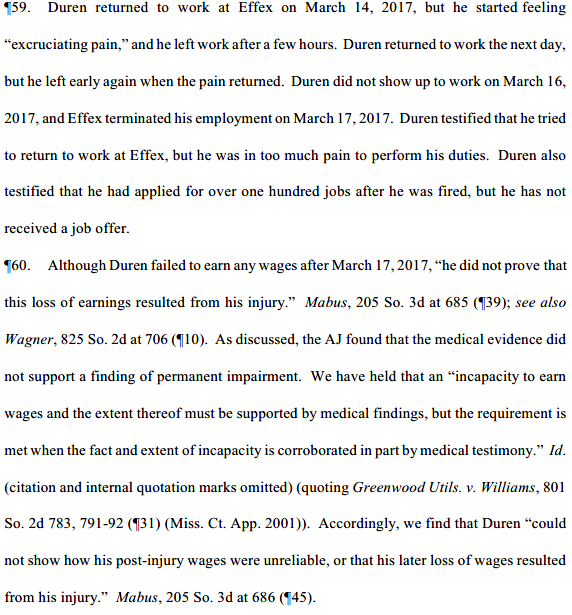
DEEPER DIVE: This case had an interesting post-MMI fact pattern where the claimant was released to return to work without restrictions, was offered to return to work for the Employer at his pre-injury wages, and returned to work there, but then quit working for the Employer due to complaints of pain. Under these facts, the Court of Appeals noted that there was a presumption of no loss of wage-earning capacity and held that the claimant did not overcome it:


Other Orders

Hammer v. State, 2019-KA-01633-COA (denying rehearing)
Shannon v. Shannon, 2020-CA-00847-COA (denying rehearing)


Hand Down List

Mississippi Court of Appeals opinions of May 10, 2022

The Mississippi Court of Appeals set a new record since the launch of this blog by handing down fourteen opinions. After briefly contemplating a dash to the exit, I decided to slog through all of them so you don’t necessarily have to. Needless to say, there is something for everybody today!

(Apologies for the all-but-certain uptick in typos)


Fugler v. Bank of Brookhaven, 2021-CA-00303-COA (Civil – Personal Injury/Premises Liability)
Affirming summary judgment in favor of the defendant in a slip and fall case, holding that the plaintiff, who allegedly tripped on a floor mat but testified she did not see the mat before tripping, failed rebut the defendant’s summary judgment motion and supporting affidavit stating that the bank had no knowledge of prior incidents with its floor mats or any issues with the mat involved, that around 300 customers entered the bank daily and the bank was not aware of any prior mat-related trips or complaints, that the mat was heavy-duty commercial grade and was replaced annually to prevent wear, and that bank employees constantly monitored the floors.
(All judges concurred.)


Keys v. Military Department Gulfport, 2021-WC-00352-COA (Civil – Workers’ Comp)
Reversing the Commission’s finding that the Employer/Carrier was entitled to a credit for indemnity payments that the claimant received but assigned back to the employer during the time the claimant was receiving paid sick leave, holding that since the claimant was awarded permanent total disability benefits, section 25-3-95(2)(b) (prohibiting a state employee from using accrued personal and/or medical leave and receiving workers’ comp to earn more than 100% of his state-employment wages) did not apply.
(Judge Wilson specially concurred, joined in part by Judge McCarty.)

NOTE – I think Judge Wilson’s special concurrence provides a clearer path forward in workers’ comp cases: Regardless of whether the indemnity benefits during the time in question were classified as TTD or PTD, the claimant was entitled to a total of 450 weeks of indemnity benefits (however classified) and since the claimant did not receive any indemnity benefits during the period he was assigning benefits back to the Employer, the Employer/Carrier were not entitled to a credit for those weeks.


Smith v. State, 2021-CP-00099-COA (Civil – PCR)
Affirming the circuit court’s denial of a pro se plaintiff’s PCR petition, holding that the plaintiff presented no evidence to show a reasonable ground for the trial court to believe he was incompetent to plead guilty.
(All judges concurred.)


Prystupa v. Rankin County Board of Supervisors, 2020-CA-01049-COA (Civil – MTCA/Statute of Limitations/Latent Injury)
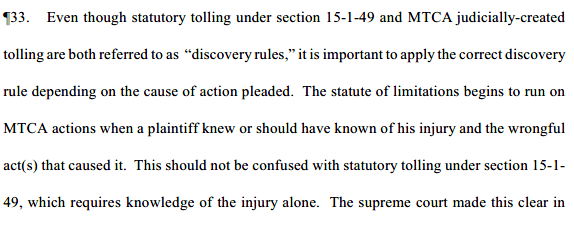
Affirming the dismissal of a flooding damage MTCA claim based on the running of the statute of limitations, holding that this claim was an MTCA negligence claim subject to a one-year statute of limitations that began to run when the plaintiff knew or should have known of both the injury and its probable cause. In this case, the Court of Appeals held that the statute of limitations began to run when the plaintiff knew of the flooding (the injury) and knew it was due to a blocked drain (the cause) as opposed to when he found out that crushed pipe caused the blocked drain (i.e. caused the cause). The Court of Appeals also affirmed the circuit court’s denial of the plaintiff’s Rule 59(e) motion to aleter or amend based on fraudulent concealment and the circuit court’s denial of the plaintiff’s motion for leave to amend his complaint to add claims of nuisance and trespass.
(Judge McCarty concurred in part and in the result without separate written opinion. Judge Emfinger did not participate.)

TAKE HEED, lest you fall victim to the distinction between “statutory tolling” and “MTCA tolling”:


Schmidt v. Schmidt, 2020-CA-01253-COA (Civil – Custody)
Affirming the chancellor’s decision granting sole physical custody to the mother, holding that there was no error in finding that the deterioration of the parties’ ability to co-parent constituted a material change in circumstances entitling the mother to sole physical custody and no error in the application of the Albright factors.
(Judge Wilson concurred in part and in the result without separate written opinion.)


Smith v. Mississippi Department of Public Safety, 2021-SA-00020-COA (Civil – State Boards and Agencies)
Affirming the circuit court’s judgment affirming the Mississippi Employee Appeals Board’s decision upholding the claimant’s termination, holding that the claimant’s procedural due process rights were not violated because he was provided notice of the charges and an opportunity to be heard, that his substantive due process rights and rights under the MS State Personnel Board rules were not violated because the MEAB’s decision was supported by substantial evidence and was not arbitrary, and that the claim that the claimant was terminated because of communications with his wife and that the MEAB’s decision was based on uncorroborated hearsay was without merit.
(All judges concurred.)


McIntosh Transport, LLC v. Love’s Travel Stop & Country Stores, Inc., 2021-CA-00154-COA (Civil – Contract/Arbitration)
Reversing the circuit court’s order granting the defendants’ motion to compel arbitration, holding that the contract containing the contract was not binding on the plaintiff because it was signed by a 19-year-old who signed his grandfather’s name and whose only authority was the actual authority to retrieve the truck following repairs that did not include the authority to bind the company to arbitration.
(Chief Judge Barnes concurred in part and in the result without separate written opinion. Judge Carlton concurred in the result only without separate written opinion.)


Case v. Case, 2020-CA-01047-COA (Civil – Custody/Equitable Distribution of Marital Property/Albright Factors/Ferguson Factors)
Affirming the chancellor’s decision on child custody, but reversing the chancellor’s decision on the equitable distribution of marital property. Regarding custody, the Court of Appeals held that the chancellor’s application of the Albright factors was supported by substantial evidence. Regarding equitable distribution, the Court of Appeals affirmed all of the chancellor’s findings except his valuation of the marital property which it reversed and rendered due to a calculation error.
(Judge Wilson and Judge Westbrooks concur in part and in the result without separate written opinion.)

MY TAKE – Few, if any, of us are in the legal field because of a proclivity for math yet it still haunts us all.


Wadley v. Hubbs, 2021-CA-00866-COA (Civil – Real Property/Notice of Appeal)
Reversing the circuit court’s dismissal of the plaintiff’s appeal from a county court judgment as untimely, holding that the plaintiff’s notice of appeal that was stamped “Filed” after the county court’s judgment but before disposition of the plaintiff’s motion to set aside the judgment was effective and timely even though the header of the notice said “IN THE COUNTY COURT” because the body of the notice made it clear the plaintiff was appealing to the circuit court and the notice was stamped “Filed” by the circuit clerk.
(All judges concurred.)


Murray v. State, 2021-KA-00264-COA (Criminal – Felony/Hearsay/Rule 412)
Affirming conviction of statutory rape, holding that the circuit court erred in allowing the victim’s mother’s to testify about a neighbor’s out-of-court statement, but that it was harmless and “essentially cumulative evidence of non-criminal activity that [the defendant] admitted.” The Court of Appeals also held that the circuit court did not err in denying the defendant’s ore tenus request to compel the victim’s counseling records because even though a determination of whether the records were privileged could not be made until the records were examined, the defendant did not comply with Rule 412 of the Mississippi Rules of Evidence. The Court of Appeals also held that the plaintiff’s claims of ineffective assistance of counsel for failure to request an alibi instruction, failure to object to hearsay, failure to request a limiting instruction regarding the hearsay testimony, and failure to make a timely request for the victim’s counseling records did not entitled him to relief on this appeal.
(All judges concurred.)


Bailey v. State, 2021-KA-00281-COA (Criminal – Felony/Lindsey Brief)
Affirming conviction of fondling of a six-year-old and sentence to life imprisonment as a violent habitual offender, noting that the defendant’s appointed appellate counsel filed a Lindsey brief and holding that the defendant’s pro se brief arguing that the trial court lacked jurisdiction and that his indictment was not marked “filed” was factually mistaken and without merit.
(Judge Smith did not participate.)


Finley v. PERS, 2021-SA-00089-COA (Civil – State Boards and Agencies/PERS/Disability)
Reversing the circuit court’s judgment affirming PERS Medical Board’s denial of the plaintiff’s claim for non-duty-related disability retirement benefits, holding that PERS’s assessment of the plaintiff’s job requirements and ability to perform her job was arbitrary and capricious. The case was remanded for PERS to determine if the plaintiff could perform the true duties of registrar with her disability and the support staff, if any, she had at the time.
(Judge Wilson concurred in part and in result without separate written opinion.)


Boyd v. MDOC, 2021-CC-00459-COA (Civil – State Boards and Agencies/MDOC)
Affirming the MDOC’s disciplinary actions against the plaintiff whose oversight led to MDOC’s failure to issue an arrest warrant for a probationer who did not report to his assigned probation office upon release from MDOC custody who then killed two Brookhaven police officers in the line of duty, holding that the plaintiff failed to meet her burdens of proof and persuasion to overcome the presumption of correctness due MDOC’s decision.
(All judges concurred.)


Parker v. Ross, 2020-CA-01055-COA (Civil – Wills, Trusts, and Estates)
Affirming in part and reversing in part the chancery court’s grant of summary judgment in a claim alleging mismanagement of a trust and to recover real property that was allegedly improperly sold. The Court of Appeals affirmed the chancellor’s judgment in part, holding that any claims governed by the three-year statute of limitations were time-barred. The Court of Appeals also reversed the chancellor’s judgment in part, holding that the allegations related to the mismanagement of the trust were subject to a ten-year statute of limitations and that one of the plaintiffs had created a genuine issue of material fact as to his unsoundness of mind and remanded this matter to the chancery court for further proceedings.
(Judge Emfinger dissented, joined by Judge Wilson and Judge Greenlee and joined in part by Judge McDonald.)


Other Orders

Lawrence v. State, 2021-TS-1324-COA (providing, on the court’s own motion, the appellant and his attorney, Wayne Dowdy, one final opportunity to show cause why this appeal should not be dismissed as untimely)


Phew…

Summaries of the Mississippi Court of Appeals opinions of April 26, 2022

The Mississippi Court of Appeals dropped eight nine opinions today and there is a lot to sort through. Two divorce cases (one involving equitable distribution of a marital residence and the other a life estate via constructive trust for a mother-in-law), a PCR case, a workers’ comp case involving medical causation, an adverse possession/tax sale case, a personal injury via falling through a roof case, an appeal of an estate case dismissed for lack of final order, and two criminal cases. One of the criminal cases is the second “should the indictment for attempt have alleged an overt act” case we have gotten in a row and it sees a dissenting Judge Westbrooks align herself with Justice Coleman’s dissent last week.

I am always balancing the desire to post these summaries quickly and the need to get back to paying work with the desire to provide a reasonably polished [free] product. Due to the number of cases and the fact that I have to leave the office a little early to coach a little league baseball game, there is extra weight on the “speed” side of the balance today.
Thanks,
Management


Archie v. Archie, 2020-CA-01370-COA (Civil – Domestic Relations/Equitable Distribution/Marital Residence)
Affirming the chancellor’s modification of a final judgment of divorce as to equitable distribution of the marital residence, holding that there was no error in the chancellor ordering the ex-wife to sell the paid-off martial home in order to satisfy the ex-wife’s obligation to pay her ex-husband his share of the equity where the ex-wife had been unable to secure a loan on the paid-off house, even though the ex-husband had not pleaded a request for an order requiring the ex-wife to sell the residence. The court repeatedly noted that the chancellor had broad discretion to “fashion an equitable remedy” and held that the chancellor’s remedy here was appropriate.
(Judge Wilson concurred in part and the in the result without separate written opinion.)


Bevalaque v. State, 2021-CP-00150-COA (Civil – PCR)
Affirming dismissal of a pro se plaintiff’s third PCR motion, holding that the motion was time-barred and successive-writ barred and that no exceptions applied.
(All judges concurred.)


Bowdry v. City of Tupelo, 2021-WC-00390-COA (Civil – Workers’ Compensation/Medical Causation)
Affirming the MWCC’s finding that the claimant’s neck claim was not related to his compensable work-injury, holding that the Commission’s finding that the claimant failed to prove causation was supported by substantial evidence.
(All judges concurred.)

PRACTICE POINT: The Court of Appeals noted that on appeal they do not review the AJ’s findings, but the Commission’s findings and did not address the claimant’s arguments about the AJ’s findings:

This is because the Commission does not function as an appellate court reviewing the AJs’ findings. This is because the Commission, not the AJ, is the ultimate trier and finder of fact for workers’ comp claims. See, e.g., Hugh Dancy Co. Inc. v. Mooneyham, 68 So. 3d 76 (Miss. Ct. App. 2011)


Anderson v. Jackson, 2019-CA-01773-COA (Civil – Real Property/Adverse Possession/Unclean Hands/Tax Sale)
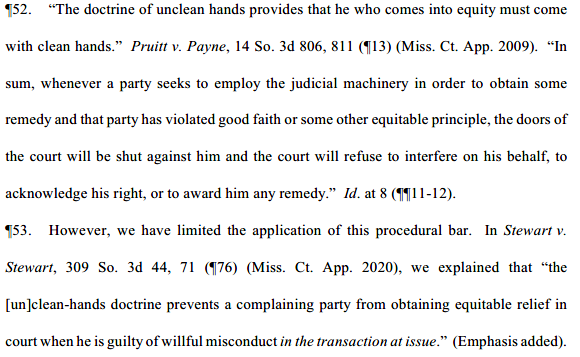
Reversing the chancellor’s findings granting title of real property to one party (Levon) based on findings that Levon had obtained title by adverse possession or by tax sale and that the opposing party (Rosie) had unclean hands, holding that the chancellor erred in granting title to Levon because he failed to prove the elements of adverse possession by clear and convincing evidence, that the tax sale was void due to flawed notice of redemption, and that the doctrine of unclean hands was erroneously applied to bar Rosie’s challenge because Rosie’s conduct was related to a forty-year-old estate case, not the transaction at issue.
(All judges concurred.)

Since accusations of “unclean hands” get thrown around in litigation on occasion, I thought this summary of the equitable doctrine of unclean hands is a useful refresher:

NOTE – As always, but only more so here, if this case applies to your practice you need to read it yourself. There are many details in this forty-page opinion that I have not even attempted to tease apart.


Herron v. Herron, 2021-CA-00090-COA (Civil – Domestic Relations/Constructive Trust/Property Valuation)
Affirming the chancellor’s findings in a divorce action granting a life estate via constructive trust in a home on the marital property to the ex-wife’s mother in assigning value to property awarded to the ex-husband, holding that there was clear and convincing proof that the house was intended to be owned by the mother in a life estate and that there was substantial credible evidence supporting the chancellor’s valuations of the personal property in question.
(All judges concurred.)


Gillespie v. Lamey, 2021-CA-00076-COA (Civil – Personal Injury/Summary Judgment/Duty to Warn)
Affirming summary judgment in favor of a defendant dismissing the plaintiff’s claim for personal injuries sustained when the plaintiff fell through a roof while working on a skylight on the defendant’s property, holding that (1) the plaintiff presented no evidence that the defendant failed to warn the plaintiff of any dangerous condition of which the defendant had actual or constructive knowledge and (2) the allegedly dangerous condition was “intimately connected” to the work he was hired to do.
(Judge Smith did not participate, all other judges concurred.)


Smith v. Richmond, 2020-CP-01064-COA (Civil – Wills, Trusts, and Estates/Civil Procedure)
Dismissing the appeal, holding that the pro se appellant’s attempted appeal of the chancery court’s denial of a Rule 60(b) motion to set aside an interim order, a motion to recuse, and a “motion to change jurisdiction” must be dismissed because each of these motions was an interlocutory order not appealable as of right.
(All judges concurred.)


Wayne v. State, 2021-KA-00084-COA (Criminal – Felony/Rebuttal Evidence/Sufficiency and Weight of Evidence)
Affirming murder conviction, holding that there was no error (1) in allowing the State to recall a State’s witness and introduce and play the defendant’s recorded statement in rebuttal because the recorded statement contradicted the defendant’s trial testimony, (2) in introducing the defendant’s entire statement because it was proper impeachment evidence, or (3) in denying the defendant’s post-trial motion because the evidence was sufficient to support the conviction and that the conviction was not against the weight of the evidence.
(All judges concurred.)


Beale v. State, 2020-KA-00614-COA (Criminal – Felony/Overt Act)
Affirming conviction two counts of attempted murder of two police officers, holding (1) an indictment for the crime of attempted murder does not require the description of an overt act, (2) that two jury instructions did not constitute a constructive amendment to the indictment, and (3) testimony from an officer about what a witness told him at the crime scene was not hearsay because they were not offered to prove the truth of the matter asserted but to explain the next steps in the course of his investigation.
(Judge Westbrooks dissented, joined in part by Judge McDonald. Judge McDonald concurred in part and dissented in part without separate written opinion. Judge Emfinger concurred in part and in the result without separate written opinion. Judge Wilson concurred in result only without separate written opinion. All other judges concurred.)

NOTE – We have gotten an “is the indictment missing an alleged overt act” case in back-to-back hand-down days. In her dissent, Judge Westbrooks’s argues that she is taking a position consistent with the position that Justice Coleman took just last week in Brady v. State (my post here) (opinion link here).


Other Opinions

Durrant Inc. v. Lee County, Mississippi, 2019-CA-01826-COA (denying motion for rehearing)
Bell v. State, 2020-CT-00592-COA (denying motion for rehearing)


Hand Down List

Summaries of the Mississippi Court of Appeals opinions of March 22, 2022

The Mississippi Court of Appeals dropped nine opinions today including upheld convictions, dismissal of a civil case for discovery violations, a workers’ comp appeal, petitions for custody modification, and a couple of of PCR motions.


Davis v. State, 2020-CP-00283-COA (Civil – PCR)
Affirming the circuit court’s denial of a pro se motion for PCR, holding that the circuit court did not err in finding that the claim of ineffective assistance of counsel was procedurally barred.
(All judges concurred)


Fluker v. State, 2021-CP-00162-COA (Civil – PCR)
Affirming the circuit court’s denial of a pro se motion for PCR (the plaintiff’s fourth such effort), holding that the plaintiff waived any procedural defects in his indictment when he pleaded guilty and that his claim based on the circuit clerk’s failure to stamp “filed” on the indictment was therefore procedurally barred.
(All judges concurred)


Mize v. Shiloh Market, Inc., 2020-CP-01119-COA (Civil – Personal Injury/Rule 37/Rule 60(b))
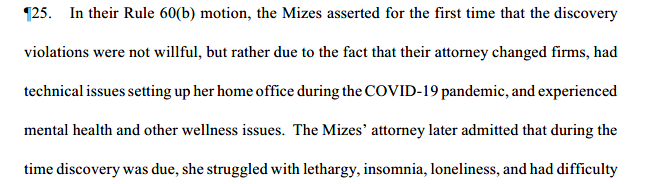
Affirming the dismissal of a trip-and-fall lawsuit based upon the plaintiffs’ failure to cooperate in discovery, holding that it was within the circuit court’s discretion to dismiss the claims after the plaintiffs’ failed to respond to the defendant’s discovery after the deadline set by a consent order granting the defendant’s motion to compel discovery responses and to deny the plaintiffs’ Rule 60(b) motion.
(Judge Westbrooks and Judge McDonald concurred in result only without separate written opinion).

Addendum – COVID and the Law: Neither the circuit court nor the court of appeals was persuaded by the plaintiffs’ Rule 60(b) motion argument that their discovery responses were not served because of attorney was having issues, including some COVID-related, constituted “exceptional circumstances”:


Kreppner v. Kreppner, 2021-CA-00006-COA (Civil – Domestic Relations/Child Custody Modification)
Affirming the chancellor’s denial of the mother’s motion to modify the terms of an agreed custody order, holding that the father’s remarriage and the resulting changes in the minor’s life did not constitute a “material change in circumstances” and that the Riley test did not apply because there was no evidence of genuinely adverse circumstances.”
(Judge Westbrooks concurred in result only without separate written opinion)


Butler v. State, 2020-KA-00806-COA (Criminal – Felony/Culpable Negligence Manslaughter)
Affirming conviction of culpable negligence manslaughter stemming from a boat collision, holding (1) that the circuit court did not err in granting the State’s motion in limine excluding evidence about the other driver’s prior drug use, (2) that the State presented sufficient evidence for the conviction without regarding to any intoxication argument because there was evidence that the defendant violated five boating rules leading up to the collision, and (3) that the weight-of-the-evidence argument was procedurally barred and meritless.
(Judge Lawrence wrote a special concurrence joined by Judge Greenlee, Judge McDonald, and Judge McCarty)


Wall v. Wall, 2020-CA-01182-COA (Civil – Domestic Relations/Child Custody Modification)
Affirming the chancery court’s involuntary dismissal of the father’s petition for child custody modification, holding that the chancellor did not err in dismissing the petition under Rule 41(b) at the conclusion of the hearing because the father did not prove a material change in circumstances and that the lack of specific discussion of the father’s concerns about the mother’s alcohol use did not mean the issue was overlooked such that the chancellor failed to consider the totality of the circumstances.
(Judge Lawrence concurred in result only without separate written opinion)


Hawkins v. State, 2020-KA-01263-COA (Criminal – Felony/DUI)
Affirming conviction of two counts of aggravated DUI after the defendant’s appellate counsel filed a Lindsey brief and the defendant elected not to file a supplemental brief pro se.
(All judges concurred)


Texas Mutual Insurance Company v. Vaughters, 2021-WC-00364-COA (Civil – Workers’ Compensation/Jurisdiction)
Dismissing an appeal from the MWCC, holding that the Commission’s order vacating the AJ’s order and remanding for a determination as to compensability, coverage, and jurisdiction was not a final, appealable judgment.
(All judges concurred)


Manuel v. State, 2020-KA-00711-COA (Criminal – Felony/Excited Utterance)
Affirming convictions and sentences for second-degree murder and aggravated assault, holding that the circuit court did not abuse its discretion by (1) admitting testimony under the excited-utterance hearsay exception, (2) excusing a juror mid-trial for failure to disclose information during voir dire, (3) collecting the parties’ jury panel information sheets following jury selection and placing them under seal, or (4) sentencing the defendant as a habitual offender.
(Judge Westbrooks concurred in part and dissented in part, joined by Judge McDonald and Judge McCarty; Judge McDonald and Judge McCarty concurred in part and dissented in part without separate written opinion; and Judge Emfinger concurred in part and in the result without separate written opinion)


Other Orders

Robertson v. Houston, Mississippi Public School District, 2020-CA-931-COA (denying motion for rehearing)
Hardin v. Hardin, 2020-CA-1314-COA (denying motion for rehearing)
Butler v. State, 2021-CA-337-COA (granting State’s motion to dismiss for lack of appealable judgment)
Evans v. State, 2021-TS-1423-COA (allowing appeal to proceed without prejudice to State’s ability to rebut presumption that notice of appeal was timely)


Hand Down List

Summaries of the Mississippi Court of Appeals opinions of Feb. 15, 2022

Anderson v. S&S Properties, LLC, 2021-CA-33-COA (Civil – Real Property/Summary Judgment/Tax Sale)
Affirming summary judgment granted by the chancery court setting aside a tax sale and ordering the county to refund the purchase price to the purchaser, holding that the purchaser had standing and that the county failed to serve proper notice of the tax sale to the assessed property owners. Note: The COA held that the purchaser had standing to sue in this particular case because the amended version of Miss. Code Ann. § 27-25-27(2) did not apply retroactively. The amended statute provides: “No purchaser of land at any tax sale, nor holder of the legal title under him by descent or distribution, shall have any right of action to challenge the validity of the tax sale.”

Ford v. State, 2020-KA-278-COA (Criminal – Felony/Criminal Procedure)
Affirming conviction of first-degree murder, holding:
1. The defendant was not entitled to a directed verdict under Weathersby because the Weathersby issue was procedurally barred and because Weathersby did not apply in this case where there was contradicting.
2. The circuit court did not err by not allowing the defendant to represent himself because the defendant did not expressly make such a request.
3. The circuit court did not err in allowing an investigator to testify about his recollection of a verbal statement the defendant gave to law enforcement.
4. The defendant’s counsel was not constitutionally ineffective for not proposing a “stand your ground” instruction (trial strategy), not filing a motion for new trial or JNOV (this was deficient, but not “prejudicial” in that there is no reasonable probability that, but for counsel’s unprofessional errors, the result of the trial would have been different), not arguing the Weathersby rule (Weathersby was already held to be inapplicable), and not subpoenaing eyewitness testimony (trial strategy).
5. There was no prosecutorial misconduct during closing argument when the prosecutor argued that the trajectory of the bullet showed that the defendant and the victim were not fighting for the gun.
6. The defendant’s should not be reversed as a result of cumulative error because the other issues on appeal were without merit.

Diversicare of Meridian, LLC v. Shelton, 2020-CA-1362-COA (Civil – Contract/Arbitration Agreement)
Affirming the circuit court’s denial of a motion to compel arbitration in a wrongful death nursing-home case, holding that the nursing home failed to provide sufficient proof that the resident gave her daughter, who signed admissions paperwork including an arbitration agreement, authority to bind the resident to arbitrate any future disputes arising from her stay.
NOTE: Although the court of appeals affirmed the denial of the motion to compel arbitration, it held that the circuit court erred in ruling that written authority was required. Specifically, the court of appeals held: “[A] mentally competent individual may orally grant authority to another person to sign documents required for admission to a nursing home.”

Rutland v. Burroughs, 2020-CA-1100-COA (Civil – Torts/Civil Procedure)
Affirming the circuit court’s grant of summary judgment dismissing a malicious prosecution and intentional infliction of emotional distress lawsuit after the plaintiff’s attorney withdrew, the 60-day period given to the plaintiff to retain new counsel or proceed pro se passed without any such action taken by the plaintiff and the plaintiff did not file a timely response to the motion for summary judgment.

Robinson v. Smith, 2020-CA-1249-COA (Civil – Personal Injury/Counter-Claim/Civil Procedure)
Reversing the circuit court’s grant of summary judgment that was based on a default judgment on a counter-claim, holding based on the plain language of Rules 7, 12, and 13, the counter-claim was procedurally improper because it was not asserted in the answer and the plaintiff therefore has no obligation to respond to it.

Lambes v. Lambes, 2020-CA-95-COA (Civil – Domestic Relations/Custody)
Affirming the chancery court’s ruling that it was in the best interest and welfare of the children to place them in the father’s custody, holding that the father was not precluded from being awarded custody after he admitted to the ground of habitual cruel and inhuman treatment when that admission was based on the chancellor’s statement that all rights regarding custody etc would be preserved, and that there were not misrepresentations in the GAL report warranting reversal when the record showed the chancellor made his decision based upon independent findings of fact.

Tillman v. KLLM Transport, 2021-WC-57-COA (Civil – Workers’ Comp/One-Year Limitations Period)
Affirming the MWCC’s dismissal of a workers’ comp claim based on the one-year limitations period, holding that the dismissal of the workers’ comp claim for the claimant’s failure to file a pre-hearing statement is a “rejection of the claim” sufficient to start the one-year limitations period under section 71-3-53 regardless of when or if a B-31 was filed.

Shannon v. Shannon, 2020-CA-847-COA (en banc) (Civil – Domestic Relations)
Affirming the chancery court’s rulings granting divorce on the ground of habitual cruel and inhuman treatment, granting a permanent restraining order against and divesting title from the at-fault party, applying the Ferguson factors, and denying a motion to continue or to allow remote participation.

Williams v. State, 2020-CP-950-COA (en banc) (Civil – PCR)
Reversing the circuit court’s denial of a pro se motion for post-conviction collateral relief, holding that the circuit court did not have sufficient evidence to revoke the defendant’s post-release supervision because (1) the defendant was not convicted of the crime that prompted the revocation of his PRS and (2) there was insufficient evidence in the record that the defendant had failed to pay fees, fines, and restitution. This case was remanded to the circuit court for further proceedings.

Other Orders
4 Denials of Motions for Rehearing


Enter your email address to have the opinion summaries and other posts emailed to you as soon as they are published.
(You can always unsubscribe later.)