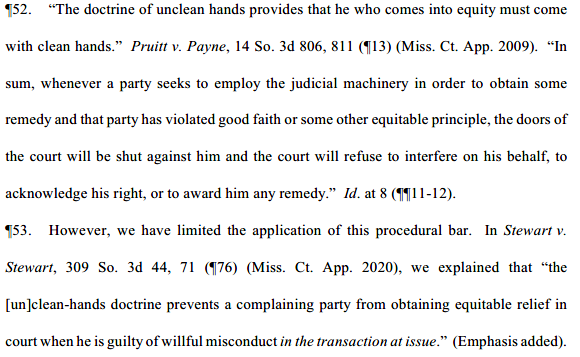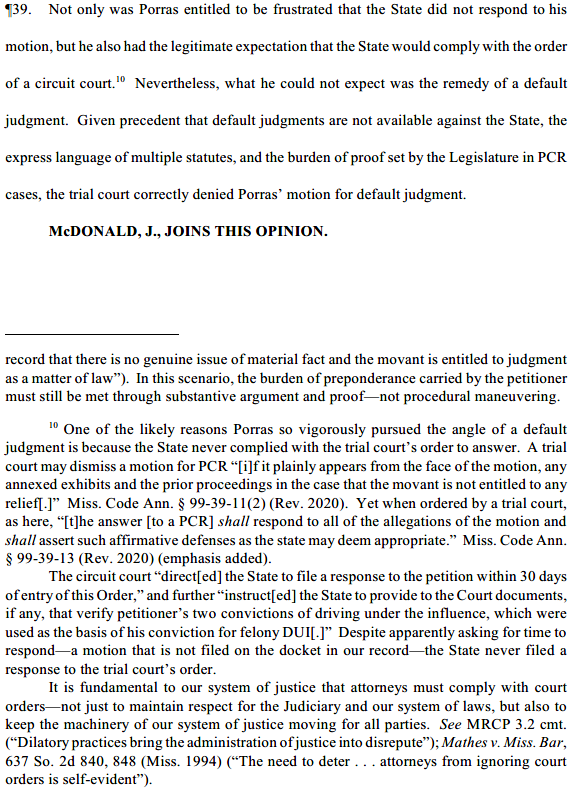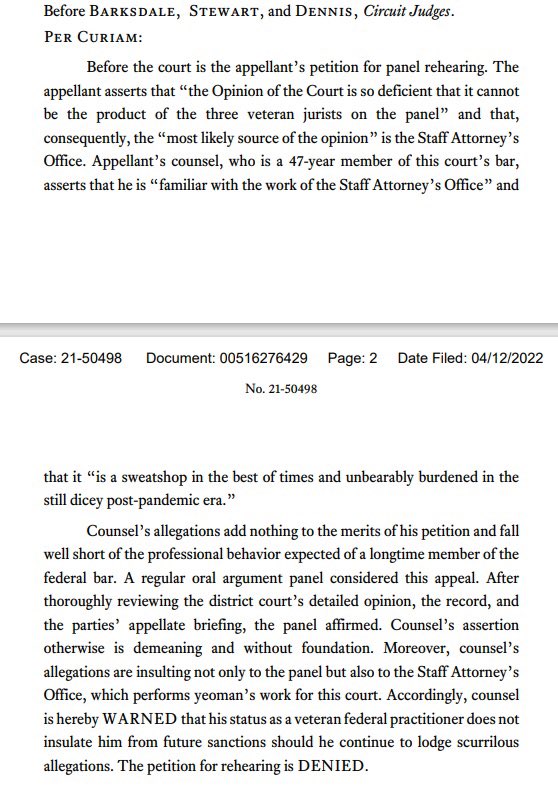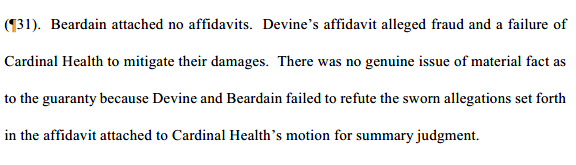
Summaries of the Mississippi Supreme Court’s opinions of March 24, 2022

The Mississippi Supreme Court handed down two opinions today. One is an interlocutory appeal of an order denying a motion to transfer venue centered around an incorrect address listed with the Secretary of State and the other is an initial, arbitration-agreement skirmish in a lawsuit Mississippi’s Community Mental Health Centers filed against United Health Care of Mississippi over a rate-cut dispute.


Weeks, Inc. v. Lewis, 2020-IA-01337-SCT (Civil – Personal Injury/Venue)
Reversing the circuit court’s denial of the defendant’s motion to transfer venue, holding that venue based on a corporation’s principal place of business is determined by “the actual physical location” and expressly rejecting the plaintiff’s argument that venue was proper in a different county where the “principal address” listed in the defendant’s corporate filings with the Secretary of State is located.
(All justices concurred)


United Healthcare of Mississippi Inc. v. Mississippi’s Community Mental Health Commissions, 2020-CA-00697-SCT (Civil – Contract/Arbitration/Preliminary Injunction)
Affirming the circuit court’s ruling enjoining the Medicaid service provider from imposing a 5% rate cut and denying its motion to compel arbitration in a lawsuit filed by Mississippi’s Community Mental Health Centers (CMHC), holding (1) that trial courts have authority to enter preliminary injunctions even when there is an enforceable arbitration agreement, (2) that the record supported the trial court’s finding of a substantial likelihood that the service provider violated Miss. Code Ann. § 43-13-117(H)(1)(c) which governs Medicaid payment rates, and (3) that the trial court did not err in finding that the arbitration agreement was enforceable because it was not signed by a single CMHC board.
(All participating justices concurred; Justice Beam did not participate)


Other Orders

Golden v. State, 2019-CT-00757-SCT (denying cert petition)
M.A.S. v. Lamar County Department of Child Protective Services, 2020-CT-70-SCT (denying cert petition)
Alexander v. State, 2020-CT-177-SCT (denying cert petition)
Smith v. State, 202o-CT-580-SCT (denying cert petition and amended cert petition)
Gordon v. Dickerson, 2020-CT-601-SCT (granting cert petition)
Badger v. State, 2020-M-646 (denying “Motion to Reinvest Jurisdiction Into The Circuit Court of Amite County” and warning that future filings deemed frivolous may result not only in monetary sanctions, but also restrictions on filing applications for post-conviction collateral relief (or pleadings in that nature) in forma pauperis)


Hand Down List

Summaries of the Mississippi Court of Appeals opinions of March 22, 2022

The Mississippi Court of Appeals dropped nine opinions today including upheld convictions, dismissal of a civil case for discovery violations, a workers’ comp appeal, petitions for custody modification, and a couple of of PCR motions.


Davis v. State, 2020-CP-00283-COA (Civil – PCR)
Affirming the circuit court’s denial of a pro se motion for PCR, holding that the circuit court did not err in finding that the claim of ineffective assistance of counsel was procedurally barred.
(All judges concurred)


Fluker v. State, 2021-CP-00162-COA (Civil – PCR)
Affirming the circuit court’s denial of a pro se motion for PCR (the plaintiff’s fourth such effort), holding that the plaintiff waived any procedural defects in his indictment when he pleaded guilty and that his claim based on the circuit clerk’s failure to stamp “filed” on the indictment was therefore procedurally barred.
(All judges concurred)


Mize v. Shiloh Market, Inc., 2020-CP-01119-COA (Civil – Personal Injury/Rule 37/Rule 60(b))
Affirming the dismissal of a trip-and-fall lawsuit based upon the plaintiffs’ failure to cooperate in discovery, holding that it was within the circuit court’s discretion to dismiss the claims after the plaintiffs’ failed to respond to the defendant’s discovery after the deadline set by a consent order granting the defendant’s motion to compel discovery responses and to deny the plaintiffs’ Rule 60(b) motion.
(Judge Westbrooks and Judge McDonald concurred in result only without separate written opinion).

Addendum – COVID and the Law: Neither the circuit court nor the court of appeals was persuaded by the plaintiffs’ Rule 60(b) motion argument that their discovery responses were not served because of attorney was having issues, including some COVID-related, constituted “exceptional circumstances”:


Kreppner v. Kreppner, 2021-CA-00006-COA (Civil – Domestic Relations/Child Custody Modification)
Affirming the chancellor’s denial of the mother’s motion to modify the terms of an agreed custody order, holding that the father’s remarriage and the resulting changes in the minor’s life did not constitute a “material change in circumstances” and that the Riley test did not apply because there was no evidence of genuinely adverse circumstances.”
(Judge Westbrooks concurred in result only without separate written opinion)


Butler v. State, 2020-KA-00806-COA (Criminal – Felony/Culpable Negligence Manslaughter)
Affirming conviction of culpable negligence manslaughter stemming from a boat collision, holding (1) that the circuit court did not err in granting the State’s motion in limine excluding evidence about the other driver’s prior drug use, (2) that the State presented sufficient evidence for the conviction without regarding to any intoxication argument because there was evidence that the defendant violated five boating rules leading up to the collision, and (3) that the weight-of-the-evidence argument was procedurally barred and meritless.
(Judge Lawrence wrote a special concurrence joined by Judge Greenlee, Judge McDonald, and Judge McCarty)


Wall v. Wall, 2020-CA-01182-COA (Civil – Domestic Relations/Child Custody Modification)
Affirming the chancery court’s involuntary dismissal of the father’s petition for child custody modification, holding that the chancellor did not err in dismissing the petition under Rule 41(b) at the conclusion of the hearing because the father did not prove a material change in circumstances and that the lack of specific discussion of the father’s concerns about the mother’s alcohol use did not mean the issue was overlooked such that the chancellor failed to consider the totality of the circumstances.
(Judge Lawrence concurred in result only without separate written opinion)


Hawkins v. State, 2020-KA-01263-COA (Criminal – Felony/DUI)
Affirming conviction of two counts of aggravated DUI after the defendant’s appellate counsel filed a Lindsey brief and the defendant elected not to file a supplemental brief pro se.
(All judges concurred)


Texas Mutual Insurance Company v. Vaughters, 2021-WC-00364-COA (Civil – Workers’ Compensation/Jurisdiction)
Dismissing an appeal from the MWCC, holding that the Commission’s order vacating the AJ’s order and remanding for a determination as to compensability, coverage, and jurisdiction was not a final, appealable judgment.
(All judges concurred)


Manuel v. State, 2020-KA-00711-COA (Criminal – Felony/Excited Utterance)
Affirming convictions and sentences for second-degree murder and aggravated assault, holding that the circuit court did not abuse its discretion by (1) admitting testimony under the excited-utterance hearsay exception, (2) excusing a juror mid-trial for failure to disclose information during voir dire, (3) collecting the parties’ jury panel information sheets following jury selection and placing them under seal, or (4) sentencing the defendant as a habitual offender.
(Judge Westbrooks concurred in part and dissented in part, joined by Judge McDonald and Judge McCarty; Judge McDonald and Judge McCarty concurred in part and dissented in part without separate written opinion; and Judge Emfinger concurred in part and in the result without separate written opinion)


Other Orders

Robertson v. Houston, Mississippi Public School District, 2020-CA-931-COA (denying motion for rehearing)
Hardin v. Hardin, 2020-CA-1314-COA (denying motion for rehearing)
Butler v. State, 2021-CA-337-COA (granting State’s motion to dismiss for lack of appealable judgment)
Evans v. State, 2021-TS-1423-COA (allowing appeal to proceed without prejudice to State’s ability to rebut presumption that notice of appeal was timely)


Hand Down List

Summaries of the Mississippi Supreme Court opinions of March 17, 2022

The folks publishing the hand down lists are not on spring break. There were four opinions today that are must-reads for anyone whose law practice these opinions touch. There is a medical malpractice/expert testimony decision, a dismissal for failure to prosecute decision that is more about the abuse-of-discretion standard of review, a breach of commercial lease opinion, and a will probate opinion.


Claiborne County Hospital v. Truitt, 2020-IA-01017-SCT (Civil – Medical Malpractice/Summary Judgment/Experts)
The plaintiff fell while walking to the restroom to give a urine sample. The plaintiff filed a negligence claim against the hospital, alleging that a nurse failed to assist him to the restroom. The hospital filed a motion for summary judgment on the grounds that the plaintiff lacked medical expert testimony. The plaintiff argued that the layman’s exception applied or, alternatively, that the plaintiff had identified the requisite expert testimony in an interrogatory answer. The circuit court denied the hospital’s motion for summary judgment and the Supreme Court granted interlocutory appeal. The Supreme Court reversed the circuit court and rendered judgment in favor of the hospital, holding that “the layman’s exception does not apply to the facts of this case because Truitt’s claim involves the rendering of medical services and a nurse’s professional judgment for which expert testimony is required.” The Supreme Court also held that the designation via interrogatory answer was insufficient because the “designation does not provide sworn expert testimony” and noting that the plaintiff “only provided the name of his expert and a brief description of the anticipated testimony.”
(All justices concurred)


Leasy v. SW Gaming, LLC, 2019-CT-01505-SCT (Civil – Personal Injury/Failure to Prosecute/Standard of Review)
Reversing the Court of Appeals and reinstating the circuit court’s judgment dismissing the plaintiff’s claim for failure to prosecute, holding that the Court of Appeals improperly reweighed the evidence and reaffirming the controlling abuse-of-discretion standard.
(Justice King dissented, joined by Justice Kitchens. Justice Beam did not participate in the decision)
(Note: At the Court of Appeals level, Judge Carlton wrote a dissent that was joined by Judge Wilson)

Practice Point – Standards of review matter! The Mississippi Supreme Court has shown a renewed interest in standards of review. This opinion is more about the standard of review than it is about the failure to prosecute. The Supreme Court described the Court of Appeals’ incorrect application of the standard of review as follows:

The Supreme Court bluntly concluded:


Holcomb, Dunbar, Watts, Best, Masters & Golmon, P.A. v. 400 South Lamar Oxford Mad Hatter Partners, LLC, 2019-CT-01702-SCT (Civil – Real Property/Landlord-Tenant Law/Commercial Real Estate)
Affirming the circuit court’s denial of the tenant’s motion for partial summary judgment seeking a dismissal of the landlord’s claims for back rent, holding that the landlord’s demand for possession and the tenant’s departure from the premises did not prevent the landlord from recovering back rent; affirming the circuit court’s grant of summary judgment to the landlord based upon material breaches by the tenant; affirming the Court of Appeals’ finding that the tenant’s mitigation argument was waived because it was not raised prior to the appeal; affirming the Court of Appeals’ decision granting the landlord’s motion to quash the tenant’s request for records related to a news story a spat between the landlord’s principal and another developer because those records were not relevant to the appeal; and affirming the circuit court’s denial of the tenant’s untimely motion to amend to add claims of libel and libel per se because they were delayed and barred by the one-year statute of limitations.
(All participating justices concurred.)


In the Matter of the Last Will and Testament of Luke Beard, Deceased: Antonio Christmas v. Diane Christmas, 2019-CT-01821-SCT (Civil – Wills, Trusts, and Estates/Probate)
Reversing the court of appeals and reinstating the chancery court’s dismissal of a petition to probate a purported will, holding that in the absence of the testimony of at least one subscribing witness, a proponent of a will must prove the handwriting of the testator and at least two subscribing witnesses. This unanimous, textualist decision centered around whether the phrase “or some of them” in section 91-7-7 referred to the subscribing witnesses or collectively to the testator and the subscribing witnesses. Ultimately, the Supreme Court adopted Judge Wilson’s analysis of the textual quandary from his dissent at the Court of Appeals, holding:


The Mississippi Bar v. Henderson, 2021-BD-01141-SCT (Civil – Bar Matters)
Imposing a reciprocal public censure to an attorney publicly censured in Tennessee and assessing costs.


Other Orders

Dille v. State, 2019-CT-00855-SCT (denying petitions for cert)
Lairy v. Chandler, 2019-CT-01423-SCT (granting petition for cert)
Cork v. State, 2020-KA-00060-SCT (denying pro se motion for rehearing)
Magnolia Health Plan, Inc. v. Mississippi’s Community Health Commissions, 2020-CA-00167-SCT (denying motion for rehearing)


Hand Down List

Summaries of the Mississippi Court of Appeals opinions of March 15, 2022

The Mississippi Court of Appeals handed down six opinions today with a little something for everybody. There are two real-property decisions, two PCR denials, one criminal conviction affirmed, and an MTCA/12(b)(6) decision.


DeSoto County v. Vinson,  2021-CA-00122-COA (Civil – Real Property/Division of Subdivision Lot)
Affirming the circuit court’s decision reversing a DeSoto County Board of Supervisors decision regarding the division of a subdivision lot into two separate residential lots, holding that the circuit court did not err in ruling that the properly owner should resubmit an application to divide property with written approval of “adversely affected” and “directly interested” parties or proceed under section 19-27-31 in chancery court.
(All judges concurred)


Land v. Land, 2021-CA-00402-COA (Civil – Real Property/Partition of Property)
Affirming the chancellor’s denial of complaint for partition, holding that chancellor did not err in ruling that the residential property claimed as homestead property by one party could only be partitioned by written agreement of the parties and could not be involuntarily partitioned by chancery court decree.
(All judges concurred)


Bridges v. State, 2020-CA-00816-COA (Civil – PCR)
Affirming the circuit court’s denial of a motion for post-conviction relief, holding that the circuit court did not err in finding that there was insufficient evidence to prove that the second PCR motion satisfied a statutory exemption to procedural bars and that the evidence did not show good cause for failing to provide additional affidavits.
(Judge Westbrooks concurred in part and in result, joined by Judge McDonald and Judge Lawrence, and joined in part by Judge McCarty)


Jackson v. State, 2021-KA-00292-COA (Criminal – Felony)
Affirming conviction of sexual battery and filming a minor engaging in sexually explicit conduct and a sentence to serve consecutive terms of thirty years and forty years, holding that there were no arguable issues for appeal based upon a Lindsey brief and the Court’s independent review of the record.
(All judges concurred)


Horton v. State, 2021-CP-00383-COA (Civil – PCR)
Affirming the circuit court’s denial of a PCR motion, holding that the circuit court did not err in ruling that the sentence was not unconstitutional and that his confession was voluntary.
(All judges concurred)


J.D. v. McComb School District, 2020-CA-00022-COA (Civil – Personal injury/Civil Procedure/12(b)(6))
Reversing the circuit court’s ruling granting the defendant’s motion to dismiss for failure to state a claim upon which relief can be granted, holding that the plaintiff’s allegations that a minor was attacked at school and that the school district had knowledge of similar conduct by the attacker and breached its ministerial duty to use ordinary care and to take reasonable steps to minimize foreseeable risk to the plaintiff.
(Judge Smith dissented, joined by Judge Greenlee and Judge Lawrence and joined in part by Judge Emfinger)

Practice Point: In footnote 6, the majority opinion addressed and rejected the dissent’s argument that the plaintiff should have included additional details regarding the alleged prior conduct of the attacker, summarizing the liberal pleading requirements of Rule 8:


Other Orders

None


Hand Down List Page

Summaries of the Mississippi Supreme Court opinions of March 10, 2022

The Mississippi Supreme Court handed down three opinions today. In a case of first impression, the court held that short term rentals through services like Airbnb and VRBO constitute “residential purposes” rather than “commercial purposes” and thus do not violate restrictive covenants barring use of homes for commercial purposes. The court also reversed the judgment of the Mississippi Court of Appeals and reinstated a conviction for witness intimidation in what started as a voter fraud case in Canton, Mississippi.


Ellis v. Ellis, 2020-CA-00691-SCT (Civil – Domestic Relations/Divorce)
Reversing the chancery court’s order distributing marital assets and awarding alimony and attorneys’ fees, holding that the chancery court lacked jurisdiction to enter the order that was sought by and in favor of the party who was on the receiving end of a judgment of divorce by default in Texas because the chancery court had previously dismissed a prior, Mississippi complaint for divorce and counterclaim for divorce with prejudice.
(Justice King wrote a special concurrence, agreeing fully with the Court’s decision, but writing that Redd v. Redd (In re Conservatorship of Redd),
No. 2019-CA-01281-SCT, 2021 WL 5368656 (Miss. Nov. 18, 2021) was wrongly decided. This opinion was joined by Justice Beam and joined in part by Chief Justice Randolph.)


Rainey v. State, 2019-CT-01651-SCT (Criminal – Felony/Voter Fraud/Witness Intimidation/Eighth Amendment)
Reversing the Mississippi Court of Appeals’ judgment that had reversed a conviction for witness intimidation and a fifteen-year sentence, holding that there was sufficient evidence to support the conviction where there was testimony that the defendant registered two individuals to vote and then gave them $10 for “a round of beer,” later gave one of those individuals a ride to vote and then $10 for lunch, and then, after the voter was questioned by investigators, the defendant visited and confronted the voter about the investigation. The court also held that the fifteen-year sentence did not violate the Eight Amendment.
(Justice King dissented, joined by Justice Kitchens and Justice Coleman.)


Lake Serene Property Owners Association Inc. v. Esplin, 2020-CA-00689-SCT (Civil – Real Property/Restrictive Covenants)
Affirming the chancery court’s finding in a breach of residential covenant case, holding that short-term rentals of private homes through online services such as Airbnb, VRBO, and HomeAway constitute use for “residential purposes” rather than “commercial purposes” in the absence of definitions of those terms in the covenants and holding that the association’s board of directors did not have authority to amend the bylaws in a manner that restricted the owners’ covenant rights to host short-term rentals.
(Justice Ishee concurred in part and dissented in part, joined by Justice Griffis.)

NOTE: This was a case of first impression in Mississippi on the issue of whether short-term rentals through services such as Airbnb constitute “residential purposes.” All nine justices concurred in the holding that short-term rentals do constitute “residential purposes” rather than “commercial purposes.” The court did not dwell on this, but I think it is implicit in the decision that if the covenants had defined “residential purposes” in a way that excluded short-term rentals, or if short-term rentals were otherwise specifically prohibited by the covenants, the result would have been different. In any event, this is a win for hosts and hosting platforms.


Other Orders

Knox v. State, 2014-DR-849-SCT (denying Motion for Leave to File Successive Petition for Post-Conviction Relief and Knox’s First Amended Motion for Leave to File Successor Petition for Post-Conviction Relief are dismissed and Second Amended Motion for Leave to File Successor Petition for Post-Conviction Relief is denied)

Ellis v. Ellis, 2020-CA-691-SCT (denying Motion to Take Judicial Notice of Other Relevant Court Proceedings filed by Joseph Dale Ellis, Sr. and Motion to Take Judicial Notice of Texas Court of Appeals’ Memorandum Opinion, Judgment, and Final Mandate and for Inclusion of Same in Appellate Record filed by Joseph Dale Ellis, Sr.)

Atkins v. Moore, 2021-CA-780 (denying a not otherwise not defined “motion for relief”)


Complete Hand Down List

Summaries of the Mississippi Court of Appeals opinions of March 8, 2022

There are six opinions from the Mississippi Court of Appeals today on a wide range of topics, including a holding that a defendant’s failure to respond to a complaint filed on March 6, 2020, until thirty-one days after service of process constituted “excusable neglect” in light of the COVID shutdowns at the time.

Hamer v. State, 2019-KA-01633-COA (Criminal – Felony/Evidence/Rule 403/Golden Rule)
Affirming conviction on two counts of capital murder and armed robbery and sentence to life in prison without parole, holding primarily that (1) wiretapped phone calls between the convicted and his father, whose drug trafficking enterprise the convicted had worked for, were admissible to show motive and tell “the complete story” to the jury, (2) the evidence was sufficient to establish nexus between the killing and the underlying felony to constitute capital murder, (3) and there was no impermissible Golden Rule argument at closing.
(Judge Westbrooks wrote an opinion concurring in part and dissenting in part, joined by Judge McDonald.)


Crockett v. State, 2021-CP-00022-COA (Civil – PCR/Time Bar)
Affirming circuit court’s denial of a pro se motion for post-conviction collateral relief, holding that the claim of an involuntary guilty plea was both time-barred and meritless.
(All judges concurred, Chief Judge Barnes and Judge Wilson concurred in part and in the result without separate written opinion.)


Erves v. Hosemann, 2020-CA-00467-COA (Civil – Property/Daubert)
Affirming chancellor’s decision denying relief in an action for an injunction to stop the use of a driveway and for monetary damages, holding that the petitioners failed to establish legal title to the subject property and specifically holding that the defendants’ expert witnesses were qualified and that the chancellor’s ruling was not against the overwhelming weight of the evidence.

Practice Point: Appellants got dinged on their Daubert challenge for arguing reliability on appeal when the only issue raised at the trial court was the experts’ qualifications:


(All judges concurred, Judge McCarty concurred in part and in the result without separate written opinion.)


Archer v. Harlow’s Casino Resort & Spa, 2020-CP-00930-COA (Civil – Other/Default/Excusable Neglect)
Affirming in part and reversing in part the circuit court’s grant of the defendant’s motion to dismiss, holding that the circuit court did not abuse its discretion in finding that the defendant showed excusable neglect when it sought an extension of time to answer the complaint thirty-one days after being served and holding that the circuit clerk did not err by correcting a mistake and removing an entry of default, but holding that the trial court should have dismissed the complaint without prejudice and allowed the plaintiff an opportunity to amend her complaint under Rule 15(a).

ADDENDUM – COVID AND THE LAW: The defendant casino blamed the COVID-19 pandemic for being late to respond to the complaint. The casino was served with process on March 9, 2020, three days before the governor of Kentucky (where the casino’s counsel is located) issued a state of emergency and one week before Governor Reeves entered an order in Mississippi closing the casino. The casino asserted that these restrictions made it difficult to gather information from the closed casino in order to prepare and answer. The circuit court granted the late-filed extension request “in light of the current pandemic and government orders restricting operations and travel.” The court of appeals held that this was not an abuse of the circuit court’s broad discretion in this realm. In this case: COVID shutdown in March 2020 = “excusable neglect.”
(All judges concurred, Judge Wilson concurred in part and in the result without written opinion.)


Everett v. Dykes, 2020-CP-01331-COA (Civil – Property Damage/Recusal/Rule 48B)
Dismissing a pro se appeal of an order denying a motion for recusal of the circuit judge, holding that the appellant failed to comply with the procedure required by Rule 48B of the Mississippi Rules of Appellate Procedure for an interlocutory appeal of the denial of a recusal motion.
(Judge Lawrence dissented without separate written opinion.)


Rives v. Ishee, 2020-CA-01328-COA (Civil – Contract/Statute of Limitations)
Affirming the chancellor’s dismissal of a breach of contract lawsuit, holding that the plaintiffs’ second lawsuit was time-barred because they did not file suit until more than three years after they learned they would receive no money from the restaurant and the statute of limitations was not tolled during the first lawsuit because it was dismissed for want of prosecution. The court of appeals also held that the remedy of quantum meruit was inapplicable because there was a contract between the parties.
(Judge Westbrooks concurred in part and dissented in part, joined by Judge Greenlee.)


Other Orders

Westmoreland v. State, 2020-KA-00509-COA (denying motion for rehearing)
Winters v. State, 2020-KA-00809-COA (denying motion for rehearing)


Complete Hand Down List

Summaries of the Mississippi Supreme Court opinions of March 3, 2022

I am posting these summaries on a delay because I spent yesterday at Legoland in Florida with my family. While I was strolling through Bricksburg and riding a Duplo block safari truck, the Mississippi Supreme Court unleashed 126 pages of opinions in just four cases. Only one decision was unanimous and the others were 7-2, 5-4, and 5-4, each of which drew thoughtful dissents.

The more contentious cases were a death penalty post-conviction claim, a case of first impression applying the federal vacatur rule, and a decision addressing the limitations period in a thorny implied indemnity case.


Jones v. State, 2021-KA-00275-SCT (Criminal – Felony/Manslaughter)
Affirming conviction for manslaughter, holding (1) the circuit court did not err by not requiring the jury to specify whether its verdict was based on heat of passion or imperfect self-defense because those are both factual theories encompassed within section 97-3-35, (2) there was sufficient evidence to support the jury’s verdict, and (3) dispersing the jury for lunch was within the circuit court’s discretion and no timely request to sequester was made.
(All participating justices concurred.)


Batiste v. State, 2019-CA-00283-SCT (en banc) (Civil – Death Penalty – Post Conviction/Recusal/Gladney)
Affirming the circuit court’s denial of Bastiste’s motion for recusal based on an argument that the circuit judge’s memory of an alleged conversation with a juror could be relied on in witness-credibility determinations while evaluating the underlying PRC claim and denying the underlying PCR claim, holding (1) that it was speculation that the judge might be a necessary witness in the case, (2) that the Office of Capital Post-Conviction Counsel did not even attempt to follow the appropriate method for post-verdict juror inquiry laid out in Gladney, and (3) that Batiste’s Six Amendment right to an impartial jury was not violated when the circuit court determined that discussions of the racial composition of the jury were brought about within the jury itself rather than from an extraneous source.
(Justice Kitchens wrote a dissent, joined by Justice King.)


Gamma Healthcare Inc. v. Estate of Grantham, 2019-CT-00913-SCT (en banc) (Civil – Workers’ Comp)
Affirming the Court of Appeals’ decisions dismissing the case as moot following the untimely death of the claimant, applying federal vacatur rule and vacating the MWCC’s orders to replace the claimant’s septic and HVAC systems, and reversing the MWCC’s award of sanctions.

The vacatur issue was one of first impression in Mississippi. The Mississippi Supreme Court’s decision included the following excerpt from the U.S. Supreme Court on the vacatur standard:

The United States Supreme Court has held that:

When a civil case becomes moot pending appellate adjudication, “[t]he
established practice . . . in the federal system . . . is to reverse or vacate the judgment below and remand with a direction to dismiss.” United States v. Munsingwear, Inc., 340 U.S. 36, 39, 71 S. Ct. 104, 106, 95 L. Ed. 36 (1950). . . . Vacatur is in order when mootness occurs through happenstance—circumstance not attributable to the parties—or, . . . , the “unilateral action of the party who prevailed in the lower court.” U.S. Bancorp Mortgage Co., 513 U.S., at 23, 115 S. Ct., at 390; cf. id., at 29, 115 S. Ct., at 393 (“mootness by reason of settlement [ordinarily] does not justify vacatur of a judgment under review”).

Arizonans for Off. Eng. v. Arizona, 520 U.S. 43, 71-72, 117 S. Ct. 1055, 1071, 137 L. Ed.2d 170 (1997) (emphasis added) (first, second, and fifth alterations in original). “Because this practice is rooted in equity, the decision whether to vacate turns on ‘the conditions and circumstances of the particular case.’” Azar v. Garza, 138 S. Ct. 1790, 1792, 201 L. Ed. 2d 118 (2018) (quoting United States v. Hamburg-Amerikanische Packetfahrt-Actien Gesellschaft, 239 U.S. 466, 478, 36 S. Ct. 212, 60 L. Ed. 387 (1916)). The Supreme Court also has held that:

The point of vacatur is to prevent an unreviewable decision “from spawning any legal consequences,” so that no party is harmed by what we have called a “preliminary” adjudication. Munsingwear, 340 U.S., at 40-41, 71 S. Ct. 104. . . . When happenstance prevents that review from occurring, the normal rule should apply: Vacatur then rightly “strips the decision below of its binding effect,” Deakins v. Monaghan, 484 U.S. 193, 200, 108 S. Ct. 523, 98 L. Ed. 2d 529 (1988), and “clears the path for future relitigation,” Munsingwear, 340 U.S., at 40, 71 S. Ct. 104.

Camreta v. Greene, 563 U.S. 692, 713, 131 S. Ct. 2020, 2035, 179 L. Ed. 2d 1118 (2011).

Gamma Healthcare, Inc. v. Estate of Grantham, 2019-CT-00913-SCT at ¶15 (Miss. 2022).

(Justice Randolph wrote a dissent, joined by Justice Coleman, Justice Ishee, and Justice Griffis.)


Cooley v. Pine Belt Oil Co., Inc., 2019-IA-01835-SCT (en banc) (Civil – Implied Indemnity)
Reversing, on interlocutory appeal, the circuit court’s denial of the defendant’s motion for summary judgment on an indemnity claim and rendering judgment in favor of the defendant. Long before this litigation commenced, MDEQ ordered the two sides of this dispute to remediate a gasoline line leak on March 5, 2009. Pine Belt, the landowner, paid for the remediation. Then, in 2015, Pine Belt retained an expert who opined that the leak occurred when the property was owned by the Cooleys.

On April 15, 2016, Pine Belt filed a complaint for implied indemnity against the Cooleys seeking to recover the remediation expenses that Pine Belt incurred in response to MDEQ’s order. The Cooleys filed a motion for summary judgment based on the statute of limitations and Pine Belt argued that an implied indemnity claim cannot accrue before a liability party can be identified and because there must be a final, fixed amount. The circuit court denied the motion. The Mississippi Supreme Court granted interlocutory appeal, reversed the circuit court, and rendered judgment in favor of Pine Belt. The Mississippi Supreme Court specifically held that the statute of limitations began to run when MDEQ ordered the remediation:

Although the amount that Pine Belt was ordered to pay by MDEQ was unliquidated, the MDEQ order legally obligated Pine Belt to pay for present and future cleanup costs which Pine Belt all along believed, in fairness, should be paid by the Cooleys. Because the order placed Pine Belt under a compulsion to pay damages which it believed should be paid by another, this Court finds that all of the elements of implied indemnity were present and the statute of limitations began to run on March 5, 2009, and ended on March 5, 2012. Pine Belt did not file its complaint until April 15, 2016. Thus, Pine Belt’s implied indemnity action is time barred.

Cooley v. Pine Belt Oil Co., Inc., 2019-IA-01835 ¶29 (Miss. 2022) (emphasis added).

(Chief Justice Randolph wrote a partial concurrence, partial dissent, joined by Justice Coleman, Justice Maxwell, and Justice Ishee.)


Other Orders

Grayson v. State, 1998-DP-01782-SCT (denying pro se motion to withdraw motion to carry out execution forthwith)
Powers v. State, 2017-DR-696-SCT (granting motion to seal exhibits from public, but not from opposing counsel)
Fluker v. State, 2020-CT-791-SCT (denying pro se petition for writ of certiorari)
Fields v. State, 2020-KA-1317-SCT (denying motion for rehearing)


Complete Hand Down List

Summaries of the Mississippi Court of Appeals opinions of March 1, 2022

Today’s court of appeals opinions involve a reputed patent troll, alienation of affection, and a bureaucratic nightmare.


International Association of Certified Home Inspectors and Nick Gromicko v. HomeSafe Inspection, Inc., 2020-CA-00520-COA (Civil – Contract/Misrepresentation/Damages Proof)
Affirming in part and reversing in part the circuit court’s judgment on a jury verdict in a suit that included claims for breach of contract, conversion, and negligent misrepresentation filed by a patent troll holder against a trade association after a deal between the two went poorly. This story began when the patent holder filed a patent infringement suit against a member of the trade association, and the trade association sprang into action and made an effort to strike a deal with the patent holder. The parties reached a deal where patent holder would grant a bulk license to the trade association’s membership to use the patented technology and would agree not to sue any trade association member and, in exchange, the trade association would pay the patent holder a portion of the membership dues it collected. A contract was entered and the a dispute arose about how to carry out the contract that centered around how the license was presented on the trade association’s website. The patent holder filed suit and the jury returned a verdict in favor of the patent holder against the trade association and its founder. The court of appeals made three main holdings. First, the court of appeals held that the patent holder, which had been administratively dissolved by the Secretary of State at the time the contract was entered, had standing to sue because the former entity had been reinstated by the time the lawsuit was filed. Second, the court of appeals held that the patent holder did not prove compensatory damages for breach of contract and conversion with “reasonable certainty” because the damages model used at trial was prepared by unidentified individuals who did not use any recognized methodology and who did not testify at trial. Accordingly, the court of appeals reversed and remanded to the circuit court to determine nominal damages for the breach of contract and for conversion. Third, the court of appeals discussed the difference between a “misrepresentation of fact” and a “promise of future conduct” and held that the trade association’s “lofty promises” made during negotiations were not misrepresentations about then-existing facts and therefore reversed the judgment of liability on the negligent misrepresentation claim and entered judgment in favor of the trade association dismissing that claim.
(All participating judges concurred.)


Dew v. Harris, 2020-CA-01261-COA (Civil – Torts/Alienation of Affection)
Reversing the circuit court’s grant of summary judgment dismissing ex-husband’s alienation of affection lawsuit, holding that there was a genuine dispute over material facts in the form of opposing affidavits and that the trial court had improperly considered the credibility and the weight of the evidence presented during the summary judgment proceedings. This case was remanded for further proceedings.
(All participating judges concurred.)


In the Interest of L.T., K.T., E.T., and S.T.: Mississippi Department of Child Protection Services v. Youth Court of Warren County, Mississippi, 2021-SA-00069-COA (Civil – Domestic Relations/Youth Court)
Reversing the youth court’s decision ordering CPS to pay attorney fees and travel expenses to a minors’ guardian under Rule 11, holding that Rule 11 cannot be used to award sanctions against a party that has not actually filed anything even when another party has endured a “bureaucratic nightmare.”
(All participating judges concurred.)


Other Decisions

Mississippi Department of Economic and Community Development v. General Reinsurance Corporation, 2020-WC-761-COA (denying motion for rehearing).

Bryant v. Bryant, 2020-CA-883-COA (denying motion for rehearing, Barnes and Wilson would grant).


Complete Hand Down List

Summaries of the Mississippi Supreme Court opinions of February 24, 2022

The Mississippi Supreme Court handed down four opinions today: one civil procedure decision on interlocutory appeal, one MDES decision, and two decisions affirming criminal convictions.


University of Mississippi Medical Center v. Jensen, 2020-IA-872-SCT (Civil – Personal Injury/Statute of Limitations/Service of Process)
Reversing, on interlocutory appeal, the county court’s ruling granting the plaintiff’s motion for extension of time to serve process, holding that the plaintiff did not show good cause where the plaintiff attempted to serve process on an administrative assistant, who accepted service on behalf of UMMC’s CEO, instead of the attorney general. Because the statute of limitations had expired, judgment was rendered in favor of UMMC.

“As neither inadvertence, mistake of counsel, or ignorance of the rules suffice to establish good cause, the county court lacked substantial evidence to support its finding that Jensen had shown good cause for an extension of time to serve process under Rule 4(h).”

Univ. of Miss. Med. Ctr v. Jensen, 2020-IA-827-SCT (Miss. 2022) (citation omitted).

Mississippi Department of Employment Security v. Dover Trucking, LLC, 2020-CC-1267-SCT (Civil – State Boards and Agency/Employment)
Reversing the circuit court’s order that reversed the MDES Board of Review’s decision that the claimant was an “employee” of a trucking company, holding that that the agency’s decision was supported by substantial evidence and was not arbitrary or capricious.


Williams v. State, 2020-KA-772-SCT (Criminal – Felony/Rebuttal Evidence)
Affirming conviction of one count of sexual battery, holding that the circuit court did not err in admitting State’s rebuttal evidence related to the defendant’s ankle monitor that had not been disclosed prior to trial because that evidence was not within the State’s due diligence/disclosure obligations prior to trial based on the defendant’s pre-trial representations. The supreme court also held that the circuit court did not err in excluding evidence that the minor victim had previously twerked on the school bus and that the defendant’s sufficiency of the evidence claim was meritless.


Williams v. State, 2019-CT-1007-SCT (en banc) (Criminal – Felony/Accomplice Liability)
Affirming, on writ of certiorari, convictions for two counts of conspiracy and two counts of possession with intent to distribute, holding that the evidence was sufficient to convict on accomplice liability rather than constructive possession where an inmate was directing a drug-trafficking ring from prison over the phone and whose home was found to have large amounts of cocaine and marijuana, as well as $93,259 in cash.


Other Orders

Ward v. Cranford, 2020-CT-410-SCT (denying petition for writ of certiorari)
Brown v. State, 2020-M-630 (denying petition for leave to proceed in trial court and for permission to file successive petition for post-conviction collateral relief)
State v. Corrothers, 2021-IA-836-SCT (denying motion for rehearing)
Cooper v. State, 2021-CT-1012-SCT (dismissing pro se “writ of certiorari”)


Hand Down List for February 24, 2022

Summaries of the Mississippi Court of Appeals opinions of February 22, 2022

There are three opinions from the Mississippi Court of Appeals today. Two of the decision affirmed the denials of pro se, PCR motions. The more interesting decision to me is a domestic relations case tangentially involving COVID.


Tolliver v. Tolliver, 2020-CA-1357-COA (Civil – Domestic Relations/modification/COVID)
Affirming a judgment dismissing a request for a downward modification of alimony and child support obligations, holding that the chancellor did not err in determining that the petitioner was responsible for losing his primary job when he failed to return to work after a mandatory, fourteen-day COVID quarantine and voluntarily quit additional part time work and that the chancellor applied the correct burden of proof requiring the petitioner to show that his termination of employment and change in income were not caused by his own bad-faith actions.

ADDENDUM – COVID AND THE LAW: I am certain this will not be the last decision dealing with the secondary effects of COVID. In this case, the petitioner contracted COVID and was ordered to isolate from July 20, 2020, through August 3, 2020. He received sick pay from his employer during this mandatory quarantine. He claimed that he was still experiencing COVID symptoms when his mandatory quarantine expired on August 4, 2020, and did not return to work. He received a letter from his employer on August 10, 2020, informing him that he had been terminated as of August 7, 2020 for failure to report his absences. An aggravating factor in this case is that the employer’s termination letter also charged that the petitioner was engaged in outside employment during his paid sick leave which violated company policy. COVID was not a main character in the court’s decision, but it appears the petitioner wanted it to be. I expect to see more of this in the future.


Jones v. State, 2021-CP-270-COA (Civil – PCR)
Affirming the circuit court’s denial of a pro se motion for post-conviction relief, holding that the claim was procedurally barred and that, in any event, the petitioner’s plea colloquy was sufficient for his sentencing as a habitual offender.


Ellis v. State, 2020-CP-1026-COA (Civil – PCR)
Affirming the circuit court’s denial of a pro se motion for post-conviction collateral relief, holding that the claim was procedurally barred and that underlying claims were without merit.


Other Orders

The court denied motions for rehearing in Piccaluga v. State, 2020-KA-346-COA, and in Humphrey v. Steve Holts, 2021-CA-46-COA.


Complete Hand Down List for February 22, 2022