Summaries of the Mississippi Court of Appeals opinions of April 19, 2022

The Court of Appeals handed down four opinions today. One case addresses the chancery court’s jurisdiction to hear an appeal challenging cost adjustments from the Department of Medicaid. There is one PCR case with an interesting concurrence regarding the State’s immunity from default judgments. The other two cases are criminal cases: one involving assault of a police officer and the other involving a trial that did not go well for the one co-conspirator who opted not to plead guilty.


Poplar Springs Nursing Center v. Mississippi Division of Medicaid, 2020-SA-01333-COA (Civil – Boards and Agencies)
Affirming the chancery court’s ruling that it did not have subject matter jurisdiction to review a series of cost adjustments by the Department of Medicaid, holding that the nursing home failed to exhaust its administrative remedies by failing to seek timely review of cost adjuster letters.
(Judge Emfinger did not not participate, all participating judges concurred.)


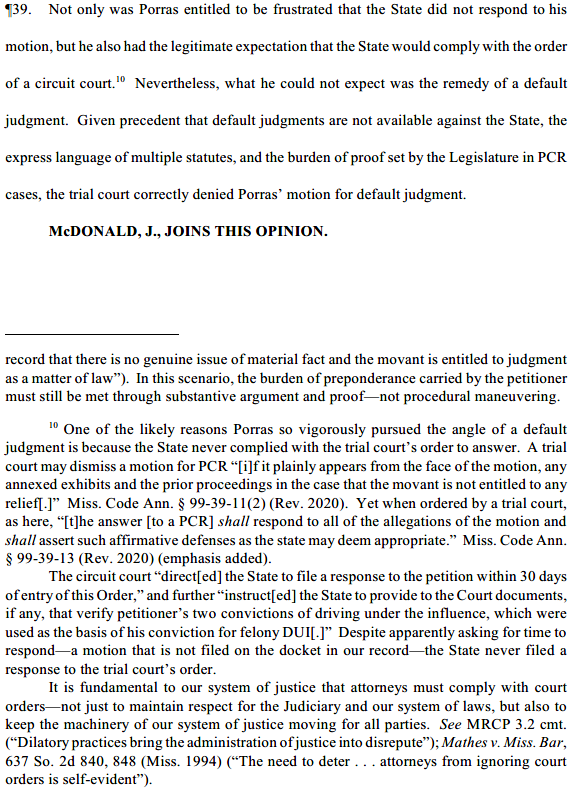
Porras v. State, 2021-CP-00052-COA (Civil – PCR)
Affirming the circuit court’s denial of a PCR motion, holding that there was no error in denying the request for appointed counsel for the PCR hearing, no error in failing to require the State to file a written response to the PCR motion, and, ultimately, no error in denying the PCR motion.
(Judge McCarty wrote special concurrence, joined by Judge McDonald

NOTE: Judge McCarty’s special concurrence thoughtfully addressed the argument that the petitioner was entitled to a default judgment because the State failed to respond the PCR motion in violation of an order of the circuit court. McCarty first set out the law and policy behind establishing a broad prohibition of default judgments against the State. He then wrote that the petitioner had a right to expect the State to comply with the circuit court and had other possible remedies, but that default judgment was not an available remedy.


Bradford v. State, 2021-KA-00509-COA (Criminal – Felony/Simple Assault)
Affirming conviction and sentence for simple assault of a police officer, holding that the evidence was sufficient to establish lawful arrest and that the officer sustained a bodily injury including, but not limited to, evidence of an attempted biting that was thwarted by the officer’s jacket and a kick to the groin that found its mark.
(Judge McDonald concurred in part and in the result without separate written opinion and Judge Westbrooks concurred in result only without separate written opinion.)


Edwards v. State, 2021-KA-00259-COA (Criminal – Felony/Armed Robbery)
Affirmed conviction and sentence for armed robbery and conspiracy to commit armed robbery, holding that the evidence (including evidence from co-conspirators turned State’s witnesses) was sufficient for a reasonable jury to find the elements of a conspiracy to rob a GameStop were proved beyond a reasonable doubt and that the convictions of armed robbery and conspiracy to commit armed robbery were not against the weight of the evidence.
(All participating judges concurred.)


Other Orders

None


Hand Down List Link

Summaries of the Mississippi Court of Appeals opinions of April 12, 2022

The Mississippi Court of Appeals handed down two opinions today, one criminal and one civil. The criminal opinion affirmed a conviction, finding no merit on a litany of issues. The civil opinion affirmed summary judgment on a breach of contract claim based on a personal guaranty included in a credit application with a business’s supplier.


Barnes v. State, 2021-KA-00404-COA (Criminal – Felony/Hearsay/Jury Instructions/Rule 404(b))
Affirming conviction of two counts of fondling, holding (1) no error in jury instruction re: sufficiency of unsubstantiated/uncorroborated, but not contradicted/discredited, testimony of victim of a sex crime to support guilty verdict; (2) no error in allowing testimony by investigator “based on professional experience” because not expert opinion; (3) error in allowing hearsay was harmless because the same information was also introduced through admissible source; (4) Rule 404(b) objection re: other students who reported misconduct waived because not made contemporaneously and because it showed why the school initiated an investigation; (5) no error in admitting recorded conversations between victim and defendant where intelligible recording was not produced until the first day of trial (at least partially because defense did not request more time to prepare); (6) no error in admitting purported statement of the defendant over discovery violation objection because the statement had produced in discovery and defense counsel admitted being familiar with it; (7) no merit to ineffective assistance of counsel claim; and (8) the evidence was sufficient to support the convictions. The court of appeals invoked the plain error doctrine to remand the case for correction of a scrivener’s error in the sentencing order.
(Judge Westbrooks and Judge McDonald concurred in part and in the result without separate written opinion. Judge McCarty concurred in result only without separate written opinion.)


Devine v. Cardinal Health 110, LLC, 2020-CA-01101-COA (Civil – Contract/Personal Guaranty/Affirmative Defenses)
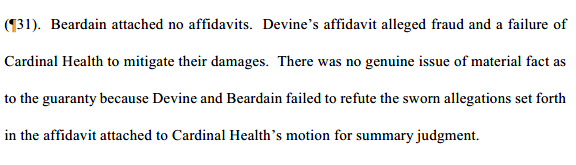
Affirming the circuit court’s grant of summary judgment in favor of the plaintiff/supplier, holding that there was no error in finding that the owners of a company had personally bound themselves to pay their company’s debt to the plaintiff/supplier per the terms of a credit application that contained a personal guaranty. The court of appeals noted that the defendants did not attach affidavits in response to the summary judgment motion that addressed the guaranty:

The court of appeals then held that the plaintiff/supplier–a secured creditor– had no duty to mitigate before filing a lawsuit for damages and that the defendant that asserted fraud in response to the motion for summary judgment had waived that affirmative defense by failing to plead it in his answer to the complaint.
(All judges concurred.)


Other Orders

Hartzler v. Bosarge, 2019-CT-01606 (granting motion to dismiss appeal as interlocutory)

Doe v. Doe, 2020-CA-00853-COA (denying motion for rehearing)

Braswell v. Braswell, 2020-CA-01090-COA (denying motion for rehearing)

Nunn v. State, 2021-TS-01371-COA (granting pro se motion for out-of-time appeal and granting motion to withdraw and substitute counsel)


Hand Down List

Summaries of the Mississippi Supreme Court opinions of April 7, 2022

The Mississippi Supreme Court handed down five opinions today. I think Weber v. Estate of Hill will be a frequently cited case on the issue of medical expert causation testimony, especially in the medical malpractice context. There is also an insurance coverage decision (where the court granted interlocutory appeal and then affirmed the circuit court), another medical malpractice case dealing with a hospital’s lack of liability for treatment plans of independent physicians, a contempt of youth court case, and a Mississippi Bar disciplinary decision.


Donaldson v. Cotton, 2020CA-00581-SCT (Civil – Other/Contempt)
Vacating the a youth court judge’s order of contempt against a county prosecutor fining him for past and continuing refusal to draft youth court orders, holding that youth court judges have inherent authority to order a county prosecutor to prepare orders in youth court matters but that the alleged contempt was constructive criminal contempt and thus the attorney’s due process rights were violated. The order was vacated, the case was remanded, and the youth court judge was direct to recuse for further proceedings.
(Justice Coleman dissented, joined by Chief Justice Randolph and Justice Beam.)


Weber v. Estate of Hill, 2020-CA-00293-SCT (Civil – Medical Malpractice/Causation/Experts)
Denying rehearing and and modifying two paragraphs (¶ 37 and ¶ 38) of the original opinion. On direct appeal, the supreme court affirmed the circuit court’s denial of the defendants’ motion for JNOV that argued there was no admissible expert testimony on causation, holding that the testimony of one of the plaintiff’s medical experts provided a basis for a juror to reasonably conclude that a timely C-section delivery would have provided the baby with a greater-than-50-percent chance of a substantially better outcome even though that expert testified that he lacked the expertise necessary to quantify the degree to which the labor and delivery process aggravated the injury. On cross appeal, the supreme court reversed the circuit court’s reduction of the jury’s $2,538,322 award for non-economic damages, holding that this action filed in December 2002 was governed by Mississippi’s wrongful-death statute because the medical-malpractice noneconomic-damages cap was not in place until September 1, 2004.
(Justice Griffis dissented, joined by Justice Coleman and Justice Maxwell. Chief Justice Randolph did not participate.)

NOTE: This was a big win for the plaintiff and it is a must-read case on medical expert causation testimony, especially in the medical malpractice context. I have not read the record, but my understanding from the majority opinion and the dissent is that no expert specifically testified that a timely C-section delivery would have provided the baby with a greater-than-50-percent chance of a substantially better outcome. Instead, the supreme court allowed the jury to “connect the dots” (the “dots” being other pieces of expert testimony) in determining that the plaintiff satisfied that causation standard even though the plaintiff’s obstetrics and maternal-fetal medicine expert testified he was not qualified to connect these dots and give an opinion as to the percentage aggravation would be.


Mississippi Farm Bureau Casualty Insurance Company v. Powell, 2020-IA-00432-SCT (Civil – Insurance/Coverage)
On interlocutory appeal, affirming the circuit court’s denial of the insurance company’s motion for summary judgment seeking a declaratory judgment that it had no duty to provide coverage, no duty to defend/indemnify, and no duty to pay medpay benefits, holding that a fall from scaffolding that was erected on a trailer that was hitched to an insured pickup was an auto accident arising out of the use and ownership of the covered vehicles.
(Justice Maxwell concurred in result only, joined by Justice Chamberlain and Justice Griffis, and joined by Justice Coleman in part.)


St. Dominic-Jackson Memorial Hospital v. Newton, 2020-IA-00494-SCT (Civil – Medical Malpractice)
On interlocutory appeal, reversing the circuit court’s denial of the hospital’s motion for summary judgment, holding that the Mississippi law does not impose a duty on a hospital to require peer review of a treatment plan before allowing a doctor and patient to use its facilities.
(Justice Kitchens dissented, joined by Justice King.)

PRACTICE POINT: This is less-than-ideal feedback to receive from the supreme court…

Other Orders

Howell v. State, 2020-CA-00868-SCT (directing the parties to file supplemental briefs on the following issue: Whether the Court should overrule Rowland v. State, 42 So. 3d 503 (Miss. 2010), and any other case in which, and to the extent that, we have held the fundamental rights exception to the procedural bars may be applied to the three-year statute of limitations codified by the Legislature in the Uniform Post-Conviction Collateral Relief Act)

Bryant v. Bryant, 2020-CT-00883-SCT (granting cert)

Newell v. State, 2020-CT-01137-SCT (denying cert)

Thornhill v. Walker-Hill Environmental, 2020-CT-01181-SCT (granting cert)

The Mississippi Bar v. Malone, 2021-BD-00467-SCT (suspending attorney Robert W. Malone for two years)


Hand Down List

Summaries of the Mississippi Court of Appeals opinions of April 5, 2022

After a slow week on the opinion front the Mississippi Court of Appeals is back in action with eight opinions today. There is a domestic relations case dealing with a slew of arguments about child support and child custody, a criminal appeal addressing waiver of potential conflicts with codefendants being represented by a single attorney, a disability opinion, an unemployment opinion, and several PCR opinions.


Wallace v. Wallace, 2020-CA-01148-COA (Civil – Domestic Relations/Custody/Child Support)
Affirming the chancellor’s decisions related to a series of motions related to child support and custody modification:
1. No error in finding the father in arrears for child support for the period of time during which the mother had voluntarily modified the custody arrangement, but not the child support arrangement.
2. No error in finding the father in arrears for nonapyment of daycare and after-school expenses even though the mother “stockpiled” receipts for years rather than presenting them every 30 days as required by the MDA.
3. No error in decision that the mother was not in contempt for withholding visitation in light of the “substantial discretion regarding contempt matters” afforded to chancellors and evidence in the record that visitation was never withheld.
4. No error in no awarding both parents the right to claim the children as dependents for tax purposes because in the absence of specific findings of fact the court assumes the chancellor resolved any factual disputes in favor of the appellee.
5. No error in declining to hold the mother in contempt over the aforementioned stockpiling of daycare/after-school receipts.
6. No error in awarding the mother attorney’s fees in light of the fact that the father was held in contempt.
7. No error in awarding just $1,000 in attorney’s fees to the father for the mother’s violation of the morals clause considering the discretion chancellor’s enjoy on such decisions.
8. No error in ordering the father to provide for the children’s health insurance considering the children’s loss of access to employment-related insurance after the mother’s job was eliminated due to COVID-19.
(Judge Westbrooks and Judge McCarty concurred in part and in the result without separate written opinion)


Magee v. State and Haynes v. State, 2020-KA-01378-COA (Criminal – Felony/Waiver of Potential Conflicts/Dual Representation/Sufficiency of the Evidence/Jury Instructions)
Affirming convictions of co-defendants in consolidated appeals. The court of appeals affirmed the circuit court’s ruling giving the defendants what they asked for by allowing them to waive potential conflicts with being represented by the same attorney, finding that the defendants knowingly and intelligently waived the potential conflicts. The court of appeals held that the evidence was sufficient to support the convictions of both defendants for kidnapping and conspiracy, and the conviction of one defendant for sexual battery. Finally, the court of appeals held that there was no error in denying two of the defendants’ proposed jury instructions or in the circuit court’s sua sponte conspiracy instruction.
(All judges concurred)


Hickerson v. State, 2021-CA-00176-COA (Civil – PCR)
Affirming the circuit court’s denial of a petition for PCR, holding that there was no error in finding that the petition was procedurally deficient for failing to attach competent affidavits and that the claim of ineffective assistance of counsel was meritless.
(Chief Judge Barnes concurred in part and in the result without separate written opinion; Judge Lawrence did not participate)


Barbour v. Singing River Health System Employees’ Retirement Plan and Trust, 2020-CA-01407-COA (Civil – State Board and Agencies/Disability)
Affirming the chancellor’s decision denying disability benefits, holding that to the extent the chancellor’s reference to an incorrect standard of review was in error, it was harmless because the plaintiff was not an “employee” of Singing River at the time of his injury.
(Judge Wilson concurred in part and in result, joined by Judge Smith and Judge Emfinger and in part by Judge McCarty)


Handyman House Techs, LLC v. Mississippi Department of Employment Security, 2021-CC-00029-COA (Civil – State Boards and Agencies/MDES)
Affirming the circuit court’s decision affirming MDES’s determination that an applicant for unemployment benefits was a “employee” rather than an “independent contractor,” holding that the MDES Board of Review’s decision was not arbitrary or capricious.
(Chief Judge Barnes and Judge McCarty concurred in part and in the result without separate written opinion)


Ford v. State, 2020-CP-00372-COA (Civil – PCR)
Affirming the circuit court’s dismissal of a PCR motion, holding that the circuit court correctly ruled that the second PCR motion was an impermissible successive motion.
(All judges concurred)


Thompson v. State, 2020-CP-01236-COA (Civil – PCR)
Affirming the circuit court’s dismissal of a PCR, finding no merit to the claims that the indictment was defective, that the guilty plea was not knowingly and intelligently entered, that the defendant’s attorney had a conflict of interest and provided ineffective assistance of counsel, or that the defendant’s statement and the victim’s statement were coerced.
(All judges concurred)


Booker v. State, 2018-CA-00664-COA (Civil – PCR/Miller)
On rehearing, withdrawing a previous opinion and substituting an opinion holding that the circuit court did not err in determining that the defendant did not have a statutory right to be resentenced under Miller, that the circuit court did not err in denying the defendant’s request for parole eligibility, that the defendant was not deprived of an opportunity to be heard on the issue of rehabilitation, that the defendant failed to prove ineffective assistance of counsel, and that the sentence was not unconstitutional based on arguments about the defendant’s age and IQ.


Other Orders

Walker v. State, 2020-KA-228-COA (denying motion for rehearing)


Hand Down List

Summaries of the Mississippi Supreme Court’s opinions of March 31, 2022

The mix of beautiful spring weather and apocalyptic tornado warnings this week set the stage for just one opinion from the Mississippi Supreme Court to compliment the one opinion handed down by the Mississippi Court of Appeals on Tuesday. The case today is an insurance coverage dispute that analyzes several provisions of an excess policy and determines that summary judgment finding of no coverage under a pollution exclusion was in error.


Omega Protein, Inc. v. Evanston Insurance Company, 2020-CA-01097-SCT (Civil – Insurance/Insurance Coverage/Excess Insurance)
The Supreme Court reversed the circuit court’s grant of the excess carrier’s motion for summary judgment in a dec action where the excess carrier sought a declaration of no coverage for injuries and a death sustained in a plant explosion that occurred while a contractor was performing welding work at the plant. The Supreme Court held that (1) a pollution exclusion did not apply as a matter of law because it was ambiguous and susceptible to more than one interpretation and must be construed in favor of coverage, (2) coverage under the excess policy was not triggered by the primary insurer paying out limits because there had been no adjudication of fault or negligence of the named-insured contractor, and (3) the issue of the plant’s status as an additional insured under the insured contractor’s excess policy could not be determined because there had been no adjudication of fault or negligence of the named-insured contractor.
(All justices concurred)


Other Orders

Dooley v. Dooley, 2020-CA-01061-SCT (dismissing appeals filed by appellant and appellees for want of jurisdiction)
Omega Protein, Inc. v. Evanston Insurance Company, 2020-CA-01097-SCT (denying motion for rehearing, withdrawing original opinion, and substituting the opinion above)


Hand Down List

Summaries of the Mississippi Supreme Court opinions of March 17, 2022

The folks publishing the hand down lists are not on spring break. There were four opinions today that are must-reads for anyone whose law practice these opinions touch. There is a medical malpractice/expert testimony decision, a dismissal for failure to prosecute decision that is more about the abuse-of-discretion standard of review, a breach of commercial lease opinion, and a will probate opinion.


Claiborne County Hospital v. Truitt, 2020-IA-01017-SCT (Civil – Medical Malpractice/Summary Judgment/Experts)
The plaintiff fell while walking to the restroom to give a urine sample. The plaintiff filed a negligence claim against the hospital, alleging that a nurse failed to assist him to the restroom. The hospital filed a motion for summary judgment on the grounds that the plaintiff lacked medical expert testimony. The plaintiff argued that the layman’s exception applied or, alternatively, that the plaintiff had identified the requisite expert testimony in an interrogatory answer. The circuit court denied the hospital’s motion for summary judgment and the Supreme Court granted interlocutory appeal. The Supreme Court reversed the circuit court and rendered judgment in favor of the hospital, holding that “the layman’s exception does not apply to the facts of this case because Truitt’s claim involves the rendering of medical services and a nurse’s professional judgment for which expert testimony is required.” The Supreme Court also held that the designation via interrogatory answer was insufficient because the “designation does not provide sworn expert testimony” and noting that the plaintiff “only provided the name of his expert and a brief description of the anticipated testimony.”
(All justices concurred)


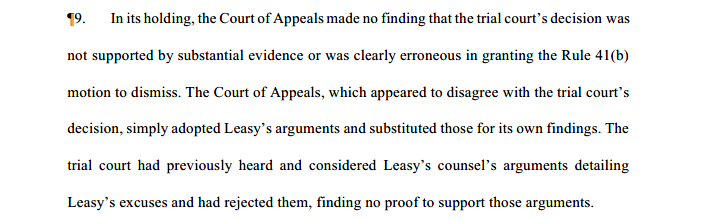
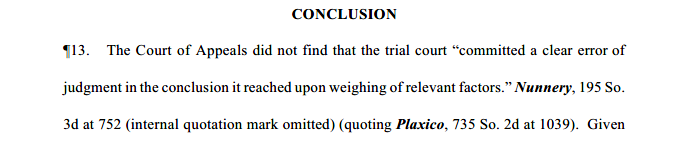
Leasy v. SW Gaming, LLC, 2019-CT-01505-SCT (Civil – Personal Injury/Failure to Prosecute/Standard of Review)
Reversing the Court of Appeals and reinstating the circuit court’s judgment dismissing the plaintiff’s claim for failure to prosecute, holding that the Court of Appeals improperly reweighed the evidence and reaffirming the controlling abuse-of-discretion standard.
(Justice King dissented, joined by Justice Kitchens. Justice Beam did not participate in the decision)
(Note: At the Court of Appeals level, Judge Carlton wrote a dissent that was joined by Judge Wilson)

Practice Point – Standards of review matter! The Mississippi Supreme Court has shown a renewed interest in standards of review. This opinion is more about the standard of review than it is about the failure to prosecute. The Supreme Court described the Court of Appeals’ incorrect application of the standard of review as follows:

The Supreme Court bluntly concluded:


Holcomb, Dunbar, Watts, Best, Masters & Golmon, P.A. v. 400 South Lamar Oxford Mad Hatter Partners, LLC, 2019-CT-01702-SCT (Civil – Real Property/Landlord-Tenant Law/Commercial Real Estate)
Affirming the circuit court’s denial of the tenant’s motion for partial summary judgment seeking a dismissal of the landlord’s claims for back rent, holding that the landlord’s demand for possession and the tenant’s departure from the premises did not prevent the landlord from recovering back rent; affirming the circuit court’s grant of summary judgment to the landlord based upon material breaches by the tenant; affirming the Court of Appeals’ finding that the tenant’s mitigation argument was waived because it was not raised prior to the appeal; affirming the Court of Appeals’ decision granting the landlord’s motion to quash the tenant’s request for records related to a news story a spat between the landlord’s principal and another developer because those records were not relevant to the appeal; and affirming the circuit court’s denial of the tenant’s untimely motion to amend to add claims of libel and libel per se because they were delayed and barred by the one-year statute of limitations.
(All participating justices concurred.)


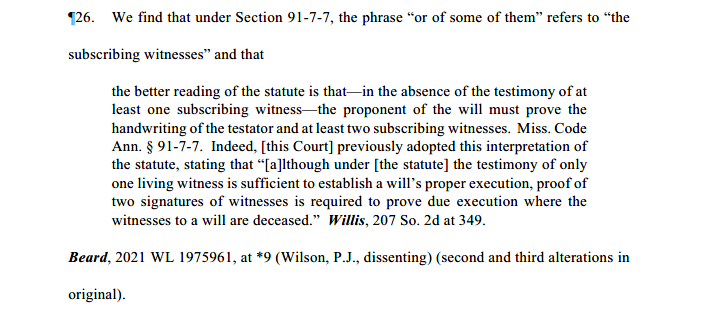
In the Matter of the Last Will and Testament of Luke Beard, Deceased: Antonio Christmas v. Diane Christmas, 2019-CT-01821-SCT (Civil – Wills, Trusts, and Estates/Probate)
Reversing the court of appeals and reinstating the chancery court’s dismissal of a petition to probate a purported will, holding that in the absence of the testimony of at least one subscribing witness, a proponent of a will must prove the handwriting of the testator and at least two subscribing witnesses. This unanimous, textualist decision centered around whether the phrase “or some of them” in section 91-7-7 referred to the subscribing witnesses or collectively to the testator and the subscribing witnesses. Ultimately, the Supreme Court adopted Judge Wilson’s analysis of the textual quandary from his dissent at the Court of Appeals, holding:


The Mississippi Bar v. Henderson, 2021-BD-01141-SCT (Civil – Bar Matters)
Imposing a reciprocal public censure to an attorney publicly censured in Tennessee and assessing costs.


Other Orders

Dille v. State, 2019-CT-00855-SCT (denying petitions for cert)
Lairy v. Chandler, 2019-CT-01423-SCT (granting petition for cert)
Cork v. State, 2020-KA-00060-SCT (denying pro se motion for rehearing)
Magnolia Health Plan, Inc. v. Mississippi’s Community Health Commissions, 2020-CA-00167-SCT (denying motion for rehearing)


Hand Down List

Summaries of the Mississippi Supreme Court opinions of February 24, 2022

The Mississippi Supreme Court handed down four opinions today: one civil procedure decision on interlocutory appeal, one MDES decision, and two decisions affirming criminal convictions.


University of Mississippi Medical Center v. Jensen, 2020-IA-872-SCT (Civil – Personal Injury/Statute of Limitations/Service of Process)
Reversing, on interlocutory appeal, the county court’s ruling granting the plaintiff’s motion for extension of time to serve process, holding that the plaintiff did not show good cause where the plaintiff attempted to serve process on an administrative assistant, who accepted service on behalf of UMMC’s CEO, instead of the attorney general. Because the statute of limitations had expired, judgment was rendered in favor of UMMC.

“As neither inadvertence, mistake of counsel, or ignorance of the rules suffice to establish good cause, the county court lacked substantial evidence to support its finding that Jensen had shown good cause for an extension of time to serve process under Rule 4(h).”

Univ. of Miss. Med. Ctr v. Jensen, 2020-IA-827-SCT (Miss. 2022) (citation omitted).

Mississippi Department of Employment Security v. Dover Trucking, LLC, 2020-CC-1267-SCT (Civil – State Boards and Agency/Employment)
Reversing the circuit court’s order that reversed the MDES Board of Review’s decision that the claimant was an “employee” of a trucking company, holding that that the agency’s decision was supported by substantial evidence and was not arbitrary or capricious.


Williams v. State, 2020-KA-772-SCT (Criminal – Felony/Rebuttal Evidence)
Affirming conviction of one count of sexual battery, holding that the circuit court did not err in admitting State’s rebuttal evidence related to the defendant’s ankle monitor that had not been disclosed prior to trial because that evidence was not within the State’s due diligence/disclosure obligations prior to trial based on the defendant’s pre-trial representations. The supreme court also held that the circuit court did not err in excluding evidence that the minor victim had previously twerked on the school bus and that the defendant’s sufficiency of the evidence claim was meritless.


Williams v. State, 2019-CT-1007-SCT (en banc) (Criminal – Felony/Accomplice Liability)
Affirming, on writ of certiorari, convictions for two counts of conspiracy and two counts of possession with intent to distribute, holding that the evidence was sufficient to convict on accomplice liability rather than constructive possession where an inmate was directing a drug-trafficking ring from prison over the phone and whose home was found to have large amounts of cocaine and marijuana, as well as $93,259 in cash.


Other Orders

Ward v. Cranford, 2020-CT-410-SCT (denying petition for writ of certiorari)
Brown v. State, 2020-M-630 (denying petition for leave to proceed in trial court and for permission to file successive petition for post-conviction collateral relief)
State v. Corrothers, 2021-IA-836-SCT (denying motion for rehearing)
Cooper v. State, 2021-CT-1012-SCT (dismissing pro se “writ of certiorari”)


Hand Down List for February 24, 2022

Summaries of the Mississippi Court of Appeals opinions of Feb. 15, 2022

Anderson v. S&S Properties, LLC, 2021-CA-33-COA (Civil – Real Property/Summary Judgment/Tax Sale)
Affirming summary judgment granted by the chancery court setting aside a tax sale and ordering the county to refund the purchase price to the purchaser, holding that the purchaser had standing and that the county failed to serve proper notice of the tax sale to the assessed property owners. Note: The COA held that the purchaser had standing to sue in this particular case because the amended version of Miss. Code Ann. § 27-25-27(2) did not apply retroactively. The amended statute provides: “No purchaser of land at any tax sale, nor holder of the legal title under him by descent or distribution, shall have any right of action to challenge the validity of the tax sale.”

Ford v. State, 2020-KA-278-COA (Criminal – Felony/Criminal Procedure)
Affirming conviction of first-degree murder, holding:
1. The defendant was not entitled to a directed verdict under Weathersby because the Weathersby issue was procedurally barred and because Weathersby did not apply in this case where there was contradicting.
2. The circuit court did not err by not allowing the defendant to represent himself because the defendant did not expressly make such a request.
3. The circuit court did not err in allowing an investigator to testify about his recollection of a verbal statement the defendant gave to law enforcement.
4. The defendant’s counsel was not constitutionally ineffective for not proposing a “stand your ground” instruction (trial strategy), not filing a motion for new trial or JNOV (this was deficient, but not “prejudicial” in that there is no reasonable probability that, but for counsel’s unprofessional errors, the result of the trial would have been different), not arguing the Weathersby rule (Weathersby was already held to be inapplicable), and not subpoenaing eyewitness testimony (trial strategy).
5. There was no prosecutorial misconduct during closing argument when the prosecutor argued that the trajectory of the bullet showed that the defendant and the victim were not fighting for the gun.
6. The defendant’s should not be reversed as a result of cumulative error because the other issues on appeal were without merit.

Diversicare of Meridian, LLC v. Shelton, 2020-CA-1362-COA (Civil – Contract/Arbitration Agreement)
Affirming the circuit court’s denial of a motion to compel arbitration in a wrongful death nursing-home case, holding that the nursing home failed to provide sufficient proof that the resident gave her daughter, who signed admissions paperwork including an arbitration agreement, authority to bind the resident to arbitrate any future disputes arising from her stay.
NOTE: Although the court of appeals affirmed the denial of the motion to compel arbitration, it held that the circuit court erred in ruling that written authority was required. Specifically, the court of appeals held: “[A] mentally competent individual may orally grant authority to another person to sign documents required for admission to a nursing home.”

Rutland v. Burroughs, 2020-CA-1100-COA (Civil – Torts/Civil Procedure)
Affirming the circuit court’s grant of summary judgment dismissing a malicious prosecution and intentional infliction of emotional distress lawsuit after the plaintiff’s attorney withdrew, the 60-day period given to the plaintiff to retain new counsel or proceed pro se passed without any such action taken by the plaintiff and the plaintiff did not file a timely response to the motion for summary judgment.

Robinson v. Smith, 2020-CA-1249-COA (Civil – Personal Injury/Counter-Claim/Civil Procedure)
Reversing the circuit court’s grant of summary judgment that was based on a default judgment on a counter-claim, holding based on the plain language of Rules 7, 12, and 13, the counter-claim was procedurally improper because it was not asserted in the answer and the plaintiff therefore has no obligation to respond to it.

Lambes v. Lambes, 2020-CA-95-COA (Civil – Domestic Relations/Custody)
Affirming the chancery court’s ruling that it was in the best interest and welfare of the children to place them in the father’s custody, holding that the father was not precluded from being awarded custody after he admitted to the ground of habitual cruel and inhuman treatment when that admission was based on the chancellor’s statement that all rights regarding custody etc would be preserved, and that there were not misrepresentations in the GAL report warranting reversal when the record showed the chancellor made his decision based upon independent findings of fact.

Tillman v. KLLM Transport, 2021-WC-57-COA (Civil – Workers’ Comp/One-Year Limitations Period)
Affirming the MWCC’s dismissal of a workers’ comp claim based on the one-year limitations period, holding that the dismissal of the workers’ comp claim for the claimant’s failure to file a pre-hearing statement is a “rejection of the claim” sufficient to start the one-year limitations period under section 71-3-53 regardless of when or if a B-31 was filed.

Shannon v. Shannon, 2020-CA-847-COA (en banc) (Civil – Domestic Relations)
Affirming the chancery court’s rulings granting divorce on the ground of habitual cruel and inhuman treatment, granting a permanent restraining order against and divesting title from the at-fault party, applying the Ferguson factors, and denying a motion to continue or to allow remote participation.

Williams v. State, 2020-CP-950-COA (en banc) (Civil – PCR)
Reversing the circuit court’s denial of a pro se motion for post-conviction collateral relief, holding that the circuit court did not have sufficient evidence to revoke the defendant’s post-release supervision because (1) the defendant was not convicted of the crime that prompted the revocation of his PRS and (2) there was insufficient evidence in the record that the defendant had failed to pay fees, fines, and restitution. This case was remanded to the circuit court for further proceedings.

Other Orders
4 Denials of Motions for Rehearing


Enter your email address to have the opinion summaries and other posts emailed to you as soon as they are published.
(You can always unsubscribe later.)

Mississippi Supreme Court Hand Downs for February 10, 2022

Brown v. State, 2020-KA-1366-SCT (Criminal – Felony/Constructive Possession Instruction)
Affirming a conviction for three counts of possession of a controlled substance and one count of unlawful possession of a firearm by a convicted felon with a sentence of twenty-four years to under the habitual offender statute, holding that the circuit court did not err in granting the State’s jury instruction on constructive possession or in denying the defendant’s proposed instruction on circumstantial evidence.

Copes v. State, 2019-CT-302-SCT (en banc) (Criminal – Felony/Right to Counsel of Choice)
Affirming a conviction for two counts of sexual battery of two minors and a sentence of twenty years, holding that the defendant was not denied his right to his counsel of choice under the Sixth Amendment when his lead counsel was removed during trial from questioning witnesses and making closing arguments due to repeated misconduct including violation of the judge’s orders.

Augustine v. State, 2019-CT-1467-SCT (en banc) (Criminal-Felony/Impeachment Testimony)
Reversing the court of appeals and reinstating/affirming a conviction for second-degree murder, holding that the circuit court did not err by allowing an officer to testify to the content of a prior witness’s statement for impeachment purposes and, assuming arguendo that it was error, that the overwhelming weight of the evidence supported the conviction.

Alexander v. State, 2019-CT-1612-SCT (en banc) (Criminal-Felony/Habitual Offender Status/Miller Hearing)
Reversing the court of appeals and reinstating/affirming a 1998 conviction for capital murder and sentence to life without parole, holding that the circuit court did not abuse its discretion when it denied the defendant’s motion to fund a mitigation expert and holding that the defendant was not deprived of his right to have a jury impose his sentence.

Other Orders
1 Denial of a “Motion for Review by Supreme Court of Court of Appeals’ Denial of Attorney’s Fees”
1 Denial of a Cert Petition
1 Denial of a Motion for Rehearing

Complete Hand Down List


BONUS CONTENT

Every so often, one needs to find support for a proposition that is so obvious that a citation is elusive. See generally Orin S. Kerr, A Theory of Law, 16 Green Bag 2d 111 (2012). The supreme court gifted the bar with this pithy statement that will come in handy in the future:

"It is axiomatic that a judge's rulings during trial are to be followed." Copes v. State, No. 2019-CT-00302-SCT (¶ 11) (Miss. 2022)

Enter your email address to have the hand down summaries and other posts emailed to you as soon as they are published. (You can always unsubscribe later.)
Mississippi Court of Appeals Hand Downs for February 8, 2022

Blue Cross and Blue Shield of Mississippi v. Brown and Brown of Mississippi, LLC, 2020-CA-1414-COA (Civil – Contract/Garnishment)
Brown obtained two judgments against a BCBS insurance agent, enrolled the judgments, and then filed suit to enforce the judgments and suggestions for writs of garnishment against BCBS and others. BCBS denied it was indebted to the agent. The circuit court ordered BCBS to tender the agent’s commissions to Brown. BCBS appealed, and the court of appeals reversed the circuit court and rendered judgment in favor of BCBS, finding that the agent had assigned her interest in the commissions to a third party long before the writ of garnishment was served. The court of appeals also held that BCBS was entitled to its costs under section 11-35-45 and remanded to the circuit court to address that issue.

Ladner v. State, 2020-KA-299-COA (Criminal – Felony)
Affirming a conviction of possession of a firearm by a felon, holding that it was harmless error for the the circuit court to exclude non-hearsay testimony under the hearsay rule and that the circuit court did not err admitting body cam footage. The opinion lists a claim of ineffective assistance of counsel as one of the issues raised, but there is no discussion of that in the majority opinion, the special concurrence, or the dissent.

Nowell v. Stewart, 2020-CA-728-COA (Civil – Domestic Relations/Child Support)
Affirming the chancellor’s judgment increasing the child support modification based on a material change in circumstances.

Mangum v. State, 2020-CP-1205-COA (Civil – Post-Conviction Relief)
Affirming the circuit court’s dismissal of a motion for PCR based on the statute of limitations and the successive-motions bar.

United Services Automobile Association v. Moffatt, 2020-CA-1391-COA (Civil – Insurance/UM UIM)
The county court granted summary judgment in favor of a UM carrier, finding that the amended complaint naming the UM carrier was time barred because it was filed more than three years after the accident. The plaintiff appealed to the circuit court and the summary judgment was reversed. The UM carrier appealed to the court of appeals and the court of appeals affirmed the circuit court and remanded the case to the county court. The court of appeals held that there was a genuine fact issue for a jury as to when the plaintiff’s UM claim accrued based on when it could be reasonably known that the damages suffered exceed the limits of insurance available to the alleged tortfeasor.

Lowe v. State, 2019-KA-1621 (Criminal – Felony/Confrontation Clause)
Affirming a conviction of the sale of cocaine and sentencing as a habitual offender, holding that an officer’s testimony that a non-testifying confidential informant said she had bought drugs from the defendant in the past violated the Confrontation Clause of the Sixth Amendment but was harmless error.

Other Orders
6 Rehearing Denials

Link to Hand Down List