Mississippi Supreme Court decisions of May 5, 2022

The Mississippi Supreme Court handed down two opinions today. One addresses whether additional discovery may be had or the record supplemented at the circuit court level on appeal from a decision of a governing authority of a municipality or county. The other is a circuit clerk v. drug court dispute over the collection of drug court participation fees.


Board of Supervisors of Jackson County, Mississippi v. Qualite Sports Lighting, LLC, 2020-IA-01301-SCT (Civil – State Boards and Agencies)
Reversing and remanding circuit court’s order directing the supplementation of the record in an appeal of a decision of the Jackson County Board of Supervisors, holding that the 2018 amendments to the process of appealing a decision of the governing authority of a municipality or county as laid out in section 11-51-75 (Rev. 2018) of the Mississippi Code Annotated did not allow Qualite, who was appealing the board’s decision to the circuit court, to conduct discovery or go beyond the record that was originally before the board.
(All justices concurred.)


Thompson v. DeSoto County Intervention Court, 2020-CA-00956-SCT (Civil – Other/Drug Court)
The circuit court entered an order directing that drug court fees be paid to the circuit clerk’s office. The circuit clerk filed a petition to set aside or rescind that order, arguing that the drug court participation fee was not a criminal fine or fee and that the circuit clerk’s office was not compensated for processing the participation fee, and want not able to take a cut of it, since she had no statutory duty to do collect the participation fee. The circuit court denied the motion and the circuit clerk appealed. The Mississippi Supreme Court affirmed, holding that the drug court is a criminal court and that fees obtained during its proceedings are criminal fees. Therefore, it is the circuit clerk’s duty to collect drug/intervention court fees under section 9-1-43(5) of the Mississippi Code Annotated.
(Justice King concurred in result only without separate written opinion. Justice Chamberlin did not participate.)


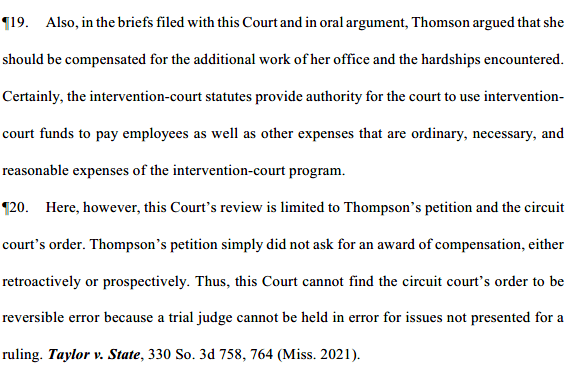
NOTE – The circuit clerk asked for compensation on appeal. The supreme court addressed that request, but did not award compensation because the scope of review was limited to the clerk’s petition which did not seek compensation and the circuit court’s order on that petition:


Other Orders

Hartzler v. Bosarge, 2019-CT-01606-SCT (lifting the suspension of certiorari proceedings and granting the Rule 42 (MRAP) Joint Motion to Dismiss Appeal insofar as the petition for a writ of certiorari is dismissed as moot)

Belk v. State, 2020-CT-00465-SCT (denying cert)

Watson v. State, 2020-CT-00789-SCT (denying cert)

Sutton v. State, 2020-CP-01322-SCT (denying rehearing)

Humphrey v. Steve Holts, 2021-CT-00046-SCT (granting cert)


Hand Down Page

Mississippi Supreme Court decisions of April 28, 2022

After some sort of technical hiccup with the State’s web domain that knocked the Mississippi Supreme Court’s website offline for a spell, they are back in business. The Court handed down one hearty opinion in a wrongful death case that involves § 1983, qualified immunity, the MTCA, the appealability of summary judgment denials, and hearsay.


City of Jackson v. Johnson, 2020-CA-00318-SCT (Civil – Tort/Wrongful Death/1983/MTCA)
Reversing and rendering a jury verdict holding the City liable under § 1983 and affirming the trial court’s judgment finding the City liable under the MTCA for the decedent’s wrongful death. The victim was murdered shortly after calling 911 to report a prowler. The dispatcher did not tell the victim to remain on the line, in violation of the City’s policies and procedure. Two JPD officers went to the victim’s house, did not detect that the prowler had entered a window, did not make contact with the victim, and left. The victim was found dead the next day. The victim’s family filed suit under § 1983 and under the MTCA.

The 911 operator and officers got out via qualified immunity on summary judgment. The § 1983 case was tried by a jury and the MTCA case was tried “simultaneously” before the bench. The jury found that the City violated the victim’s constitutional rights to due process and awarded $1M in damages. The trial court awarded $500,000 (i.e. the statutory maximum) under the MTCA.

On appeal, the Mississippi Supreme Court held that the City was entitled to a directed verdict on the § 1983 claim, reasoning that our constitutional due process rights do not include the right to be protected by the state from acts of private violence. Regarding the MTCA claim, the Supreme Court held that the 911 dispatcher’s conduct in responding to the victim’s call did not involve an element of choice or judgment and the City was therefore not protected by discretionary function immunity from liability under the MTCA.

There was a hearsay issue involving the defendant’s statement contained in the police report that warrants a brief discussion. The trial court admitted the police report, but with the assailant’s statement to police redacted, finding that the assailant could not be compelled to testify against himself and that hearsay exception in Rule 804(b)(3) did not apply because the statement was not being used against the assailant/declarant. Later in the trial, the court allowed the plaintiff’s expert to reply on the assailant’s statement in forming his opinions over the City’s objection that the expert had relied on inadmissible hearsay. The Mississippi Supreme Court did not have to address the argument that the expert’s testimony was a “conduit for otherwise inadmissible hearsay” because it held that that the assailant’s statement to police was admissible under the Rule 804(b)(3) exception after all, so there was no error in admitting the expert testimony that relied upon it.

(Chief Justice Randolph wrote a special concurrence, joined in part by Justice Maxwell, Justice Chamberlin, Justice Ishee, and Justice Griffis. Justice Griffis also wrote a special concurrence.)

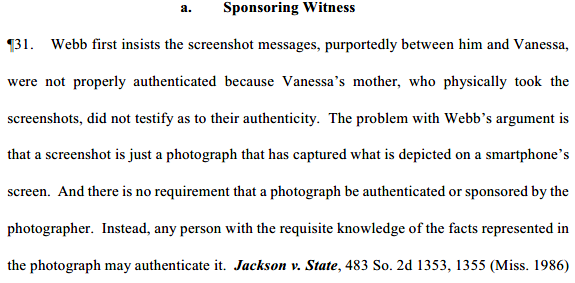
Practice Point – I found it remarkable that the Mississippi Supreme Court heretofore had not addressed the issue of whether the denial of a motion for summary judgment can be appealed after a trial. They did here, and now we know:

One More Thing – We were this close (maybe) to the Mississippi Supreme Court addressing one of my pet issues: When a case involves an MTCA defendant and a non-MTCA defendant how, exactly, should a hybrid bench/jury trial proceed?


Other Orders

Hutto v. State, 2017-DR-01207-SCT (granting the plaintiff’s Motion for Leave to File Rebuttal to Opposition to Motion for Appointment of Counsel for Representation for Successive Petition for Post-Conviction Relief and the State’s Motion for Leave to File Surrebuttal in Opposition to Motion for Appointment of Counsel for Representation for Successive Petition for Post-Conviction Relief)

Randle v. Randle, 2020-CT-0033-SCT (granting cert)

McPhail v. McPhail, 2020-CA-00739-SCT (denying Motion Pursuant to Rule 8 and Rule 27 of the Rules of Appellate Procedure is hereby denied and remanding to the chancery court of Grenada County for an adjudication of a request for release on bond pending appeal in light of his child support payment subsequent to the February 24, 2022 denial of his prior motion)

HL&C Marion, LLC v. DIMA Homes, Inc., 2020-CT-00750-SCT (CORRECTION: granting cert 6-0)

Williams v. State, 2020-KA-772-SCT (denying rehearing)

Morningstar v. Perkins Law Firm, 2020-CT-1203-SCT (denying cert)

Embrey v. Young, 2021-CT-91-SCT (denying cert)


Hand Down Page

Summaries of the Mississippi Supreme Court’s opinions of April 21, 2022

The Mississippi Supreme Court handed down two opinions today. One decides an interlocutory appeal of the denial of the defendants’ motion for summary judgment in a tire blowout case that hinged on the doctrine of res ipsa loquitur. The other is a criminal case considering convictions for attempted willful trespass and auto burglary that addresses issues of whether the indictment was sufficient, whether evidence of other was acts should have been excluded, and whether the defendant’s “theory of the case” instruction was wrongly denied.


Darling Ingredients Inc. v. Moore, 2020-IA-01149-SCT (Civil – Personal Injury/Res Ipsa Loquitur)
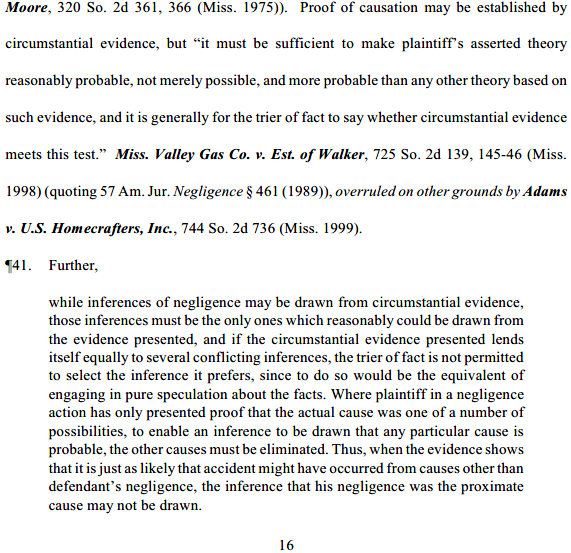
On interlocutory appeal, reversing the circuit court’s denial of the defendants’ motion for summary judgment in an auto liability case stemming from the failure of a tire on the defendants’ vehicle, holding that the doctrine of res ipsa loquitur did not apply because a vehicle’s tire can fail for reasons other than negligence of the vehicle’s driver or owner. Because the doctrine of res ipsa loquitur was not applicable and the plaintiff had no evidence of negligence on the part of the defendants, judgment was rendered for the defendants.
(This decision was unanimous)

NOTE: Although this opinion stops just short of specifically saying so, I read it as establishing a bright-line rule that the doctrine of res ipsa loquitur is inapplicable to cases where a motorist is injured by the failure of a tire on another vehicle:

This opinion is also noteworthy for its succinct summary of the doctrine of res ipsa loquitur and its analysis of the second element (“the occurrence was such that in the ordinary course of things it would not have happened if those in control of the instrumentality used proper care”) that will be useful in future RIL briefing.


Brady v. State, 2021-KA-00163-SCT (Criminal – Felony/Willful Trespass/Auto Burglary)
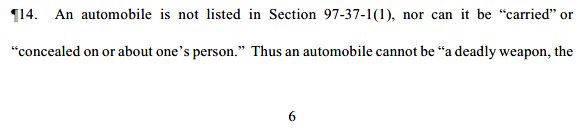
Affirming convictions of attempted willful trespass and two counts of auto burglary, holding (1) no error in denying a motion to quash the indictment for attempted burglary of a dwelling because the indictment adequately alleged an overt act, (2) no error in not sua sponte precluding evidence of other bad acts not related to the indicated charges, and (3) no error in denying a proposed instruction that the defense argued expounded on the defense’s theory of the case where the subject of the proposed instruction was adequately covered in other jury instructions.
(Justice Coleman dissented, arguing that the indictment failed to allege an overt act in furtherance of the attempted breaking and entering)


Other Orders

Carter v. State, 2019-CT-01854-SCT (denying cert petition)
Burgin v. State, 2020-CT-01031-SCT (denying cert petition)
The Mississippi Bar v. Sims, 2021-BD-01090-SCT (granting petition to transfer license to disability inactive status)
In Re: Administrative Orders of the Supreme Court of Mississippi (directing the disbursement of $160,623.66 in civil legal assistance funds among the MS Volunteer Lawyers Project, North MS Rural Legal Services, and MS Center for Legal Services)


Hand Down List


In other news, congratulations to Professor Christopher Green of Ole Miss Law who was cited four (4) times in Justice Thomas’s concurrence in United States v. Madero that was decided today.

Summaries of the Mississippi Supreme Court opinions of April 7, 2022

The Mississippi Supreme Court handed down five opinions today. I think Weber v. Estate of Hill will be a frequently cited case on the issue of medical expert causation testimony, especially in the medical malpractice context. There is also an insurance coverage decision (where the court granted interlocutory appeal and then affirmed the circuit court), another medical malpractice case dealing with a hospital’s lack of liability for treatment plans of independent physicians, a contempt of youth court case, and a Mississippi Bar disciplinary decision.


Donaldson v. Cotton, 2020CA-00581-SCT (Civil – Other/Contempt)
Vacating the a youth court judge’s order of contempt against a county prosecutor fining him for past and continuing refusal to draft youth court orders, holding that youth court judges have inherent authority to order a county prosecutor to prepare orders in youth court matters but that the alleged contempt was constructive criminal contempt and thus the attorney’s due process rights were violated. The order was vacated, the case was remanded, and the youth court judge was direct to recuse for further proceedings.
(Justice Coleman dissented, joined by Chief Justice Randolph and Justice Beam.)


Weber v. Estate of Hill, 2020-CA-00293-SCT (Civil – Medical Malpractice/Causation/Experts)
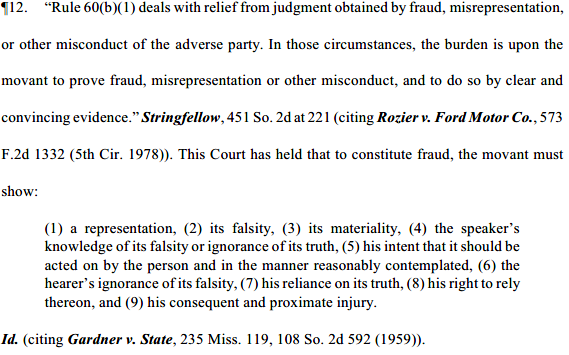
Denying rehearing and and modifying two paragraphs (¶ 37 and ¶ 38) of the original opinion. On direct appeal, the supreme court affirmed the circuit court’s denial of the defendants’ motion for JNOV that argued there was no admissible expert testimony on causation, holding that the testimony of one of the plaintiff’s medical experts provided a basis for a juror to reasonably conclude that a timely C-section delivery would have provided the baby with a greater-than-50-percent chance of a substantially better outcome even though that expert testified that he lacked the expertise necessary to quantify the degree to which the labor and delivery process aggravated the injury. On cross appeal, the supreme court reversed the circuit court’s reduction of the jury’s $2,538,322 award for non-economic damages, holding that this action filed in December 2002 was governed by Mississippi’s wrongful-death statute because the medical-malpractice noneconomic-damages cap was not in place until September 1, 2004.
(Justice Griffis dissented, joined by Justice Coleman and Justice Maxwell. Chief Justice Randolph did not participate.)

NOTE: This was a big win for the plaintiff and it is a must-read case on medical expert causation testimony, especially in the medical malpractice context. I have not read the record, but my understanding from the majority opinion and the dissent is that no expert specifically testified that a timely C-section delivery would have provided the baby with a greater-than-50-percent chance of a substantially better outcome. Instead, the supreme court allowed the jury to “connect the dots” (the “dots” being other pieces of expert testimony) in determining that the plaintiff satisfied that causation standard even though the plaintiff’s obstetrics and maternal-fetal medicine expert testified he was not qualified to connect these dots and give an opinion as to the percentage aggravation would be.


Mississippi Farm Bureau Casualty Insurance Company v. Powell, 2020-IA-00432-SCT (Civil – Insurance/Coverage)
On interlocutory appeal, affirming the circuit court’s denial of the insurance company’s motion for summary judgment seeking a declaratory judgment that it had no duty to provide coverage, no duty to defend/indemnify, and no duty to pay medpay benefits, holding that a fall from scaffolding that was erected on a trailer that was hitched to an insured pickup was an auto accident arising out of the use and ownership of the covered vehicles.
(Justice Maxwell concurred in result only, joined by Justice Chamberlain and Justice Griffis, and joined by Justice Coleman in part.)


St. Dominic-Jackson Memorial Hospital v. Newton, 2020-IA-00494-SCT (Civil – Medical Malpractice)
On interlocutory appeal, reversing the circuit court’s denial of the hospital’s motion for summary judgment, holding that the Mississippi law does not impose a duty on a hospital to require peer review of a treatment plan before allowing a doctor and patient to use its facilities.
(Justice Kitchens dissented, joined by Justice King.)

PRACTICE POINT: This is less-than-ideal feedback to receive from the supreme court…

Other Orders

Howell v. State, 2020-CA-00868-SCT (directing the parties to file supplemental briefs on the following issue: Whether the Court should overrule Rowland v. State, 42 So. 3d 503 (Miss. 2010), and any other case in which, and to the extent that, we have held the fundamental rights exception to the procedural bars may be applied to the three-year statute of limitations codified by the Legislature in the Uniform Post-Conviction Collateral Relief Act)

Bryant v. Bryant, 2020-CT-00883-SCT (granting cert)

Newell v. State, 2020-CT-01137-SCT (denying cert)

Thornhill v. Walker-Hill Environmental, 2020-CT-01181-SCT (granting cert)

The Mississippi Bar v. Malone, 2021-BD-00467-SCT (suspending attorney Robert W. Malone for two years)


Hand Down List