
Mississippi Court of Appeals Decisions of November 29, 2022

The Mississippi Court of Appeals returned from Thanksgiving break with five opinions. Two cases are medical malpractice cases (one an appeal of summary judgment for lack of expert testimony and the other an appeal of a denied motion to compel arbitration). Two are criminal cases, and the other case is a custody case with cross motions for modification and a motion for contempt.


Davis v. State, 2021-KA-00908-COA (Criminal – Felony)
Affirming conviction of first-degree, deliberate design murder, holding that the trial court did not abuse its discretion in limiting the defense’s cross-examination of a detective to exclude testimony about other investigations and noting that the Confrontation Clause does not open the door to irrelevant testimony on cross-examination.
(10-0)


Mixon v. Berry, 2021-CA-00494-COA (Civil – Medical Malpractice)
Affirming summary judgment in favor of a doctor in a med mal case for lack of medical expert testimony, holding that summary judgment was proper because the plaintiff failed to produce sworn expert testimony to establish the applicable standard of care, breach, and proximate cause, and that the trial court did not err in not granting a 56(f) continuance that was not requested or in denying the motion for reconsideration.
(10-0)

Practice Point – Here is some useful black-letter law from this opinion:


Turnage v. State, 2021-KA-01229-COA (Criminal – Felony)
Affirming conviction of a high school teacher of two counts of sexual battery of a student, holding that there were no issues warranting reversal after reviewing appellate counsel’s Lindsey brief and independently reviewing the record.
(10-0)


Lamy v. Lamy, 2021-CA-00770-COA (Civil – Custody)
Affirming in part and reversing in part the chancery court’s rulings on competing complaints for modification and a motion for contempt, holding that the chancellor did not err in admitting evidence used by the GAL and attached to her report, did not err in classifying one agreed custody order as temporary but did err by interpreting that order as awarding sole physical custody to the mother, and did not err in not finding the mother in contempt.
(5-1-4: Judge McDonald concurred in part and in the result without separate written opinion; Chief Judge Barnes, Judge Westbrooks, and Judge McCarty concurred in part and in dissent in part without separate written opinion; Judge Wilson concurred in part and dissented in part, joined by Chief Judge Barnes, Judge Westbrooks, and Judge McCarty, and joined in part by Judge McDonald.)

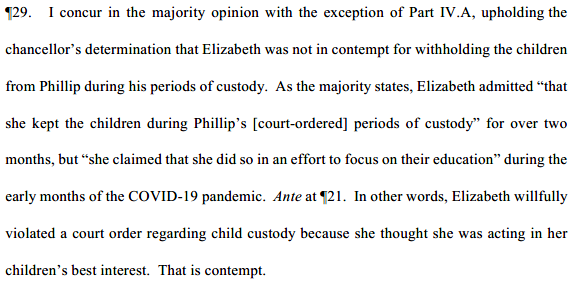
Note – In response to the motion for contempt, the mother pleaded COVID in her explanation of why she kept the children during the father’s period of custody. The dissent didn’t buy the excuse:

Durant Healthcare, LLC v. Garrette, 2021-CA-00823-COA (Civil – Contract)
Affirming denial of a motion to compel arbitration in a wrongful death case, holding that the evidence in the record supported the trial court’s finding that the resident lacked the mental capacity to sign the nursing home’s arbitration agreement on the date of admission, that the resident’s daughter did not have authority to sign as his agent, and that the proof was sufficiently clear to affirm the trial court’s denial of the facility’s request for arbitration-related discovery.
(7-3: Judge Carlton dissented, joined by Judge Wilson and Judge Lawrence.)


Other Orders

Turner & Associates P.L.L.C. v. Estate of Watkins, 2021-CA-00258-COA (denying rehearing)

Hand Down List

Mississippi Supreme Court Decisions of September 22, 2022

The Mississippi Supreme Court handed down three opinions today. Two are criminal cases dealing with issues that occurred during voir dire. In one, the issue was an inculpatory exclamation by the defendant. In the other, the issue was two jurors’ undisclosed connection the defendant. The third opinion is a journey through contempt law.


Scott v. State, 2021-KA-01015-SCT (Criminal – Felony)
Affirming conviction of burglary, holding that the court did not abuse its discretion denying the defendant’s attorney’s request for a mistrial after the defendant exclaimed during voir dire that he was “guilty as hell.”
(9-0)

Note – This decision seems correct to me.


Watts v. State, 2021-KA-00873-SCT (Criminal – Felony)
Affirming denial of a JNOV after the defendant was convicted of conspiracy to commit armed robbery, attempted armed robbery, aggravated assault, and possession of a firearm by a convicted felon and a denial, holding that although two jurors did not disclose that they were related to a man who was murdered by the defendant’s brother in 2006 the court did not commit clear error in determining after an evidentiary hearing that those jurors lacked substantial knowledge of their connection with the defendant during voir dire.
(9-0)


Seals v. Stanton, 2020-CA-00741-SCT (Civil – Domestic Relations)
This decision waded into a morass of contempt and affirmed the chancellor in part, reversed and remanded in part, and vacated in part. The Supreme Court affirmed the chancellor’s finding that two attorneys handling a divorce proceeding were in direct criminal contempt for missing a hearing, vacating the penalty for that because it exceeded statutory authority and remanded on that issue, and affirmed an award of attorney’s fees to the other side. The Supreme Court vacated judgment of direct criminal contempt against another attorney and remanded for proceedings on under the constructive criminal contempt standards. The Supreme Court held that the chancellor erred in finding these attorneys in direct criminal contempt for violating a court order and remanded for a determination of whether an indirect civil contempt proceeding should be commenced.
(6-3: Justice Kitchens dissented, joined by Justice King and Justice Coleman.)

Practice Point – Don’t miss hearings. Don’t violate orders. If you have further questions about what went wrong here or about the intricacies of direct criminal contempt, indirect/constructive criminal contempt, and civil contempt I refer refer you to the opinion and wish you the best.


Other Orders

Hamer v. State, 2019-CT-01633-SCT (denying cert)
Nowell v. Stewart, 2020-CT-00728-SCT (denying cert)
Johnson v. State, 2022-CT-01308-SCT (dismissing cert sua sponte)


Hand Down List

Mississippi Court of Appeals Decisions of June 7, 2022

A deposition took me out of blogging service for most of the afternoon, so a little later than usual I give you summaries of the nine opinions handed down by the Mississippi Court of Appeals. These opinions cover the statute of frauds, trusts, appellate jurisdiction, youth court, authentication of text messages, equitable division and alimony in a divorce case, workers’ comp, PCR, and more.


SEL Business Services, LLC v. Lord, 2021-CA-00368-COA (Civil – Real Property/Statute of Frauds)
Affirming the chancery court’s dismissal of a suit to reclaim property or alternatively for unjust enrichment, holding that a “handshake deal” for the purchase of a building that was sold before that deal came to fruition was subject to the statute of frauds, that the statute of frauds was not satisfied, and that the equitable remedy of unjust enrichment was therefore unavailable.
(All judges concurred.)


Lennon v. Lowrey & Fortner, P.A., 2021-CA-00426-COA (Civil – Wills, Trusts & Estates/Appellate Procedure/Appellate Jurisdiction)
Granting a motion to dismiss an appeal for lack of jurisdiction in a case of first impression, holding that the 30-day time period for perfecting an appeal began to run upon the entry of an order adjudicating a claim for attorney’s fees against a trust–not the final judgment terminating the trust.
(All judges concurred.)


Smith v. Adams County Youth Court, 2021-CP-00196-COA (Civil – Juvenile Justice)
Dismissing an appeal of the denial of a minor’s post-disposition motion for modification arguing that his guilty plea was the result of ineffective assistance of counsel, holding that the notice of appeal was prematurely filed because the youth court had not been given an opportunity to consider these arguments and any supporting evidence.
(Judge Wilson concurred in result only without separate written opinion.)


Warner v. Warner, 2020-CA-01098-COA (Civil – Domestic Relations/Divorce/Valuation/Equitable Division/Alimony/Contempt)
Reversing the chancellor’s judgment in a divorce case, holding that the chancellor erred in valuation and equitable division of marital assets, in the award of alimony, and in finding the ex-husband in contempt and awarding attorney’s fees as a result.
(Judge Wilson concurred in part and in the result without separate written opinion.)

Simpson v. State, 2021-KA-00075-COA (Civil – Felony/Authentication)
Affirming convictions of two counts of first-degree murder, first-degree arson, and possession of a deadly weapon by a felon, holding that there was no plain error with regard to the authentication of text messages and that there was no merit to the claim of ineffective assistance for not objecting to the properly-authenticated text messages.
(Judge Emfinger did not participate.)


Carson v. State, 2021-KA-00436-COA (Criminal – Felony/Weight and Sufficiency)
Affirming conviction of possession of cocaine, holding that the circuit court did not err in denying a motion for new trial challenging the weight and sufficiency of the evidence and finding no merit to the defendant’s pro se arguments that his rights under the Fourth Amendment and the Confrontation Clause were violated, that the State’s case hinged on “racial profiling,” that he had ineffective assistance of counsel, and that the circuit judge failed to comply with Sharplin.
(All judges concurred.)


Ellis v. State, 2020-CP-00770-COA (Civil – PCR)
Affirming the circuit court’s denial of the plaintiff’s PCR motion, holding that the motion was time-barred and that the plaintiff failed to raise any claims resulting in the deprivation of his fundamental constitutional rights that would defeat the time bar.
(Judge Wilson and Judge Emfinger concurred in part and in the result without separate written opinion. Judge McDonald concurred in the result only without separate written opinion.)


Reardon v. State, 2020-CP-01259-COA (Civil – PCR)
Affirming the circuit court’s denial of the plaintiff’s PCR motion, holding that the motion was procedurally barred and that his claims of ineffective assistance of counsel, deprivation of fundamental rights, and failure to recuse were without merit.
(Chief Judge Barnes and Judge Wilson concurred in part and in the result without separate written opinion. Judge McDonald concurred in the result only without separate written opinion. Judge Greenlee and Judge McCarty did not participate.)


Duren v. Effex Management Solutions, LLC, 2021-WC-00337-COA (Civil – Workers’ Compensation)
Affirming the Commission’s ruling, holding that there was substantial evidence to support the Commission’s decision that the claimant failed to prove that he suffered a permanent disability and the decision to award TTD through the date of MMI, but denying post-MMI medical treatment, prescription, and mileage reimbursements.
(Judge Wilson concurred in part and in the result without separate written opinion. Judge Westbrooks and Judge McDonald concurred in the result only without separate written opinion.)

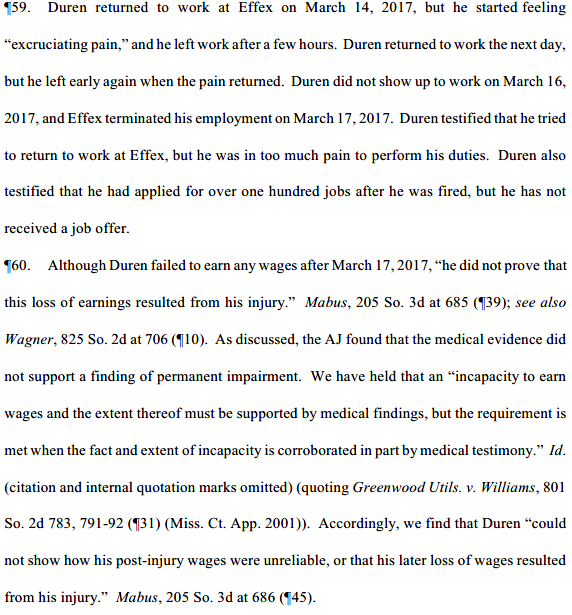
DEEPER DIVE: This case had an interesting post-MMI fact pattern where the claimant was released to return to work without restrictions, was offered to return to work for the Employer at his pre-injury wages, and returned to work there, but then quit working for the Employer due to complaints of pain. Under these facts, the Court of Appeals noted that there was a presumption of no loss of wage-earning capacity and held that the claimant did not overcome it:


Other Orders

Hammer v. State, 2019-KA-01633-COA (denying rehearing)
Shannon v. Shannon, 2020-CA-00847-COA (denying rehearing)


Hand Down List

Summaries of the Mississippi Supreme Court opinions of April 7, 2022

The Mississippi Supreme Court handed down five opinions today. I think Weber v. Estate of Hill will be a frequently cited case on the issue of medical expert causation testimony, especially in the medical malpractice context. There is also an insurance coverage decision (where the court granted interlocutory appeal and then affirmed the circuit court), another medical malpractice case dealing with a hospital’s lack of liability for treatment plans of independent physicians, a contempt of youth court case, and a Mississippi Bar disciplinary decision.


Donaldson v. Cotton, 2020CA-00581-SCT (Civil – Other/Contempt)
Vacating the a youth court judge’s order of contempt against a county prosecutor fining him for past and continuing refusal to draft youth court orders, holding that youth court judges have inherent authority to order a county prosecutor to prepare orders in youth court matters but that the alleged contempt was constructive criminal contempt and thus the attorney’s due process rights were violated. The order was vacated, the case was remanded, and the youth court judge was direct to recuse for further proceedings.
(Justice Coleman dissented, joined by Chief Justice Randolph and Justice Beam.)


Weber v. Estate of Hill, 2020-CA-00293-SCT (Civil – Medical Malpractice/Causation/Experts)
Denying rehearing and and modifying two paragraphs (¶ 37 and ¶ 38) of the original opinion. On direct appeal, the supreme court affirmed the circuit court’s denial of the defendants’ motion for JNOV that argued there was no admissible expert testimony on causation, holding that the testimony of one of the plaintiff’s medical experts provided a basis for a juror to reasonably conclude that a timely C-section delivery would have provided the baby with a greater-than-50-percent chance of a substantially better outcome even though that expert testified that he lacked the expertise necessary to quantify the degree to which the labor and delivery process aggravated the injury. On cross appeal, the supreme court reversed the circuit court’s reduction of the jury’s $2,538,322 award for non-economic damages, holding that this action filed in December 2002 was governed by Mississippi’s wrongful-death statute because the medical-malpractice noneconomic-damages cap was not in place until September 1, 2004.
(Justice Griffis dissented, joined by Justice Coleman and Justice Maxwell. Chief Justice Randolph did not participate.)

NOTE: This was a big win for the plaintiff and it is a must-read case on medical expert causation testimony, especially in the medical malpractice context. I have not read the record, but my understanding from the majority opinion and the dissent is that no expert specifically testified that a timely C-section delivery would have provided the baby with a greater-than-50-percent chance of a substantially better outcome. Instead, the supreme court allowed the jury to “connect the dots” (the “dots” being other pieces of expert testimony) in determining that the plaintiff satisfied that causation standard even though the plaintiff’s obstetrics and maternal-fetal medicine expert testified he was not qualified to connect these dots and give an opinion as to the percentage aggravation would be.


Mississippi Farm Bureau Casualty Insurance Company v. Powell, 2020-IA-00432-SCT (Civil – Insurance/Coverage)
On interlocutory appeal, affirming the circuit court’s denial of the insurance company’s motion for summary judgment seeking a declaratory judgment that it had no duty to provide coverage, no duty to defend/indemnify, and no duty to pay medpay benefits, holding that a fall from scaffolding that was erected on a trailer that was hitched to an insured pickup was an auto accident arising out of the use and ownership of the covered vehicles.
(Justice Maxwell concurred in result only, joined by Justice Chamberlain and Justice Griffis, and joined by Justice Coleman in part.)


St. Dominic-Jackson Memorial Hospital v. Newton, 2020-IA-00494-SCT (Civil – Medical Malpractice)
On interlocutory appeal, reversing the circuit court’s denial of the hospital’s motion for summary judgment, holding that the Mississippi law does not impose a duty on a hospital to require peer review of a treatment plan before allowing a doctor and patient to use its facilities.
(Justice Kitchens dissented, joined by Justice King.)

PRACTICE POINT: This is less-than-ideal feedback to receive from the supreme court…

Other Orders

Howell v. State, 2020-CA-00868-SCT (directing the parties to file supplemental briefs on the following issue: Whether the Court should overrule Rowland v. State, 42 So. 3d 503 (Miss. 2010), and any other case in which, and to the extent that, we have held the fundamental rights exception to the procedural bars may be applied to the three-year statute of limitations codified by the Legislature in the Uniform Post-Conviction Collateral Relief Act)

Bryant v. Bryant, 2020-CT-00883-SCT (granting cert)

Newell v. State, 2020-CT-01137-SCT (denying cert)

Thornhill v. Walker-Hill Environmental, 2020-CT-01181-SCT (granting cert)

The Mississippi Bar v. Malone, 2021-BD-00467-SCT (suspending attorney Robert W. Malone for two years)


Hand Down List