Double Issue: Mississippi Supreme Court Decisions of July 31, 2025 and August 7, 2025

The Mississippi Supreme Court handed down one opinion last week and one this week. Both were direct criminal appeals, but this week’s decision is a death penalty case. You can read about them below.


July 31, 2025

Harrelson v. State, 2024-KA-00600-SCT (Criminal – Felony)
Affirming conviction of statutory rape, holding that the defendant was not deprived of a fair trial by improper comments by the State because there was no objection at trial and there was substantial evidence of guilt, and holding that the verdict was not against the overwhelming weight of the evidence.
(9-0: Chamberlin for the Court)


Other Orders

  • Miller v. State, 2023-CA-00322-SCT (denying cert)
  • United Emergency Services of Mississippi, Inc. v. Miller, 2023-IA-00767-SCT (denying rehearing)
  • J.S. v. Ocean Springs School District, 2023-CA-01009-SCT (denying rehearing)
  • Tubbs v. State, 2023-KA-01124-SCT (denying rehearing)
  • In Re: Administrative Orders of the Supreme Court of Mississippi, 2025-AD-00001-SCT (directing the disbursement of $216,005.10, in civil legal assistance funds among the MS Center for Legal Services, MS Volunteer Lawyers Project, and North MS Rural Legal Services)
  • Liberty Mutual Insurance Company v. Body, 2025-IA-00510-SCT (granting interloc)

Hand Down Page


August 7, 2025

Abram v. State, 2023-DP-00614-SCT (Criminal – Death Penalty)
Affirming conviction of two counts of capital murder and one count of attempted murder and his death sentence, holding that the circuit court did not abuse its discretion by admitting evidence from locations other than the crime scene, that the evidence was sufficient to support the capital murder convictions, and that the capital-murder convictions were not against the overwhelming weight of the evidence, and declining to abandon the M’Naghten Rule.
(9-0: Ishee for the Court)


Other Orders

  • Nailer v. State, 2023-CA-00627-SCT (denying cert)
  • Estate of Roberts: Herd v. Stokes, 2023-CT-00713-SCT (denying cert)
  • Gardner v. State, 2023-CT-00903-SCT (granting cert)
  • Wilson v. State, 2023-CT-01050-SCT (denying cert)
  • Grimes v. State, 2023-CT-01254-SCT (denying cert)

Hand Down Page

Mississippi Supreme Court Decisions of May 8, 2025

The Mississippi Supreme Court handed down one opinion in a dog-bite case on interlocutory appeal. The Court also entered an order setting an execution date in a capital case.


TLM Investments, LLC v. Yates, 2024-IA-00204-SCT (Civil – Personal Injury)
Reversing the circuit court’s denial of summary judgment in a dog-bite case, holding that the plaintiff did not come forward with evidence that the property owner/lessor had actual or constructive knowledge of a tenant’s dog or of its dangerous propensities or that the plaintiff was an intended third-party beneficiary of the lease agreement.
(9-0)


Other Orders

  • Jordan v. State, 1998-DP-00901-SCT (granting motion to set execution date)
  • Shoemaker v. State, 2019-M-00832 (denying application for leave to proceed in the trial court, finding the motion frivolous, and restricting the petitioner from filing further PCR petitions in forma pauperis)
  • Magee v. State, 2023-CT-00008-SCT (denying cert)
  • Howell v. State, 2023-CT-00265-SCT (denying cert)
  • Cauthen v. State, 2023-CT-00589-SCT (denying cert)
  • Walker v. State, 2023-KA-01153-SCT (denying rehearing)
  • Jordan v. State, 2024-DR-01272-SCT (denying motion for leave to file PCR motion)
  • Jordan v. State, 2024-DR-01272-SCT (denying State’s motion to dismiss fifth PCR petition and denying defendant’s motion to strike)
  • Timmons v. State, 2025-M-00057 (granting leave to file motion for PCR)

Hand Down Page

Mississippi Supreme Court Decisions of December 5, 2024

The Mississippi Supreme Court handed down six opinions today covering personal jurisdiction, waiver of defenses, venue, bad faith, death penalty PRC, and direct criminal appeal. There are also orders amending Rule 10 and Rule 12 of the Mississippi Rules of Civil Procedure.


Palmer v. McRae, 2023-CP-01026-SCT (Civil – Other)
Affirming the circuit court’s order enforcing sureties’ liability, holding that the appellant’s arguments on appeal were waived and procedurally barred on appeal because he failed to appear or otherwise defend in the circuit court.
(8-1-0: King concurred in result only without writing)


Mississippi Department of Human Services v. Johnson, 2022-CT-00605-SCT (Civil – Other)
Reversing the chancery court’s and Court of Appeals’ decisions related to a motion to set aside a 2002 paternity order, holding that while the chancery court lacked personal jurisdiction due to insufficient service of process under Rule 81(d), the defendant waived that challenged by stipulating to the validity of the 2002 order in 2003.
(6-3-0: Randolph concurred in part and in result without writing; Griffis concurred in part and in result, joined by Maxwell and joined in part by Randolph)


Boyett v. Cain, 2022-CT-00978-SCT (Civil – Other)
Reversing the circuit court and the Court of Appeals, holding that they erred in finding that the proper venue for a prisoner to challenge an MDOC decision is the county in which the prisoner is located and clarifying that Section 11-11-3 controls and venue is proper in a county in which a defendant resides or in a county where a substantial act or even caused the alleged injury.
(9-0)


United Services Automobile Association v. Estate of Minor, 2023-CA-00049-SCT (Civil – Insurance)
Affirming a jury award of punitive damages in a bad faith claim on direct appeal but reversing the trial court’s denial of a post-trial motion for attorney’s fees, holding (1) that the trial court did not err in submitting the issue of punitive damages to the jury, (2) that the trial court did not err in submitting what he deemed to be a reasonable amount of attorney’s fees (the plaintiffs’ attorneys’ contingency fee), (3) that the $10M punitive damages award was within the Campbell guideline, (4) that trial court did not err in instructing the jury that adjusters were charged with knowledge of all records at all times, in denying the carrier’s request to depose the insured, or in excluding the insured’s bribery convictions, (5) and rendering a judgment awarding attorney’s fees of $4.5M plus post-judgment interest based on a 45% contingency fee on the punitive damages award.
(5-3: Maxwell concurred in part and dissented in part, joined by Chamberlin and joined in part by Griffis; Griffis dissented, joined in part by Maxwell; Coleman did not participate)


Corrothers v. State, 2023-CA-00401-SCT (Civil – Death Penalty – Post Conviction)
Affirming denial of PCR motion, holding that the trial court did not err in finding that the petitioner failed to prove improper juror communication.
(7-2-0: Kitchens and King concurred in result only without writing)


Mitchell v. State, 2023-KA-00859-SCT (Criminal – Felony)
Affirming conviction of second-degree murder, holding that the trial court did not err in instructing the jury and dismissing the ineffective assistance of counsel claims without prejudice.
(8-1-0: Ishee concurred, joined in part by Randolph and Beam)


Other Orders

  • In Re: The Rules of Civil Procedure, 89-R-99001-SCT (amending Rule 10 of the Mississippi Rules of Civil Procedure) (deleting subsection (d) that required a copy of an account or written instrument to be attached to the pleading asserting a claim founded on such)
  • In Re: The Rules of Civil Procedure, 89-R-99001-SCT (amending Rule 12 of the Mississippi Rules of Civil Procedure) (Advisory Committee Historical Notes states that was done to consistently refer to an “answer” to a counterclaim rather than a “reply”)
  • Landrum v. Livingston Holdings, LLC, 2022-CA-00498-SCT (denying rehearing)
  • Clemmons v. State, 2022-CT-00700-SCT (denying cert)
  • Brown v. Black, 2022-CT-00869 (denying cert)
  • Boyett v. Cain, 2022-CT-00978-SCT (denying motion for reconsideration)
  • Johnson v. State, 2023-CA-00117-SCT (denying rehearing)
  • Wells v. State, 2023-KA-00670-SCT (denying rehearing)
  • In Re: Andrew McGraw, 2024-M-00654 (denying application to proceed in the trial court, finding that the application is frivolous, and restricting the petitioner from filing further PCR applications in forma pauperis)

Hand Down Page

Mississippi Supreme Court Decisions of March 7, 2024

The Mississippi Supreme Court handed down four opinions last Thursday. There is an appeal of the dismissal of an MTCA claim on summary judgment, an appeal of a Medicaid reimbursement-rate decision, and an appeal by a victorious pro se party. The headliner, however, is the appeal of Willie Godbolt’s convictions for the infamous 2017 shooting of eight people in Lincoln County.


Federinko v. Forrest County, Mississippi, 2023-CA-00204-SCT (Civil – MTCA)
Affirming the trial court’s grant of summary judgment for the defendant, holding that the plaintiff failed to allege a tortious or negligent act with respect to the MTCA defendants’ decision not to conduct an autopsy or obtain postmortem blood and fluids.
(9-0)


Mississippi Division of Medicaid v. Women’s Pavilion of South Mississippi, PLLC, 2023-SA-00098-SCT (Civil – State Boards & Agencies)
Affirming the chancery court’s decision vacating Medicaid’s reimbursement-rate decision, holding that the administrative officer did not have to defer to Medicaid’s initial decision but was to make findings of fact and a determination of the issues presented.
(8-0: Beam did not participate)


Stratton v. McKey, 2023-CP-00451-SCT (Civil – Other)
Affirming the circuit court’s denial of the pro se plaintiff’s Rule 60 motion to vacate a judgment in his favor that awarded him possession of his classic truck and monetary damages.
(9-0)


Godbolt v. State, 2020-DP-00440-SCT (Criminal – Death Penalty – Direct Appeal)
Affirming conviction of four counts of capital murder, four counts of first-degree murder, two counts of kidnapping, one count of attempted murder, and one count of armed robbery garnering four death sentences, six life sentences, and two twenty-year terms, holding that the trial court did not err in (1) denying a motion to server; (2) transferring venue to a neighboring county (with a jury drawn from a distant county); (3) “limiting” voir dire where the process lasted four days and produced nearly 800-pages of transcript; (4) denying a motion to suppress statements made to media and law enforcement; (5) denying a motion to suppress evidence obtained from the defendant’s home, vehicle, cell phone, other electronic devices; (6) allowing the defendant’s wife to testify under Rule 601(b)(2); (7) admitting evidence of prior bad acts; (8) admitting 911 calls; (9) not ordering a psychiatric evaluation that the defendant opposed; (10) admitting Facebook messages over an authentication objection; (11) only allowing the defendant (who exercised his right not to testify) limited time for allocution during closing arguments; (12) denying motion to exclude victim impact evidence; and the Supreme Court also (13) deferred the ineffective assistance claim to the PCR phase; (14) held that there was no Brady violation regarding the destruction of the defendant’s phone after all data and information from the phone were given to the defendant; (15) that the defendant’s right to an impartial jury was not violated; (16) held that there was no evidence of prosecutorial misconduct; (17) that the “heinous, atrocious or cruel” aggravator was not unconstitutional; (18) that the death penalty was not unconstitutional; (19) that the death penalty was not disproportional; (20) and that there was no error, so the cumulative error argument was without merit.
(7-2: King dissented, joined by Kitchens)

NOTE– You should never treat my summaries as a substitute for reading cases that you intend to rely on. This is especially true in a case like this one. This is probably the longest summary I have posted, but I have only scratched the surface.


Other Orders

Love v. State, 2021-CT-01101-SCT (granting pro se cert petition)

Norwood v. Smith, 2021-IA-01404-SCT (dismissing interlocutory appeal)

Rehabilitation Centers, Inc. v. Williams, 2023-CT-00453-SCT (denying in part and dismissing in part petition for cert and reverse and stay of mandate or in the alternative petition for interlocutory appeal)


Hand Down Page

Mississippi Supreme Court Decisions of October 5, 2023

The Mississippi Supreme Court handed down two opinions today, but do not be deceived by that stat. One of the opinions is a 100+ page decision in a death-penalty PCR case. The other is an appeal of denial a motion to compel arbitration. There is also a linked attorney-discipline case.


Galloway v. State, 2013-DR-01796-SCT (Criminal – Death Penalty – Post Conviction)
Denying motion for leave to proceed in the trial court with PCR petition, holding that (1) the petitioner failed to overcome the presumption that what trial counsel did and did not present as mitigating evidence such as the petitioner’s “true-life story” and mental health issues during the penalty phase might be considered sound trial strategy instead of ineffective assistance; (2) there was no merit to the petitioner’s claim of ineffective assistance during jury selection where counsel used no Batson challenges and an all-white jury was seated or that counsel was otherwise ineffective in voir dire; (3) there was no merit to the petitioner’s claim of ineffective assistance during guilt-innocence phase for not investigating or challenging lack of investigating/challenging the medical examiner’s testimony, in limiting the review of Defense expert’s forensic expert or failing to consult with/prepare him, in failing to assert a Miss. R. Evid. 702 pretrial challenge to the medical examiner’s testimony, or failing to object to the medical examiner’s testimony as outside the scope of the disclosed testimony; (4) there was no merit to the claim that the State corrupted the truth-seeking function of the trial by suppressing material impeachment evidence or presenting false and misleading evidence; (5) the death verdict was not unconstitutionally coerced from a holdout juror; (6) a juror’s exposure to medical coverage showing the victim violated constitutional rights; (7) a juror’s false statement during voir dire that he had not previously served on a criminal jury did not give rise to an inference of prejudice; (8) the petitioner did not show that he was prejudiced when he was placed the defendant in an electronic restraint; (9) death by lethal injection would not violate the petitioner’s rights under the Eighth Amendment or Fourteenth Amendment; and (10) there was no aggregation of errors mandating a reversal.
(9-0)


PriorityOne Bank v. Folkes, 2022-CA-00429-SCT (Civil – Contract)
Affirming denial of motion to compel arbitration, holding that the bank waived the right to arbitration by substantially participating in the litigation and did not file a motion to compel arbitration until after an amended complaint was filed.
(7-2: Griffis dissented, joined by Beam)

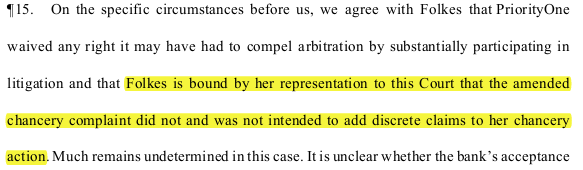
PRACTICE POINT – The Supreme Court’s decision appears to hinge on the fact that the amended complained did not add a new cause of action (which was in dispute). This was enough to affirm the denial of the motion to compel arbitration, but the Supreme Court made it clear the plaintiff was bound by her representation that no new claim was asserted:


Other Orders

Jarvis v. State, 2021-M-01196 (denying application for leave to proceed in the trial court, finding the filing frivolous, and warning that future frivolous filings could result in sanctions)

The Mississippi Bar v. Hessler, 2023-BD-00057-SCT (suspending an attorney from the practice of law for one year and one day, with the suspension deferred retroactively to June 22, 2022)

Wakefield v. State, 2021-CT-00187-SCT (denying cert)

Buchanan v. Hope Federal Credit Union, 2021-CT-00218-SCT (denying cert)

In Re: Resignation of Emily Bonds Davey f/k/a Emily Sides Bonds From The Practice of Law in Mississippi, 2023-BD-00963 (granting leave under Rule 11(b) of the Rules of Discipline for the Mississippi State Bar to resign in good standing from the practice of law in Mississippi)


Hand Down Page

Mississippi Supreme Court Decisions of June 1, 2023

The Mississippi Supreme Court handed down seven opinions today, and covered a lot of territory in doing so. There is a breach of contract/attorney’s fees case, a fraudulent joinder venue case, a youth court venue case, a money dispute between a school board and school district, a direct criminal appeal, a death penalty PCR case, and an election contest. [There was a lot to get through today and I got a late start. I am sure there is a typo or two below that I will get around to catching and correcting.]


Healy v. AT&T Services, Inc., 2021-CP-01411-SCT (Civil – Other)
Affirming in part and reversing in part the chancellor’s decision in a breach of contract claim filed by a lawyer/law firm due to reassignment of a 1-800 number, holding that the chancellor did not err in awarding nominal damages of $500 where there was inadequate proof of actual damages but reversing the chancellor’s exclusion of attorney’s fees in the award of sanctions for discovery violations and remanded for determination of the appropriate amount.
(9-0)

Practice Point – Footnote 3 of this opinion is a cautionary tale for those submitted evidence in the record at the trial court level and those reviewing the clerk’s record during the appeal:

The plaintiff in this case was seeking lost profits, but was only awarded nominal damages because there was insufficient evidence to show decreased earnings. To support the damages claim on appeal, the plaintiff submitted the plaintiff’s trial testimony, the firm’s QuickBooks reports for 2017-2018, and the plaintiff’s 2019 tax return. I don’t know if the QuickBooks reports would have moved the needle in this case, but that’s a question one generally does not want lingering after an appeal.

Another Practice Point – This opinion has a thorough discussion of the law on the measure of damages for breach of contract and lost profits claims. It is worth bookmarking for that purpose.


Doe v. Adams County Dept. of Child Protection Services, 2022-CA-00240-SCT (Civil – Other)
Affirming youth court’s denial of motion to transfer venue in an action to terminate parental rights for lack of jurisdiction and motion for recusal, holding that venue was proper because both the natural mother and the child resided in the venue county and that the trial court did not commit a manifest abuse of discretion in denying a motion for recusal.
(9-0)


Alpha Management Corp. v. Harris, 2022-IA-00354-SCT (Civil – Wrongful Death)
consolidated with
Community Park Apartments, Inc. v. Harris, 2022-IA-0355-SCT (Civil – Wrongful Death)
Reversing the trial court’s denial of motions to transfer venue, holding that the defendant that purportedly established venue in Hinds County was not a material and proper party and setting aside a default judgment against the fraudulently-joined defendant.
(7-1-1: Coleman concurred in part, joined in part by Griffis; Griffis concurred in part and dissented in part, joined in part by Coleman.)

NOTE – When discussing its decision to set aside the default judgment against the fraudulently-joined defendant, the Supreme Court had this to say:


Board of Supervisors of Lowndes County v. Lowndes County School District, 2021-CA-00999-SCT (Civil – Other)
Reversing the trial court’s grant of summary judgment in favor of the school district in a dispute over the board’s decision to exclude more than $3M from the district’s requested ad valorem tax effort, holding that the district’s exclusive remedy was section 11-51-75 which required an appeal of the board’s decision to be filed in the circuit court within 10 days and that the district failed to do so.
(7-2-0: King concurred in the result only, joined by Kitchens.)


Welch v. State, 2022-KA-00457-SCT (Criminal – Felony)
Affirming conviction of statutory rape, holding that trial counsel’s decision not to collect and test defendant’s relatives’ DNA was reasonable trial strategy and not deficient performance and did not cause prejudice.
(9-0)


Garcia v. State, 2021-CA-01214-SCT (Civil – Death Penalty – Post Conviction)
Affirming denial of PCR motion to set aside a plea of guilty to capital murder and sentence to death, holding that the trial court did not fail to address the petitioner’s expert testimony and did not err by continuing to rely on the petitioner’s own competency expert or in ruling the petitioner was competent to plead guilty, that trial counsel was not constitutionally ineffective for not calling attention to a potential autism diagnosis or in preparing the petitioner to plead guilty, and the petitioner was not deprived of expert assistance under Ake.
(9-0)


Barton v. Adams-Williams, 2023-EC-00586-SCT (Civil – Election Contest)
Affirming denial of petition to disqualify a candidate for county prosecutor, holding that the trial court applied the proper standard in analyzing the candidate’s residency and did not manifestly err in its factual findings.
(9-0)


Other Orders

In Re: Advisory Committee on Rules, 89-R-99016-SCT (appointing Nicholas K. Thompson as member of Supreme Court of Mississippi Advisory Committee on Rules)

Rules for Court Reporters, 89-R-99021-SCT (appointing Theresa Lumley and Hon. David B. Strong, Huey Bang, and Jerry D. Sharp as members of the Board of Certified Court Reporters)

Lowe v. State, 2019-CT-01621-SCT (dismissing cert petition)

Powers v. State,  2017-DR-00696-SCT (denying motion to stay, granting in part a motion to compel disclosure, and granting leave to file reply)


Hand Down Page

Mississippi Supreme Court Decisions of February 16, 2023

The Mississippi Supreme Court handed down one opinion today, along with several orders including the suspension of a municipal court judge for abuse of power.


Garcia v. State, 2020-DR-01224-SCT (Civil – PCR)
Affirming denial of PCR motion, holding that even under heightened scrutiny due in capital cases the plaintiff did not present a substantial showing that he was denied the right to effective assistance of counsel for not pursuing and presenting fetal alcohol syndrome disorder as a mitigating factor, for not presenting and explaining all mitigating evidence, or for not developing and presenting evidence that the defendant was under the substantial domination of another person.
(6-3-0: Kitchens concurred in part and in the result, joined by King and Ishee and joined in part by Coleman)


Other Orders

Cooper v. State, 2018-M-01124 (denying PCR motion)

Gilmer v. McRae, 2021-CA-00028-SCT (granting appellees’ motion for fees and costs)

Mississippi Commission on Judicial Performance v. Municipal Court Judge Carlos E. Moore, 2022-JP-00504-SCT (suspending respondent from office without pay for sixty days from his position as municipal judge for both Grenada and Clarksdale, ordering public reprimand in each county, and ordering a $1,500 fine)

Yates Services, LLC v. Hill, 2022-M-00879-SCT (denying petition for interlocutory appeal)

Hawkins v. State, 2022-M-01131 (denying application for leave to proceed in trial court, finding the application frivolous, and warning against future frivolous filings)


Hand Down List

Mississippi Supreme Court Decisions of June 30, 2022

The Mississippi Supreme Court handed down three opinions today: a case that resolved a fight over the Mississippi Division of Medicaid’s efforts to recoup overpayments to a senior care facility, an MTCA issue that wasn’t, and a post-conviction death penalty decision regarding a request to transfer DNA evidence.


Wilkinson County Senior Care, LLC v. Mississippi Division of Medicaid, 2020-SA-01332-SCT (Civil – State Boards and Agencies)
Affirming the chancery court’s order allowing the Mississippi Division of Medicaid to recoup a substantial overpayment made to a senior care facility for the years 2002-2003 that the DOM did not demand until 2011, holding that the delay did not bar DOM’s recover because (1) neither equitable estoppel nor any other legal or equitable principles barred the claim; (2) the decision was not arbitrary and capricious, clearly erroneous, or unsupported by substantial evidence; and (3) the delay did not violate the facility’s due process rights.
(9-0)


Strickland v. Rankin County School District, 2019-CT-01669-SCT (Civil – Personal Injury/MTCA/Negligence)
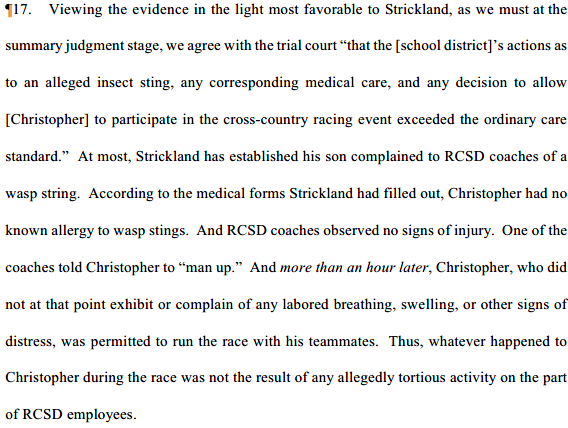
Affirming the trial court’s grant of summary judgment in favor of the school district, juking the question of whether the defendant was entitled to discretionary function immunity (that split the COA 5-5) and holding that the plaintiff had not established the basic element of negligence where the evidence provided by the plaintiff–a cross-country runner for the school–was stung by a wasp, was examined by at least one coach, was told to “man up” and run the race, began running, felt dizzy just after the mile marker, and fell and hit his head.
(5-1-2) (Justice Ishee concurred in result only, joined in part by Chief Justice Randolph. Justice Kitchens dissented, joined by Justice King. Justice Beam did not participate.)

NOTE – Here is a summary of the Court’s analysis of the element of breach:


Manning v. State, 2020-CA-01096-SCT (Civil – Death Penalty – Post Conviction)
Affirming the circuit court’s denial of a request to transfer DNA evidence to a different facility for additional DNA testing after the Court previously granted PCR to allow testing but six years of testing had allegedly yielded inconclusive results, holding that the circuit court had authority to decide the motion to transfer the evidence and that the circuit court did not abuse its discretion by denying the motion.
(7-2) (Justice King dissented, joined by Justice King)


Other Orders

Rules for Court Reporters, 89-R-99021-SCT (appointing Hon. Leslie D. King, Kati Vogt, Julie Mims, and Latanya Allen as members of the Board of Certified Court Reporters for two-year terms from July 1, 2022, through June 30, 2024)

Bolton v. John Lee, P.A., 2020-CA-00344-SCT (assigning appeal to Court of Appeals for a decision within 270 days of the entry of this order)

Doe v. Doe, 2020-CT-00853-SCT (denying cert)

Manhattan Nursing and Rehabilitation Center, LLC v. Barbara Hollinshed, 2020-CT-00882-SCT (denying cert)

Jiles v. State, 2021-CT-00034-SCT (denying cert)

The Mississippi Bar v. Mayers, 2021-BD-00268-SCT (suspending Urura W. Mayers from the practice of law pending final resolution of the petition for discipline filed by The Mississippi Bar)

Longo v. City of Waveland, Mississippi, 2021-CA-00735-SCT (consolidating two appeals)

Johnson v. State, 2022-M-00303 (denying reconsideration)


Hand Down List

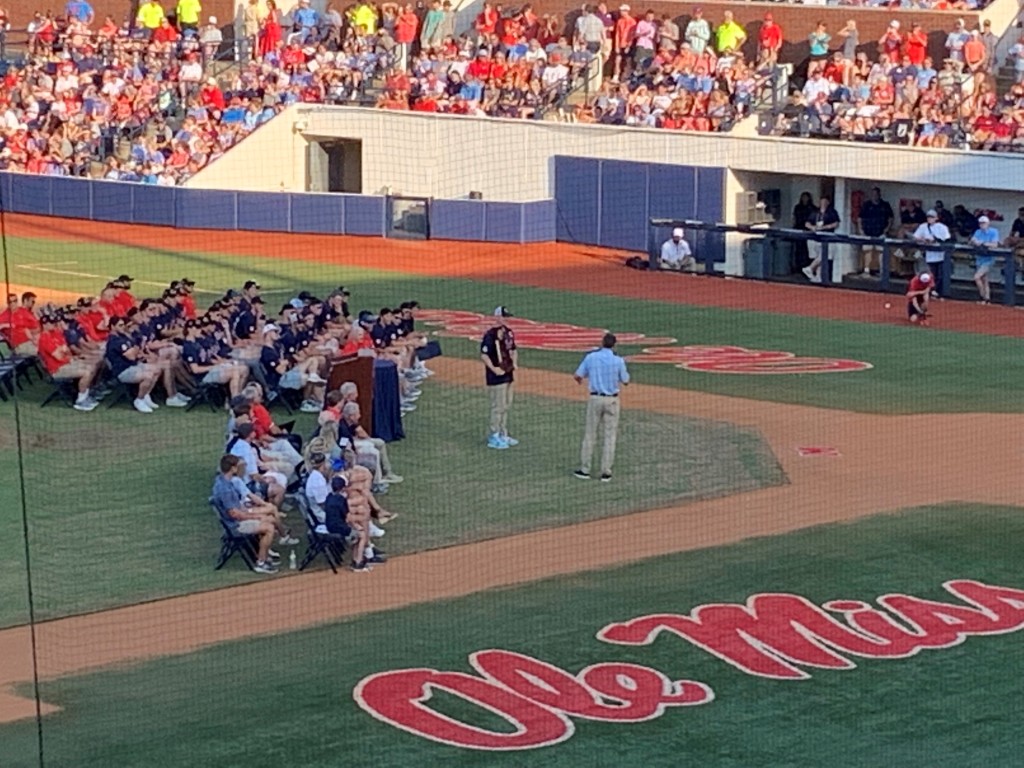
I try to keep things apolitical around here, but my two older boys and I went to Oxford yesterday and we can confirm that the Ole Miss Rebels did in fact win the 2022 College World Series. The boys obtained autographs from the gracious and patient Dylan DeLucia, Peyton Chatagnier, and Coach Bianco as evidence.

Mississippi Supreme Court Decisions of May 12, 2022

The Mississippi Supreme Court handed down six opinions today with subject matter covering capital murder conviction and death penalty, UM/UMI coverage, election contests, appellate procedure, wills, and judicial estoppel.


Johnson v. Brock, 2020-EC-00982-SCT (Civil – Election Contest/Summary Judgment)
Affirming summary judgment dismissing the plaintiffs’ contest the results of a city counsel election, holding that the plaintiffs failed to satisfy their burden in opposing summary judgment where the plaintiffs’ briefs relied upon affidavits that were not in the record and they otherwise failed to come forward with evidence that there were voting irregularities that led to their election losses.
(Justice King did not participate.)


Bufkin v. Geico Insurance Agency, Inc., 2021-CA-00251-SCT (Civil – Insurance/UM/UIM)
Affirming summary judgment in favor of the UM carrier, declining to overrule precedent holding that an employee is not legally entitled to make a claim under their employers’ underinsured motorist coverage.
(All justices concurred.)

Note – The plaintiff argued Mississippi’s law on this question of statutory interpretation was the minority approach and urged the Supreme Court to adopt the majority view. The Supreme Court declined to do so:


McRae v. Mitchell, 2021-IA-00101-SCT (Civil – Other/Interlocutory Appeal/Appellate Procedure)
Dismissing an appeal from a non-final judgment of the chancery court, explaining that the Mississippi Supreme Court treated the notice of appeal as a petition for interlocutory appeal and granted the petition, but held that it lacked jurisdiction since the notice of appeal was not filed within 21 days of after the entry of the non-final judgment.
(Chief Justice Randolph did not participate.)


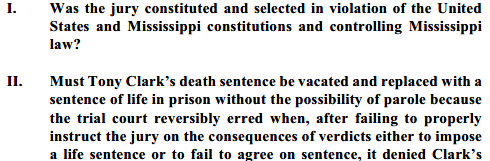
Clark v. State, 2019-DP-00689-SCT (Criminal – Death Penalty – Direct Appeal)
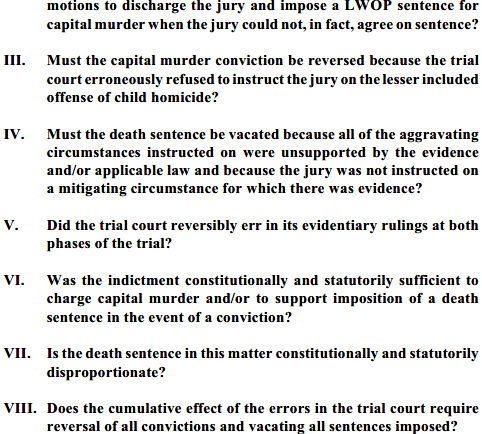
Affirming conviction of capital murder and sentence to death by lethal injection for the slaying of a convenience store clerk in Canton, Mississippi. The issues raised on appeal that the Mississippi Supreme Court addressed were:


(Justice Kitchens dissented, joined by Justice King and Justice Ishee. Justice King dissented, joined by Justice Kitchens and Justice Ishee.)

NOTE – The majority opinion is 99 pages long plus 13 pages of appendices. There are 34 pages of dissents. The curt summary above does not do this opinion justice because I simply do not have the bandwidth to tackle the details of this opinion at this moment.


Estate of Bakarich v. Bakarich, 2020-IA-00339-SCT (Civil – Wills, Trusts, and Estates/Interlocutory Appeal)
Affirming the chancellor’s denial of the co-executrices’ request based on a fee-shifting provision in the will seeking to make a challenger pay the estate’s attorney’s fees in defending challenges to the co-executrices’ actions, but reversing the the chancellor’s decision directing the co-executrices to personally pay the estate’s costs and attorney’s fees associated with the underlying motions and petitions.
(Justice King concurred in part and dissented in part, joined by Justice Kitchens. Justice Beam did not participate.)


Jones v. Alcorn State University, 2020-CA-01238-SCT (Civil – Other/Judicial Estoppel)
Affirming the dismissal of the plaintiff’s breach of contract lawsuit, holding that the plaintiff’s lawsuit was barred by the doctrine of judicial estoppel because the plaintiff failed to reveal his lawsuit in two bankruptcy filings.
(Justice Maxwell [1] wrote a special concurrence, joined by Chief Justice Randolph (who wrote the majority opinion)[2], Justice Coleman [3], Justice Beam [4], and Justice Chamberlin [5], and by Justice Griffis in part. Justice Griffis concurred in part and dissented in part, joined by justice Kitchens.)

Question – What is the effect of a five-justice special concurrence from a nine-member court? Anything other than letting future litigants know that a majority of the court agrees whatever propositions are in the special concurrence? I will look into it later, but I do not know the answer off the top of my head.


Other Orders

Augustine v. State, 2019-CT-01467-SCT (denying motion for rehearing)
Johnson v. State, 2019-CT-01801-SCT (dismissing cert petition)
Figueroa v. State, 2020-CT-00114-SCT (denying cert petition)
Piccaluga v. State, 2020-CT-00346-SCT (denying cert petition)


Hand Down List Page


One more thing – At some point early this morning this blog had its 1,000th unique visit and passed 1,800 total hits in the three months since I launched it. Many thanks to those who have visited, subscribed, and shared the blog and to those who have provided encouragement and helpful feedback. I hope that it has been and continues to be a useful resource.

Summaries of the Mississippi Supreme Court opinions of March 3, 2022

I am posting these summaries on a delay because I spent yesterday at Legoland in Florida with my family. While I was strolling through Bricksburg and riding a Duplo block safari truck, the Mississippi Supreme Court unleashed 126 pages of opinions in just four cases. Only one decision was unanimous and the others were 7-2, 5-4, and 5-4, each of which drew thoughtful dissents.

The more contentious cases were a death penalty post-conviction claim, a case of first impression applying the federal vacatur rule, and a decision addressing the limitations period in a thorny implied indemnity case.


Jones v. State, 2021-KA-00275-SCT (Criminal – Felony/Manslaughter)
Affirming conviction for manslaughter, holding (1) the circuit court did not err by not requiring the jury to specify whether its verdict was based on heat of passion or imperfect self-defense because those are both factual theories encompassed within section 97-3-35, (2) there was sufficient evidence to support the jury’s verdict, and (3) dispersing the jury for lunch was within the circuit court’s discretion and no timely request to sequester was made.
(All participating justices concurred.)


Batiste v. State, 2019-CA-00283-SCT (en banc) (Civil – Death Penalty – Post Conviction/Recusal/Gladney)
Affirming the circuit court’s denial of Bastiste’s motion for recusal based on an argument that the circuit judge’s memory of an alleged conversation with a juror could be relied on in witness-credibility determinations while evaluating the underlying PRC claim and denying the underlying PCR claim, holding (1) that it was speculation that the judge might be a necessary witness in the case, (2) that the Office of Capital Post-Conviction Counsel did not even attempt to follow the appropriate method for post-verdict juror inquiry laid out in Gladney, and (3) that Batiste’s Six Amendment right to an impartial jury was not violated when the circuit court determined that discussions of the racial composition of the jury were brought about within the jury itself rather than from an extraneous source.
(Justice Kitchens wrote a dissent, joined by Justice King.)


Gamma Healthcare Inc. v. Estate of Grantham, 2019-CT-00913-SCT (en banc) (Civil – Workers’ Comp)
Affirming the Court of Appeals’ decisions dismissing the case as moot following the untimely death of the claimant, applying federal vacatur rule and vacating the MWCC’s orders to replace the claimant’s septic and HVAC systems, and reversing the MWCC’s award of sanctions.

The vacatur issue was one of first impression in Mississippi. The Mississippi Supreme Court’s decision included the following excerpt from the U.S. Supreme Court on the vacatur standard:

The United States Supreme Court has held that:

When a civil case becomes moot pending appellate adjudication, “[t]he
established practice . . . in the federal system . . . is to reverse or vacate the judgment below and remand with a direction to dismiss.” United States v. Munsingwear, Inc., 340 U.S. 36, 39, 71 S. Ct. 104, 106, 95 L. Ed. 36 (1950). . . . Vacatur is in order when mootness occurs through happenstance—circumstance not attributable to the parties—or, . . . , the “unilateral action of the party who prevailed in the lower court.” U.S. Bancorp Mortgage Co., 513 U.S., at 23, 115 S. Ct., at 390; cf. id., at 29, 115 S. Ct., at 393 (“mootness by reason of settlement [ordinarily] does not justify vacatur of a judgment under review”).

Arizonans for Off. Eng. v. Arizona, 520 U.S. 43, 71-72, 117 S. Ct. 1055, 1071, 137 L. Ed.2d 170 (1997) (emphasis added) (first, second, and fifth alterations in original). “Because this practice is rooted in equity, the decision whether to vacate turns on ‘the conditions and circumstances of the particular case.’” Azar v. Garza, 138 S. Ct. 1790, 1792, 201 L. Ed. 2d 118 (2018) (quoting United States v. Hamburg-Amerikanische Packetfahrt-Actien Gesellschaft, 239 U.S. 466, 478, 36 S. Ct. 212, 60 L. Ed. 387 (1916)). The Supreme Court also has held that:

The point of vacatur is to prevent an unreviewable decision “from spawning any legal consequences,” so that no party is harmed by what we have called a “preliminary” adjudication. Munsingwear, 340 U.S., at 40-41, 71 S. Ct. 104. . . . When happenstance prevents that review from occurring, the normal rule should apply: Vacatur then rightly “strips the decision below of its binding effect,” Deakins v. Monaghan, 484 U.S. 193, 200, 108 S. Ct. 523, 98 L. Ed. 2d 529 (1988), and “clears the path for future relitigation,” Munsingwear, 340 U.S., at 40, 71 S. Ct. 104.

Camreta v. Greene, 563 U.S. 692, 713, 131 S. Ct. 2020, 2035, 179 L. Ed. 2d 1118 (2011).

Gamma Healthcare, Inc. v. Estate of Grantham, 2019-CT-00913-SCT at ¶15 (Miss. 2022).

(Justice Randolph wrote a dissent, joined by Justice Coleman, Justice Ishee, and Justice Griffis.)


Cooley v. Pine Belt Oil Co., Inc., 2019-IA-01835-SCT (en banc) (Civil – Implied Indemnity)
Reversing, on interlocutory appeal, the circuit court’s denial of the defendant’s motion for summary judgment on an indemnity claim and rendering judgment in favor of the defendant. Long before this litigation commenced, MDEQ ordered the two sides of this dispute to remediate a gasoline line leak on March 5, 2009. Pine Belt, the landowner, paid for the remediation. Then, in 2015, Pine Belt retained an expert who opined that the leak occurred when the property was owned by the Cooleys.

On April 15, 2016, Pine Belt filed a complaint for implied indemnity against the Cooleys seeking to recover the remediation expenses that Pine Belt incurred in response to MDEQ’s order. The Cooleys filed a motion for summary judgment based on the statute of limitations and Pine Belt argued that an implied indemnity claim cannot accrue before a liability party can be identified and because there must be a final, fixed amount. The circuit court denied the motion. The Mississippi Supreme Court granted interlocutory appeal, reversed the circuit court, and rendered judgment in favor of Pine Belt. The Mississippi Supreme Court specifically held that the statute of limitations began to run when MDEQ ordered the remediation:

Although the amount that Pine Belt was ordered to pay by MDEQ was unliquidated, the MDEQ order legally obligated Pine Belt to pay for present and future cleanup costs which Pine Belt all along believed, in fairness, should be paid by the Cooleys. Because the order placed Pine Belt under a compulsion to pay damages which it believed should be paid by another, this Court finds that all of the elements of implied indemnity were present and the statute of limitations began to run on March 5, 2009, and ended on March 5, 2012. Pine Belt did not file its complaint until April 15, 2016. Thus, Pine Belt’s implied indemnity action is time barred.

Cooley v. Pine Belt Oil Co., Inc., 2019-IA-01835 ¶29 (Miss. 2022) (emphasis added).

(Chief Justice Randolph wrote a partial concurrence, partial dissent, joined by Justice Coleman, Justice Maxwell, and Justice Ishee.)


Other Orders

Grayson v. State, 1998-DP-01782-SCT (denying pro se motion to withdraw motion to carry out execution forthwith)
Powers v. State, 2017-DR-696-SCT (granting motion to seal exhibits from public, but not from opposing counsel)
Fluker v. State, 2020-CT-791-SCT (denying pro se petition for writ of certiorari)
Fields v. State, 2020-KA-1317-SCT (denying motion for rehearing)


Complete Hand Down List