
Summaries of the Mississippi Court of Appeals opinions of April 26, 2022

The Mississippi Court of Appeals dropped eight nine opinions today and there is a lot to sort through. Two divorce cases (one involving equitable distribution of a marital residence and the other a life estate via constructive trust for a mother-in-law), a PCR case, a workers’ comp case involving medical causation, an adverse possession/tax sale case, a personal injury via falling through a roof case, an appeal of an estate case dismissed for lack of final order, and two criminal cases. One of the criminal cases is the second “should the indictment for attempt have alleged an overt act” case we have gotten in a row and it sees a dissenting Judge Westbrooks align herself with Justice Coleman’s dissent last week.

I am always balancing the desire to post these summaries quickly and the need to get back to paying work with the desire to provide a reasonably polished [free] product. Due to the number of cases and the fact that I have to leave the office a little early to coach a little league baseball game, there is extra weight on the “speed” side of the balance today.
Thanks,
Management


Archie v. Archie, 2020-CA-01370-COA (Civil – Domestic Relations/Equitable Distribution/Marital Residence)
Affirming the chancellor’s modification of a final judgment of divorce as to equitable distribution of the marital residence, holding that there was no error in the chancellor ordering the ex-wife to sell the paid-off martial home in order to satisfy the ex-wife’s obligation to pay her ex-husband his share of the equity where the ex-wife had been unable to secure a loan on the paid-off house, even though the ex-husband had not pleaded a request for an order requiring the ex-wife to sell the residence. The court repeatedly noted that the chancellor had broad discretion to “fashion an equitable remedy” and held that the chancellor’s remedy here was appropriate.
(Judge Wilson concurred in part and the in the result without separate written opinion.)


Bevalaque v. State, 2021-CP-00150-COA (Civil – PCR)
Affirming dismissal of a pro se plaintiff’s third PCR motion, holding that the motion was time-barred and successive-writ barred and that no exceptions applied.
(All judges concurred.)


Bowdry v. City of Tupelo, 2021-WC-00390-COA (Civil – Workers’ Compensation/Medical Causation)
Affirming the MWCC’s finding that the claimant’s neck claim was not related to his compensable work-injury, holding that the Commission’s finding that the claimant failed to prove causation was supported by substantial evidence.
(All judges concurred.)

PRACTICE POINT: The Court of Appeals noted that on appeal they do not review the AJ’s findings, but the Commission’s findings and did not address the claimant’s arguments about the AJ’s findings:

This is because the Commission does not function as an appellate court reviewing the AJs’ findings. This is because the Commission, not the AJ, is the ultimate trier and finder of fact for workers’ comp claims. See, e.g., Hugh Dancy Co. Inc. v. Mooneyham, 68 So. 3d 76 (Miss. Ct. App. 2011)


Anderson v. Jackson, 2019-CA-01773-COA (Civil – Real Property/Adverse Possession/Unclean Hands/Tax Sale)
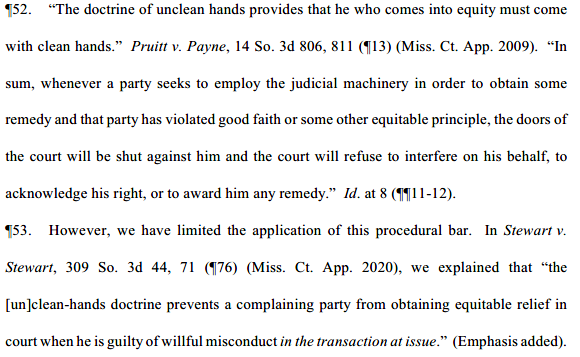
Reversing the chancellor’s findings granting title of real property to one party (Levon) based on findings that Levon had obtained title by adverse possession or by tax sale and that the opposing party (Rosie) had unclean hands, holding that the chancellor erred in granting title to Levon because he failed to prove the elements of adverse possession by clear and convincing evidence, that the tax sale was void due to flawed notice of redemption, and that the doctrine of unclean hands was erroneously applied to bar Rosie’s challenge because Rosie’s conduct was related to a forty-year-old estate case, not the transaction at issue.
(All judges concurred.)

Since accusations of “unclean hands” get thrown around in litigation on occasion, I thought this summary of the equitable doctrine of unclean hands is a useful refresher:
NOTE – As always, but only more so here, if this case applies to your practice you need to read it yourself. There are many details in this forty-page opinion that I have not even attempted to tease apart.


Herron v. Herron, 2021-CA-00090-COA (Civil – Domestic Relations/Constructive Trust/Property Valuation)
Affirming the chancellor’s findings in a divorce action granting a life estate via constructive trust in a home on the marital property to the ex-wife’s mother in assigning value to property awarded to the ex-husband, holding that there was clear and convincing proof that the house was intended to be owned by the mother in a life estate and that there was substantial credible evidence supporting the chancellor’s valuations of the personal property in question.
(All judges concurred.)


Gillespie v. Lamey, 2021-CA-00076-COA (Civil – Personal Injury/Summary Judgment/Duty to Warn)
Affirming summary judgment in favor of a defendant dismissing the plaintiff’s claim for personal injuries sustained when the plaintiff fell through a roof while working on a skylight on the defendant’s property, holding that (1) the plaintiff presented no evidence that the defendant failed to warn the plaintiff of any dangerous condition of which the defendant had actual or constructive knowledge and (2) the allegedly dangerous condition was “intimately connected” to the work he was hired to do.
(Judge Smith did not participate, all other judges concurred.)


Smith v. Richmond, 2020-CP-01064-COA (Civil – Wills, Trusts, and Estates/Civil Procedure)
Dismissing the appeal, holding that the pro se appellant’s attempted appeal of the chancery court’s denial of a Rule 60(b) motion to set aside an interim order, a motion to recuse, and a “motion to change jurisdiction” must be dismissed because each of these motions was an interlocutory order not appealable as of right.
(All judges concurred.)


Wayne v. State, 2021-KA-00084-COA (Criminal – Felony/Rebuttal Evidence/Sufficiency and Weight of Evidence)
Affirming murder conviction, holding that there was no error (1) in allowing the State to recall a State’s witness and introduce and play the defendant’s recorded statement in rebuttal because the recorded statement contradicted the defendant’s trial testimony, (2) in introducing the defendant’s entire statement because it was proper impeachment evidence, or (3) in denying the defendant’s post-trial motion because the evidence was sufficient to support the conviction and that the conviction was not against the weight of the evidence.
(All judges concurred.)


Beale v. State, 2020-KA-00614-COA (Criminal – Felony/Overt Act)
Affirming conviction two counts of attempted murder of two police officers, holding (1) an indictment for the crime of attempted murder does not require the description of an overt act, (2) that two jury instructions did not constitute a constructive amendment to the indictment, and (3) testimony from an officer about what a witness told him at the crime scene was not hearsay because they were not offered to prove the truth of the matter asserted but to explain the next steps in the course of his investigation.
(Judge Westbrooks dissented, joined in part by Judge McDonald. Judge McDonald concurred in part and dissented in part without separate written opinion. Judge Emfinger concurred in part and in the result without separate written opinion. Judge Wilson concurred in result only without separate written opinion. All other judges concurred.)

NOTE – We have gotten an “is the indictment missing an alleged overt act” case in back-to-back hand-down days. In her dissent, Judge Westbrooks’s argues that she is taking a position consistent with the position that Justice Coleman took just last week in Brady v. State (my post here) (opinion link here).


Other Opinions

Durrant Inc. v. Lee County, Mississippi, 2019-CA-01826-COA (denying motion for rehearing)
Bell v. State, 2020-CT-00592-COA (denying motion for rehearing)

Hand Down List

Summaries of the Mississippi Court of Appeals opinions of April 12, 2022

The Mississippi Court of Appeals handed down two opinions today, one criminal and one civil. The criminal opinion affirmed a conviction, finding no merit on a litany of issues. The civil opinion affirmed summary judgment on a breach of contract claim based on a personal guaranty included in a credit application with a business’s supplier.


Barnes v. State, 2021-KA-00404-COA (Criminal – Felony/Hearsay/Jury Instructions/Rule 404(b))
Affirming conviction of two counts of fondling, holding (1) no error in jury instruction re: sufficiency of unsubstantiated/uncorroborated, but not contradicted/discredited, testimony of victim of a sex crime to support guilty verdict; (2) no error in allowing testimony by investigator “based on professional experience” because not expert opinion; (3) error in allowing hearsay was harmless because the same information was also introduced through admissible source; (4) Rule 404(b) objection re: other students who reported misconduct waived because not made contemporaneously and because it showed why the school initiated an investigation; (5) no error in admitting recorded conversations between victim and defendant where intelligible recording was not produced until the first day of trial (at least partially because defense did not request more time to prepare); (6) no error in admitting purported statement of the defendant over discovery violation objection because the statement had produced in discovery and defense counsel admitted being familiar with it; (7) no merit to ineffective assistance of counsel claim; and (8) the evidence was sufficient to support the convictions. The court of appeals invoked the plain error doctrine to remand the case for correction of a scrivener’s error in the sentencing order.
(Judge Westbrooks and Judge McDonald concurred in part and in the result without separate written opinion. Judge McCarty concurred in result only without separate written opinion.)


Devine v. Cardinal Health 110, LLC, 2020-CA-01101-COA (Civil – Contract/Personal Guaranty/Affirmative Defenses)
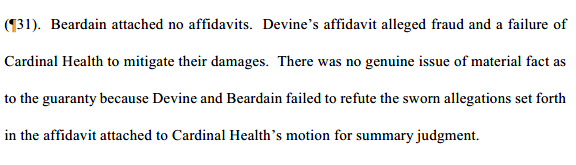
Affirming the circuit court’s grant of summary judgment in favor of the plaintiff/supplier, holding that there was no error in finding that the owners of a company had personally bound themselves to pay their company’s debt to the plaintiff/supplier per the terms of a credit application that contained a personal guaranty. The court of appeals noted that the defendants did not attach affidavits in response to the summary judgment motion that addressed the guaranty:

The court of appeals then held that the plaintiff/supplier–a secured creditor– had no duty to mitigate before filing a lawsuit for damages and that the defendant that asserted fraud in response to the motion for summary judgment had waived that affirmative defense by failing to plead it in his answer to the complaint.
(All judges concurred.)


Other Orders

Hartzler v. Bosarge, 2019-CT-01606 (granting motion to dismiss appeal as interlocutory)

Doe v. Doe, 2020-CA-00853-COA (denying motion for rehearing)

Braswell v. Braswell, 2020-CA-01090-COA (denying motion for rehearing)

Nunn v. State, 2021-TS-01371-COA (granting pro se motion for out-of-time appeal and granting motion to withdraw and substitute counsel)


Hand Down List

Summaries of the Mississippi Court of Appeals opinions of March 8, 2022

There are six opinions from the Mississippi Court of Appeals today on a wide range of topics, including a holding that a defendant’s failure to respond to a complaint filed on March 6, 2020, until thirty-one days after service of process constituted “excusable neglect” in light of the COVID shutdowns at the time.

Hamer v. State, 2019-KA-01633-COA (Criminal – Felony/Evidence/Rule 403/Golden Rule)
Affirming conviction on two counts of capital murder and armed robbery and sentence to life in prison without parole, holding primarily that (1) wiretapped phone calls between the convicted and his father, whose drug trafficking enterprise the convicted had worked for, were admissible to show motive and tell “the complete story” to the jury, (2) the evidence was sufficient to establish nexus between the killing and the underlying felony to constitute capital murder, (3) and there was no impermissible Golden Rule argument at closing.
(Judge Westbrooks wrote an opinion concurring in part and dissenting in part, joined by Judge McDonald.)


Crockett v. State, 2021-CP-00022-COA (Civil – PCR/Time Bar)
Affirming circuit court’s denial of a pro se motion for post-conviction collateral relief, holding that the claim of an involuntary guilty plea was both time-barred and meritless.
(All judges concurred, Chief Judge Barnes and Judge Wilson concurred in part and in the result without separate written opinion.)


Erves v. Hosemann, 2020-CA-00467-COA (Civil – Property/Daubert)
Affirming chancellor’s decision denying relief in an action for an injunction to stop the use of a driveway and for monetary damages, holding that the petitioners failed to establish legal title to the subject property and specifically holding that the defendants’ expert witnesses were qualified and that the chancellor’s ruling was not against the overwhelming weight of the evidence.

Practice Point: Appellants got dinged on their Daubert challenge for arguing reliability on appeal when the only issue raised at the trial court was the experts’ qualifications:


(All judges concurred, Judge McCarty concurred in part and in the result without separate written opinion.)


Archer v. Harlow’s Casino Resort & Spa, 2020-CP-00930-COA (Civil – Other/Default/Excusable Neglect)
Affirming in part and reversing in part the circuit court’s grant of the defendant’s motion to dismiss, holding that the circuit court did not abuse its discretion in finding that the defendant showed excusable neglect when it sought an extension of time to answer the complaint thirty-one days after being served and holding that the circuit clerk did not err by correcting a mistake and removing an entry of default, but holding that the trial court should have dismissed the complaint without prejudice and allowed the plaintiff an opportunity to amend her complaint under Rule 15(a).

ADDENDUM – COVID AND THE LAW: The defendant casino blamed the COVID-19 pandemic for being late to respond to the complaint. The casino was served with process on March 9, 2020, three days before the governor of Kentucky (where the casino’s counsel is located) issued a state of emergency and one week before Governor Reeves entered an order in Mississippi closing the casino. The casino asserted that these restrictions made it difficult to gather information from the closed casino in order to prepare and answer. The circuit court granted the late-filed extension request “in light of the current pandemic and government orders restricting operations and travel.” The court of appeals held that this was not an abuse of the circuit court’s broad discretion in this realm. In this case: COVID shutdown in March 2020 = “excusable neglect.”
(All judges concurred, Judge Wilson concurred in part and in the result without written opinion.)


Everett v. Dykes, 2020-CP-01331-COA (Civil – Property Damage/Recusal/Rule 48B)
Dismissing a pro se appeal of an order denying a motion for recusal of the circuit judge, holding that the appellant failed to comply with the procedure required by Rule 48B of the Mississippi Rules of Appellate Procedure for an interlocutory appeal of the denial of a recusal motion.
(Judge Lawrence dissented without separate written opinion.)


Rives v. Ishee, 2020-CA-01328-COA (Civil – Contract/Statute of Limitations)
Affirming the chancellor’s dismissal of a breach of contract lawsuit, holding that the plaintiffs’ second lawsuit was time-barred because they did not file suit until more than three years after they learned they would receive no money from the restaurant and the statute of limitations was not tolled during the first lawsuit because it was dismissed for want of prosecution. The court of appeals also held that the remedy of quantum meruit was inapplicable because there was a contract between the parties.
(Judge Westbrooks concurred in part and dissented in part, joined by Judge Greenlee.)


Other Orders

Westmoreland v. State, 2020-KA-00509-COA (denying motion for rehearing)
Winters v. State, 2020-KA-00809-COA (denying motion for rehearing)


Complete Hand Down List

Mississippi Court of Appeals Hand Downs for February 8, 2022

Blue Cross and Blue Shield of Mississippi v. Brown and Brown of Mississippi, LLC, 2020-CA-1414-COA (Civil – Contract/Garnishment)
Brown obtained two judgments against a BCBS insurance agent, enrolled the judgments, and then filed suit to enforce the judgments and suggestions for writs of garnishment against BCBS and others. BCBS denied it was indebted to the agent. The circuit court ordered BCBS to tender the agent’s commissions to Brown. BCBS appealed, and the court of appeals reversed the circuit court and rendered judgment in favor of BCBS, finding that the agent had assigned her interest in the commissions to a third party long before the writ of garnishment was served. The court of appeals also held that BCBS was entitled to its costs under section 11-35-45 and remanded to the circuit court to address that issue.

Ladner v. State, 2020-KA-299-COA (Criminal – Felony)
Affirming a conviction of possession of a firearm by a felon, holding that it was harmless error for the the circuit court to exclude non-hearsay testimony under the hearsay rule and that the circuit court did not err admitting body cam footage. The opinion lists a claim of ineffective assistance of counsel as one of the issues raised, but there is no discussion of that in the majority opinion, the special concurrence, or the dissent.

Nowell v. Stewart, 2020-CA-728-COA (Civil – Domestic Relations/Child Support)
Affirming the chancellor’s judgment increasing the child support modification based on a material change in circumstances.

Mangum v. State, 2020-CP-1205-COA (Civil – Post-Conviction Relief)
Affirming the circuit court’s dismissal of a motion for PCR based on the statute of limitations and the successive-motions bar.

United Services Automobile Association v. Moffatt, 2020-CA-1391-COA (Civil – Insurance/UM UIM)
The county court granted summary judgment in favor of a UM carrier, finding that the amended complaint naming the UM carrier was time barred because it was filed more than three years after the accident. The plaintiff appealed to the circuit court and the summary judgment was reversed. The UM carrier appealed to the court of appeals and the court of appeals affirmed the circuit court and remanded the case to the county court. The court of appeals held that there was a genuine fact issue for a jury as to when the plaintiff’s UM claim accrued based on when it could be reasonably known that the damages suffered exceed the limits of insurance available to the alleged tortfeasor.

Lowe v. State, 2019-KA-1621 (Criminal – Felony/Confrontation Clause)
Affirming a conviction of the sale of cocaine and sentencing as a habitual offender, holding that an officer’s testimony that a non-testifying confidential informant said she had bought drugs from the defendant in the past violated the Confrontation Clause of the Sixth Amendment but was harmless error.

Other Orders
6 Rehearing Denials

Link to Hand Down List