The Mississippi Supreme Court handed down one opinion today. It is a 5-4 decision on interlocutory appeal of an order denying a venue transfer.
Nat’l Health Ins. Co. v. Lever, 2024-IA-00112-SCT (Civil – Insurance) Reversing the trial court’s denial of a motion to transfer venue in a lawsuit against a health insurance company, holding that venue was not proper where the medical treatment was rendered because the medical treatment was not a “substantial event” under the venue statute as it was not an act of the defendant. (5-4: Randolph dissented, joined by King, Ishee, and Sullivan)
Other Orders
Culbertson v. State, 2023-CT-00588-SCT (dismissing cert petition that was previously granted)
Ladner v. Hinton Homes LLC, 2024-CT-00941-SCT (denying cert)
The Mississippi Supreme Court waited until I was out of town last week to unleash its largest batch of opinions of the year. Six opinions were handed down on Thursday, including one of my cases which was on interlocutory appeal for a service of process issue. There is also one direct criminal appeal, two breach of contract cases (one trial and one summary judgment), an election contest, and a statute of limitations case.
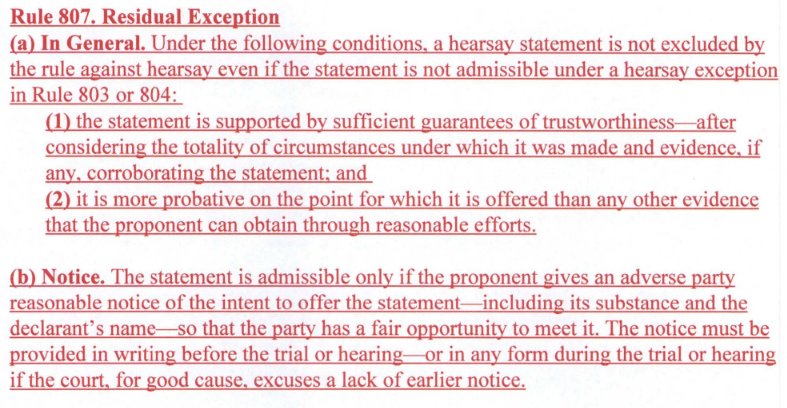
The Court also adopted a new rule of evidence that is “residual exception” to the rule against hearsay.
Unruh v. Johnson, 2024-IA-00028-SCT (Civil – Personal Injury) Reversing the trial court’s denial of motions to dismiss for insufficient service of process, holding that the trial court erred by granting the plaintiff’s motion for enlargement of time to serve process because the plaintiff could not show “good cause” where both the motion for enlargement of time and the first service attempt came one day after the 120-day service period ended and the plaintiff failed to articulate a legitimate basis for failing to attempt to timely serve process, holding that filing the motion for enlargement of time one day after the 120-day period did not toll the statute of limitations, and rendering judgment in favor of the defendant. (9-0)
Note – I represented the appellant/defendant in this appeal. I jumped in on this one with Bobby Stephenson when I joined Wilkins Patterson last summer right after interlocutory appeal was granted.
Phillips v. State, 2023-KA-01218-SCT (Criminal – Felony) Affirming conviction of aggravated assault, holding that the admission of statements on body-camera footage were not testimonial and statements in search warrant affidavit did not violate the Confrontation Clause, that introducing underlying facts and circumstances of the search warrant containing a comment about the defendant’s post-Miranda silence was error albeit harmless, that the cumulative error doctrine did not apply, and that the defendant did not receive ineffective assistance of counsel. (8-0: Randolph did not participate)
Radco Fishing and Rental Tools, Inc. v. Commercial Resources, Inc., 2023-CA-00376-SCT (Civil – Contract) Affirming judgment against the defendant for outstanding principal and interest under an accounts receivable line of credit agreement and award of attorneys’ fees, holding that the trial court did not err by granting a motion for partial summary judgment dismissing affirmative defenses, that the defendants’ motions for summary judgment are not reviewable on appeal after they proceeded to trial and litigated, that the trial court did not err by granting a motion to admit parol evidence, that the trial court did not err in denying the defendants’ motions for directed verdict and granting the plaintiff’s motion for directed verdict, that the trial court did not err in granting the plaintiff’s jury instruction on liability, that the trial court did not err by denying the defendants’ post-trial motions, and that the trial court did not err in altering the judgment due to the jury’s disregard of the peremptory instruction and directed verdict, and that the trial court did not err by granting the plaintiff’s motion to bifurcate and award attorneys’ fees. (6-6*-2: Maxwell specially concurred, joined by five other justices, making it binding precedent; Griffis concurred in part and dissented in part, joined by Coleman)
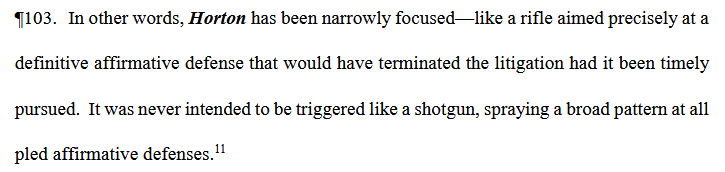
*Precedential Special Concurrence – With a total of six votes, Maxwell’s special concurrence is precedent and provides significant guidance for the bench and bar going forward, so it deserves its own summary. The special concurrence held that the trial court erred in granting a blanket ruling against all of the defendants’ affirmative defenses, specifically holding that Horton does not apply to “all” affirmative defenses, only those that would have terminated litigation if asserted earlier.
The concurrence explained:
Footnote 11 was also noteworthy:
Final Note – The dissent argued for limiting the Horton doctrine to the issue of asserting the right to arbitration.
Housing Authority of the City of Yazoo City, Mississippi v. Billings, 2023-IA-00975-SCT (Civil – Contract) Reversing the trial court’s order denying the Housing Authority’s motion for summary judgment on a breach of contract claim against it, holding that none of the alleged terms of the employment contract were contained in the Housing Authority board’s minutes, and rendering judgment in favor of the Housing Authority. (9-0)
Gavin v. Evers, 2024-EC-00061-SCT (Civil – Election Contest) Affirming the trial court’s grant of summary judgment in an election contest, holding that the trial court did not err in considering the motion to dismiss and motion for summary judgment simultaneously, did not err in excluding an affidavit that was not based on the affiant’s personal knowledge, did not err in finding no genuine issue of material fact in the voting irregularities claim, did not err by finding that the prevailing candidate met the two-year residency requirement, and did not err in denying the motion for reconsideration and request for additional findings of fact and conclusions of law. (9-0)
Dollar General Corporation v. Dobbs, 2023-IA-00617-SCT (Civil – Torts) Reversing the county court’s denial of the defendant’s motion to dismiss for failure to state a claim, holding that the trial court erred in finding the three-year statute of limitations applied where the complaint stated only a claim of defamation which is subject to a one-year statute of limitations. (5-4)
Other Orders
Johnson v. State, 2022-CT-00665-SCT (denying cert)
Law Will and Testament of Prichard: Martin v. Arceneaux, 2022-CT-01035-SCT (denying cert)
Wilson v. State, 2023-CT-00070-SCT (dismissing pro se cert petition as untimely)
Wallace v. State, 2023-CT-00071-SCT (denying cert)
NCAA v. Farrar, 2023-IA-00282-SCT (denying rehearing)
In Re: Capitol Complex Improvement District Inferior Court, 2025-M-00007-SCT (granting motion to withdraw petition to adopt local rules of CCID Court)
In Re: Mississippi Rules of Evidence, 89-R-99002-SCT (granting motion to adopt Mississippi Rule of Evidence 807) Here is the text of the new rule:
The Mississippi Supreme Court handed down four opinions today. There is an interesting Fourth Amendment case of first impression regarding a cell phone search. The lone civil decision has thorough discussions of the doctrines of mootness, standing, and judicial admissions.
Lenoir v. State, 2023-IA-01181-SCT (Criminal – Felony) Affirming an interlocutory order of the circuit court denying a motion to disqualify the judge and quash the indictment, holding that the joint order of the two circuit judges in the district recusing themselves and appointing a circuit judge from another district was valid under Section 9-1-105(5), that the appointment of another circuit judge did not fail for lack of notice, that the Court would not consider evidence that was not in the record on appeal but attached to a brief, that dismissal was not warranted where he had not been formally appointed at the time the case was presented to the grand jury because there was not evidence of improper influence, that a recused judge’s signature on a the grand jury report did not equate to “hearing any matters arising in this case,” and that an argument that the special judge’s issuance of search warrants is premature. (7-0: Randolph and Sullivan did not participate)
Watts v. State, 2023-KA-00893-SCT (Criminal – Felony) Affirming conviction of first degree murder, holding that the evidence was sufficient to support the conviction which was not against the overwhelming weight of the evidence, that a jury instruction on deliberate design killing to which that was no objection was not improper as a matter of law, and that a jury instruction on inferring malice aforethought was not an improper comment on the weight of the evidence. (9-0)
Knight v. State, 2022-KA-01138-SCT (Criminal – Felony) Affirming conviction of two counts of exploitation of a child and one count of touching a child, holding that a warrantless search of the defendant’s cellphone did not violate the Fourth Amendment under the private search doctrine, that the prosecutor’s complained-of comments were not so prejudicial or inflammatory as to require reversal, that there was no merit to the challenges to the search warrants, that the claim that the State knowingly presented false evidence was without merit and that it was within the jury’s province to weight inconsistent and contradictory testimony, that the disproportionate sentence argument was barred fro failure to address the Solem factors, passing on the ineffective-assistance-of-counsel claim, and that without error there could be no cumulative error reversal. (5-1-2: King concurred in part and in the result without writing; Ishee dissented, joined by Sullivan; Randolph did not participate)
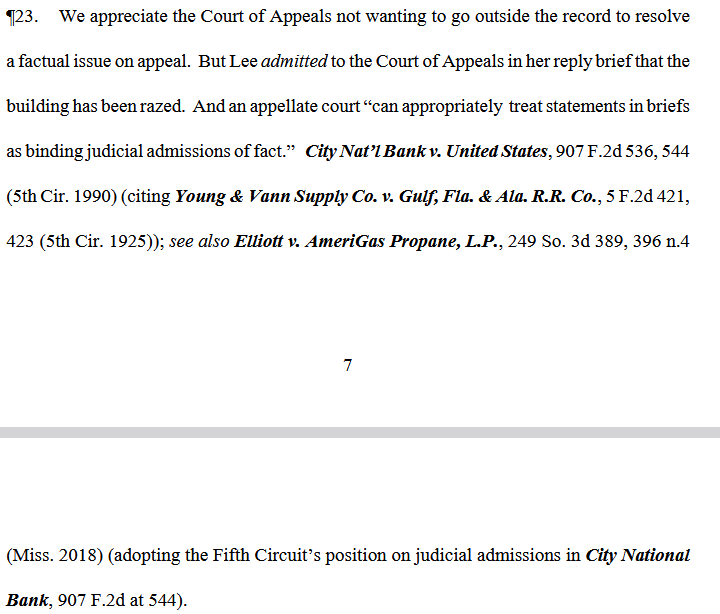
Lee v. The City of Pascagoula, 2022-CT-01190-SCT (Civil – State Boards & Agencies) Vacating judgment of the Court of Appeals and dismissing the appeal for mootness, holding that the appeal was moot because the motel that it involved had been razed and that the plaintiff lacked standing because she no longer had an interest in the property. (9-0)
Practice Point – The Mississippi Supreme Court relied on Fifth Circuit precedent and held that appellate courts can treat statements in briefs as binding admissions of fact:
Other Orders
Lenoir v. State, 2023-IA-01181-SCT (granting motion to strike)
The Mississippi Supreme Court handed down one opinion today. It is an uncommon interlocutory appeal in a felony case considering a double jeopardy argument.
Middleton v. State, 2024-IA-00144-SCT (Criminal – Felony) Affirming the trial court’s denial of a motion to dismiss an indictment for felony possession of methamphetamine on the basis of double jeopardy, holding that the municipal court’s determination of the fine for possession of a controlled substance did not constitute a conviction for a possession of a controlled substance for double jeopardy to attach. (9-0)
Other Orders
Estate of Warren: Warren v. Maharrey, 2023-CT-00438-SCT (denying cert)
In Re: Lonnie Coleman, 2024-M-00712 (granting mandamus and directing the trial court to enter rulings within 30 days)
I did not post Court of Appeals decisions on Tuesday because I was in an all-day deposition and went from there to a pinewood derby. I will try to catch up on those later. But today the Mississippi Supreme Court handed down two opinions. One deals with the MTCA’s venue provisions in a wrongful-death case and the other disposes of an appeal of felony convictions and sentencing with an interesting Fourth Amendment analysis.
Jones County v. Estate of Bright, 2021-IA-00631-SCT (Civil – Wrongful Death) Reversing the circuit court’s denial of venue change in an MTCA case stemming from a police chase that killed a bystander, holding on interlocutory appeal that under the MTCA venue was only proper in the counties where the administrative offices of the political-subdivision defendants are located (Jones or Lauderdale), and not where the acts or omissions occurred (Pearl River) because the state was not a named defendant. (8-0: Chief Justice Randolph did not participate)
Fisher v. State, 2021-KA-00828-SCT (Civil – Felony) Affirming convictions of drug possession and trafficking charges and sentencing as a habitual offender, holding that the defendant was not denied the right to testify on his own behalf where the record was silent as to whether he wanted to testify, that there was no Fourth Amendment search when officers climbed a ladder in a common area with the building owner’s permission to look into the defendant’s ceilingless storage unit, and that resentencing was not necessary because the trial court imposed the mandatory minimum for the aggravated trafficking conviction not on his habitual offender status that was determined without sufficient evidence. (9-0)
Other Orders
In Re: Commission on Mandatory Continuing Legal Education, 89-R-99011-SCT (granting Petition of the Mississippi Commission on Continuing Legal Education allowing attorneys to complete their CLE obligations set forth in Rule 3 through online, webinars or live, in-person programs for the 2022-2023 CLE reporting year)
In Re: Rules Governing Admission to the Mississippi Bar, 89-R-99012-SCT (granting Petition to Amend the Rules Governing Admission to the Mississippi Bar filed by the Mississippi Board of Bar Admissions; denying Petition to Amend Rule IV §8 of the Rules Governing Admission to the Mississippi Bar filed by Jefferson Carl Harvey on April 21, 2022 and the Emergency Petition to Amend Rule IV Section 8 of the Rules Governing Admission to the Mississippi Bar filed by Applicant 11596 on June 25, 2021; and dismissing Petition for Ruling Regarding Motion #2022-1321 A/K/A “Petition to Amend the Rules Governing Admission to the Mississippi Bar” filed by Jefferson Carl Harvey on October 31, 2022)
Rules for Court Reporters, 89-R-99021-SCT (amending The Rules and Regulations Governing Certified Court Reporters)
Beale v. State, 2020-CT-00614-SCT (granting cert)
Devine v. Cardinal Health 101, LLC, 2020-CT-01101-SCT (granting joint motion to suspend cert proceedings and dismiss cert petition as moot)
Adams v. State, 2020-CT-01383-SCT (denying cert)
Adams v. State, 2020-CT-01383-SCT (denying pro se cert petition)
Watts v. State, 2021-KA-00873-SCT (denying rehearing)
The Mississippi Supreme Court handed down three unanimous opinions today. The lone civil case is an interlocutory appeal of a slip-and-fall case. The other two are criminal cases, one affirmed a conviction and the other reversed a conviction based on the “fruit of the poisonous tree” doctrine.
Byram Cafe Group, LLC v. Tucker, 2021-IA-00723-SCT (Civil – Personal Injury) Reversing the circuit court’s denial of the defendant’s motion for summary judgment in a slip-and-fall case, holding that the record including the plaintiffs’ deposition testimony did not support their claim that the defendant created a dangerous condition or that the defendant’s negligence caused the fall. (9-0)
Garrett v. State, 2021-KA-00754-SCT (Criminal – Felony) Affirming a conviction of burglary of a hotel room, holding that the defendant did not meet his burden on appeal of showing that the conviction was not supported by sufficient evidence or that the verdict was contrary to the overwhelming evidence. (9-0)
Green v. State, 2021-KA-00617-SCT (Criminal – Felony) Reversing convictions of conspiracy to commit armed robbery, armed robbery, and burglary of a dwelling, holding that the circuit court erred by admitting evidence that the defendant possessed the victim’s car keys (the “linchpin evidence” supporting the convictions) that was wholly derived from the defendant’s statement that the circuit court had excluded because it was improperly induced. (9-0)
Other Orders
Clark v. State, 2019-DP-00689-SCT (rehearing denied)
Durrant Inc. v. Lee County, Mississippi, 2019-CT-01826-SCT (denying cert)
The Mississippi Supreme Court handed down six opinions today with subject matter covering capital murder conviction and death penalty, UM/UMI coverage, election contests, appellate procedure, wills, and judicial estoppel.
Johnson v. Brock, 2020-EC-00982-SCT (Civil – Election Contest/Summary Judgment) Affirming summary judgment dismissing the plaintiffs’ contest the results of a city counsel election, holding that the plaintiffs failed to satisfy their burden in opposing summary judgment where the plaintiffs’ briefs relied upon affidavits that were not in the record and they otherwise failed to come forward with evidence that there were voting irregularities that led to their election losses. (Justice King did not participate.)
Bufkin v. Geico Insurance Agency, Inc., 2021-CA-00251-SCT (Civil – Insurance/UM/UIM) Affirming summary judgment in favor of the UM carrier, declining to overrule precedent holding that an employee is not legally entitled to make a claim under their employers’ underinsured motorist coverage. (All justices concurred.)
Note – The plaintiff argued Mississippi’s law on this question of statutory interpretation was the minority approach and urged the Supreme Court to adopt the majority view. The Supreme Court declined to do so:
McRae v. Mitchell, 2021-IA-00101-SCT (Civil – Other/Interlocutory Appeal/Appellate Procedure) Dismissing an appeal from a non-final judgment of the chancery court, explaining that the Mississippi Supreme Court treated the notice of appeal as a petition for interlocutory appeal and granted the petition, but held that it lacked jurisdiction since the notice of appeal was not filed within 21 days of after the entry of the non-final judgment. (Chief Justice Randolph did not participate.)
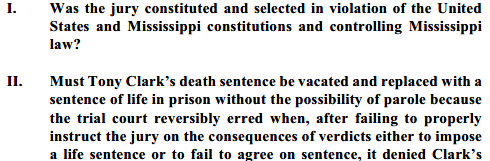
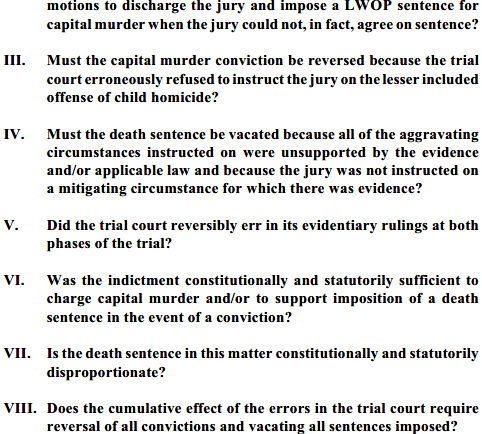
Clark v. State, 2019-DP-00689-SCT (Criminal – Death Penalty – Direct Appeal) Affirming conviction of capital murder and sentence to death by lethal injection for the slaying of a convenience store clerk in Canton, Mississippi. The issues raised on appeal that the Mississippi Supreme Court addressed were:
(Justice Kitchens dissented, joined by Justice King and Justice Ishee. Justice King dissented, joined by Justice Kitchens and Justice Ishee.)
NOTE – The majority opinion is 99 pages long plus 13 pages of appendices. There are 34 pages of dissents. The curt summary above does not do this opinion justice because I simply do not have the bandwidth to tackle the details of this opinion at this moment.
Estate of Bakarich v. Bakarich, 2020-IA-00339-SCT (Civil – Wills, Trusts, and Estates/Interlocutory Appeal) Affirming the chancellor’s denial of the co-executrices’ request based on a fee-shifting provision in the will seeking to make a challenger pay the estate’s attorney’s fees in defending challenges to the co-executrices’ actions, but reversing the the chancellor’s decision directing the co-executrices to personally pay the estate’s costs and attorney’s fees associated with the underlying motions and petitions. (Justice King concurred in part and dissented in part, joined by Justice Kitchens. Justice Beam did not participate.)
Jones v. Alcorn State University, 2020-CA-01238-SCT (Civil – Other/Judicial Estoppel) Affirming the dismissal of the plaintiff’s breach of contract lawsuit, holding that the plaintiff’s lawsuit was barred by the doctrine of judicial estoppel because the plaintiff failed to reveal his lawsuit in two bankruptcy filings. (Justice Maxwell [1] wrote a special concurrence, joined by Chief Justice Randolph (who wrote the majority opinion)[2], Justice Coleman [3], Justice Beam [4], and Justice Chamberlin [5], and by Justice Griffis in part. Justice Griffis concurred in part and dissented in part, joined by justice Kitchens.)
Question – What is the effect of a five-justice special concurrence from a nine-member court? Anything other than letting future litigants know that a majority of the court agrees whatever propositions are in the special concurrence? I will look into it later, but I do not know the answer off the top of my head.
Other Orders
Augustine v. State, 2019-CT-01467-SCT (denying motion for rehearing) Johnson v. State, 2019-CT-01801-SCT (dismissing cert petition) Figueroa v. State, 2020-CT-00114-SCT (denying cert petition) Piccaluga v. State, 2020-CT-00346-SCT (denying cert petition)
One more thing – At some point early this morning this blog had its 1,000th unique visit and passed 1,800 total hits in the three months since I launched it. Many thanks to those who have visited, subscribed, and shared the blog and to those who have provided encouragement and helpful feedback. I hope that it has been and continues to be a useful resource.
The Mississippi Supreme Court handed down two opinions today. One decides an interlocutory appeal of the denial of the defendants’ motion for summary judgment in a tire blowout case that hinged on the doctrine of res ipsa loquitur. The other is a criminal case considering convictions for attempted willful trespass and auto burglary that addresses issues of whether the indictment was sufficient, whether evidence of other was acts should have been excluded, and whether the defendant’s “theory of the case” instruction was wrongly denied.
Darling Ingredients Inc. v. Moore, 2020-IA-01149-SCT (Civil – Personal Injury/Res Ipsa Loquitur) On interlocutory appeal, reversing the circuit court’s denial of the defendants’ motion for summary judgment in an auto liability case stemming from the failure of a tire on the defendants’ vehicle, holding that the doctrine of res ipsa loquitur did not apply because a vehicle’s tire can fail for reasons other than negligence of the vehicle’s driver or owner. Because the doctrine of res ipsa loquitur was not applicable and the plaintiff had no evidence of negligence on the part of the defendants, judgment was rendered for the defendants. (This decision was unanimous)
NOTE: Although this opinion stops just short of specifically saying so, I read it as establishing a bright-line rule that the doctrine of res ipsa loquitur is inapplicable to cases where a motorist is injured by the failure of a tire on another vehicle:
This opinion is also noteworthy for its succinct summary of the doctrine of res ipsa loquitur and its analysis of the second element (“the occurrence was such that in the ordinary course of things it would not have happened if those in control of the instrumentality used proper care”) that will be useful in future RIL briefing.
Brady v. State, 2021-KA-00163-SCT (Criminal – Felony/Willful Trespass/Auto Burglary) Affirming convictions of attempted willful trespass and two counts of auto burglary, holding (1) no error in denying a motion to quash the indictment for attempted burglary of a dwelling because the indictment adequately alleged an overt act, (2) no error in not sua sponte precluding evidence of other bad acts not related to the indicated charges, and (3) no error in denying a proposed instruction that the defense argued expounded on the defense’s theory of the case where the subject of the proposed instruction was adequately covered in other jury instructions. (Justice Coleman dissented, arguing that the indictment failed to allege an overt act in furtherance of the attempted breaking and entering)
Other Orders
Carter v. State, 2019-CT-01854-SCT (denying cert petition) Burgin v. State, 2020-CT-01031-SCT (denying cert petition) The Mississippi Bar v. Sims, 2021-BD-01090-SCT (granting petition to transfer license to disability inactive status) In Re: Administrative Orders of the Supreme Court of Mississippi (directing the disbursement of $160,623.66 in civil legal assistance funds among the MS Volunteer Lawyers Project, North MS Rural Legal Services, and MS Center for Legal Services)
In other news, congratulations to Professor Christopher Green of Ole Miss Law who was cited four (4) times in Justice Thomas’s concurrence in United States v. Madero that was decided today.
The folks publishing the hand down lists are not on spring break. There were four opinions today that are must-reads for anyone whose law practice these opinions touch. There is a medical malpractice/expert testimony decision, a dismissal for failure to prosecute decision that is more about the abuse-of-discretion standard of review, a breach of commercial lease opinion, and a will probate opinion.
Claiborne County Hospital v. Truitt, 2020-IA-01017-SCT (Civil – Medical Malpractice/Summary Judgment/Experts) The plaintiff fell while walking to the restroom to give a urine sample. The plaintiff filed a negligence claim against the hospital, alleging that a nurse failed to assist him to the restroom. The hospital filed a motion for summary judgment on the grounds that the plaintiff lacked medical expert testimony. The plaintiff argued that the layman’s exception applied or, alternatively, that the plaintiff had identified the requisite expert testimony in an interrogatory answer. The circuit court denied the hospital’s motion for summary judgment and the Supreme Court granted interlocutory appeal. The Supreme Court reversed the circuit court and rendered judgment in favor of the hospital, holding that “the layman’s exception does not apply to the facts of this case because Truitt’s claim involves the rendering of medical services and a nurse’s professional judgment for which expert testimony is required.” The Supreme Court also held that the designation via interrogatory answer was insufficient because the “designation does not provide sworn expert testimony” and noting that the plaintiff “only provided the name of his expert and a brief description of the anticipated testimony.” (All justices concurred)
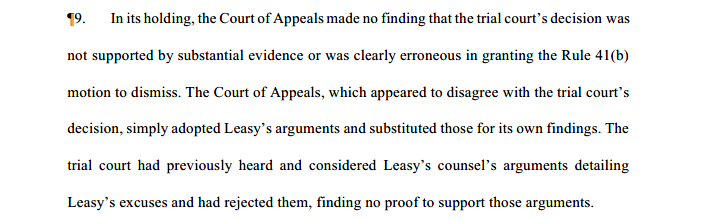
Leasy v. SW Gaming, LLC, 2019-CT-01505-SCT (Civil – Personal Injury/Failure to Prosecute/Standard of Review) Reversing the Court of Appeals and reinstating the circuit court’s judgment dismissing the plaintiff’s claim for failure to prosecute, holding that the Court of Appeals improperly reweighed the evidence and reaffirming the controlling abuse-of-discretion standard. (Justice King dissented, joined by Justice Kitchens. Justice Beam did not participate in the decision) (Note: At the Court of Appeals level, Judge Carlton wrote a dissent that was joined by Judge Wilson)
Practice Point – Standards of review matter! The Mississippi Supreme Court has shown a renewed interest in standards of review. This opinion is more about the standard of review than it is about the failure to prosecute. The Supreme Court described the Court of Appeals’ incorrect application of the standard of review as follows:
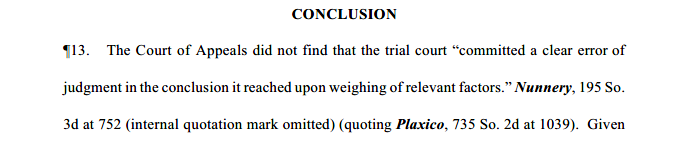
The Supreme Court bluntly concluded:
Holcomb, Dunbar, Watts, Best, Masters & Golmon, P.A. v. 400 South Lamar Oxford Mad Hatter Partners, LLC, 2019-CT-01702-SCT (Civil – Real Property/Landlord-Tenant Law/Commercial Real Estate) Affirming the circuit court’s denial of the tenant’s motion for partial summary judgment seeking a dismissal of the landlord’s claims for back rent, holding that the landlord’s demand for possession and the tenant’s departure from the premises did not prevent the landlord from recovering back rent; affirming the circuit court’s grant of summary judgment to the landlord based upon material breaches by the tenant; affirming the Court of Appeals’ finding that the tenant’s mitigation argument was waived because it was not raised prior to the appeal; affirming the Court of Appeals’ decision granting the landlord’s motion to quash the tenant’s request for records related to a news story a spat between the landlord’s principal and another developer because those records were not relevant to the appeal; and affirming the circuit court’s denial of the tenant’s untimely motion to amend to add claims of libel and libel per se because they were delayed and barred by the one-year statute of limitations. (All participating justices concurred.)
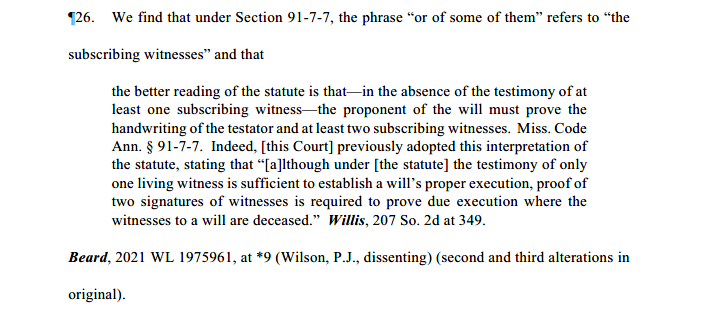
In the Matter of the Last Will and Testament of Luke Beard, Deceased: Antonio Christmas v. Diane Christmas, 2019-CT-01821-SCT (Civil – Wills, Trusts, and Estates/Probate) Reversing the court of appeals and reinstating the chancery court’s dismissal of a petition to probate a purported will, holding that in the absence of the testimony of at least one subscribing witness, a proponent of a will must prove the handwriting of the testator and at least two subscribing witnesses. This unanimous, textualist decision centered around whether the phrase “or some of them” in section 91-7-7 referred to the subscribing witnesses or collectively to the testator and the subscribing witnesses. Ultimately, the Supreme Court adopted Judge Wilson’s analysis of the textual quandary from his dissent at the Court of Appeals, holding:
The Mississippi Bar v. Henderson, 2021-BD-01141-SCT (Civil – Bar Matters) Imposing a reciprocal public censure to an attorney publicly censured in Tennessee and assessing costs.
Other Orders
Dille v. State, 2019-CT-00855-SCT (denying petitions for cert) Lairy v. Chandler, 2019-CT-01423-SCT (granting petition for cert) Cork v. State, 2020-KA-00060-SCT (denying pro se motion for rehearing) Magnolia Health Plan, Inc. v. Mississippi’s Community Health Commissions, 2020-CA-00167-SCT (denying motion for rehearing)
The Mississippi Supreme Court handed down four opinions today: one civil procedure decision on interlocutory appeal, one MDES decision, and two decisions affirming criminal convictions.
University of Mississippi Medical Center v. Jensen, 2020-IA-872-SCT (Civil – Personal Injury/Statute of Limitations/Service of Process) Reversing, on interlocutory appeal, the county court’s ruling granting the plaintiff’s motion for extension of time to serve process, holding that the plaintiff did not show good cause where the plaintiff attempted to serve process on an administrative assistant, who accepted service on behalf of UMMC’s CEO, instead of the attorney general. Because the statute of limitations had expired, judgment was rendered in favor of UMMC.
“As neither inadvertence, mistake of counsel, or ignorance of the rules suffice to establish good cause, the county court lacked substantial evidence to support its finding that Jensen had shown good cause for an extension of time to serve process under Rule 4(h).”
Univ. of Miss. Med. Ctr v. Jensen, 2020-IA-827-SCT (Miss. 2022) (citation omitted).
Mississippi Department of Employment Security v. Dover Trucking, LLC, 2020-CC-1267-SCT (Civil – State Boards and Agency/Employment) Reversing the circuit court’s order that reversed the MDES Board of Review’s decision that the claimant was an “employee” of a trucking company, holding that that the agency’s decision was supported by substantial evidence and was not arbitrary or capricious.
Williams v. State, 2020-KA-772-SCT (Criminal – Felony/Rebuttal Evidence) Affirming conviction of one count of sexual battery, holding that the circuit court did not err in admitting State’s rebuttal evidence related to the defendant’s ankle monitor that had not been disclosed prior to trial because that evidence was not within the State’s due diligence/disclosure obligations prior to trial based on the defendant’s pre-trial representations. The supreme court also held that the circuit court did not err in excluding evidence that the minor victim had previously twerked on the school bus and that the defendant’s sufficiency of the evidence claim was meritless.
Williams v. State, 2019-CT-1007-SCT (en banc) (Criminal – Felony/Accomplice Liability) Affirming, on writ of certiorari, convictions for two counts of conspiracy and two counts of possession with intent to distribute, holding that the evidence was sufficient to convict on accomplice liability rather than constructive possession where an inmate was directing a drug-trafficking ring from prison over the phone and whose home was found to have large amounts of cocaine and marijuana, as well as $93,259 in cash.
Other Orders
Ward v. Cranford, 2020-CT-410-SCT (denying petition for writ of certiorari) Brown v. State, 2020-M-630 (denying petition for leave to proceed in trial court and for permission to file successive petition for post-conviction collateral relief) State v. Corrothers, 2021-IA-836-SCT (denying motion for rehearing) Cooper v. State, 2021-CT-1012-SCT (dismissing pro se “writ of certiorari”)





 Mississippi Appeals Blog