Mississippi Supreme Court decisions of April 28, 2022

After some sort of technical hiccup with the State’s web domain that knocked the Mississippi Supreme Court’s website offline for a spell, they are back in business. The Court handed down one hearty opinion in a wrongful death case that involves § 1983, qualified immunity, the MTCA, the appealability of summary judgment denials, and hearsay.


City of Jackson v. Johnson, 2020-CA-00318-SCT (Civil – Tort/Wrongful Death/1983/MTCA)
Reversing and rendering a jury verdict holding the City liable under § 1983 and affirming the trial court’s judgment finding the City liable under the MTCA for the decedent’s wrongful death. The victim was murdered shortly after calling 911 to report a prowler. The dispatcher did not tell the victim to remain on the line, in violation of the City’s policies and procedure. Two JPD officers went to the victim’s house, did not detect that the prowler had entered a window, did not make contact with the victim, and left. The victim was found dead the next day. The victim’s family filed suit under § 1983 and under the MTCA.

The 911 operator and officers got out via qualified immunity on summary judgment. The § 1983 case was tried by a jury and the MTCA case was tried “simultaneously” before the bench. The jury found that the City violated the victim’s constitutional rights to due process and awarded $1M in damages. The trial court awarded $500,000 (i.e. the statutory maximum) under the MTCA.

On appeal, the Mississippi Supreme Court held that the City was entitled to a directed verdict on the § 1983 claim, reasoning that our constitutional due process rights do not include the right to be protected by the state from acts of private violence. Regarding the MTCA claim, the Supreme Court held that the 911 dispatcher’s conduct in responding to the victim’s call did not involve an element of choice or judgment and the City was therefore not protected by discretionary function immunity from liability under the MTCA.

There was a hearsay issue involving the defendant’s statement contained in the police report that warrants a brief discussion. The trial court admitted the police report, but with the assailant’s statement to police redacted, finding that the assailant could not be compelled to testify against himself and that hearsay exception in Rule 804(b)(3) did not apply because the statement was not being used against the assailant/declarant. Later in the trial, the court allowed the plaintiff’s expert to reply on the assailant’s statement in forming his opinions over the City’s objection that the expert had relied on inadmissible hearsay. The Mississippi Supreme Court did not have to address the argument that the expert’s testimony was a “conduit for otherwise inadmissible hearsay” because it held that that the assailant’s statement to police was admissible under the Rule 804(b)(3) exception after all, so there was no error in admitting the expert testimony that relied upon it.

(Chief Justice Randolph wrote a special concurrence, joined in part by Justice Maxwell, Justice Chamberlin, Justice Ishee, and Justice Griffis. Justice Griffis also wrote a special concurrence.)

Practice Point – I found it remarkable that the Mississippi Supreme Court heretofore had not addressed the issue of whether the denial of a motion for summary judgment can be appealed after a trial. They did here, and now we know:

One More Thing – We were this close (maybe) to the Mississippi Supreme Court addressing one of my pet issues: When a case involves an MTCA defendant and a non-MTCA defendant how, exactly, should a hybrid bench/jury trial proceed?


Other Orders

Hutto v. State, 2017-DR-01207-SCT (granting the plaintiff’s Motion for Leave to File Rebuttal to Opposition to Motion for Appointment of Counsel for Representation for Successive Petition for Post-Conviction Relief and the State’s Motion for Leave to File Surrebuttal in Opposition to Motion for Appointment of Counsel for Representation for Successive Petition for Post-Conviction Relief)

Randle v. Randle, 2020-CT-0033-SCT (granting cert)

McPhail v. McPhail, 2020-CA-00739-SCT (denying Motion Pursuant to Rule 8 and Rule 27 of the Rules of Appellate Procedure is hereby denied and remanding to the chancery court of Grenada County for an adjudication of a request for release on bond pending appeal in light of his child support payment subsequent to the February 24, 2022 denial of his prior motion)

HL&C Marion, LLC v. DIMA Homes, Inc., 2020-CT-00750-SCT (CORRECTION: granting cert 6-0)

Williams v. State, 2020-KA-772-SCT (denying rehearing)

Morningstar v. Perkins Law Firm, 2020-CT-1203-SCT (denying cert)

Embrey v. Young, 2021-CT-91-SCT (denying cert)


Hand Down Page

Summaries of the Mississippi Supreme Court’s opinions of April 21, 2022

The Mississippi Supreme Court handed down two opinions today. One decides an interlocutory appeal of the denial of the defendants’ motion for summary judgment in a tire blowout case that hinged on the doctrine of res ipsa loquitur. The other is a criminal case considering convictions for attempted willful trespass and auto burglary that addresses issues of whether the indictment was sufficient, whether evidence of other was acts should have been excluded, and whether the defendant’s “theory of the case” instruction was wrongly denied.


Darling Ingredients Inc. v. Moore, 2020-IA-01149-SCT (Civil – Personal Injury/Res Ipsa Loquitur)
On interlocutory appeal, reversing the circuit court’s denial of the defendants’ motion for summary judgment in an auto liability case stemming from the failure of a tire on the defendants’ vehicle, holding that the doctrine of res ipsa loquitur did not apply because a vehicle’s tire can fail for reasons other than negligence of the vehicle’s driver or owner. Because the doctrine of res ipsa loquitur was not applicable and the plaintiff had no evidence of negligence on the part of the defendants, judgment was rendered for the defendants.
(This decision was unanimous)

NOTE: Although this opinion stops just short of specifically saying so, I read it as establishing a bright-line rule that the doctrine of res ipsa loquitur is inapplicable to cases where a motorist is injured by the failure of a tire on another vehicle:

This opinion is also noteworthy for its succinct summary of the doctrine of res ipsa loquitur and its analysis of the second element (“the occurrence was such that in the ordinary course of things it would not have happened if those in control of the instrumentality used proper care”) that will be useful in future RIL briefing.


Brady v. State, 2021-KA-00163-SCT (Criminal – Felony/Willful Trespass/Auto Burglary)
Affirming convictions of attempted willful trespass and two counts of auto burglary, holding (1) no error in denying a motion to quash the indictment for attempted burglary of a dwelling because the indictment adequately alleged an overt act, (2) no error in not sua sponte precluding evidence of other bad acts not related to the indicated charges, and (3) no error in denying a proposed instruction that the defense argued expounded on the defense’s theory of the case where the subject of the proposed instruction was adequately covered in other jury instructions.
(Justice Coleman dissented, arguing that the indictment failed to allege an overt act in furtherance of the attempted breaking and entering)


Other Orders

Carter v. State, 2019-CT-01854-SCT (denying cert petition)
Burgin v. State, 2020-CT-01031-SCT (denying cert petition)
The Mississippi Bar v. Sims, 2021-BD-01090-SCT (granting petition to transfer license to disability inactive status)
In Re: Administrative Orders of the Supreme Court of Mississippi (directing the disbursement of $160,623.66 in civil legal assistance funds among the MS Volunteer Lawyers Project, North MS Rural Legal Services, and MS Center for Legal Services)


Hand Down List


In other news, congratulations to Professor Christopher Green of Ole Miss Law who was cited four (4) times in Justice Thomas’s concurrence in United States v. Madero that was decided today.

Summaries of the Mississippi Supreme Court opinions of April 14, 2022

We will call the blog post title a belated April Fools’ Day joke because the Mississippi Supreme Court did not hand down any opinions today. In the absence of an opinion to summarize, I thought I would share some #AppellateTwitter cringe content that surfaced today.


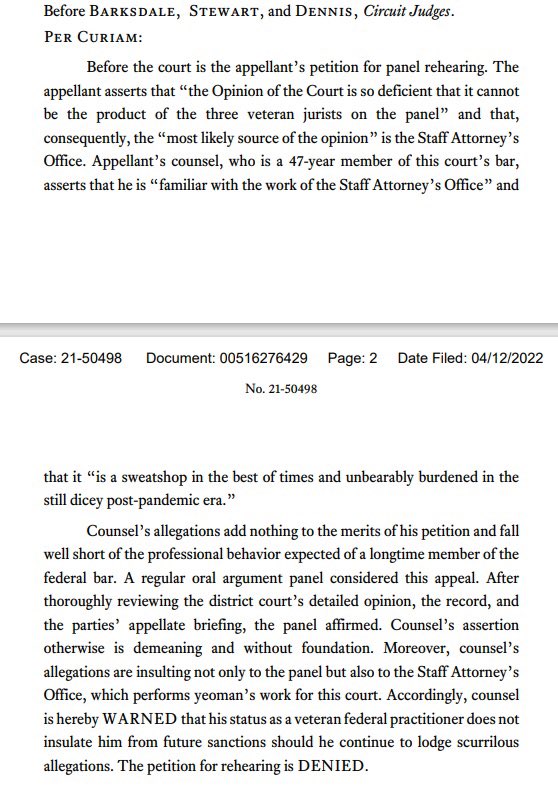
No litigator likes to lose. Some losses are more frustrating than others. Motions for reconsideration and motions for rehearing are difficult to write and they demand finesse. I would submit that the tack taken by the appellant’s counsel described in per curiam decision from the Fifth Circuit below did not supply the requisite measure of finesse. As tweeted by attorney David R. Fine (who is not the appellant’s counsel referred to in the order):

Well, that strategy didn’t go so well. #appellatetwitter

Originally tweeted by David R. Fine (@finedr1965) on April 14, 2022.

The road to a great motion for reconsideration/motion for rehearing is not the easiest, but overtly insulting the court and court staff is a relatively easy ditch to avoid.

But Twitter did what Twitter does and stirred up some good commentary on how to approach motions for reconsideration/rehearing.

Happy writing. Be careful out there.


Other Orders

Singing River MOB, LLC v. Jackson County, Mississippi, 2019-IA-10630-SCT (denying motion for rehearing)

Magee v. State, 2019-CT-01794-SCT (granting cert petition)

Johnson v. State, 2020-CT-01308-SCT (granting cert petition)


Hand Down List

Summaries of the Mississippi Supreme Court opinions of April 7, 2022

The Mississippi Supreme Court handed down five opinions today. I think Weber v. Estate of Hill will be a frequently cited case on the issue of medical expert causation testimony, especially in the medical malpractice context. There is also an insurance coverage decision (where the court granted interlocutory appeal and then affirmed the circuit court), another medical malpractice case dealing with a hospital’s lack of liability for treatment plans of independent physicians, a contempt of youth court case, and a Mississippi Bar disciplinary decision.


Donaldson v. Cotton, 2020CA-00581-SCT (Civil – Other/Contempt)
Vacating the a youth court judge’s order of contempt against a county prosecutor fining him for past and continuing refusal to draft youth court orders, holding that youth court judges have inherent authority to order a county prosecutor to prepare orders in youth court matters but that the alleged contempt was constructive criminal contempt and thus the attorney’s due process rights were violated. The order was vacated, the case was remanded, and the youth court judge was direct to recuse for further proceedings.
(Justice Coleman dissented, joined by Chief Justice Randolph and Justice Beam.)


Weber v. Estate of Hill, 2020-CA-00293-SCT (Civil – Medical Malpractice/Causation/Experts)
Denying rehearing and and modifying two paragraphs (¶ 37 and ¶ 38) of the original opinion. On direct appeal, the supreme court affirmed the circuit court’s denial of the defendants’ motion for JNOV that argued there was no admissible expert testimony on causation, holding that the testimony of one of the plaintiff’s medical experts provided a basis for a juror to reasonably conclude that a timely C-section delivery would have provided the baby with a greater-than-50-percent chance of a substantially better outcome even though that expert testified that he lacked the expertise necessary to quantify the degree to which the labor and delivery process aggravated the injury. On cross appeal, the supreme court reversed the circuit court’s reduction of the jury’s $2,538,322 award for non-economic damages, holding that this action filed in December 2002 was governed by Mississippi’s wrongful-death statute because the medical-malpractice noneconomic-damages cap was not in place until September 1, 2004.
(Justice Griffis dissented, joined by Justice Coleman and Justice Maxwell. Chief Justice Randolph did not participate.)

NOTE: This was a big win for the plaintiff and it is a must-read case on medical expert causation testimony, especially in the medical malpractice context. I have not read the record, but my understanding from the majority opinion and the dissent is that no expert specifically testified that a timely C-section delivery would have provided the baby with a greater-than-50-percent chance of a substantially better outcome. Instead, the supreme court allowed the jury to “connect the dots” (the “dots” being other pieces of expert testimony) in determining that the plaintiff satisfied that causation standard even though the plaintiff’s obstetrics and maternal-fetal medicine expert testified he was not qualified to connect these dots and give an opinion as to the percentage aggravation would be.


Mississippi Farm Bureau Casualty Insurance Company v. Powell, 2020-IA-00432-SCT (Civil – Insurance/Coverage)
On interlocutory appeal, affirming the circuit court’s denial of the insurance company’s motion for summary judgment seeking a declaratory judgment that it had no duty to provide coverage, no duty to defend/indemnify, and no duty to pay medpay benefits, holding that a fall from scaffolding that was erected on a trailer that was hitched to an insured pickup was an auto accident arising out of the use and ownership of the covered vehicles.
(Justice Maxwell concurred in result only, joined by Justice Chamberlain and Justice Griffis, and joined by Justice Coleman in part.)


St. Dominic-Jackson Memorial Hospital v. Newton, 2020-IA-00494-SCT (Civil – Medical Malpractice)
On interlocutory appeal, reversing the circuit court’s denial of the hospital’s motion for summary judgment, holding that the Mississippi law does not impose a duty on a hospital to require peer review of a treatment plan before allowing a doctor and patient to use its facilities.
(Justice Kitchens dissented, joined by Justice King.)

PRACTICE POINT: This is less-than-ideal feedback to receive from the supreme court…

Other Orders

Howell v. State, 2020-CA-00868-SCT (directing the parties to file supplemental briefs on the following issue: Whether the Court should overrule Rowland v. State, 42 So. 3d 503 (Miss. 2010), and any other case in which, and to the extent that, we have held the fundamental rights exception to the procedural bars may be applied to the three-year statute of limitations codified by the Legislature in the Uniform Post-Conviction Collateral Relief Act)

Bryant v. Bryant, 2020-CT-00883-SCT (granting cert)

Newell v. State, 2020-CT-01137-SCT (denying cert)

Thornhill v. Walker-Hill Environmental, 2020-CT-01181-SCT (granting cert)

The Mississippi Bar v. Malone, 2021-BD-00467-SCT (suspending attorney Robert W. Malone for two years)


Hand Down List

Summaries of the Mississippi Supreme Court’s opinions of March 31, 2022

The mix of beautiful spring weather and apocalyptic tornado warnings this week set the stage for just one opinion from the Mississippi Supreme Court to compliment the one opinion handed down by the Mississippi Court of Appeals on Tuesday. The case today is an insurance coverage dispute that analyzes several provisions of an excess policy and determines that summary judgment finding of no coverage under a pollution exclusion was in error.


Omega Protein, Inc. v. Evanston Insurance Company, 2020-CA-01097-SCT (Civil – Insurance/Insurance Coverage/Excess Insurance)
The Supreme Court reversed the circuit court’s grant of the excess carrier’s motion for summary judgment in a dec action where the excess carrier sought a declaration of no coverage for injuries and a death sustained in a plant explosion that occurred while a contractor was performing welding work at the plant. The Supreme Court held that (1) a pollution exclusion did not apply as a matter of law because it was ambiguous and susceptible to more than one interpretation and must be construed in favor of coverage, (2) coverage under the excess policy was not triggered by the primary insurer paying out limits because there had been no adjudication of fault or negligence of the named-insured contractor, and (3) the issue of the plant’s status as an additional insured under the insured contractor’s excess policy could not be determined because there had been no adjudication of fault or negligence of the named-insured contractor.
(All justices concurred)


Other Orders

Dooley v. Dooley, 2020-CA-01061-SCT (dismissing appeals filed by appellant and appellees for want of jurisdiction)
Omega Protein, Inc. v. Evanston Insurance Company, 2020-CA-01097-SCT (denying motion for rehearing, withdrawing original opinion, and substituting the opinion above)


Hand Down List

Summaries of the Mississippi Supreme Court’s opinions of March 24, 2022

The Mississippi Supreme Court handed down two opinions today. One is an interlocutory appeal of an order denying a motion to transfer venue centered around an incorrect address listed with the Secretary of State and the other is an initial, arbitration-agreement skirmish in a lawsuit Mississippi’s Community Mental Health Centers filed against United Health Care of Mississippi over a rate-cut dispute.


Weeks, Inc. v. Lewis, 2020-IA-01337-SCT (Civil – Personal Injury/Venue)
Reversing the circuit court’s denial of the defendant’s motion to transfer venue, holding that venue based on a corporation’s principal place of business is determined by “the actual physical location” and expressly rejecting the plaintiff’s argument that venue was proper in a different county where the “principal address” listed in the defendant’s corporate filings with the Secretary of State is located.
(All justices concurred)


United Healthcare of Mississippi Inc. v. Mississippi’s Community Mental Health Commissions, 2020-CA-00697-SCT (Civil – Contract/Arbitration/Preliminary Injunction)
Affirming the circuit court’s ruling enjoining the Medicaid service provider from imposing a 5% rate cut and denying its motion to compel arbitration in a lawsuit filed by Mississippi’s Community Mental Health Centers (CMHC), holding (1) that trial courts have authority to enter preliminary injunctions even when there is an enforceable arbitration agreement, (2) that the record supported the trial court’s finding of a substantial likelihood that the service provider violated Miss. Code Ann. § 43-13-117(H)(1)(c) which governs Medicaid payment rates, and (3) that the trial court did not err in finding that the arbitration agreement was enforceable because it was not signed by a single CMHC board.
(All participating justices concurred; Justice Beam did not participate)


Other Orders

Golden v. State, 2019-CT-00757-SCT (denying cert petition)
M.A.S. v. Lamar County Department of Child Protective Services, 2020-CT-70-SCT (denying cert petition)
Alexander v. State, 2020-CT-177-SCT (denying cert petition)
Smith v. State, 202o-CT-580-SCT (denying cert petition and amended cert petition)
Gordon v. Dickerson, 2020-CT-601-SCT (granting cert petition)
Badger v. State, 2020-M-646 (denying “Motion to Reinvest Jurisdiction Into The Circuit Court of Amite County” and warning that future filings deemed frivolous may result not only in monetary sanctions, but also restrictions on filing applications for post-conviction collateral relief (or pleadings in that nature) in forma pauperis)


Hand Down List

Summaries of the Mississippi Supreme Court opinions of March 17, 2022

The folks publishing the hand down lists are not on spring break. There were four opinions today that are must-reads for anyone whose law practice these opinions touch. There is a medical malpractice/expert testimony decision, a dismissal for failure to prosecute decision that is more about the abuse-of-discretion standard of review, a breach of commercial lease opinion, and a will probate opinion.


Claiborne County Hospital v. Truitt, 2020-IA-01017-SCT (Civil – Medical Malpractice/Summary Judgment/Experts)
The plaintiff fell while walking to the restroom to give a urine sample. The plaintiff filed a negligence claim against the hospital, alleging that a nurse failed to assist him to the restroom. The hospital filed a motion for summary judgment on the grounds that the plaintiff lacked medical expert testimony. The plaintiff argued that the layman’s exception applied or, alternatively, that the plaintiff had identified the requisite expert testimony in an interrogatory answer. The circuit court denied the hospital’s motion for summary judgment and the Supreme Court granted interlocutory appeal. The Supreme Court reversed the circuit court and rendered judgment in favor of the hospital, holding that “the layman’s exception does not apply to the facts of this case because Truitt’s claim involves the rendering of medical services and a nurse’s professional judgment for which expert testimony is required.” The Supreme Court also held that the designation via interrogatory answer was insufficient because the “designation does not provide sworn expert testimony” and noting that the plaintiff “only provided the name of his expert and a brief description of the anticipated testimony.”
(All justices concurred)


Leasy v. SW Gaming, LLC, 2019-CT-01505-SCT (Civil – Personal Injury/Failure to Prosecute/Standard of Review)
Reversing the Court of Appeals and reinstating the circuit court’s judgment dismissing the plaintiff’s claim for failure to prosecute, holding that the Court of Appeals improperly reweighed the evidence and reaffirming the controlling abuse-of-discretion standard.
(Justice King dissented, joined by Justice Kitchens. Justice Beam did not participate in the decision)
(Note: At the Court of Appeals level, Judge Carlton wrote a dissent that was joined by Judge Wilson)

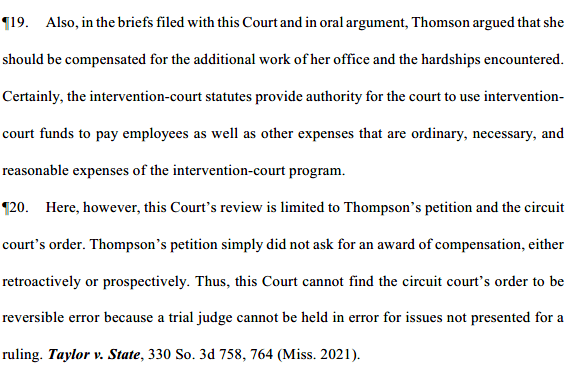
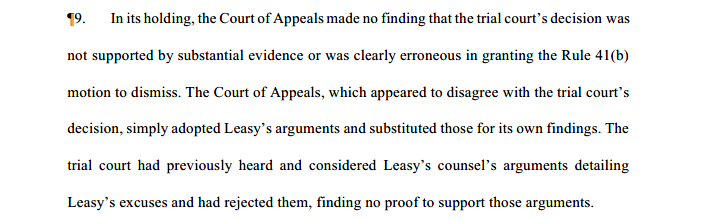
Practice Point – Standards of review matter! The Mississippi Supreme Court has shown a renewed interest in standards of review. This opinion is more about the standard of review than it is about the failure to prosecute. The Supreme Court described the Court of Appeals’ incorrect application of the standard of review as follows:

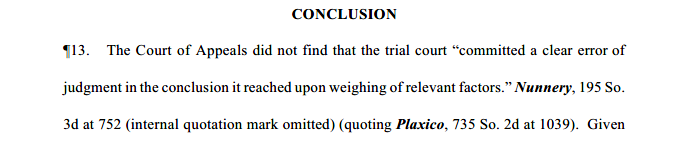
The Supreme Court bluntly concluded:


Holcomb, Dunbar, Watts, Best, Masters & Golmon, P.A. v. 400 South Lamar Oxford Mad Hatter Partners, LLC, 2019-CT-01702-SCT (Civil – Real Property/Landlord-Tenant Law/Commercial Real Estate)
Affirming the circuit court’s denial of the tenant’s motion for partial summary judgment seeking a dismissal of the landlord’s claims for back rent, holding that the landlord’s demand for possession and the tenant’s departure from the premises did not prevent the landlord from recovering back rent; affirming the circuit court’s grant of summary judgment to the landlord based upon material breaches by the tenant; affirming the Court of Appeals’ finding that the tenant’s mitigation argument was waived because it was not raised prior to the appeal; affirming the Court of Appeals’ decision granting the landlord’s motion to quash the tenant’s request for records related to a news story a spat between the landlord’s principal and another developer because those records were not relevant to the appeal; and affirming the circuit court’s denial of the tenant’s untimely motion to amend to add claims of libel and libel per se because they were delayed and barred by the one-year statute of limitations.
(All participating justices concurred.)


In the Matter of the Last Will and Testament of Luke Beard, Deceased: Antonio Christmas v. Diane Christmas, 2019-CT-01821-SCT (Civil – Wills, Trusts, and Estates/Probate)
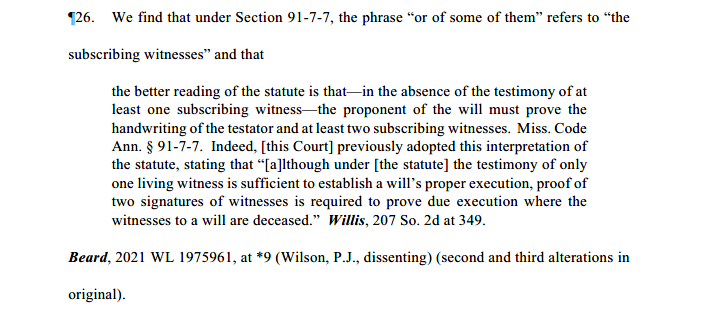
Reversing the court of appeals and reinstating the chancery court’s dismissal of a petition to probate a purported will, holding that in the absence of the testimony of at least one subscribing witness, a proponent of a will must prove the handwriting of the testator and at least two subscribing witnesses. This unanimous, textualist decision centered around whether the phrase “or some of them” in section 91-7-7 referred to the subscribing witnesses or collectively to the testator and the subscribing witnesses. Ultimately, the Supreme Court adopted Judge Wilson’s analysis of the textual quandary from his dissent at the Court of Appeals, holding:


The Mississippi Bar v. Henderson, 2021-BD-01141-SCT (Civil – Bar Matters)
Imposing a reciprocal public censure to an attorney publicly censured in Tennessee and assessing costs.


Other Orders

Dille v. State, 2019-CT-00855-SCT (denying petitions for cert)
Lairy v. Chandler, 2019-CT-01423-SCT (granting petition for cert)
Cork v. State, 2020-KA-00060-SCT (denying pro se motion for rehearing)
Magnolia Health Plan, Inc. v. Mississippi’s Community Health Commissions, 2020-CA-00167-SCT (denying motion for rehearing)


Hand Down List

Summaries of the Mississippi Supreme Court opinions of March 10, 2022

The Mississippi Supreme Court handed down three opinions today. In a case of first impression, the court held that short term rentals through services like Airbnb and VRBO constitute “residential purposes” rather than “commercial purposes” and thus do not violate restrictive covenants barring use of homes for commercial purposes. The court also reversed the judgment of the Mississippi Court of Appeals and reinstated a conviction for witness intimidation in what started as a voter fraud case in Canton, Mississippi.


Ellis v. Ellis, 2020-CA-00691-SCT (Civil – Domestic Relations/Divorce)
Reversing the chancery court’s order distributing marital assets and awarding alimony and attorneys’ fees, holding that the chancery court lacked jurisdiction to enter the order that was sought by and in favor of the party who was on the receiving end of a judgment of divorce by default in Texas because the chancery court had previously dismissed a prior, Mississippi complaint for divorce and counterclaim for divorce with prejudice.
(Justice King wrote a special concurrence, agreeing fully with the Court’s decision, but writing that Redd v. Redd (In re Conservatorship of Redd),
No. 2019-CA-01281-SCT, 2021 WL 5368656 (Miss. Nov. 18, 2021) was wrongly decided. This opinion was joined by Justice Beam and joined in part by Chief Justice Randolph.)


Rainey v. State, 2019-CT-01651-SCT (Criminal – Felony/Voter Fraud/Witness Intimidation/Eighth Amendment)
Reversing the Mississippi Court of Appeals’ judgment that had reversed a conviction for witness intimidation and a fifteen-year sentence, holding that there was sufficient evidence to support the conviction where there was testimony that the defendant registered two individuals to vote and then gave them $10 for “a round of beer,” later gave one of those individuals a ride to vote and then $10 for lunch, and then, after the voter was questioned by investigators, the defendant visited and confronted the voter about the investigation. The court also held that the fifteen-year sentence did not violate the Eight Amendment.
(Justice King dissented, joined by Justice Kitchens and Justice Coleman.)


Lake Serene Property Owners Association Inc. v. Esplin, 2020-CA-00689-SCT (Civil – Real Property/Restrictive Covenants)
Affirming the chancery court’s finding in a breach of residential covenant case, holding that short-term rentals of private homes through online services such as Airbnb, VRBO, and HomeAway constitute use for “residential purposes” rather than “commercial purposes” in the absence of definitions of those terms in the covenants and holding that the association’s board of directors did not have authority to amend the bylaws in a manner that restricted the owners’ covenant rights to host short-term rentals.
(Justice Ishee concurred in part and dissented in part, joined by Justice Griffis.)

NOTE: This was a case of first impression in Mississippi on the issue of whether short-term rentals through services such as Airbnb constitute “residential purposes.” All nine justices concurred in the holding that short-term rentals do constitute “residential purposes” rather than “commercial purposes.” The court did not dwell on this, but I think it is implicit in the decision that if the covenants had defined “residential purposes” in a way that excluded short-term rentals, or if short-term rentals were otherwise specifically prohibited by the covenants, the result would have been different. In any event, this is a win for hosts and hosting platforms.


Other Orders

Knox v. State, 2014-DR-849-SCT (denying Motion for Leave to File Successive Petition for Post-Conviction Relief and Knox’s First Amended Motion for Leave to File Successor Petition for Post-Conviction Relief are dismissed and Second Amended Motion for Leave to File Successor Petition for Post-Conviction Relief is denied)

Ellis v. Ellis, 2020-CA-691-SCT (denying Motion to Take Judicial Notice of Other Relevant Court Proceedings filed by Joseph Dale Ellis, Sr. and Motion to Take Judicial Notice of Texas Court of Appeals’ Memorandum Opinion, Judgment, and Final Mandate and for Inclusion of Same in Appellate Record filed by Joseph Dale Ellis, Sr.)

Atkins v. Moore, 2021-CA-780 (denying a not otherwise not defined “motion for relief”)


Complete Hand Down List

Summaries of the Mississippi Supreme Court opinions of March 3, 2022

I am posting these summaries on a delay because I spent yesterday at Legoland in Florida with my family. While I was strolling through Bricksburg and riding a Duplo block safari truck, the Mississippi Supreme Court unleashed 126 pages of opinions in just four cases. Only one decision was unanimous and the others were 7-2, 5-4, and 5-4, each of which drew thoughtful dissents.

The more contentious cases were a death penalty post-conviction claim, a case of first impression applying the federal vacatur rule, and a decision addressing the limitations period in a thorny implied indemnity case.


Jones v. State, 2021-KA-00275-SCT (Criminal – Felony/Manslaughter)
Affirming conviction for manslaughter, holding (1) the circuit court did not err by not requiring the jury to specify whether its verdict was based on heat of passion or imperfect self-defense because those are both factual theories encompassed within section 97-3-35, (2) there was sufficient evidence to support the jury’s verdict, and (3) dispersing the jury for lunch was within the circuit court’s discretion and no timely request to sequester was made.
(All participating justices concurred.)


Batiste v. State, 2019-CA-00283-SCT (en banc) (Civil – Death Penalty – Post Conviction/Recusal/Gladney)
Affirming the circuit court’s denial of Bastiste’s motion for recusal based on an argument that the circuit judge’s memory of an alleged conversation with a juror could be relied on in witness-credibility determinations while evaluating the underlying PRC claim and denying the underlying PCR claim, holding (1) that it was speculation that the judge might be a necessary witness in the case, (2) that the Office of Capital Post-Conviction Counsel did not even attempt to follow the appropriate method for post-verdict juror inquiry laid out in Gladney, and (3) that Batiste’s Six Amendment right to an impartial jury was not violated when the circuit court determined that discussions of the racial composition of the jury were brought about within the jury itself rather than from an extraneous source.
(Justice Kitchens wrote a dissent, joined by Justice King.)


Gamma Healthcare Inc. v. Estate of Grantham, 2019-CT-00913-SCT (en banc) (Civil – Workers’ Comp)
Affirming the Court of Appeals’ decisions dismissing the case as moot following the untimely death of the claimant, applying federal vacatur rule and vacating the MWCC’s orders to replace the claimant’s septic and HVAC systems, and reversing the MWCC’s award of sanctions.

The vacatur issue was one of first impression in Mississippi. The Mississippi Supreme Court’s decision included the following excerpt from the U.S. Supreme Court on the vacatur standard:

The United States Supreme Court has held that:

When a civil case becomes moot pending appellate adjudication, “[t]he
established practice . . . in the federal system . . . is to reverse or vacate the judgment below and remand with a direction to dismiss.” United States v. Munsingwear, Inc., 340 U.S. 36, 39, 71 S. Ct. 104, 106, 95 L. Ed. 36 (1950). . . . Vacatur is in order when mootness occurs through happenstance—circumstance not attributable to the parties—or, . . . , the “unilateral action of the party who prevailed in the lower court.” U.S. Bancorp Mortgage Co., 513 U.S., at 23, 115 S. Ct., at 390; cf. id., at 29, 115 S. Ct., at 393 (“mootness by reason of settlement [ordinarily] does not justify vacatur of a judgment under review”).

Arizonans for Off. Eng. v. Arizona, 520 U.S. 43, 71-72, 117 S. Ct. 1055, 1071, 137 L. Ed.2d 170 (1997) (emphasis added) (first, second, and fifth alterations in original). “Because this practice is rooted in equity, the decision whether to vacate turns on ‘the conditions and circumstances of the particular case.’” Azar v. Garza, 138 S. Ct. 1790, 1792, 201 L. Ed. 2d 118 (2018) (quoting United States v. Hamburg-Amerikanische Packetfahrt-Actien Gesellschaft, 239 U.S. 466, 478, 36 S. Ct. 212, 60 L. Ed. 387 (1916)). The Supreme Court also has held that:

The point of vacatur is to prevent an unreviewable decision “from spawning any legal consequences,” so that no party is harmed by what we have called a “preliminary” adjudication. Munsingwear, 340 U.S., at 40-41, 71 S. Ct. 104. . . . When happenstance prevents that review from occurring, the normal rule should apply: Vacatur then rightly “strips the decision below of its binding effect,” Deakins v. Monaghan, 484 U.S. 193, 200, 108 S. Ct. 523, 98 L. Ed. 2d 529 (1988), and “clears the path for future relitigation,” Munsingwear, 340 U.S., at 40, 71 S. Ct. 104.

Camreta v. Greene, 563 U.S. 692, 713, 131 S. Ct. 2020, 2035, 179 L. Ed. 2d 1118 (2011).

Gamma Healthcare, Inc. v. Estate of Grantham, 2019-CT-00913-SCT at ¶15 (Miss. 2022).

(Justice Randolph wrote a dissent, joined by Justice Coleman, Justice Ishee, and Justice Griffis.)


Cooley v. Pine Belt Oil Co., Inc., 2019-IA-01835-SCT (en banc) (Civil – Implied Indemnity)
Reversing, on interlocutory appeal, the circuit court’s denial of the defendant’s motion for summary judgment on an indemnity claim and rendering judgment in favor of the defendant. Long before this litigation commenced, MDEQ ordered the two sides of this dispute to remediate a gasoline line leak on March 5, 2009. Pine Belt, the landowner, paid for the remediation. Then, in 2015, Pine Belt retained an expert who opined that the leak occurred when the property was owned by the Cooleys.

On April 15, 2016, Pine Belt filed a complaint for implied indemnity against the Cooleys seeking to recover the remediation expenses that Pine Belt incurred in response to MDEQ’s order. The Cooleys filed a motion for summary judgment based on the statute of limitations and Pine Belt argued that an implied indemnity claim cannot accrue before a liability party can be identified and because there must be a final, fixed amount. The circuit court denied the motion. The Mississippi Supreme Court granted interlocutory appeal, reversed the circuit court, and rendered judgment in favor of Pine Belt. The Mississippi Supreme Court specifically held that the statute of limitations began to run when MDEQ ordered the remediation:

Although the amount that Pine Belt was ordered to pay by MDEQ was unliquidated, the MDEQ order legally obligated Pine Belt to pay for present and future cleanup costs which Pine Belt all along believed, in fairness, should be paid by the Cooleys. Because the order placed Pine Belt under a compulsion to pay damages which it believed should be paid by another, this Court finds that all of the elements of implied indemnity were present and the statute of limitations began to run on March 5, 2009, and ended on March 5, 2012. Pine Belt did not file its complaint until April 15, 2016. Thus, Pine Belt’s implied indemnity action is time barred.

Cooley v. Pine Belt Oil Co., Inc., 2019-IA-01835 ¶29 (Miss. 2022) (emphasis added).

(Chief Justice Randolph wrote a partial concurrence, partial dissent, joined by Justice Coleman, Justice Maxwell, and Justice Ishee.)


Other Orders

Grayson v. State, 1998-DP-01782-SCT (denying pro se motion to withdraw motion to carry out execution forthwith)
Powers v. State, 2017-DR-696-SCT (granting motion to seal exhibits from public, but not from opposing counsel)
Fluker v. State, 2020-CT-791-SCT (denying pro se petition for writ of certiorari)
Fields v. State, 2020-KA-1317-SCT (denying motion for rehearing)


Complete Hand Down List

Summaries of the Mississippi Supreme Court opinions of February 24, 2022

The Mississippi Supreme Court handed down four opinions today: one civil procedure decision on interlocutory appeal, one MDES decision, and two decisions affirming criminal convictions.


University of Mississippi Medical Center v. Jensen, 2020-IA-872-SCT (Civil – Personal Injury/Statute of Limitations/Service of Process)
Reversing, on interlocutory appeal, the county court’s ruling granting the plaintiff’s motion for extension of time to serve process, holding that the plaintiff did not show good cause where the plaintiff attempted to serve process on an administrative assistant, who accepted service on behalf of UMMC’s CEO, instead of the attorney general. Because the statute of limitations had expired, judgment was rendered in favor of UMMC.

“As neither inadvertence, mistake of counsel, or ignorance of the rules suffice to establish good cause, the county court lacked substantial evidence to support its finding that Jensen had shown good cause for an extension of time to serve process under Rule 4(h).”

Univ. of Miss. Med. Ctr v. Jensen, 2020-IA-827-SCT (Miss. 2022) (citation omitted).

Mississippi Department of Employment Security v. Dover Trucking, LLC, 2020-CC-1267-SCT (Civil – State Boards and Agency/Employment)
Reversing the circuit court’s order that reversed the MDES Board of Review’s decision that the claimant was an “employee” of a trucking company, holding that that the agency’s decision was supported by substantial evidence and was not arbitrary or capricious.


Williams v. State, 2020-KA-772-SCT (Criminal – Felony/Rebuttal Evidence)
Affirming conviction of one count of sexual battery, holding that the circuit court did not err in admitting State’s rebuttal evidence related to the defendant’s ankle monitor that had not been disclosed prior to trial because that evidence was not within the State’s due diligence/disclosure obligations prior to trial based on the defendant’s pre-trial representations. The supreme court also held that the circuit court did not err in excluding evidence that the minor victim had previously twerked on the school bus and that the defendant’s sufficiency of the evidence claim was meritless.


Williams v. State, 2019-CT-1007-SCT (en banc) (Criminal – Felony/Accomplice Liability)
Affirming, on writ of certiorari, convictions for two counts of conspiracy and two counts of possession with intent to distribute, holding that the evidence was sufficient to convict on accomplice liability rather than constructive possession where an inmate was directing a drug-trafficking ring from prison over the phone and whose home was found to have large amounts of cocaine and marijuana, as well as $93,259 in cash.


Other Orders

Ward v. Cranford, 2020-CT-410-SCT (denying petition for writ of certiorari)
Brown v. State, 2020-M-630 (denying petition for leave to proceed in trial court and for permission to file successive petition for post-conviction collateral relief)
State v. Corrothers, 2021-IA-836-SCT (denying motion for rehearing)
Cooper v. State, 2021-CT-1012-SCT (dismissing pro se “writ of certiorari”)


Hand Down List for February 24, 2022