Mississippi Supreme Court Decisions of May 4, 2023

The Mississippi Supreme Court handed down three opinions today. One involves where an employee of a police department was entitled to a probable cause hearing, another is a trusts decision on cert that turned on the validity of statute of limitations arguments made for the first time on appeal, and the third is an intentional tort/First Amendment case stemming from a case that was the subject of a popular podcast. The Supreme Court also granted cert in one case.


Wallace v. State, 2022-CA-00119-SCT (Civil – Other)
Affirming the circuit court’s decision denying a probable cause hearing after a police department employee was charged with simple assault of a minor, holding that a law enforcement officer who is not certified under section 45-6-11(3)(a) is not entitled to a probable cause hearing under section 99-3-28(1)(a)(i) and that the defendant was not entitled to a probable cause hearing because he was not within the scope of section 45-6-3(c).
(9-0)


Parker v. Ross, 2020-CT-01055-SCT (Civil – Wills, Trusts & Estates)
Affirming in part and reversing in part the Court of Appeals in a trusts case, holding (1) the trial court did not err by granting a motion to dismissed based on the three-year statute of limitations and that the Court of Appeals erred by reversing that decision based on the ten-year statute of limitations that was raised for the first time on appeal and (2) that the trial court did err in finding that the statute of limitations was not tolled due to disability, affirming the Court of Appeals’ reversal based on sufficiency of evidence of disability.
(8-0: Kitchens did not participate.)


Wagner v. Andreacchio, 2021-IA-01199-SCT (Civil – Torts)
Reversing the trial court’s denial of the defendant’s motion to dismiss claims of intentional infliction of emotional distress, gross negligence, invasion of privacy, and civil conspiracy stemming from the defendant’s publication of portions of an investigative file related to the plaintiffs’ son’s death, holding that the defendant’s publication of public records is constitutionally-protected speech.
(8-1: Griffis dissented)

NOTE – This is the case stems from the death of Christian Andreacchio that was the subject of the first season of the Culpable podcast.


Other Orders

In Re: State Intervention Courts Advisory Committee, 89-R-99039-SCT (appointing or reappointing E. Gregory Snowden, Director of the Administrative Office of the Courts, as Chair of the State Intervention Courts Advisory Committee and the following as members through December 31, 2023: Judge Michael M. Taylor, Judge Winston L. Kidd, Judge Robert Helfrich, Judge Charles E. Webster, Judge Kathy King Jackson, Melody Madaris, Representative Angela Cockerham, Mark Smith, Judge Randi P. Mueller, and Nathan Blevins)

Dampier v. State, 2021-CT-00280-SCT (granting cert)

Scruggs v. Farmland Mutual Insurance Company, 2021-CA-00877-SCT (denying rehearing)

Jarvis v. State, 2021-CT-00930-SCT (denying cert)

Wallace v. State, 2021-CT-01149-SCT (denying cert)

Keys v. Rehabilitation, Inc., 2021-CT-01338-SCT (denying cert)


Hand Down Page

Mississippi Court of Appeals Decisions of November 1, 2022

The Mississippi Court of Appeals kicked off November with eight opinions. There are two domestic cases dealing with custody and divorce, a personal injury case adjacent to a workers’ comp claim with a statute of limitation issue, two reversals in administrative cases (MDES and MDHS), two PCR cases, and one criminal case.


Jarvis v. State, 2021-CP-00930-COA (Civil – PCR)
Affirming denial of PCR motion, holding that the plaintiff’s guilty plea waived his defective-indictment claim based on alleged insufficiency in the State’s evidence and that his ineffective assistance claim lacked merit.
(9-1-0: Judge Wilson concurred in part and in the result without separate written opinion.)


Blagodirova v. Schrock, 2020-CA-01162-COA (Civil – Custody)
Affirming in part and reversing in part a chancellor’s child-custody modification order, holding that the chancery court manifestly erred by finding an adverse effect on the child, did not err in denying attorney’s fees, and did not abuse its discretion in denying a motion to compel completion of a financial disclosure statement.
(4-2-4: Judge Emfinger concurred in part and in the result without separate written opinion; Judge McCarty concurred in the result only without separate written opinion; Judge Carlton concurred in part and dissented in part, joined by Chief Judge Barnes, Judge Greenlee, and Judge Smith.)


Baughman v. Baughman, 2021-CA-00074-COA (Civil – Domestic Relations)
Affirming in part and reversing in part on an appeal and cross-appeal from a divorce proceeding, affirming denial of the ex-husband’s claim for separate maintenance, affirming the denial of divorce on the grounds of adultery, and reversing the denial of divorce on the ground of habitual cruel and inhuman treatment.
(5-4-0: Judge Emfinger concurred in part and in the result without separate written opinion; Judge Wilson, Judge Greenlee, and Judge Lawrence concurred in the result only without separate written opinion; and Judge Carlton did not participate.)


Keys v. Rehabilitation, Inc., 2021-CA-01338-COA (Civil – Personal Injury)
Affirming dismissal of certain claims as barred by the statute of limitations, holding that the plaintiff’s claims against a third-party (not the Employer, Carrier, or TPA) arising from the utilization review process in the course of his treatment for a workers’ comp injury were barred by the three-year statute of limitations.
(9-0: Judge Emfinger did not participate.)

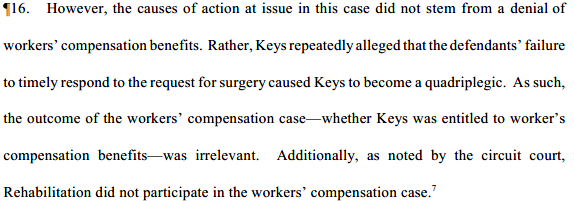
NOTE – A critical aspect of this decision was that the lawsuit did not arise from the denial of workers’ comp benefits:


Bowman v. State, 2020-KA-01371-COA (Criminal – Felony)
Affirming conviction of second-degree murder and tampering with evidence, holding that the trial court did not err in allowing the state medical examiner to testify about the cause and manner of death, in denying motions to suppress evidence seized at the defendant’s Mississippi property and in his vehicle in Utah, in denying a flight-evidence motion in limine and giving a flight-evidence jury instruction, or in refusing the defendant’s request for additional circumstantial evidence instructions, and that the convictions were not against the overwhelming weight of the evidence and were based on sufficient evidence.
(7-2-0: Judge McCarty and Judge Emfinger concurred in part and in the result without separate written opinion; Judge Smith did not participate.)


MDHS v. Reaves, 2021-SA-01133-COA (Civil – State Boards and Agencies)
Reversing the chancery court’s order directing MDHS to reimburse the plaintiff for past child-support payments, holding that reimbursement was improper because a noncustodial parent cannot recover the child-support payments he made on behalf of his child.
(7-3: Judge McDonald concurred in part and in the result without separate written opinion; Judge Wilson and Judge Westbrooks concurred in result only without separate written opinion.)


Wallace v. State, 2021-CP-01149-COA (Civil – PCR)
Affirming the circuit court’s denial of the plaintiff’s second PCR petition, holding that the court did not err when it was not persuaded that the guilty plea lacked a factual basis and was involuntary, that the indictment was defective, or that counsel was ineffective.
(9-1-0: Judge Wilson concurred in the result only without separate written opinion.)


Vector Transportation Co. v. MDES, 2021-CC-00576-COA (Civil – State Boards and Agencies)
Reversing the circuit court’s judgment affirming the MDES Board of Review’s determination that an employee was entitled to unemployment benefits, holding that the employer met its burden of proof to show that the employee’s termination was for misconduct.
(6-3: Judge McDonald concurred in part and dissented in part; Judge Westbrooks dissented, joined by Judge Wilson and joined in part by Judge McDonald; Chief Judge Barnes did not participate.)


Other Orders

Simpson v. State, 2021-KA-00075-COA (denying rehearing)

Terpening v. F.L. Crane & Sons, Inc., 2021-CA-00544-COA (denying rehearing)


Hand Down List

Mississippi Supreme Court Decisions of October 27, 2022

Today was a lean day from the Mississippi Supreme Court. No opinions were handed down, but four orders were listed on the hand-down page. I have reposted the summary of one decision from last week about pleading affirmative defenses because I do not think the importance of heeding that decision can be overstated.


Other Orders

Booker v. State, 2018-CT-00664-SCT (denying cert in PCR case)

Porras v. State, 2021-CT-00052-SCT (dismissing cert petition in PCR case as untimely filed)

Carter v. Total Foot Care, 2021-CT-00610-SCT (denying cert where the COA affirmed summary judgment that was based RFAs deemed admitted because the plaintiff failed to respond to them)

In Re: Administrative Orders of the Supreme Court of Mississippi, 2022-AD-00001-SCT (directing the disbursement of $156,119.26 in civil legal assistance funds among the MS Volunteer Lawyers Project, North MS Rural Legal Services, and MS Center for Legal Services)


Reposting from last week to save a life:

Pruitt v. Sargent, 2021-CA-00511-SCT (Civil – Personal injury)
Reversing the circuit court’s decision granting the defendant’s motion to dismiss based on the running of the statute of limitations, holding that the defendants waived the statute of limitations defense by failing to adequately plead it in their answer.
(6-2-0: Justice Coleman concurred in part and in the result, joined by Justice Griffis; Justice Beam concurred in the result only without separate written opinion)

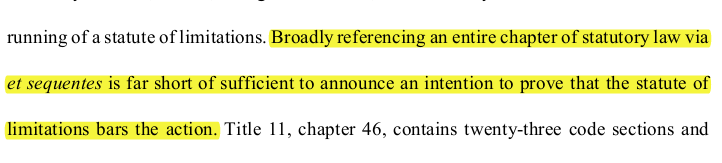
PRACTICE POINT – The Supreme Court laid down some black-letter law today on pleading the statute of limitations as an affirmative defense and its reasoning probably applies to other affirmative defenses. The Court took a look at the defenses that were pleaded and found they fell short of the standard:

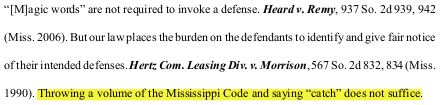
Then, the Court said flatly that et seq. didn’t cut it:

In case the message has not been received, consider:

Be careful out there.

Mississippi Court of Appeals Decisions of July 19, 2022

We are back in action! The Mississippi Court of Appeals handed down six opinions today after their summer break. These cover several appeals from criminal convictions, a termination of parental rights case, and an MTCA case with thorny statute of limitations computation, and PCR.


Bullock v. Mississippi Department of Child Protective Services, 2020-CA-00966-COA (Civil – Custody)
Affirming the judgment of the youth court terminating the plaintiff’s parental rights to her four children, holding that that the youth court’s decision based upon multiple, independently-sufficient statutory grounds was supported by clear and convincing evidence including evidence that one of the children had suffered severe physical, emotional, and mental abuse, and that this abuse of the one child was sufficient to support the termination of parental rights as to all four children. The Court of Appeals also held that there was no evidence that the GAL was unfair or biased.
(10-0)


Alvarado v. State, 2021-KA-00566-COA (Criminal – Felony/First-Degree Murder/Attempted First-Degree Murder)
Affirming conviction of first-degree murder and attempted first-degree murder, holding that the evidence of first-degree murder (that included surveillance footage of the defendant gunning down the victim in a gas station) and evidence of attempted first-degree murder (video showing the defendant exchanging gunfire with a second person after shooting the victim) was sufficient and that the verdict was not against the weight of the evidence.
(10-0)


Lopez v. State, 2021-CP-00331-COA (Civil – PCR)
Affirming the circuit court’s denial of the plaintiff’s motion for PCR, holding that the plaintiff’s guilty plead waived the alleged violation of his constitutional rights and that the plaintiff’s claims of ineffective assistance were waived and meritless.
(7-3-0: Judge Westbrooks concurred in part and in the result with separate written opinion, joined in part by Judge McDonald and Judge McCarty; Chief Judge Barnes concurred in result only without separate written opinion; Judge McDonald concurred in result only with separate written opinion, joined by Chief Judge Barnes.)


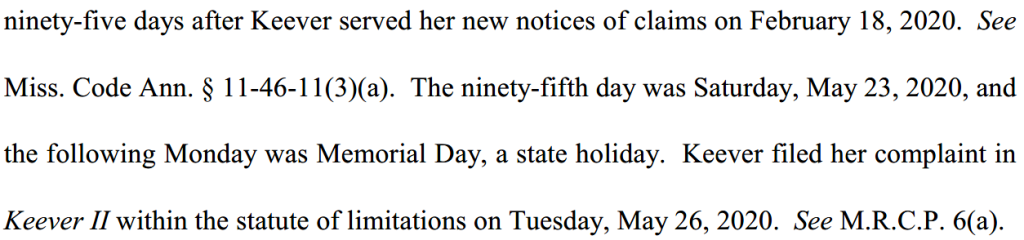
Keever v. The Board of Trustees for Mississippi Institutes of Higher Learning, 2021-SA-00036-COA (Civil – Personal Injury/MTCA/statute of limitations)
Reversing the circuit court’s dismissal of the complaint on statute of limitations grounds, holding that this, the plaintiff’s second lawsuit asserting an MTCA claim, was not barred by the statute of limitations because the statute of limitations was tolled during the pendency of the first lawsuit that was dismissed without prejudice (from the filing of the complaint to the issuance of the appellate mandate) and for another 95 days after a notice of claim for the second lawsuit was served. The Court of Appeals also held that a “stipulation of voluntary dismissal” of the first complaint after the defendants had filed answers was of no effect, that the complaint could not be dismissed based on the discretionary-function exemption, and that IHL is not entitled to a dismissal at this early stage.
(10-0)

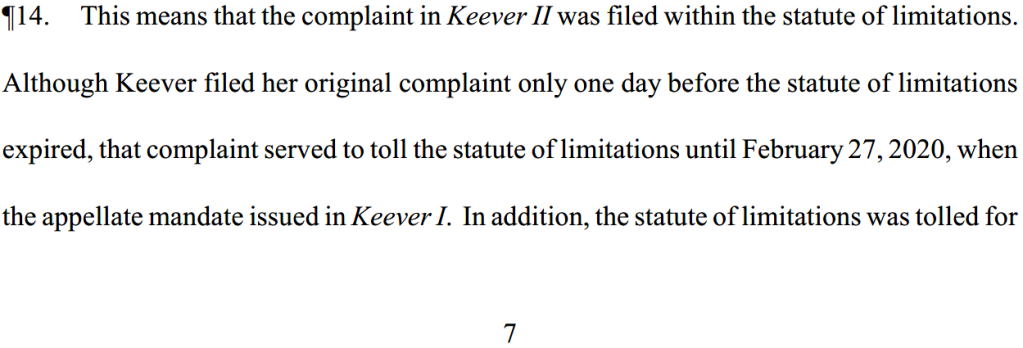
Practice Point – Here is the timeline of key events, which my brain requires in order to process opinions like this:

  • March 8, 2013 – Alleged injury
  • March 3, 2014 – Plaintiff sent notice of claim
  • March 7, 2014 First Complaint filed (this complaint was dismissed by the circuit court for failure to comply with pre-suit requirements and the dismissal was appealed and affirmed by the MS Court of Appeals)
  • February 6, 2020 – MS Supreme Court denied cert
  • February 18, 2020 – Ineffective “Stipulation of Voluntary Dismissal” filed
  • February 18, 2020 – Notice of claim letters sent (this tolled the statute, which was already being tolled during the pendency of the first lawsuit, another 95 days)
  • February 27, 2020 – Appellate mandate issued
  • May 26, 2020 – Second lawsuit filed on the last possible day

And what would stressful, statute of limitations computation party be without the last day falling on a Saturday, followed by a legal holiday?


Garlington v. State, 2020-KA-00392-COA (Criminal – Felony/Sexual Battery)
Affirming the conviction of one count of sexual battery against a minor, holding that the evidence was sufficient to support a finding that the elements of the crime were proven and to allow the jury to infer that the abuse occurred within the time frame stated in the indictment despite an alleged variance in the dates in the indictment and the proof at trial; there was no error in allowing the minor victim’s out-of-court statements under the tender years exception; no error in allowing the State to amend the indictment; no error in overruling the defendant’s Batson challenges; no error in failing to allow evidence of alleged sexual misconduct of the minor victim’s father; no Confrontation Clause violation by admitting lab results without a witness from the lab testifying at trial; no error in prohibiting Defendant’s expert from referring to certain materials that he had relied upon but had not produced to the State; no error in precluded testimony from Defendant’s would-be character witness; no Brady violation in allowing a rebuttal expert to testify; and there was no error in omitting the time frame of the abuse from the jury instructions setting forth the elements of the crime.
(7-3-0: Judge Wilson, Judge McCarty, and Judge Emfinger concurred in part and in the result without separate written opinion.)

NOTE – This is a 58-page, fact-intensive majority opinion.


Jenkins v. State, 2021-KA-00145-COA (Criminal – Felony)
Affirming conviction of trafficking at least 1kg of marijuana with intent to sell, holding that that was no Fourth Amendment violation in the circuit court’s denial of the defendant’s motion to suppress evidence obtained from search warrants for his house and vehicle or his motion and no error in denying the defendant’s motion to suppress his bank records even those records were improperly obtained via subpoena duces tecum.
(8-2-0: Judge Westbrooks concurred specially with separate written opinion, joined by Judge McDonald; Judge McDonald concurred in part and in the result without separate written opinion.)


Other Orders

Fluker v. State, 2021-CP-00162-COA (denying rehearing)


Hand Down List

Mississippi Court of Appeals Decisions of May 17, 2022

The Mississippi Court of Appeals handed down ten opinions today. One is a medical malpractice case that ran afoul of RFAs. There are several criminal appeals, a claim against an estate by a judgment-lien holder, several PRC cases including one with competing opinions on Eighth Amendment issues, and more.


Cunningham v. Mississippi Department of Corrections, 2021-CP-00428-COA (Civil – State Boards and Agencies)
Affirming circuit court’s denial of the plaintiff’s motion for judicial review of two ARP requests against MDOC, holding that the plaintiff failed to provide any documents to support his appeal and that, in any event, the plaintiff received sentencing credit for his pretrial detention.
(All judges concurred.)


Pickle v. State, 2021-CP-00972-COA (Civil – PCR)
Affirming the circuit court’s denial of the plaintiff’s motions for writ of mandamus, alternative sentencing, and a new trial or for JNOV regarding his 1978 conviction of capital murder and life imprisonment, holding that the motion was untimely, successive, and meritless.
(All judges concurred.)


Thompson v. State, 2020-KA-01279-COA (Criminal – Felony)
Affirming a conviction of drive-by-shooting that followed a domestic dispute between the defendant, the defendant’s boyfriend, and the defendant’s boyfriend’s ex-wife. The narrative in the opinion is gripping. In short, it was alleged that an Amber alert was issued for the formerly-married couple’s child when the child was with the defendant and her boyfriend (the child’s father). The couple had a physical altercation with the ex-wife at her work place in the midst of which the defendant instructed the ex-wife to “catch me outside.” Later, the ex-wife apparently inadvertently caught the defendant outside while driving and the defendant shot the ex-wife in the arm. A jury convicted the defendant of one count of drive-by-shooting and the court of appeal affirmed, holding that the conviction was not against the overwhelming weight of the evidence, the circuit court did not err in allowing the circuit clerk to testify as an authenticating witness even though she was present throughout the trial where the defendant’s counsel did not object, the circuit court did not err in refusing the defendant’s proposes “mere suspicion” instruction which would have been cumulative, and the defendant’s counsel was not ineffective.
(All judges concurred.)


Unifund CCR Partners v. Estate of Jordan, 2021-CA-00761-COA (Civil – Wills, Trusts, and Estates/Judgment Liens)
Reversing the chancery court’s ruling that claims against the estate were not timely, holding that the judgment liens against the decedent survive the time-bar of probate and were reasonably ascertainable to the executrices of the estate.
(Chief Judge Barnes and Judge Lawrence concurred in part and in the result without separate written opinion. Judge McDonald concurred in part and dissented in part without separate written opinion. Judge Westbrooks concurred in part and dissented in part, joined by Judge McDonald.)


McLaughlin v. State, 2020-KA-00360-COA (Criminal – Felony)
Affirming conviction of capital murder, third-degree arson, conspiracy, and possession of a firearm by a felon, holding that the evidence was sufficient for each of the convictions, that the defendants was procedurally barred on appeal from raising an alleged Miranda issue and that there was no plain error on this issue, that the circuit court did not err in admitting a photograph of the victim’s brain sitting on the autopsy table to show the bullet path, and that retroactive misjoinder did not apply.
(All judges concurred.)

PRACTICE POINT – Seeking to exclude gruesome photographs of victims in criminal trials is an uphill climb:


Carter v. Total Foot Care, 2021-CA-00610-COA (Civil – Medical Malpractice/Requests for Admissions)
Affirming summary judgment in favor of the defendants based on the plaintiff’s failure to respond to the defendants’ requests for admissions that were deemed admitted, holding that the trial court did not err in deeming the RFAs as admitted–including an admission that the standard of care was not breached–where the plaintiff did not respond until after the defendants filed their MSJ which was more than five months after the RFAs were served. Additionally, the Court of Appeals held that the plaintiff could not rely on responses served in a related federal court proceeding.
(All judges concurred.)

MUSING– My experience is that RFAs are rarely used effectively. In the wild, they usually look like a cartoonish attempt to trick the other side. Something like a deadly CAPTCHA test. I think the best use of RFAs is to whittle down and actually define the contours of disputed issues. And, frankly, RFAs are a way to “shake” a lawsuit that is not being prosecuted and just needs to be dismissed.


Jolly v. State, 2021-KA-00318-COA (Criminal – Felony)
Affirming conviction of four counts of statutory rape, holding that the circuit court did not err in denying the defendant’s motion to suppress his statement to law enforcement because there was no merit to the defendant’s claims that he lacked capacity to voluntarily waive his rights or that he was coerced into waiving his rights and giving a statement.
(Judge Westbrooks concurred in part and in the result without separate written opinion.)


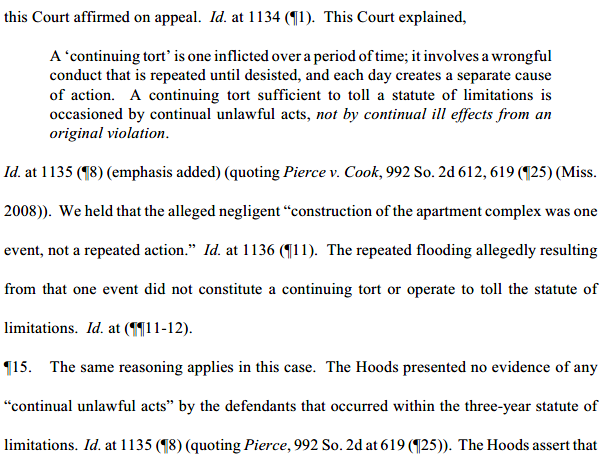
Hood v. A & A Excavating Contractors, Inc., 2021-CA-00207-COA (Civil – Property Damage/Statute of Limitations/Continuing Tort)
Affirming summary judgment dismissing the plaintiffs’ residential flooding claims against a developer and the operator of a gravel pit based on the statute of limitations, holding that the “discovery rule” did not toll the statute of limitations which began to run upon notice of the injury not the cause of the injury and the “continuing tort doctrine” did not apply where there were no “continual unlawful acts” by the defendants.
(McCarty concurred in part and dissented in part, joined by Judge Westbrooks and Judge Lawrence, and joined in part by Judge McDonald and Judge Smith. Judge McDonald dissented without separate written opinion. Judge Emfinger did not participate.)

NOTE– I though this was a helpful summary and application of the continuing tort doctrine:


Dortch v. State, 2021-CP-00103-COA (Civil – PCR)
Affirming the circuit court’s dismissal of the plaintiff’s PCR motion and motion to vacate judgment and finding no error in the circuit’s revocation of the plaintiff’s PRS.
(All judges concurred.)


Skinner v. State, 2021-CA-00080-COA (Civil – PCR)
Affirming the circuit court’s denial of the plaintiff’s PCR motion related to the plaintiff’s 2011 conviction of felony evasion and sentence to life without parole as a habitual offender (with eight prior felony convictions), holding that the Eighth Amendment claim is barred by the doctrine of res judicata and without merit and that the circuit court did not err in refusing to consider mitigating circumstances surrounding Skinner’s juvenile convictions.
(Judge McCarty concurred in part and dissented in part. Judge McDonald dissented, joined by Chief Judge Barnes and Judge Westbrook, and joined in part by Judge McCarty. Judge Emfinger did not participate.)

NOTE – The majority and the dissenting opinions contain robust discussions of the Eight Amendment analysis.


Other Order

 Tallent v. State, 2020-CP-01077-COA (denying motion for rehearing)


Hand Down List Page

Mississippi Court of Appeals opinions of May 10, 2022

The Mississippi Court of Appeals set a new record since the launch of this blog by handing down fourteen opinions. After briefly contemplating a dash to the exit, I decided to slog through all of them so you don’t necessarily have to. Needless to say, there is something for everybody today!

(Apologies for the all-but-certain uptick in typos)


Fugler v. Bank of Brookhaven, 2021-CA-00303-COA (Civil – Personal Injury/Premises Liability)
Affirming summary judgment in favor of the defendant in a slip and fall case, holding that the plaintiff, who allegedly tripped on a floor mat but testified she did not see the mat before tripping, failed rebut the defendant’s summary judgment motion and supporting affidavit stating that the bank had no knowledge of prior incidents with its floor mats or any issues with the mat involved, that around 300 customers entered the bank daily and the bank was not aware of any prior mat-related trips or complaints, that the mat was heavy-duty commercial grade and was replaced annually to prevent wear, and that bank employees constantly monitored the floors.
(All judges concurred.)


Keys v. Military Department Gulfport, 2021-WC-00352-COA (Civil – Workers’ Comp)
Reversing the Commission’s finding that the Employer/Carrier was entitled to a credit for indemnity payments that the claimant received but assigned back to the employer during the time the claimant was receiving paid sick leave, holding that since the claimant was awarded permanent total disability benefits, section 25-3-95(2)(b) (prohibiting a state employee from using accrued personal and/or medical leave and receiving workers’ comp to earn more than 100% of his state-employment wages) did not apply.
(Judge Wilson specially concurred, joined in part by Judge McCarty.)

NOTE – I think Judge Wilson’s special concurrence provides a clearer path forward in workers’ comp cases: Regardless of whether the indemnity benefits during the time in question were classified as TTD or PTD, the claimant was entitled to a total of 450 weeks of indemnity benefits (however classified) and since the claimant did not receive any indemnity benefits during the period he was assigning benefits back to the Employer, the Employer/Carrier were not entitled to a credit for those weeks.


Smith v. State, 2021-CP-00099-COA (Civil – PCR)
Affirming the circuit court’s denial of a pro se plaintiff’s PCR petition, holding that the plaintiff presented no evidence to show a reasonable ground for the trial court to believe he was incompetent to plead guilty.
(All judges concurred.)


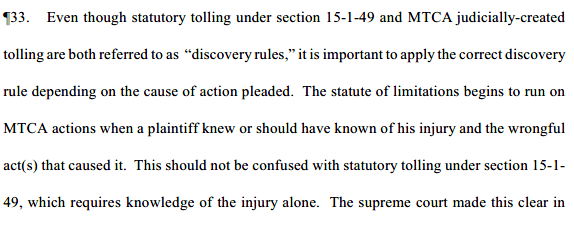
Prystupa v. Rankin County Board of Supervisors, 2020-CA-01049-COA (Civil – MTCA/Statute of Limitations/Latent Injury)
Affirming the dismissal of a flooding damage MTCA claim based on the running of the statute of limitations, holding that this claim was an MTCA negligence claim subject to a one-year statute of limitations that began to run when the plaintiff knew or should have known of both the injury and its probable cause. In this case, the Court of Appeals held that the statute of limitations began to run when the plaintiff knew of the flooding (the injury) and knew it was due to a blocked drain (the cause) as opposed to when he found out that crushed pipe caused the blocked drain (i.e. caused the cause). The Court of Appeals also affirmed the circuit court’s denial of the plaintiff’s Rule 59(e) motion to aleter or amend based on fraudulent concealment and the circuit court’s denial of the plaintiff’s motion for leave to amend his complaint to add claims of nuisance and trespass.
(Judge McCarty concurred in part and in the result without separate written opinion. Judge Emfinger did not participate.)

TAKE HEED, lest you fall victim to the distinction between “statutory tolling” and “MTCA tolling”:


Schmidt v. Schmidt, 2020-CA-01253-COA (Civil – Custody)
Affirming the chancellor’s decision granting sole physical custody to the mother, holding that there was no error in finding that the deterioration of the parties’ ability to co-parent constituted a material change in circumstances entitling the mother to sole physical custody and no error in the application of the Albright factors.
(Judge Wilson concurred in part and in the result without separate written opinion.)


Smith v. Mississippi Department of Public Safety, 2021-SA-00020-COA (Civil – State Boards and Agencies)
Affirming the circuit court’s judgment affirming the Mississippi Employee Appeals Board’s decision upholding the claimant’s termination, holding that the claimant’s procedural due process rights were not violated because he was provided notice of the charges and an opportunity to be heard, that his substantive due process rights and rights under the MS State Personnel Board rules were not violated because the MEAB’s decision was supported by substantial evidence and was not arbitrary, and that the claim that the claimant was terminated because of communications with his wife and that the MEAB’s decision was based on uncorroborated hearsay was without merit.
(All judges concurred.)


McIntosh Transport, LLC v. Love’s Travel Stop & Country Stores, Inc., 2021-CA-00154-COA (Civil – Contract/Arbitration)
Reversing the circuit court’s order granting the defendants’ motion to compel arbitration, holding that the contract containing the contract was not binding on the plaintiff because it was signed by a 19-year-old who signed his grandfather’s name and whose only authority was the actual authority to retrieve the truck following repairs that did not include the authority to bind the company to arbitration.
(Chief Judge Barnes concurred in part and in the result without separate written opinion. Judge Carlton concurred in the result only without separate written opinion.)


Case v. Case, 2020-CA-01047-COA (Civil – Custody/Equitable Distribution of Marital Property/Albright Factors/Ferguson Factors)
Affirming the chancellor’s decision on child custody, but reversing the chancellor’s decision on the equitable distribution of marital property. Regarding custody, the Court of Appeals held that the chancellor’s application of the Albright factors was supported by substantial evidence. Regarding equitable distribution, the Court of Appeals affirmed all of the chancellor’s findings except his valuation of the marital property which it reversed and rendered due to a calculation error.
(Judge Wilson and Judge Westbrooks concur in part and in the result without separate written opinion.)

MY TAKE – Few, if any, of us are in the legal field because of a proclivity for math yet it still haunts us all.


Wadley v. Hubbs, 2021-CA-00866-COA (Civil – Real Property/Notice of Appeal)
Reversing the circuit court’s dismissal of the plaintiff’s appeal from a county court judgment as untimely, holding that the plaintiff’s notice of appeal that was stamped “Filed” after the county court’s judgment but before disposition of the plaintiff’s motion to set aside the judgment was effective and timely even though the header of the notice said “IN THE COUNTY COURT” because the body of the notice made it clear the plaintiff was appealing to the circuit court and the notice was stamped “Filed” by the circuit clerk.
(All judges concurred.)


Murray v. State, 2021-KA-00264-COA (Criminal – Felony/Hearsay/Rule 412)
Affirming conviction of statutory rape, holding that the circuit court erred in allowing the victim’s mother’s to testify about a neighbor’s out-of-court statement, but that it was harmless and “essentially cumulative evidence of non-criminal activity that [the defendant] admitted.” The Court of Appeals also held that the circuit court did not err in denying the defendant’s ore tenus request to compel the victim’s counseling records because even though a determination of whether the records were privileged could not be made until the records were examined, the defendant did not comply with Rule 412 of the Mississippi Rules of Evidence. The Court of Appeals also held that the plaintiff’s claims of ineffective assistance of counsel for failure to request an alibi instruction, failure to object to hearsay, failure to request a limiting instruction regarding the hearsay testimony, and failure to make a timely request for the victim’s counseling records did not entitled him to relief on this appeal.
(All judges concurred.)


Bailey v. State, 2021-KA-00281-COA (Criminal – Felony/Lindsey Brief)
Affirming conviction of fondling of a six-year-old and sentence to life imprisonment as a violent habitual offender, noting that the defendant’s appointed appellate counsel filed a Lindsey brief and holding that the defendant’s pro se brief arguing that the trial court lacked jurisdiction and that his indictment was not marked “filed” was factually mistaken and without merit.
(Judge Smith did not participate.)


Finley v. PERS, 2021-SA-00089-COA (Civil – State Boards and Agencies/PERS/Disability)
Reversing the circuit court’s judgment affirming PERS Medical Board’s denial of the plaintiff’s claim for non-duty-related disability retirement benefits, holding that PERS’s assessment of the plaintiff’s job requirements and ability to perform her job was arbitrary and capricious. The case was remanded for PERS to determine if the plaintiff could perform the true duties of registrar with her disability and the support staff, if any, she had at the time.
(Judge Wilson concurred in part and in result without separate written opinion.)


Boyd v. MDOC, 2021-CC-00459-COA (Civil – State Boards and Agencies/MDOC)
Affirming the MDOC’s disciplinary actions against the plaintiff whose oversight led to MDOC’s failure to issue an arrest warrant for a probationer who did not report to his assigned probation office upon release from MDOC custody who then killed two Brookhaven police officers in the line of duty, holding that the plaintiff failed to meet her burdens of proof and persuasion to overcome the presumption of correctness due MDOC’s decision.
(All judges concurred.)


Parker v. Ross, 2020-CA-01055-COA (Civil – Wills, Trusts, and Estates)
Affirming in part and reversing in part the chancery court’s grant of summary judgment in a claim alleging mismanagement of a trust and to recover real property that was allegedly improperly sold. The Court of Appeals affirmed the chancellor’s judgment in part, holding that any claims governed by the three-year statute of limitations were time-barred. The Court of Appeals also reversed the chancellor’s judgment in part, holding that the allegations related to the mismanagement of the trust were subject to a ten-year statute of limitations and that one of the plaintiffs had created a genuine issue of material fact as to his unsoundness of mind and remanded this matter to the chancery court for further proceedings.
(Judge Emfinger dissented, joined by Judge Wilson and Judge Greenlee and joined in part by Judge McDonald.)


Other Orders

Lawrence v. State, 2021-TS-1324-COA (providing, on the court’s own motion, the appellant and his attorney, Wayne Dowdy, one final opportunity to show cause why this appeal should not be dismissed as untimely)


Phew…

Summaries of the Mississippi Court of Appeals opinions of March 8, 2022

There are six opinions from the Mississippi Court of Appeals today on a wide range of topics, including a holding that a defendant’s failure to respond to a complaint filed on March 6, 2020, until thirty-one days after service of process constituted “excusable neglect” in light of the COVID shutdowns at the time.

Hamer v. State, 2019-KA-01633-COA (Criminal – Felony/Evidence/Rule 403/Golden Rule)
Affirming conviction on two counts of capital murder and armed robbery and sentence to life in prison without parole, holding primarily that (1) wiretapped phone calls between the convicted and his father, whose drug trafficking enterprise the convicted had worked for, were admissible to show motive and tell “the complete story” to the jury, (2) the evidence was sufficient to establish nexus between the killing and the underlying felony to constitute capital murder, (3) and there was no impermissible Golden Rule argument at closing.
(Judge Westbrooks wrote an opinion concurring in part and dissenting in part, joined by Judge McDonald.)


Crockett v. State, 2021-CP-00022-COA (Civil – PCR/Time Bar)
Affirming circuit court’s denial of a pro se motion for post-conviction collateral relief, holding that the claim of an involuntary guilty plea was both time-barred and meritless.
(All judges concurred, Chief Judge Barnes and Judge Wilson concurred in part and in the result without separate written opinion.)


Erves v. Hosemann, 2020-CA-00467-COA (Civil – Property/Daubert)
Affirming chancellor’s decision denying relief in an action for an injunction to stop the use of a driveway and for monetary damages, holding that the petitioners failed to establish legal title to the subject property and specifically holding that the defendants’ expert witnesses were qualified and that the chancellor’s ruling was not against the overwhelming weight of the evidence.

Practice Point: Appellants got dinged on their Daubert challenge for arguing reliability on appeal when the only issue raised at the trial court was the experts’ qualifications:


(All judges concurred, Judge McCarty concurred in part and in the result without separate written opinion.)


Archer v. Harlow’s Casino Resort & Spa, 2020-CP-00930-COA (Civil – Other/Default/Excusable Neglect)
Affirming in part and reversing in part the circuit court’s grant of the defendant’s motion to dismiss, holding that the circuit court did not abuse its discretion in finding that the defendant showed excusable neglect when it sought an extension of time to answer the complaint thirty-one days after being served and holding that the circuit clerk did not err by correcting a mistake and removing an entry of default, but holding that the trial court should have dismissed the complaint without prejudice and allowed the plaintiff an opportunity to amend her complaint under Rule 15(a).

ADDENDUM – COVID AND THE LAW: The defendant casino blamed the COVID-19 pandemic for being late to respond to the complaint. The casino was served with process on March 9, 2020, three days before the governor of Kentucky (where the casino’s counsel is located) issued a state of emergency and one week before Governor Reeves entered an order in Mississippi closing the casino. The casino asserted that these restrictions made it difficult to gather information from the closed casino in order to prepare and answer. The circuit court granted the late-filed extension request “in light of the current pandemic and government orders restricting operations and travel.” The court of appeals held that this was not an abuse of the circuit court’s broad discretion in this realm. In this case: COVID shutdown in March 2020 = “excusable neglect.”
(All judges concurred, Judge Wilson concurred in part and in the result without written opinion.)


Everett v. Dykes, 2020-CP-01331-COA (Civil – Property Damage/Recusal/Rule 48B)
Dismissing a pro se appeal of an order denying a motion for recusal of the circuit judge, holding that the appellant failed to comply with the procedure required by Rule 48B of the Mississippi Rules of Appellate Procedure for an interlocutory appeal of the denial of a recusal motion.
(Judge Lawrence dissented without separate written opinion.)


Rives v. Ishee, 2020-CA-01328-COA (Civil – Contract/Statute of Limitations)
Affirming the chancellor’s dismissal of a breach of contract lawsuit, holding that the plaintiffs’ second lawsuit was time-barred because they did not file suit until more than three years after they learned they would receive no money from the restaurant and the statute of limitations was not tolled during the first lawsuit because it was dismissed for want of prosecution. The court of appeals also held that the remedy of quantum meruit was inapplicable because there was a contract between the parties.
(Judge Westbrooks concurred in part and dissented in part, joined by Judge Greenlee.)


Other Orders

Westmoreland v. State, 2020-KA-00509-COA (denying motion for rehearing)
Winters v. State, 2020-KA-00809-COA (denying motion for rehearing)


Complete Hand Down List

Summaries of the Mississippi Supreme Court opinions of February 24, 2022

The Mississippi Supreme Court handed down four opinions today: one civil procedure decision on interlocutory appeal, one MDES decision, and two decisions affirming criminal convictions.


University of Mississippi Medical Center v. Jensen, 2020-IA-872-SCT (Civil – Personal Injury/Statute of Limitations/Service of Process)
Reversing, on interlocutory appeal, the county court’s ruling granting the plaintiff’s motion for extension of time to serve process, holding that the plaintiff did not show good cause where the plaintiff attempted to serve process on an administrative assistant, who accepted service on behalf of UMMC’s CEO, instead of the attorney general. Because the statute of limitations had expired, judgment was rendered in favor of UMMC.

“As neither inadvertence, mistake of counsel, or ignorance of the rules suffice to establish good cause, the county court lacked substantial evidence to support its finding that Jensen had shown good cause for an extension of time to serve process under Rule 4(h).”

Univ. of Miss. Med. Ctr v. Jensen, 2020-IA-827-SCT (Miss. 2022) (citation omitted).

Mississippi Department of Employment Security v. Dover Trucking, LLC, 2020-CC-1267-SCT (Civil – State Boards and Agency/Employment)
Reversing the circuit court’s order that reversed the MDES Board of Review’s decision that the claimant was an “employee” of a trucking company, holding that that the agency’s decision was supported by substantial evidence and was not arbitrary or capricious.


Williams v. State, 2020-KA-772-SCT (Criminal – Felony/Rebuttal Evidence)
Affirming conviction of one count of sexual battery, holding that the circuit court did not err in admitting State’s rebuttal evidence related to the defendant’s ankle monitor that had not been disclosed prior to trial because that evidence was not within the State’s due diligence/disclosure obligations prior to trial based on the defendant’s pre-trial representations. The supreme court also held that the circuit court did not err in excluding evidence that the minor victim had previously twerked on the school bus and that the defendant’s sufficiency of the evidence claim was meritless.


Williams v. State, 2019-CT-1007-SCT (en banc) (Criminal – Felony/Accomplice Liability)
Affirming, on writ of certiorari, convictions for two counts of conspiracy and two counts of possession with intent to distribute, holding that the evidence was sufficient to convict on accomplice liability rather than constructive possession where an inmate was directing a drug-trafficking ring from prison over the phone and whose home was found to have large amounts of cocaine and marijuana, as well as $93,259 in cash.


Other Orders

Ward v. Cranford, 2020-CT-410-SCT (denying petition for writ of certiorari)
Brown v. State, 2020-M-630 (denying petition for leave to proceed in trial court and for permission to file successive petition for post-conviction collateral relief)
State v. Corrothers, 2021-IA-836-SCT (denying motion for rehearing)
Cooper v. State, 2021-CT-1012-SCT (dismissing pro se “writ of certiorari”)


Hand Down List for February 24, 2022