Mississippi Court of Appeals Decisions of January 10, 2023

The Mississippi Court of Appeals handed down nine opinions today. These decisions cover a wide range of areas including wills, felonies, personal injury, defamation, and adoption. One of the more interesting and potentially useful decisions analyzes the admissibility of images from Google Earth and measurements generated by Google Earth.


Perrigin v. State, 2021-KA-00858-COA (Criminal – Felony)
Affirming conviction of sexual battery of a minor, holding that the verdict was not against the weight of the evidence, that the Confrontation Clause was not violated since the victim did testify at trial, and that the ineffective assistance of counsel claim should be raised on a PCR petition.
(9-1-0: Judge Emfinger concurred in part and in the result without separate written opinion)


Wilkerson v. Wilkerson, 2021-CA-01208-COA (Civil – Wills, Trusts & Estates)
Affirming the chancellor’s ruling in a will contest, holding that the word “should” was permissive and that, in any event, even if there was a mandatory requirement that one son have an opportunity to purchase a property there was sufficient evidence to support the chancellor’s finding that he did have such a chance.
(10-0)


Bolton v. Lee, 2020-CA-00344-COA (Civil – Other)
Affirming a dismissal for failure to state a claim in favor of a banker and a bank and affirming summary judgment in favor of a lawyer and law firm, holding that collateral estoppel barred the plaintiff from recovering in a civil action on the same facts that formed the basis of their criminal convictions of tax evasion and filing false tax returns.
(8-2-0: Judge Wilson and Judge Westbrooks concurred in part and in the result without separate written opinion)


Pope v. Martin, 2021-CA-00367-COA (Civil – Torts)
Affirming in part and reversing in part summary judgment granted in favor of the defendant in a defamation and wiretapping suit, holding that there was no error in granting summary judgment without a hearing or without issuing findings of fact or conclusions of law, and that summary judgment on the defamation claim was proper but that there were genuine fact issues on the wiretapping claim.
(9-1-0: Judge Emfinger concurred in part and in the result without separate written opinion)

NOTE – Summary judgment rulings made without any accompanying findings of fact and conclusions of law to explain the basis for the decision are frustrating for litigants and parties. This is especially true when no hearing was given. There are certainly cases where such rulings make sense, but when the parties have spent considerable time and energy in briefing issues it is helpful to know why you won or lost. Without an explanation of why summary judgment was granted or denied, litigants do not have an opportunity to see where they went wrong and hone their craft. It also does not help the parties focus the issues on appeal. It is clear that Rule 52 does not apply to summary judgments but rules can always be amended.

Evilsizer v. Beau Rivage Resorts, LLC, 2021-CA-01222-COA (Civil – Personal injury)
Affirming summary judgment in favor of the owner of a cooking trailer who was sued by an 18-wheeler driver who struck the awning of the cooking trailer, holding that the there were no genuine fact issues where the evidence showed that the awning was closed approximately one hour before the collision and there was no evidence that the trailer owner opened the awning before the accident or had actual or constructive notice that the awning was open and extending into the roadway.
(8-1-0: Judge McDonald concurred in result only without separate written opinion; Judge Westbrooks did not participate)


Boutwell v. Fairchild, 2021-CA-01046-COA (Civil – Domestic Relations)
Affirming termination of parent rights and allowing adoption, holding that the court had subject matter jurisdiction, that the child was eligible for adoption because the chancery court had properly assumed original and exclusive jurisdiction over the matter, and that the chancellor did not err in finding that parental rights should be terminated.
(8-2-0: Judge McDonald concurred in part and in the result without separate written opinion; Judge McCarty concurred in result only without separate written opinion)


Green v. State, 2021-KA-00613-COA (Criminal – Felony)
Affirming conviction of aggravated domestic violence, holding that the trial court did not err in refusing the defendant’s lesser-included instruction for simple domestic violence because the evidence did not support that instruction.
(10-0)


Taylor v. State, 2021-KA-00721-COA (Criminal – Felony)
Reversing conviction of violating state law by living within 3,000 feet of a playground as a registered sex offender, holding that the sex-offender-registry law is not unconstitutionally vague by what is meant by “playground” or how 3,000 feet should be measured and that the evidence was sufficient to support the conviction, but reversing because the Google Earth map used to calculate the distance was not properly authenticated and contained hearsay.
(6-2-2: Judge Greenlee and Judge Emfinger concurred in part and in the result without separate written opinion; Judge Wilson concurred in the result and dissented in part, joined by Judge Greenlee and joined in part by Judge McDonald and Judge McCarty)

NOTES – The majority and the partial dissent engage in a collegial discussion of whether the term “playground” encompasses the property on which a playground sits or just the playground itself, the dissent arguing for the narrow construction. Both the majority and the partial dissent have interesting analyses of the admissibility of Google Earth images and measurements generated by it (without much disagreement on this issue).


Colburn v. State, 2021-KA-00865-COA (Criminal – Felony)
Affirming conviction for sale of meth within 1,500 feet of a church, holding that the trial court did not err in admitting evidence of the defendant’s prior conviction for possession of cocaine with intent to sell.
(5-1-4: Judge Wilson concurred in part and in the result without separate written opinion; Judge McCarty dissented, joined by Judge Westbrooks and Judge McDonald, and joined in part by Judge Lawrence)


Other Orders

None


Hand Down List

Mississippi Supreme Court Decisions of August 18, 2022

The Mississippi Supreme Court handed down one opinion today along with a passel of orders denying various post-conviction petitions as frivolous. The opinion is noteworthy because the Supreme Court granted cert and then reversed the Court of Appeals and the chancery court on issues that do not appear to have been argued at any point in the appeal briefing and were not addressed by the Court of Appeals.


Randle v. Randle, 2020-CT-00433-SCT (Civil – Wills, Trusts, and Estates)
Reversing the Court of Appeals and the chancellor on cert, holding that the lower courts incorrectly considered settlement proceeds from a wrongful-death claim as an asset of the estate and incorrectly adjudicated the decedent’s heirs-at-law instead of making a determination of wrongful-death beneficiaries.
(9-0)

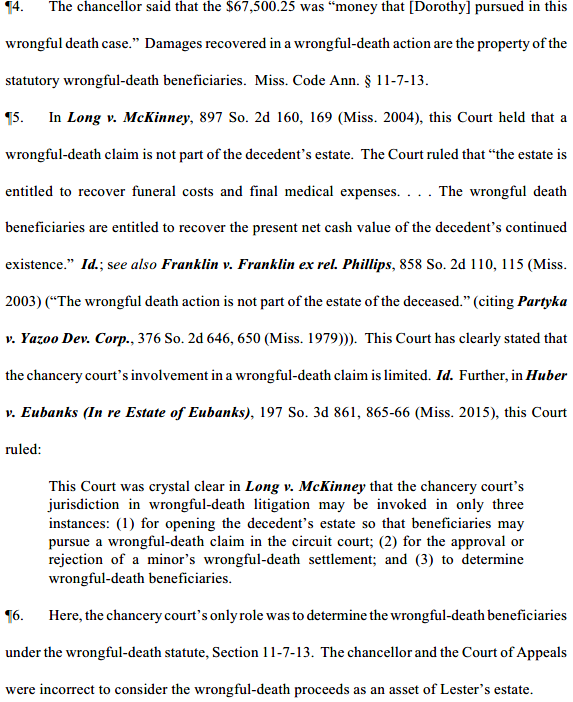
ADDENDUM – The Supreme Court’s decision hinged on issues that were not addressed by the parties’ briefs, the Court of Appeals’ opinion, or the cert petition. The parties were focused on issues related to the use of DNA evidence to determine heirs and the chancellor’s order requiring a supersedeas bond which are the issues the Court of Appeals decided. But the Supreme Court addressed a more fundamental issue of whether the wrongful-death proceeds were part of the decedent’s estate. Since it held they were not, the Supreme Court then held that the chancellor should have determined wrongful-death beneficiaries rather than heirs-at-law. This case was remanded back to the chancery court for a determination of wrongful-death beneficiaries.

Here is the Supreme Court emphatically explaining that wrongful-death proceeds are not part of the decedent’s estate:


Other Orders

Pinkston v. State, 2012-M-00306 (denying application for leave to proceed in the trial court, finding the claims in the successive petitions are frivolous, and warning that future frivolous filings could result in sanctions)

Daniels v. State, 2017-M-00423 (denying petition for PCR, finding that it was frivolous, and restricting the petitioner from filing further applications in forma pauperis)

Brunson v. State, 2018-M-01113 (denying petition for PCR, finding that it was frivolous, and restricting the petitioner from filing further applications in forma pauperis)

Hill v. State, 2019-M-01221 (denying denying pro se petition for en banc habeas corpus, finding the claims in the successive petitions are frivolous, and warning that future frivolous filings could result in sanctions)

Wright v. State, 2019-M-01883 (denying petition for PCR, finding that it was frivolous, and restricting the petitioner from filing further applications in forma pauperis)

Brown v. State, 2020-M-00630 (denying motion to proceed with habeas corpus petition, finding that the application was frivolous, and restricting the petitioner from filing applications in forma pauperis)


Hand Down List

Mississippi Court of Appeals Decisions of June 28, 2022

The Mississippi Court of Appeals handed down eight opinions today covering a lot of territory without a single dissent. There is an appeal of summary judgment in a slip and fall case, the reversal of summary judgment in an MTCA case, a motion to compel arbitration case, two wills and estates cases, a criminal appeal, and a few PCR cases.


Siggers v. State, 2021-CP-00985-COA (Civil – PCR)
Affirming the circuit court’s dismissal of the plaintiff’s PCR motion, holding that though it was not a barred successive motion but that it lacked merit.
(10-0)


Daniels v. Family Dollar Stores of Mississippi, Inc., 2021-CA-00781-COA (Civil – Negligence/Premises Liability/Slip and Fall)
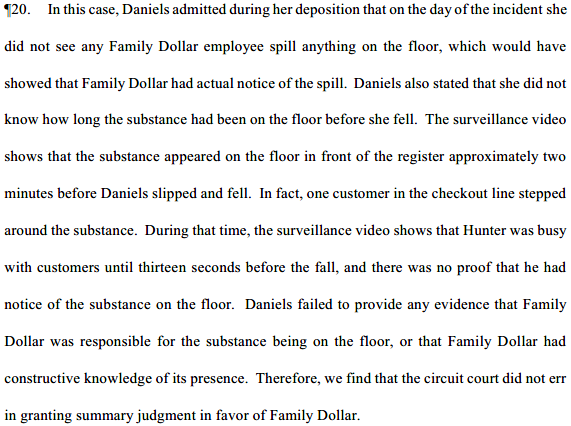
Affirming summary judgment in a premises liability case, holding that the circuit court did not err in granting summary judgment on the issue of breach where the plaintiff slipped in a puddle on the floor of a store but did not know how long it had been there and failed to prove that the store was responsible for the substance or had actual knowledge of the substance on the floor, or that the two minutes the substance had been on the floor gave the store constructive knowledge.
(10-0)

Practice Point – Here is the meat of the opinion’s reasoning on the constructive notice issue:


Towns v. Panola County Board of Supervisors, 2020-CA-01364-COA (Civil – Personal Injury/MTCA)
Reversing the circuit court’s finding that the County was entitled to “premises immunity” and “weather immunity” under the MTCA in a case where the plaintiff was injured when he drove into a culvert that had washed out, holding (1) that weather immunity did not apply because there was evidence that the County had knowledge that the culvert had deteriorated and thus weather was not the “sole” cause of the culvert washout and (2) that premises immunity did not apply because there was evidence that the condition on the premises was caused by the County.
(10-0) (Judge Emfinger concurred in part and in the result without separate written opinion)


Roberson v. State, 2020-CA-01208-COA (Civil – PCR)
Affirming the circuit court’s denial of the plaintiff’s PCR motion, holding that the decision was supported by substantial evidence and was not clearly erroneous.
(10-0) (Judge Westbrooks specially concurred, joined by Chief Judge Barnes, Judge McDonald, and joined by Judge McCarty in Part, urging more objective guidance for reevaluating recanted testimony.)


South Central Heating Inc. v. Clark Construction Inc., 2021-CA-00285-COA (Civil – Contract/Arbitration)
Affirming the circuit court’s order granting arbitration, holding that the moving party did not waive arbitration by including an alternative complaint for damages in the same pleading in which it moved to compel arbitration and stay the proceedings, applying for a default, responding to a motion for summary judgment filed on the arbitration issue, and responding to motion to file a third-party complaint.
(10-0) (Judge Westbrooks and Judge McDonald concurred in result only without separate written opinion.)

Practice Point – The Court of Appeals noted that at every turn the party seeking arbitration asserted and reserved the right to arbitration.

Additionally, if a party lets you off the mat on an entry of default after your answer to their motion to compel arbitration/complaint that they obtained after waiting six week, consider not fighting their motion to compel arbitration tooth-and-nail.


Taylor v. Tolbert, 2021-CA-00900-COA (Civil – Wills, Trusts, and Estates/Revocation by Destruction)
Affirming the chancery court’s application of the presumption of revocation by destruction, holding that the beneficiary under the will who petitioned to probate a copy of the will had not rebutted the presumption of revocation by destruction by clear and convincing evidence.
(10-0) (Judge Westbrooks concurred in result only without separate written opinion.)


McCarty v. State, 2021-KA-00418-COA (Criminal – Felony/Retroactive Joinder/Character Evidence)
Affirming convictions of aggravated assault, kidnapping, and rape, and conviction as a habitual offender to life imprisonment on each count to be served consecutively, holding that the defendant was not entitled to a new trial under the doctrine of retroactive joinder and that the defendant was not unfairly prejudiced by the admission of character evidence related to prior incidents with the victim. In response to arguments raised in the defendant’s supplemental pro se brief, the Court of Appeals held that the defendant was not due a new trial because of actual innocence, judicial misconduct, prosecutorial misconduct, or ineffective assistance.
(10-0)


Estate of Neill v. Earls, 2021-CA-00177-COA (Civil – Wills, Trusts, and Estates)
Reversing the chancellor’s order instructing the executor to revise an “executor’s deed” providing the for the transfer of the decedent’s property, holding that the language of the devise at issue was ambiguous and that the chancellor’s construction of the distribution was not supported by substantial evidence, and further holding that evidentiary record was insufficient to determine the intent of the testator so the case was remanded to allow the parties to provide additional extrinsic evidence of intent.
(9-0) (Judge Lawrence concurred in result only without separate written opinion. Chief Judge Barnes did not participate.)


Other Orders

Wall v. Wall, 2020-CA-01182-COA (denying rehearing)
Pujol v. State, 2022-TS-00024-COA (dismissing appeal as untimely for lack of appealable judgment)
Morgan v. State, 2022-TS-00298-COA (dismissing appeal as untimely for lack of appealable judgment)


Hand Down List

Mississippi Court of Appeals Decisions of June 7, 2022

A deposition took me out of blogging service for most of the afternoon, so a little later than usual I give you summaries of the nine opinions handed down by the Mississippi Court of Appeals. These opinions cover the statute of frauds, trusts, appellate jurisdiction, youth court, authentication of text messages, equitable division and alimony in a divorce case, workers’ comp, PCR, and more.


SEL Business Services, LLC v. Lord, 2021-CA-00368-COA (Civil – Real Property/Statute of Frauds)
Affirming the chancery court’s dismissal of a suit to reclaim property or alternatively for unjust enrichment, holding that a “handshake deal” for the purchase of a building that was sold before that deal came to fruition was subject to the statute of frauds, that the statute of frauds was not satisfied, and that the equitable remedy of unjust enrichment was therefore unavailable.
(All judges concurred.)


Lennon v. Lowrey & Fortner, P.A., 2021-CA-00426-COA (Civil – Wills, Trusts & Estates/Appellate Procedure/Appellate Jurisdiction)
Granting a motion to dismiss an appeal for lack of jurisdiction in a case of first impression, holding that the 30-day time period for perfecting an appeal began to run upon the entry of an order adjudicating a claim for attorney’s fees against a trust–not the final judgment terminating the trust.
(All judges concurred.)


Smith v. Adams County Youth Court, 2021-CP-00196-COA (Civil – Juvenile Justice)
Dismissing an appeal of the denial of a minor’s post-disposition motion for modification arguing that his guilty plea was the result of ineffective assistance of counsel, holding that the notice of appeal was prematurely filed because the youth court had not been given an opportunity to consider these arguments and any supporting evidence.
(Judge Wilson concurred in result only without separate written opinion.)


Warner v. Warner, 2020-CA-01098-COA (Civil – Domestic Relations/Divorce/Valuation/Equitable Division/Alimony/Contempt)
Reversing the chancellor’s judgment in a divorce case, holding that the chancellor erred in valuation and equitable division of marital assets, in the award of alimony, and in finding the ex-husband in contempt and awarding attorney’s fees as a result.
(Judge Wilson concurred in part and in the result without separate written opinion.)

Simpson v. State, 2021-KA-00075-COA (Civil – Felony/Authentication)
Affirming convictions of two counts of first-degree murder, first-degree arson, and possession of a deadly weapon by a felon, holding that there was no plain error with regard to the authentication of text messages and that there was no merit to the claim of ineffective assistance for not objecting to the properly-authenticated text messages.
(Judge Emfinger did not participate.)


Carson v. State, 2021-KA-00436-COA (Criminal – Felony/Weight and Sufficiency)
Affirming conviction of possession of cocaine, holding that the circuit court did not err in denying a motion for new trial challenging the weight and sufficiency of the evidence and finding no merit to the defendant’s pro se arguments that his rights under the Fourth Amendment and the Confrontation Clause were violated, that the State’s case hinged on “racial profiling,” that he had ineffective assistance of counsel, and that the circuit judge failed to comply with Sharplin.
(All judges concurred.)


Ellis v. State, 2020-CP-00770-COA (Civil – PCR)
Affirming the circuit court’s denial of the plaintiff’s PCR motion, holding that the motion was time-barred and that the plaintiff failed to raise any claims resulting in the deprivation of his fundamental constitutional rights that would defeat the time bar.
(Judge Wilson and Judge Emfinger concurred in part and in the result without separate written opinion. Judge McDonald concurred in the result only without separate written opinion.)


Reardon v. State, 2020-CP-01259-COA (Civil – PCR)
Affirming the circuit court’s denial of the plaintiff’s PCR motion, holding that the motion was procedurally barred and that his claims of ineffective assistance of counsel, deprivation of fundamental rights, and failure to recuse were without merit.
(Chief Judge Barnes and Judge Wilson concurred in part and in the result without separate written opinion. Judge McDonald concurred in the result only without separate written opinion. Judge Greenlee and Judge McCarty did not participate.)


Duren v. Effex Management Solutions, LLC, 2021-WC-00337-COA (Civil – Workers’ Compensation)
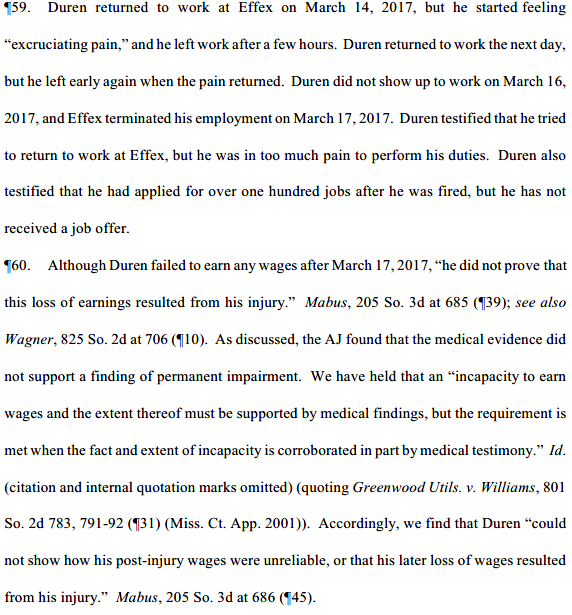
Affirming the Commission’s ruling, holding that there was substantial evidence to support the Commission’s decision that the claimant failed to prove that he suffered a permanent disability and the decision to award TTD through the date of MMI, but denying post-MMI medical treatment, prescription, and mileage reimbursements.
(Judge Wilson concurred in part and in the result without separate written opinion. Judge Westbrooks and Judge McDonald concurred in the result only without separate written opinion.)

DEEPER DIVE: This case had an interesting post-MMI fact pattern where the claimant was released to return to work without restrictions, was offered to return to work for the Employer at his pre-injury wages, and returned to work there, but then quit working for the Employer due to complaints of pain. Under these facts, the Court of Appeals noted that there was a presumption of no loss of wage-earning capacity and held that the claimant did not overcome it:


Other Orders

Hammer v. State, 2019-KA-01633-COA (denying rehearing)
Shannon v. Shannon, 2020-CA-00847-COA (denying rehearing)


Hand Down List

Mississippi Court of Appeals Decisions of May 31, 2022

The Mississippi Court of Appeals handed down five opinions today. Topics include the fate of a living trust that included a languishing cattle farm, unemployment benefits, alleged bolstering of the testimony of a minor who was the victim of sexual battery, alleged MDEQ violations by a lessee, and a PCR motion.


Stapp v. Stapp, 2020-CA-01282-COA (Civil – Wills, Trusts, and Estates)
Affirming the chancery court’s rulings in an action asking the court to divide the corpus of a living trust or, in the alternative, to make a distribution to the beneficiaries, holding that the chancellor did not err in (1) requiring that all the farm equipment be auctioned because the beneficiaries were not able to run the farm at issue and the farm had not been profitable since their father’s death, (2) requiring $50,000 to be maintained in an account for unforeseen expenses since real property remained in the trust, (3) not requiring one beneficiary to reimburse the trust for rent and utilities during her occupancy of the farmhouse in the trust and allowing her to live there indefinitely, or (4) not requiring one beneficiary to reimburse the trust for funds she received from cattle sales and not requiring the trust to reimburse the other beneficiary for expenses allegedly incurred for management of the cattle.
(Judge McCarty dissented, arguing that since the documents creating the trusts were not in the record, the trial court modified two trusts without having the terms of the trust or knowing the settlor’s intent.)


Mitchell v. Mississippi Department of Employment Security, 2021-CC-00794-COA (Civil – State Boards and Agencies/MDES)
Affirming the denial of unemployment benefits, holding that there was substantial evidence to support the ALJ’s determination that the claimant’s work-search requirement was not satisfied and declining to review other arguments that were not supported by citations to any authority.
(Judge Westbrooks concurred in part and in the result without separate written opinion.)

Note – I understand why appellate courts often handle arguments not supported by citations to authority by stating that they are waived, but then analyzing them anyway and explaining that they are meritless. In this case, it was refreshing to see the Court of Appeals simply hold that the arguments were waived and leave it at that.


Trotter v. State, 2020-CA-00094-COA (Civil – PCR)
Affirming the circuit court’s denial of the plaintiff’s PCR motion, holding that the circuit court did not err in finding that the plaintiff failed to prove his ineffective assistance of counsel claim and that the circuit court did not abuse its discretion in denying the plaintiff’s request to be resentenced to life without the possibility of parole.
(Judge Wilson concurred in part and in the result without separate written opinion; Judge McCarty concurred in result only without separate written opinion.)


Blocton v. State, 2021-KA-00197-COA (Criminal – Felony/Sexual Battery)
Affirming a conviction of sexual battery of a small child, holding (1) the circuit court did not abuse its discretion in allowing the victim’s foster mother, the forensic interviewer, and an investigator to testify about what the victim disclosed to them over the defendant’s argument that this testimony improperly bolstered the victim’s testimony and (2) the circuit court did not commit plain error in allowing the investigator to testify and that there was no merit to the defendant’s claim that his lawyer rendered constitutionally ineffective assistance.
(Judge McCarty concurred in part and in the result without separate written opinion. Judge Smith did not participate.)


Biloxi Dock & Ice, LLC v. Back Bay Fuel and Ice, LLC,  2021-CA-00701-COA (Civil – Contract/Lease)
Affirming the circuit court’s decision upholding the county court’s findings in a case arising out of a lease dispute, holding that the county court, as fact-finder, had sufficient evidence to conclude that the purchaser/landowner failed to establish that the lessee had violated MDEQ regulations that would render the lessee in default of the lease.
(All participating judges concurred.)

NOTE – A lessor in this case was named Lesso. Lesso was sometimes referred to as Lessor in the opinion. Had Lesso been the lessee we could have met calamity.


Other Orders

Lambes v. Lambes, 2020-CA-00095-COA (denying rehearing)


Hand Down List

Mississippi Supreme Court Decisions of May 26, 2022

The Mississippi Supreme Court handed down two opinions today and each packs a punch. Webb v. State has a thorough and concise analysis of issues surrounding the authentication of screenshots of Snapchat messages. Ware v. Ware is a multifaceted, chancery court battle-royale among family of the decedent involving primarily the fate of the decedent’s shares of family corporations.


Webb v. State, 2021-KA-00082-SCT (Criminal – Felony/Authentication of Social Media)
Affirming conviction of one count of fondling and three counts of sexual battery of two underage girls, holding that the circuit court did not abuse its discretion in a slew of evidentiary rulings including (1) the admission of prior sexual abuse by the defendant; (2) the admission of a photo of an entry from a diary belonging to one of the victims; (3) the admission of screenshots of Snapchat messages over an authentication and unfair prejudice challenges; and (4) the admission of text messages between the defendant and one victim’s mother. The Supreme Court was unpersuaded by the defendant’s final argument that his conviction was against the weight of the evidence.
(All justices concurred.)

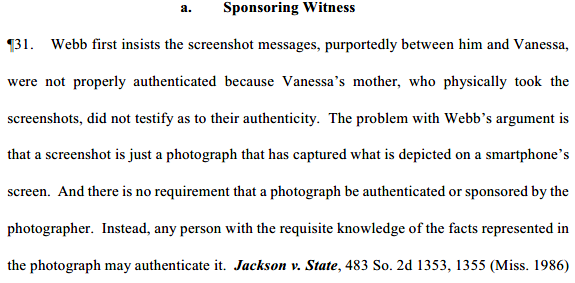
Practice PointThis is a case to bookmark for authenticating social media content or other screenshot material. The Supreme Court took a deep dive into the issue of authenticating the Snapchat screenshots at issue in this case. The screenshots at issue were taken by one victim’s mother, but the mother did not provide authenticating testimony. The Court analogized screenshots to photos, and held that screenshots do not have to be authenticated by the person who took the screenshot:

[Legal writing sidebar: I like Justice Maxwell’s use of “And” to start the third sentence. We were all told at some point that one should never begin a sentence with a conjunction. But I think doing so here effectively added clarity and concision to the opinion.]

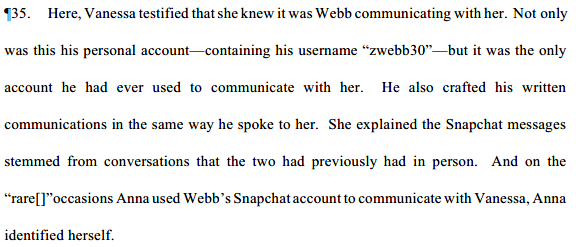
The defendant also asserted that the State failed to offer an adequate foundation for the screenshots because they did not prove that he was on the “other side” of the Snapchat communications with one of the victims. The Supreme Court noted that something more than a profile photo and an account name is required, but that “something more” can be established in many ways including circumstantial evidence:


Ware v. Ware, 2020-CA-00702-SCT (Civil – Wills, Trusts, and Estates)
Affirming in part and reversing/remanding in part a direct appeal and affirming in part and dismissing as moot in part a cross-appeal of a messy, consolidated estate case and corporate dissolution case between and among a surviving wife and the three children (a son and two daughters) she had with the decedent. The decedent owned 25% each of four family corporations. His will placed most of his assets including these shares into testamentary trusts for which his wife and three children were trustees, and the primary beneficiary was the wife with limited distribution potential to the children. Unsurprisingly, litigation ensued over how to manage the corporations and dispersion of the decedent’s assets.

The son filed for dissolution of the corporation, the chancellor denied the daughters’ motions to join/intervene, the chancellor appointed a receiver by agreed order, and the chancellor ultimately ordered that the shares by offered for sale to the corporations and then the dissolution of the corporations. The daughters appealed the denial of their motions to join/intervene and the wife appealed “a multitude of issues.” The son cross-appealed the chancellor’s net asset value determination date and methodology.

The Mississippi Supreme Court (1) reversed the chancellor’s ruling that the estate must offer the shares to the corporation prior to transferring them to the trusts, (2) affirmed the chancellor’s denial of the motions to intervene, (3) affirmed the chancellor’s decision to dissolve the corporations, and (4) reversed the dissolution judgment to the extent that it allowed the corporations to purchase shares from the estate. Accordingly, the Court remanded the case back to the chancery court to determine how to distribute the money from the sales of the corporations in which the estate holds 25% of the corporate shares.
(Chief Justice Randolph did not participate.)

Note – There is a lot more happening in the details of this opinion that I am not going to wade into here. If something mentioned above touches your practice areas, you will need to dive in yourself.


Other Orders

Grayson v. State, 1998-DP-01782-SCT (dismissing pro se motion to carry out execution forthwith)

Sims v. Sims, 2020-CT-00327 (denying cert) (grandparents, if you want to spend a lot of money to accomplish little more than firebombing your family, suing your children for grandparent visitation may be right for you)

Westmoreland v. State, 2020-CT-00509-SCT (denying cert)

Wilson v. State, 2020-CT-00762-SCT (denying cert)

Flechas v. The Mississippi Bar, 2021-BA-01051-SCT (granting motion to accept the irrevocable resignation of Eduardo A. Flechas)

In Re: Hon. James McClure, III and Hon. Gerald W. Chatham, Sr., 2022-IA-00319-SCT (treating petition for writ of prohibition filed by Circuit Court Judges James McClure, III, and Gerald W. Chatham, Sr., as a petition for interlocutory appeal pursuant to M.R.A.P. 5; granting permission to appeal, and directing all judges of the Circuit Court of the Seventeenth Judicial District are hereby to appear before Mississippi Judicial College Director Randy G. Pierce for a conference to consider the simplification of the issues and such other matters as may aid in the disposition of the proceeding by the Court, including settlement)


Hand Down List

Mississippi Court of Appeals Decisions of May 17, 2022

The Mississippi Court of Appeals handed down ten opinions today. One is a medical malpractice case that ran afoul of RFAs. There are several criminal appeals, a claim against an estate by a judgment-lien holder, several PRC cases including one with competing opinions on Eighth Amendment issues, and more.


Cunningham v. Mississippi Department of Corrections, 2021-CP-00428-COA (Civil – State Boards and Agencies)
Affirming circuit court’s denial of the plaintiff’s motion for judicial review of two ARP requests against MDOC, holding that the plaintiff failed to provide any documents to support his appeal and that, in any event, the plaintiff received sentencing credit for his pretrial detention.
(All judges concurred.)


Pickle v. State, 2021-CP-00972-COA (Civil – PCR)
Affirming the circuit court’s denial of the plaintiff’s motions for writ of mandamus, alternative sentencing, and a new trial or for JNOV regarding his 1978 conviction of capital murder and life imprisonment, holding that the motion was untimely, successive, and meritless.
(All judges concurred.)


Thompson v. State, 2020-KA-01279-COA (Criminal – Felony)
Affirming a conviction of drive-by-shooting that followed a domestic dispute between the defendant, the defendant’s boyfriend, and the defendant’s boyfriend’s ex-wife. The narrative in the opinion is gripping. In short, it was alleged that an Amber alert was issued for the formerly-married couple’s child when the child was with the defendant and her boyfriend (the child’s father). The couple had a physical altercation with the ex-wife at her work place in the midst of which the defendant instructed the ex-wife to “catch me outside.” Later, the ex-wife apparently inadvertently caught the defendant outside while driving and the defendant shot the ex-wife in the arm. A jury convicted the defendant of one count of drive-by-shooting and the court of appeal affirmed, holding that the conviction was not against the overwhelming weight of the evidence, the circuit court did not err in allowing the circuit clerk to testify as an authenticating witness even though she was present throughout the trial where the defendant’s counsel did not object, the circuit court did not err in refusing the defendant’s proposes “mere suspicion” instruction which would have been cumulative, and the defendant’s counsel was not ineffective.
(All judges concurred.)


Unifund CCR Partners v. Estate of Jordan, 2021-CA-00761-COA (Civil – Wills, Trusts, and Estates/Judgment Liens)
Reversing the chancery court’s ruling that claims against the estate were not timely, holding that the judgment liens against the decedent survive the time-bar of probate and were reasonably ascertainable to the executrices of the estate.
(Chief Judge Barnes and Judge Lawrence concurred in part and in the result without separate written opinion. Judge McDonald concurred in part and dissented in part without separate written opinion. Judge Westbrooks concurred in part and dissented in part, joined by Judge McDonald.)


McLaughlin v. State, 2020-KA-00360-COA (Criminal – Felony)
Affirming conviction of capital murder, third-degree arson, conspiracy, and possession of a firearm by a felon, holding that the evidence was sufficient for each of the convictions, that the defendants was procedurally barred on appeal from raising an alleged Miranda issue and that there was no plain error on this issue, that the circuit court did not err in admitting a photograph of the victim’s brain sitting on the autopsy table to show the bullet path, and that retroactive misjoinder did not apply.
(All judges concurred.)

PRACTICE POINT – Seeking to exclude gruesome photographs of victims in criminal trials is an uphill climb:


Carter v. Total Foot Care, 2021-CA-00610-COA (Civil – Medical Malpractice/Requests for Admissions)
Affirming summary judgment in favor of the defendants based on the plaintiff’s failure to respond to the defendants’ requests for admissions that were deemed admitted, holding that the trial court did not err in deeming the RFAs as admitted–including an admission that the standard of care was not breached–where the plaintiff did not respond until after the defendants filed their MSJ which was more than five months after the RFAs were served. Additionally, the Court of Appeals held that the plaintiff could not rely on responses served in a related federal court proceeding.
(All judges concurred.)

MUSING– My experience is that RFAs are rarely used effectively. In the wild, they usually look like a cartoonish attempt to trick the other side. Something like a deadly CAPTCHA test. I think the best use of RFAs is to whittle down and actually define the contours of disputed issues. And, frankly, RFAs are a way to “shake” a lawsuit that is not being prosecuted and just needs to be dismissed.


Jolly v. State, 2021-KA-00318-COA (Criminal – Felony)
Affirming conviction of four counts of statutory rape, holding that the circuit court did not err in denying the defendant’s motion to suppress his statement to law enforcement because there was no merit to the defendant’s claims that he lacked capacity to voluntarily waive his rights or that he was coerced into waiving his rights and giving a statement.
(Judge Westbrooks concurred in part and in the result without separate written opinion.)


Hood v. A & A Excavating Contractors, Inc., 2021-CA-00207-COA (Civil – Property Damage/Statute of Limitations/Continuing Tort)
Affirming summary judgment dismissing the plaintiffs’ residential flooding claims against a developer and the operator of a gravel pit based on the statute of limitations, holding that the “discovery rule” did not toll the statute of limitations which began to run upon notice of the injury not the cause of the injury and the “continuing tort doctrine” did not apply where there were no “continual unlawful acts” by the defendants.
(McCarty concurred in part and dissented in part, joined by Judge Westbrooks and Judge Lawrence, and joined in part by Judge McDonald and Judge Smith. Judge McDonald dissented without separate written opinion. Judge Emfinger did not participate.)

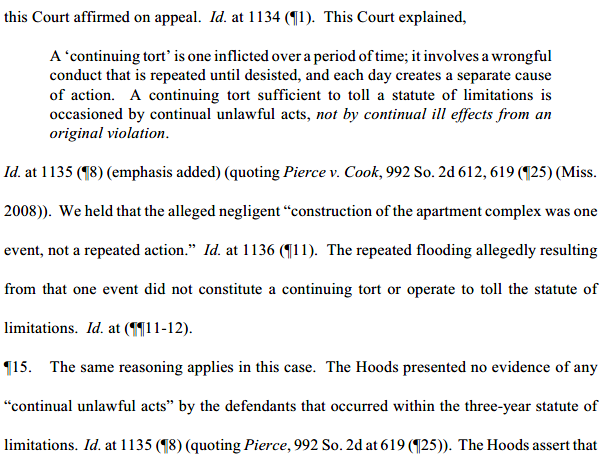
NOTE– I though this was a helpful summary and application of the continuing tort doctrine:


Dortch v. State, 2021-CP-00103-COA (Civil – PCR)
Affirming the circuit court’s dismissal of the plaintiff’s PCR motion and motion to vacate judgment and finding no error in the circuit’s revocation of the plaintiff’s PRS.
(All judges concurred.)


Skinner v. State, 2021-CA-00080-COA (Civil – PCR)
Affirming the circuit court’s denial of the plaintiff’s PCR motion related to the plaintiff’s 2011 conviction of felony evasion and sentence to life without parole as a habitual offender (with eight prior felony convictions), holding that the Eighth Amendment claim is barred by the doctrine of res judicata and without merit and that the circuit court did not err in refusing to consider mitigating circumstances surrounding Skinner’s juvenile convictions.
(Judge McCarty concurred in part and dissented in part. Judge McDonald dissented, joined by Chief Judge Barnes and Judge Westbrook, and joined in part by Judge McCarty. Judge Emfinger did not participate.)

NOTE – The majority and the dissenting opinions contain robust discussions of the Eight Amendment analysis.


Other Order

 Tallent v. State, 2020-CP-01077-COA (denying motion for rehearing)


Hand Down List Page

Mississippi Supreme Court Decisions of May 12, 2022

The Mississippi Supreme Court handed down six opinions today with subject matter covering capital murder conviction and death penalty, UM/UMI coverage, election contests, appellate procedure, wills, and judicial estoppel.


Johnson v. Brock, 2020-EC-00982-SCT (Civil – Election Contest/Summary Judgment)
Affirming summary judgment dismissing the plaintiffs’ contest the results of a city counsel election, holding that the plaintiffs failed to satisfy their burden in opposing summary judgment where the plaintiffs’ briefs relied upon affidavits that were not in the record and they otherwise failed to come forward with evidence that there were voting irregularities that led to their election losses.
(Justice King did not participate.)


Bufkin v. Geico Insurance Agency, Inc., 2021-CA-00251-SCT (Civil – Insurance/UM/UIM)
Affirming summary judgment in favor of the UM carrier, declining to overrule precedent holding that an employee is not legally entitled to make a claim under their employers’ underinsured motorist coverage.
(All justices concurred.)

Note – The plaintiff argued Mississippi’s law on this question of statutory interpretation was the minority approach and urged the Supreme Court to adopt the majority view. The Supreme Court declined to do so:


McRae v. Mitchell, 2021-IA-00101-SCT (Civil – Other/Interlocutory Appeal/Appellate Procedure)
Dismissing an appeal from a non-final judgment of the chancery court, explaining that the Mississippi Supreme Court treated the notice of appeal as a petition for interlocutory appeal and granted the petition, but held that it lacked jurisdiction since the notice of appeal was not filed within 21 days of after the entry of the non-final judgment.
(Chief Justice Randolph did not participate.)


Clark v. State, 2019-DP-00689-SCT (Criminal – Death Penalty – Direct Appeal)
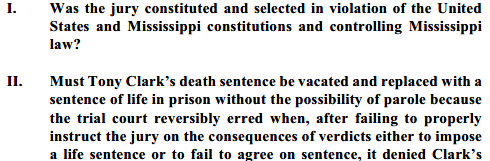
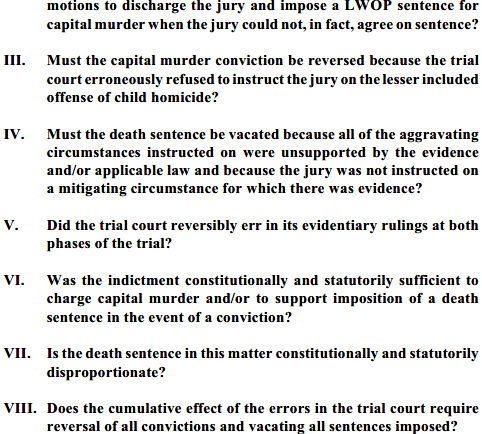
Affirming conviction of capital murder and sentence to death by lethal injection for the slaying of a convenience store clerk in Canton, Mississippi. The issues raised on appeal that the Mississippi Supreme Court addressed were:


(Justice Kitchens dissented, joined by Justice King and Justice Ishee. Justice King dissented, joined by Justice Kitchens and Justice Ishee.)

NOTE – The majority opinion is 99 pages long plus 13 pages of appendices. There are 34 pages of dissents. The curt summary above does not do this opinion justice because I simply do not have the bandwidth to tackle the details of this opinion at this moment.


Estate of Bakarich v. Bakarich, 2020-IA-00339-SCT (Civil – Wills, Trusts, and Estates/Interlocutory Appeal)
Affirming the chancellor’s denial of the co-executrices’ request based on a fee-shifting provision in the will seeking to make a challenger pay the estate’s attorney’s fees in defending challenges to the co-executrices’ actions, but reversing the the chancellor’s decision directing the co-executrices to personally pay the estate’s costs and attorney’s fees associated with the underlying motions and petitions.
(Justice King concurred in part and dissented in part, joined by Justice Kitchens. Justice Beam did not participate.)


Jones v. Alcorn State University, 2020-CA-01238-SCT (Civil – Other/Judicial Estoppel)
Affirming the dismissal of the plaintiff’s breach of contract lawsuit, holding that the plaintiff’s lawsuit was barred by the doctrine of judicial estoppel because the plaintiff failed to reveal his lawsuit in two bankruptcy filings.
(Justice Maxwell [1] wrote a special concurrence, joined by Chief Justice Randolph (who wrote the majority opinion)[2], Justice Coleman [3], Justice Beam [4], and Justice Chamberlin [5], and by Justice Griffis in part. Justice Griffis concurred in part and dissented in part, joined by justice Kitchens.)

Question – What is the effect of a five-justice special concurrence from a nine-member court? Anything other than letting future litigants know that a majority of the court agrees whatever propositions are in the special concurrence? I will look into it later, but I do not know the answer off the top of my head.


Other Orders

Augustine v. State, 2019-CT-01467-SCT (denying motion for rehearing)
Johnson v. State, 2019-CT-01801-SCT (dismissing cert petition)
Figueroa v. State, 2020-CT-00114-SCT (denying cert petition)
Piccaluga v. State, 2020-CT-00346-SCT (denying cert petition)


Hand Down List Page


One more thing – At some point early this morning this blog had its 1,000th unique visit and passed 1,800 total hits in the three months since I launched it. Many thanks to those who have visited, subscribed, and shared the blog and to those who have provided encouragement and helpful feedback. I hope that it has been and continues to be a useful resource.

Mississippi Court of Appeals opinions of May 10, 2022

The Mississippi Court of Appeals set a new record since the launch of this blog by handing down fourteen opinions. After briefly contemplating a dash to the exit, I decided to slog through all of them so you don’t necessarily have to. Needless to say, there is something for everybody today!

(Apologies for the all-but-certain uptick in typos)


Fugler v. Bank of Brookhaven, 2021-CA-00303-COA (Civil – Personal Injury/Premises Liability)
Affirming summary judgment in favor of the defendant in a slip and fall case, holding that the plaintiff, who allegedly tripped on a floor mat but testified she did not see the mat before tripping, failed rebut the defendant’s summary judgment motion and supporting affidavit stating that the bank had no knowledge of prior incidents with its floor mats or any issues with the mat involved, that around 300 customers entered the bank daily and the bank was not aware of any prior mat-related trips or complaints, that the mat was heavy-duty commercial grade and was replaced annually to prevent wear, and that bank employees constantly monitored the floors.
(All judges concurred.)


Keys v. Military Department Gulfport, 2021-WC-00352-COA (Civil – Workers’ Comp)
Reversing the Commission’s finding that the Employer/Carrier was entitled to a credit for indemnity payments that the claimant received but assigned back to the employer during the time the claimant was receiving paid sick leave, holding that since the claimant was awarded permanent total disability benefits, section 25-3-95(2)(b) (prohibiting a state employee from using accrued personal and/or medical leave and receiving workers’ comp to earn more than 100% of his state-employment wages) did not apply.
(Judge Wilson specially concurred, joined in part by Judge McCarty.)

NOTE – I think Judge Wilson’s special concurrence provides a clearer path forward in workers’ comp cases: Regardless of whether the indemnity benefits during the time in question were classified as TTD or PTD, the claimant was entitled to a total of 450 weeks of indemnity benefits (however classified) and since the claimant did not receive any indemnity benefits during the period he was assigning benefits back to the Employer, the Employer/Carrier were not entitled to a credit for those weeks.


Smith v. State, 2021-CP-00099-COA (Civil – PCR)
Affirming the circuit court’s denial of a pro se plaintiff’s PCR petition, holding that the plaintiff presented no evidence to show a reasonable ground for the trial court to believe he was incompetent to plead guilty.
(All judges concurred.)


Prystupa v. Rankin County Board of Supervisors, 2020-CA-01049-COA (Civil – MTCA/Statute of Limitations/Latent Injury)
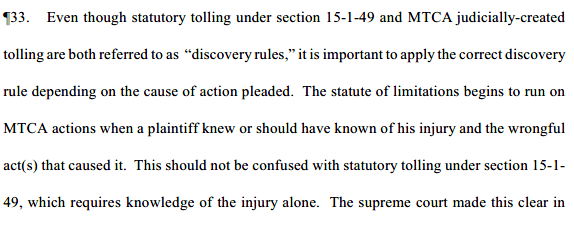
Affirming the dismissal of a flooding damage MTCA claim based on the running of the statute of limitations, holding that this claim was an MTCA negligence claim subject to a one-year statute of limitations that began to run when the plaintiff knew or should have known of both the injury and its probable cause. In this case, the Court of Appeals held that the statute of limitations began to run when the plaintiff knew of the flooding (the injury) and knew it was due to a blocked drain (the cause) as opposed to when he found out that crushed pipe caused the blocked drain (i.e. caused the cause). The Court of Appeals also affirmed the circuit court’s denial of the plaintiff’s Rule 59(e) motion to aleter or amend based on fraudulent concealment and the circuit court’s denial of the plaintiff’s motion for leave to amend his complaint to add claims of nuisance and trespass.
(Judge McCarty concurred in part and in the result without separate written opinion. Judge Emfinger did not participate.)

TAKE HEED, lest you fall victim to the distinction between “statutory tolling” and “MTCA tolling”:


Schmidt v. Schmidt, 2020-CA-01253-COA (Civil – Custody)
Affirming the chancellor’s decision granting sole physical custody to the mother, holding that there was no error in finding that the deterioration of the parties’ ability to co-parent constituted a material change in circumstances entitling the mother to sole physical custody and no error in the application of the Albright factors.
(Judge Wilson concurred in part and in the result without separate written opinion.)


Smith v. Mississippi Department of Public Safety, 2021-SA-00020-COA (Civil – State Boards and Agencies)
Affirming the circuit court’s judgment affirming the Mississippi Employee Appeals Board’s decision upholding the claimant’s termination, holding that the claimant’s procedural due process rights were not violated because he was provided notice of the charges and an opportunity to be heard, that his substantive due process rights and rights under the MS State Personnel Board rules were not violated because the MEAB’s decision was supported by substantial evidence and was not arbitrary, and that the claim that the claimant was terminated because of communications with his wife and that the MEAB’s decision was based on uncorroborated hearsay was without merit.
(All judges concurred.)


McIntosh Transport, LLC v. Love’s Travel Stop & Country Stores, Inc., 2021-CA-00154-COA (Civil – Contract/Arbitration)
Reversing the circuit court’s order granting the defendants’ motion to compel arbitration, holding that the contract containing the contract was not binding on the plaintiff because it was signed by a 19-year-old who signed his grandfather’s name and whose only authority was the actual authority to retrieve the truck following repairs that did not include the authority to bind the company to arbitration.
(Chief Judge Barnes concurred in part and in the result without separate written opinion. Judge Carlton concurred in the result only without separate written opinion.)


Case v. Case, 2020-CA-01047-COA (Civil – Custody/Equitable Distribution of Marital Property/Albright Factors/Ferguson Factors)
Affirming the chancellor’s decision on child custody, but reversing the chancellor’s decision on the equitable distribution of marital property. Regarding custody, the Court of Appeals held that the chancellor’s application of the Albright factors was supported by substantial evidence. Regarding equitable distribution, the Court of Appeals affirmed all of the chancellor’s findings except his valuation of the marital property which it reversed and rendered due to a calculation error.
(Judge Wilson and Judge Westbrooks concur in part and in the result without separate written opinion.)

MY TAKE – Few, if any, of us are in the legal field because of a proclivity for math yet it still haunts us all.


Wadley v. Hubbs, 2021-CA-00866-COA (Civil – Real Property/Notice of Appeal)
Reversing the circuit court’s dismissal of the plaintiff’s appeal from a county court judgment as untimely, holding that the plaintiff’s notice of appeal that was stamped “Filed” after the county court’s judgment but before disposition of the plaintiff’s motion to set aside the judgment was effective and timely even though the header of the notice said “IN THE COUNTY COURT” because the body of the notice made it clear the plaintiff was appealing to the circuit court and the notice was stamped “Filed” by the circuit clerk.
(All judges concurred.)


Murray v. State, 2021-KA-00264-COA (Criminal – Felony/Hearsay/Rule 412)
Affirming conviction of statutory rape, holding that the circuit court erred in allowing the victim’s mother’s to testify about a neighbor’s out-of-court statement, but that it was harmless and “essentially cumulative evidence of non-criminal activity that [the defendant] admitted.” The Court of Appeals also held that the circuit court did not err in denying the defendant’s ore tenus request to compel the victim’s counseling records because even though a determination of whether the records were privileged could not be made until the records were examined, the defendant did not comply with Rule 412 of the Mississippi Rules of Evidence. The Court of Appeals also held that the plaintiff’s claims of ineffective assistance of counsel for failure to request an alibi instruction, failure to object to hearsay, failure to request a limiting instruction regarding the hearsay testimony, and failure to make a timely request for the victim’s counseling records did not entitled him to relief on this appeal.
(All judges concurred.)


Bailey v. State, 2021-KA-00281-COA (Criminal – Felony/Lindsey Brief)
Affirming conviction of fondling of a six-year-old and sentence to life imprisonment as a violent habitual offender, noting that the defendant’s appointed appellate counsel filed a Lindsey brief and holding that the defendant’s pro se brief arguing that the trial court lacked jurisdiction and that his indictment was not marked “filed” was factually mistaken and without merit.
(Judge Smith did not participate.)


Finley v. PERS, 2021-SA-00089-COA (Civil – State Boards and Agencies/PERS/Disability)
Reversing the circuit court’s judgment affirming PERS Medical Board’s denial of the plaintiff’s claim for non-duty-related disability retirement benefits, holding that PERS’s assessment of the plaintiff’s job requirements and ability to perform her job was arbitrary and capricious. The case was remanded for PERS to determine if the plaintiff could perform the true duties of registrar with her disability and the support staff, if any, she had at the time.
(Judge Wilson concurred in part and in result without separate written opinion.)


Boyd v. MDOC, 2021-CC-00459-COA (Civil – State Boards and Agencies/MDOC)
Affirming the MDOC’s disciplinary actions against the plaintiff whose oversight led to MDOC’s failure to issue an arrest warrant for a probationer who did not report to his assigned probation office upon release from MDOC custody who then killed two Brookhaven police officers in the line of duty, holding that the plaintiff failed to meet her burdens of proof and persuasion to overcome the presumption of correctness due MDOC’s decision.
(All judges concurred.)


Parker v. Ross, 2020-CA-01055-COA (Civil – Wills, Trusts, and Estates)
Affirming in part and reversing in part the chancery court’s grant of summary judgment in a claim alleging mismanagement of a trust and to recover real property that was allegedly improperly sold. The Court of Appeals affirmed the chancellor’s judgment in part, holding that any claims governed by the three-year statute of limitations were time-barred. The Court of Appeals also reversed the chancellor’s judgment in part, holding that the allegations related to the mismanagement of the trust were subject to a ten-year statute of limitations and that one of the plaintiffs had created a genuine issue of material fact as to his unsoundness of mind and remanded this matter to the chancery court for further proceedings.
(Judge Emfinger dissented, joined by Judge Wilson and Judge Greenlee and joined in part by Judge McDonald.)


Other Orders

Lawrence v. State, 2021-TS-1324-COA (providing, on the court’s own motion, the appellant and his attorney, Wayne Dowdy, one final opportunity to show cause why this appeal should not be dismissed as untimely)


Phew…