Mississippi Supreme Court Decisions of November 17, 2022

I did not post Court of Appeals decisions on Tuesday because I was in an all-day deposition and went from there to a pinewood derby. I will try to catch up on those later. But today the Mississippi Supreme Court handed down two opinions. One deals with the MTCA’s venue provisions in a wrongful-death case and the other disposes of an appeal of felony convictions and sentencing with an interesting Fourth Amendment analysis.


Jones County v. Estate of Bright, 2021-IA-00631-SCT (Civil – Wrongful Death)
Reversing the circuit court’s denial of venue change in an MTCA case stemming from a police chase that killed a bystander, holding on interlocutory appeal that under the MTCA venue was only proper in the counties where the administrative offices of the political-subdivision defendants are located (Jones or Lauderdale), and not where the acts or omissions occurred (Pearl River) because the state was not a named defendant.
(8-0: Chief Justice Randolph did not participate)


Fisher v. State, 2021-KA-00828-SCT (Civil – Felony)
Affirming convictions of drug possession and trafficking charges and sentencing as a habitual offender, holding that the defendant was not denied the right to testify on his own behalf where the record was silent as to whether he wanted to testify, that there was no Fourth Amendment search when officers climbed a ladder in a common area with the building owner’s permission to look into the defendant’s ceilingless storage unit, and that resentencing was not necessary because the trial court imposed the mandatory minimum for the aggravated trafficking conviction not on his habitual offender status that was determined without sufficient evidence.
(9-0)


Other Orders

In Re: Commission on Mandatory Continuing Legal Education, 89-R-99011-SCT (granting Petition of the Mississippi Commission on Continuing Legal Education allowing attorneys to complete their CLE obligations set forth in Rule 3 through online, webinars or live, in-person programs for the 2022-2023 CLE reporting year)

In Re: Rules Governing Admission to the Mississippi Bar, 89-R-99012-SCT (granting Petition to Amend the Rules Governing Admission to the Mississippi Bar filed by the Mississippi Board of Bar Admissions; denying Petition to Amend Rule IV §8 of the Rules Governing Admission to the Mississippi Bar filed by Jefferson Carl Harvey on April 21, 2022 and the Emergency Petition to Amend Rule IV Section 8 of the Rules Governing Admission to the Mississippi Bar filed by Applicant 11596 on June 25, 2021; and dismissing Petition for Ruling Regarding Motion #2022-1321 A/K/A “Petition to Amend the Rules Governing Admission to the Mississippi Bar” filed by Jefferson Carl Harvey on October 31, 2022)

Rules for Court Reporters, 89-R-99021-SCT (amending The Rules and Regulations Governing Certified Court Reporters)

Beale v. State, 2020-CT-00614-SCT (granting cert)

Devine v. Cardinal Health 101, LLC, 2020-CT-01101-SCT (granting joint motion to suspend cert proceedings and dismiss cert petition as moot)

Adams v. State, 2020-CT-01383-SCT (denying cert)

Adams v. State, 2020-CT-01383-SCT (denying pro se cert petition)

Watts v. State, 2021-KA-00873-SCT (denying rehearing)

Hand Down Page

Mississippi Supreme Court Decisions of November 3, 2022

The Mississippi Supreme Court handed down no opinions today. The hand-down list had three orders, one was an interesting cert grant in a criminal case.


Powers v. State, 2017-DR-00696-SCT (denying the State’s Motion to Dismiss Petitioner’s Motion to Rehear the Court’s June 21, 2022 Order Denying Petitioner’s Motion to Hold PCR Proceedings in Abeyance)

Manuel v. State, 2020-CT-00711-SCT (granting cert)

Here is the COA opinion in Manuel v. State. The dissent's contention was limited to the sentencing as a habitual offender. Specifically, the dissent concluded that the habitual-offender portions of the sentence were not supported by sufficient evidence and should be reversed under plain error review.

Manuel v. State, 2020-KA-00711-COA (Criminal – Felony/Excited Utterance)
Affirming convictions and sentences for second-degree murder and aggravated assault, holding that the circuit court did not abuse its discretion by (1) admitting testimony under the excited-utterance hearsay exception, (2) excusing a juror mid-trial for failure to disclose information during voir dire, (3) collecting the parties’ jury panel information sheets following jury selection and placing them under seal, or (4) sentencing the defendant as a habitual offender.
(Judge Westbrooks concurred in part and dissented in part, joined by Judge McDonald and Judge McCarty; Judge McDonald and Judge McCarty concurred in part and dissented in part without separate written opinion; and Judge Emfinger concurred in part and in the result without separate written opinion)

The cert petition led with the sentencing issue, but also raised issues related to the trial court's finding that certain defense witnesses' testimony was hearsay and not excited utterances and the trial court's admission of State witness testimony under that hearsay exception.

Edwards v. State, 2021-CT-00259-SCT (denying cert)


Hand Down List

Mississippi Supreme Court Decisions of October 6, 2022 (Rewind)

I did not post summaries from the first week of October because I was out of town with my family doing something much more fun that summarizing opinions. This is a catch-up post. There was not a whole lot from the Mississippi Supreme Court that week, unless you are a digital photographer in which case it appears to have been a good week for you.


Mississippi Department of Revenue v. EKB, Inc., 2021-SA-00441-SCT (Civil – State Boards and Agencies)
Affirming the chancery court’s order vacating the Mississippi Department of Revenue’s sales tax assessment against a wedding photography business, holding that photography is not a taxable business activity (unlike film development and photo finishing) and that still digital images are not taxable digital products.
(8-0: Justice Coleman did not participate.)

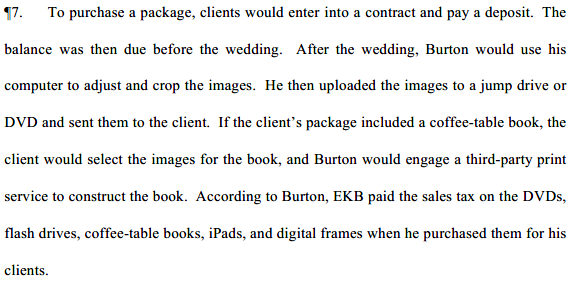
NOTE – I am neither a tax lawyer nor a photographer, but this seems like quite a win for digital photographers. Here are some particulars about the photography business at issue that gives context for the decision.


Other Orders

Johnson v. State, 2015-CT-01064-SCT (dismissing cert petition)

Wayne County Sch. Dist. v. Quitman Sch. Dist., 2020-CA-00499-SCT (denying rehearing)

Butler v. State, 2020-CT-00806-SCT (granting cert)

Haynes v. State, 2020-CT-01397-SCT (denying cert)

Fluker v. State, 2021-CT-00162-SCT (dismissing cert petition)

In Re: Hon. James McClure, III and Hon. Gerald W. Chatham, Sr.; 2022-IA-00319-SCT (denying petition for writ of prohibition)


Hand Down Page

Mississippi Supreme Court Decisions of October 27, 2022

Today was a lean day from the Mississippi Supreme Court. No opinions were handed down, but four orders were listed on the hand-down page. I have reposted the summary of one decision from last week about pleading affirmative defenses because I do not think the importance of heeding that decision can be overstated.


Other Orders

Booker v. State, 2018-CT-00664-SCT (denying cert in PCR case)

Porras v. State, 2021-CT-00052-SCT (dismissing cert petition in PCR case as untimely filed)

Carter v. Total Foot Care, 2021-CT-00610-SCT (denying cert where the COA affirmed summary judgment that was based RFAs deemed admitted because the plaintiff failed to respond to them)

In Re: Administrative Orders of the Supreme Court of Mississippi, 2022-AD-00001-SCT (directing the disbursement of $156,119.26 in civil legal assistance funds among the MS Volunteer Lawyers Project, North MS Rural Legal Services, and MS Center for Legal Services)


Reposting from last week to save a life:

Pruitt v. Sargent, 2021-CA-00511-SCT (Civil – Personal injury)
Reversing the circuit court’s decision granting the defendant’s motion to dismiss based on the running of the statute of limitations, holding that the defendants waived the statute of limitations defense by failing to adequately plead it in their answer.
(6-2-0: Justice Coleman concurred in part and in the result, joined by Justice Griffis; Justice Beam concurred in the result only without separate written opinion)

PRACTICE POINT – The Supreme Court laid down some black-letter law today on pleading the statute of limitations as an affirmative defense and its reasoning probably applies to other affirmative defenses. The Court took a look at the defenses that were pleaded and found they fell short of the standard:

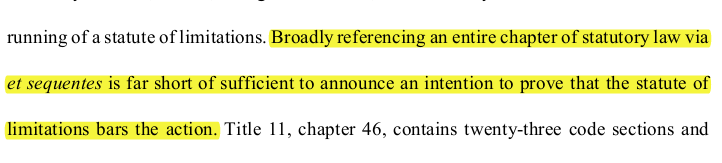
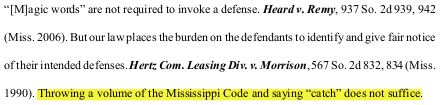
Then, the Court said flatly that et seq. didn’t cut it:

In case the message has not been received, consider:

Be careful out there.

Mississippi Supreme Court Decisions of October 20, 2022

[For reasons unknown, when I tried to publish this post earlier WordPress would only show the title with none of the content in the body. It seems to be working now. My apologies to those who have gotten multiple emails with no content.]

The Mississippi Supreme Court handed down four cases today, all civil. Two in particular are of general interest to civil practitioners. One deals with whether an et seq. or “catchall” defense was sufficient to preserve the statute of limitations as an affirmative defense and the other reviews a discovery order from the trial court. Then there are two jurisdiction cases: one deciding whether the circuit court (as opposed to the oil and gas board) has jurisdiction to hear claims against an oil company and the other whether the circuit court has jurisdiction to hear imperfect but timely notices of appeal from local government decisions.


Tiger Production Company, LLC v. Pace, 2021-IA-00315-SCT (Civil – Property Damage)
Affirming the circuit court’s denial of the defendant’s motion to dismiss on interlocutory appeal, holding that the plaintiff’s claims for compensatory and punitive damages based on allegations that an oil company put a saltwater disposal line across the plaintiff’s property without permission were purely common law claims and could not be remedied by the MS Oil and Gas Board.
(8-0: Justice Beam did not participate)


Lawson v. City of Jackson, 2021-IA-00532-SCT (Civil – Personal Injury)
Affirming in part and reversing/remanding in part a discovery order from the trial court on interlocutory appeal, holding that the trial court did not abuse its discretion in entering a protective order providing that a party did not have to respond to written discovery that would not be due until after the discovery deadline but holding that the trial court abused its discretion in restricting the plaintiff’s access to public records and in preventing the plaintiff from introducing any such public records at trial.
(9-0)


Pruitt v. Sargent, 2021-CA-00511-SCT (Civil – Personal injury)
Reversing the circuit court’s decision granting the defendant’s motion to dismiss based on the running of the statute of limitations, holding that the defendants waived the statute of limitations defense by failing to adequately plead it in their answer.
(6-2-0: Justice Coleman concurred in part and in the result, joined by Justice Griffis; Justice Beam concurred in the result only without separate written opinion)

PRACTICE POINT – The Supreme Court laid down some black-letter law today on pleading the statute of limitations as an affirmative defense and its reasoning probably applies to other affirmative defenses. The Court took a look at the defenses that were pleaded and found they fell short of the standard:

Then, the Court said flatly that et seq. didn’t cut it:


Longo v. City of Waveland, 2021-CA-00735-SCT (Civil – State Boards and Agencies)
Reversing the circuit court’s dismissal in two consolidated cases where the circuit court dismissed appeals from local governments for lack of jurisdiction, holding that a notice of appeal that is timely filed but that erroneously omits a petitioner’s name has a procedural defect that does not defeat jurisdiction and can be corrected.
(5-4: Justice Chamberlin dissented, joined by Justice Coleman, Justice Maxwell, and Justice Beam.)


Other Orders

Bridges v. State, 2020-CT-00816-SCT (denying cert)
SRHS Ambulatory Services, Inc. v. Pinehaven Group, LLC, 2020-CA-01355-SCT (denying rehearing)


Hand Down List

Mississippi Supreme Court Decisions of October 13, 2022

The Mississippi Supreme Court handed down three opinions today. The first addresses whether the use of a residential home violated a covenant prohibiting commercial use. The second opinion contains a thorough analysis of a personal jurisdiction issue (citing classics like International Shoe and World-Wide Volkswagen). The third opinion involves the allocation of sixteenth-section funds between neighboring school districts. The Court also handed down an en banc order on a motion for leave to file successive petition for PCR that is linked below.


Scioto Properties SP-16, LLC v. Graf, 2021-CA-00525-SCT (Civil – Real Property)
Affirming the chancery court’s holding that a for-profit LLC used a home commercially, holding that the “leas[ing] of the home for the specific and sole purpose of providing the residential support services itself and being compensated for doing so through Medicaid” violated a restrictive covenant against commercial use.
(9-0)

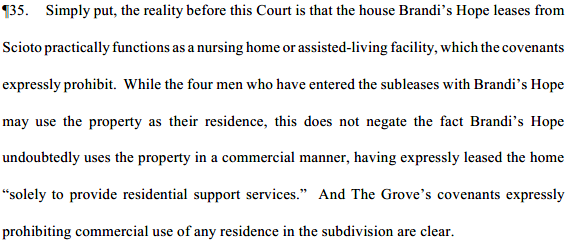
NOTE – The Court explained that the commercial services were “integral” and “not merely incidental” to the operation of the home and summarized the holding as follows:


Dillworth v. LG Chem, Ltd., 2021-CA-00629-SCT (Civil – Personal Injury)
Reversing the circuit court’s ruling that it lacked personal jurisdiction over a South Korean battery manufacturer, holding that the manufacturer placed the batteries in the stream of commerce and purposefully availed itself of the market for batteries in Mississippi and was subject to personal jurisdiction in Mississippi and holding that the plaintiff was entitled to jurisdictional discovery as to a Georgia-based subsidiary of the manufacturer.
(9-0)

PRACTICE POINT – This decision is the latest full-bore analysis of personal jurisdiction and it comes from a unanimous Supreme Court. Go ahead and bookmark this one.


Jones County School District v. Covington County School District, 2019-IA-00985-SCT (Civil – Real Property)
Vacating the chancellor’s ruling in a dispute over sixteenth-section income from townships shared by neighboring school districts and remanding, holding that the statute conditioning annual payment of sixteenth-section funds on the exchange of lists of educable children is constitutional and that the maintenance of the principal fund by the custodial district is subject to an action in equity for accounting.
(6-3: Justice Griffis concurred in part and dissented in part, joined by Justice Kitchens and Justice King)


Other Orders

Ware v. Ware, 2020-CA-00702-SCT (denying motions for rehearing)
Moffett v. State, 2018-DR-00276-SCT (denying motion for leave to file successive petition for PCR)
Smith v. Mississippi Department of Public Safety, 2021-CT-00020-SCT (denying cert)
Barnes v. State, 2021-CT-00404-SCT (denying cert)


Hand Down List

Mississippi Supreme Court Decisions of September 29, 2022

The Mississippi Supreme Court handed down four opinions today. There is a case dealing with an attempt to collect early termination fees after a new board of supervisors terminated a service contract, a case dealing with a thorny procedural issue after a default judgment was entered on a counterclaim in an appeal from justice court, a domestic case regarding the parent’s school choice with potentially broader implications, and a criminal case addressing the weight of the evidence and improper testimony about prior convictions.


Broadband Voice, LLC v. Jefferson County, Mississippi, 2021-CA-01082-SCT (Civil – Contract)
Affirming the circuit court’s dismissal of a phone and internet company’s claim for early termination fees against the county after new slate of supervisors terminated the service contract, holding that under the plain language of the contract the fee was due on the termination date rather than the date of the notice of termination and that the early-termination-fee provision that was negotiated by the prior board was unenforceable against the subsequent board.
(9-0)


Gordon v. Dickerson, 2020-CT-00601-SCT (Civil – Real Property)
Reversing the Court of Appeals, the circuit court, and the county court for denying the landlord’s motion to set aside a default judgment in county court on the tenant’s counterclaim that she asserted on appeal from justice court, holding that the landlord was not in default for purposes of Rule 55 because the counterclaim was filed in violation of Rule 15(a) (re: amendment of pleadings) and Rule 13(k) (re: appeals from justice court) cannot be read to the exclusion of Rule 15(a).
(5-4: Chief Justice Randolph dissented, joined by Justice Kitchens and Justice Ishee; Justice King dissented, joined by Justice Kitchens.)

Practice Point – There is a lot of explanation of the various rules in play in this decision. Bookmark this one and re-read it whenever you handle and appeal from justice court.


Bryant v. Bryant, 2020-CT-00883-SCT (Civil – Domestic Relations)
Affirming the Court of Appeals and the chancellor in ordering that the three minor children attend a specific public school district over the wishes of their father who was made the “final decision maker” on such matters, holding that the language of the property settlement agreement authorized the chancellor use its powers “as superior guardian to make decisions that are in the best interest of children.”
(6-3: Justice Coleman dissented, joined by Justice Maxwell and Justice Griffis; Justice Maxwell wrote a separate dissent joined by Justice Coleman.)

NOTE – The majority and the dissents disagree on a big-picture issue: the relationship between the government’s role in the relationship between parents and children. Take a few minutes and read the majority and both dissents.


Moore v. State, 2021-KA-00420-SCT (Criminal – Felony)
Affirming conviction of aggravated assault, holding that the verdict was not against the overwhelming weight of the evidence because inconsistencies in testimony did not render the verdict implausible and holding that although it was improper for the prosecution to directly elicit testimony about past convictions the error was potentially waived and ultimately harmless.
(6-3-0: Justice Maxwell concurred in part and in the result, joined by Chief Justice Randolph and Justice Beam.)


In Re: Rules Governing Admission to The Mississippi Bar, 89-R-99012-SCT (reappointing Pieter Teeuwissen, Marcie Fyke Baria, and Gwendolyn Baptist-Rucker to three-year terms (11/1/22 through 10/31/25) as members of the Mississippi Board of Bar Admissions)
Millette v. Frazier, 2022-M-00451-SCT (denying petition for permission to appeal and lifting stay of trial court proceedings)


Hand Down List

Mississippi Supreme Court Decisions of September 22, 2022

The Mississippi Supreme Court handed down three opinions today. Two are criminal cases dealing with issues that occurred during voir dire. In one, the issue was an inculpatory exclamation by the defendant. In the other, the issue was two jurors’ undisclosed connection the defendant. The third opinion is a journey through contempt law.


Scott v. State, 2021-KA-01015-SCT (Criminal – Felony)
Affirming conviction of burglary, holding that the court did not abuse its discretion denying the defendant’s attorney’s request for a mistrial after the defendant exclaimed during voir dire that he was “guilty as hell.”
(9-0)

Note – This decision seems correct to me.


Watts v. State, 2021-KA-00873-SCT (Criminal – Felony)
Affirming denial of a JNOV after the defendant was convicted of conspiracy to commit armed robbery, attempted armed robbery, aggravated assault, and possession of a firearm by a convicted felon and a denial, holding that although two jurors did not disclose that they were related to a man who was murdered by the defendant’s brother in 2006 the court did not commit clear error in determining after an evidentiary hearing that those jurors lacked substantial knowledge of their connection with the defendant during voir dire.
(9-0)


Seals v. Stanton, 2020-CA-00741-SCT (Civil – Domestic Relations)
This decision waded into a morass of contempt and affirmed the chancellor in part, reversed and remanded in part, and vacated in part. The Supreme Court affirmed the chancellor’s finding that two attorneys handling a divorce proceeding were in direct criminal contempt for missing a hearing, vacating the penalty for that because it exceeded statutory authority and remanded on that issue, and affirmed an award of attorney’s fees to the other side. The Supreme Court vacated judgment of direct criminal contempt against another attorney and remanded for proceedings on under the constructive criminal contempt standards. The Supreme Court held that the chancellor erred in finding these attorneys in direct criminal contempt for violating a court order and remanded for a determination of whether an indirect civil contempt proceeding should be commenced.
(6-3: Justice Kitchens dissented, joined by Justice King and Justice Coleman.)

Practice Point – Don’t miss hearings. Don’t violate orders. If you have further questions about what went wrong here or about the intricacies of direct criminal contempt, indirect/constructive criminal contempt, and civil contempt I refer refer you to the opinion and wish you the best.


Other Orders

Hamer v. State, 2019-CT-01633-SCT (denying cert)
Nowell v. Stewart, 2020-CT-00728-SCT (denying cert)
Johnson v. State, 2022-CT-01308-SCT (dismissing cert sua sponte)


Hand Down List

Mississippi Supreme Court Decisions of September 15, 2022

The Mississippi Supreme Court handed down three opinions from very different areas of law without a single dissent today. The first is a criminal case challenging the sufficiency and weight of the evidence. The second deals with the circuit court’s subject matter jurisdiction over a election contest. The third is a divorce appeal dashed on the rocks of 54(b).


Burden v. State, 2021-KA-00782-SCT (Criminal – Felony)
Affirming conviction of aggravated assault and denial of the defendant’s motion for new trial, holding that the evidence including testimony, medical records, and photographs was sufficient to show that the victim suffered serious bodily injury and that the defendant attempted to cause serious bodily injury and the verdict was not against the overwhelming weight of the evidence.
(9-0)


Holliday v. Devaull, 2021-EC-00486-SCT (Election Contest)
Reversing the circuit court’s decision ordering a special election, holding that the circuit court lack subject matter jurisdiction because the plaintiff failed to file a sworn copy of his complaint to the Aberdeen Municipal Democratic Executive Committee within the 10-day statutory period and that the second amended petition did not relate back to the original petition.
(9-0)


Williams v. Williams, 2021-CA-00875-SCT (Civil – Domestic Relations)
Dismissing the appeal, holding that an order granting husband’s motion to enforce the divorce agreement and entering what was called a “final judgment” incorporating the divorce agreement was not a final, appealable judgment because the court had not resolved the wife’s complaint for divorce and the grounds for divorce.
(8-1-0)

Practice Point – Our remorseless foe Rule 54(b) strike again. If anything is left to be decided, be sure the judgment you want to appeal contains the magic language of a Rule 54(b) final judgment.


Other Orders

Miles v. State, 2019-CT-00895-SCT (rehearing denied)
Mingo v. McComb School District, 2020-CT-00022-SCT (denying cert)
Simmons v. Town of Goodman, Mississippi, 2021-EC-00563-SCT (denying rehearing)


Hand Down List

Mississippi Supreme Court Decisions of September 1, 2022

The Mississippi Supreme Court handed down three opinions today. Two are criminal cases (one affirmed and one reversed/remanded over a speedy trial issue and resentencing). The other is a breach of contract case with a tough result for a law firm stuck with the tab after dealings with the State Auditor’s office (while under previous management).


Haymon v. State, 2021-KA-00240-SCT (Criminal – Felony)
Affirming Pernell and Haymon’s convictions of armed robbery, kidnapping, and aggravated assault, holding that the circuit court did not err in denying Pernell’s motion for directed verdict and/or motion for new trial because the evidence was sufficient and the verdict was not against the overwhelming evidence or in denying her request for a lesser included offense jury instruction for simple assault, and that the circuit court did not err in denying Haymon’s motion to suppress a photo identification lineup over the defendant’s arguments that an officer tainted the procedure by providing the witness with the defendant’s name and that the features of the individuals used in the lineup were suggestive.
(9-0)

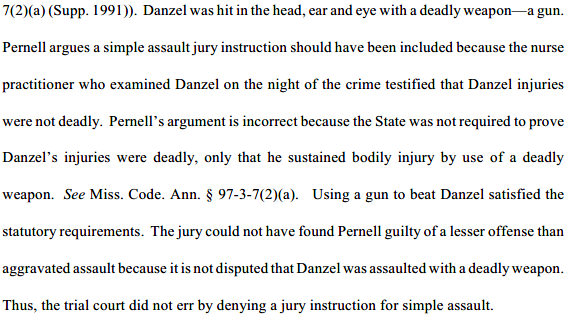
NOTE – On the issue of whether it was error to the lesser included instruction on simple assault, the Supreme Court explained that aggravated assault occurs when there is assault with a deadly weapon and that severity of the injury is irrelevant:


White v. Jernigan Copeland Attorneys, PLLC, 2020-IA-01404-SCT (Civil – Contract)
Reversing the circuit court’s denial of the Office of the State Auditor’s motion for summary judgment in a suit filed by a law firm seeking damages for a judgment it had to pay a public-relations firm that the law firm contracted with at the direction of then Auditor Pickering, holding that the retention agreement between the OSA and the law firm was void for lack of statutory compliance and that the law firm’s equitable claims against the OSA were barred by the MTCA’s statute of limitations, sticking the law firm with the (substantial) tab from the PR firm it contracted with at Pickering’s direction in anticipation of filing a suit that Pickering decided not to file.
(8-1-0: Chief Justice Randolph concurred in the result only without separate written opinion)

NOTE – This result is brutal. Pickering provided an affidavit to support the law firm’s quest to have the OSA pay the damages but the outcome of the case was controlled by statutes.


Ward v. State, 2021-KA-00664-SCT (Criminal – Felony)
Reversing the circuit court and remanding for a speedy trial-analysis and (assuming no violation is found) re-sentencing, holding that the circuit court did not conduct a proper analysis of the Barker factors when it denied the defendant’s motion to dismiss for lack of a speedy trial and erred in sentencing the defendant as a habitual offender because the proper evidence of the prior convictions was not admitted into evidence.
(7-2: Justice Maxwell concurred in part and dissented in part on the resentencing issue, joined by Justice Griffis)

COVID ADDENDUM – The COVID pandemic accounted for part of the delay in bringing this case to trial, but the Supreme Court explained that blaming COVID does not cure all delay:


Other Orders

In Re: Rules of Discipline for the Mississippi Bar, 89-R-99010-SCT (reappointing Hon. Johnnie McDaniels, Mack A. Reeves, Amy K. Taylor, Hon. Jennifer T. Schloegel, Renee M. Porter, Henry B. Zuber III, Hon. H. Craig Treadway, Jason D. Herring, and Rachel Pierce Waide to three-year terms as members of the Complaint Tribunals)

Shannon v. Shannon, 2020-CT-00847-SCT (granting cert) (COA opinion summary and link here)


Hand Down List