Mississippi Supreme Court Decisions of May 12, 2022

The Mississippi Supreme Court handed down six opinions today with subject matter covering capital murder conviction and death penalty, UM/UMI coverage, election contests, appellate procedure, wills, and judicial estoppel.


Johnson v. Brock, 2020-EC-00982-SCT (Civil – Election Contest/Summary Judgment)
Affirming summary judgment dismissing the plaintiffs’ contest the results of a city counsel election, holding that the plaintiffs failed to satisfy their burden in opposing summary judgment where the plaintiffs’ briefs relied upon affidavits that were not in the record and they otherwise failed to come forward with evidence that there were voting irregularities that led to their election losses.
(Justice King did not participate.)


Bufkin v. Geico Insurance Agency, Inc., 2021-CA-00251-SCT (Civil – Insurance/UM/UIM)
Affirming summary judgment in favor of the UM carrier, declining to overrule precedent holding that an employee is not legally entitled to make a claim under their employers’ underinsured motorist coverage.
(All justices concurred.)

Note – The plaintiff argued Mississippi’s law on this question of statutory interpretation was the minority approach and urged the Supreme Court to adopt the majority view. The Supreme Court declined to do so:


McRae v. Mitchell, 2021-IA-00101-SCT (Civil – Other/Interlocutory Appeal/Appellate Procedure)
Dismissing an appeal from a non-final judgment of the chancery court, explaining that the Mississippi Supreme Court treated the notice of appeal as a petition for interlocutory appeal and granted the petition, but held that it lacked jurisdiction since the notice of appeal was not filed within 21 days of after the entry of the non-final judgment.
(Chief Justice Randolph did not participate.)


Clark v. State, 2019-DP-00689-SCT (Criminal – Death Penalty – Direct Appeal)
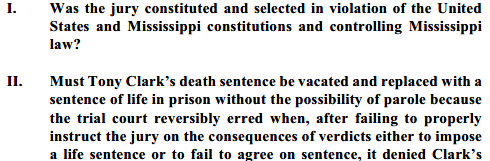
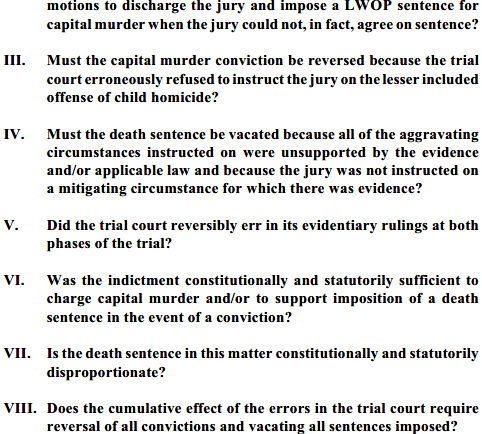
Affirming conviction of capital murder and sentence to death by lethal injection for the slaying of a convenience store clerk in Canton, Mississippi. The issues raised on appeal that the Mississippi Supreme Court addressed were:


(Justice Kitchens dissented, joined by Justice King and Justice Ishee. Justice King dissented, joined by Justice Kitchens and Justice Ishee.)

NOTE – The majority opinion is 99 pages long plus 13 pages of appendices. There are 34 pages of dissents. The curt summary above does not do this opinion justice because I simply do not have the bandwidth to tackle the details of this opinion at this moment.


Estate of Bakarich v. Bakarich, 2020-IA-00339-SCT (Civil – Wills, Trusts, and Estates/Interlocutory Appeal)
Affirming the chancellor’s denial of the co-executrices’ request based on a fee-shifting provision in the will seeking to make a challenger pay the estate’s attorney’s fees in defending challenges to the co-executrices’ actions, but reversing the the chancellor’s decision directing the co-executrices to personally pay the estate’s costs and attorney’s fees associated with the underlying motions and petitions.
(Justice King concurred in part and dissented in part, joined by Justice Kitchens. Justice Beam did not participate.)


Jones v. Alcorn State University, 2020-CA-01238-SCT (Civil – Other/Judicial Estoppel)
Affirming the dismissal of the plaintiff’s breach of contract lawsuit, holding that the plaintiff’s lawsuit was barred by the doctrine of judicial estoppel because the plaintiff failed to reveal his lawsuit in two bankruptcy filings.
(Justice Maxwell [1] wrote a special concurrence, joined by Chief Justice Randolph (who wrote the majority opinion)[2], Justice Coleman [3], Justice Beam [4], and Justice Chamberlin [5], and by Justice Griffis in part. Justice Griffis concurred in part and dissented in part, joined by justice Kitchens.)

Question – What is the effect of a five-justice special concurrence from a nine-member court? Anything other than letting future litigants know that a majority of the court agrees whatever propositions are in the special concurrence? I will look into it later, but I do not know the answer off the top of my head.


Other Orders

Augustine v. State, 2019-CT-01467-SCT (denying motion for rehearing)
Johnson v. State, 2019-CT-01801-SCT (dismissing cert petition)
Figueroa v. State, 2020-CT-00114-SCT (denying cert petition)
Piccaluga v. State, 2020-CT-00346-SCT (denying cert petition)


Hand Down List Page


One more thing – At some point early this morning this blog had its 1,000th unique visit and passed 1,800 total hits in the three months since I launched it. Many thanks to those who have visited, subscribed, and shared the blog and to those who have provided encouragement and helpful feedback. I hope that it has been and continues to be a useful resource.

Mississippi Supreme Court decisions of April 28, 2022

After some sort of technical hiccup with the State’s web domain that knocked the Mississippi Supreme Court’s website offline for a spell, they are back in business. The Court handed down one hearty opinion in a wrongful death case that involves § 1983, qualified immunity, the MTCA, the appealability of summary judgment denials, and hearsay.


City of Jackson v. Johnson, 2020-CA-00318-SCT (Civil – Tort/Wrongful Death/1983/MTCA)
Reversing and rendering a jury verdict holding the City liable under § 1983 and affirming the trial court’s judgment finding the City liable under the MTCA for the decedent’s wrongful death. The victim was murdered shortly after calling 911 to report a prowler. The dispatcher did not tell the victim to remain on the line, in violation of the City’s policies and procedure. Two JPD officers went to the victim’s house, did not detect that the prowler had entered a window, did not make contact with the victim, and left. The victim was found dead the next day. The victim’s family filed suit under § 1983 and under the MTCA.

The 911 operator and officers got out via qualified immunity on summary judgment. The § 1983 case was tried by a jury and the MTCA case was tried “simultaneously” before the bench. The jury found that the City violated the victim’s constitutional rights to due process and awarded $1M in damages. The trial court awarded $500,000 (i.e. the statutory maximum) under the MTCA.

On appeal, the Mississippi Supreme Court held that the City was entitled to a directed verdict on the § 1983 claim, reasoning that our constitutional due process rights do not include the right to be protected by the state from acts of private violence. Regarding the MTCA claim, the Supreme Court held that the 911 dispatcher’s conduct in responding to the victim’s call did not involve an element of choice or judgment and the City was therefore not protected by discretionary function immunity from liability under the MTCA.

There was a hearsay issue involving the defendant’s statement contained in the police report that warrants a brief discussion. The trial court admitted the police report, but with the assailant’s statement to police redacted, finding that the assailant could not be compelled to testify against himself and that hearsay exception in Rule 804(b)(3) did not apply because the statement was not being used against the assailant/declarant. Later in the trial, the court allowed the plaintiff’s expert to reply on the assailant’s statement in forming his opinions over the City’s objection that the expert had relied on inadmissible hearsay. The Mississippi Supreme Court did not have to address the argument that the expert’s testimony was a “conduit for otherwise inadmissible hearsay” because it held that that the assailant’s statement to police was admissible under the Rule 804(b)(3) exception after all, so there was no error in admitting the expert testimony that relied upon it.

(Chief Justice Randolph wrote a special concurrence, joined in part by Justice Maxwell, Justice Chamberlin, Justice Ishee, and Justice Griffis. Justice Griffis also wrote a special concurrence.)

Practice Point – I found it remarkable that the Mississippi Supreme Court heretofore had not addressed the issue of whether the denial of a motion for summary judgment can be appealed after a trial. They did here, and now we know:

One More Thing – We were this close (maybe) to the Mississippi Supreme Court addressing one of my pet issues: When a case involves an MTCA defendant and a non-MTCA defendant how, exactly, should a hybrid bench/jury trial proceed?


Other Orders

Hutto v. State, 2017-DR-01207-SCT (granting the plaintiff’s Motion for Leave to File Rebuttal to Opposition to Motion for Appointment of Counsel for Representation for Successive Petition for Post-Conviction Relief and the State’s Motion for Leave to File Surrebuttal in Opposition to Motion for Appointment of Counsel for Representation for Successive Petition for Post-Conviction Relief)

Randle v. Randle, 2020-CT-0033-SCT (granting cert)

McPhail v. McPhail, 2020-CA-00739-SCT (denying Motion Pursuant to Rule 8 and Rule 27 of the Rules of Appellate Procedure is hereby denied and remanding to the chancery court of Grenada County for an adjudication of a request for release on bond pending appeal in light of his child support payment subsequent to the February 24, 2022 denial of his prior motion)

HL&C Marion, LLC v. DIMA Homes, Inc., 2020-CT-00750-SCT (CORRECTION: granting cert 6-0)

Williams v. State, 2020-KA-772-SCT (denying rehearing)

Morningstar v. Perkins Law Firm, 2020-CT-1203-SCT (denying cert)

Embrey v. Young, 2021-CT-91-SCT (denying cert)


Hand Down Page

Summaries of the Mississippi Court of Appeals opinions of April 26, 2022

The Mississippi Court of Appeals dropped eight nine opinions today and there is a lot to sort through. Two divorce cases (one involving equitable distribution of a marital residence and the other a life estate via constructive trust for a mother-in-law), a PCR case, a workers’ comp case involving medical causation, an adverse possession/tax sale case, a personal injury via falling through a roof case, an appeal of an estate case dismissed for lack of final order, and two criminal cases. One of the criminal cases is the second “should the indictment for attempt have alleged an overt act” case we have gotten in a row and it sees a dissenting Judge Westbrooks align herself with Justice Coleman’s dissent last week.

I am always balancing the desire to post these summaries quickly and the need to get back to paying work with the desire to provide a reasonably polished [free] product. Due to the number of cases and the fact that I have to leave the office a little early to coach a little league baseball game, there is extra weight on the “speed” side of the balance today.
Thanks,
Management


Archie v. Archie, 2020-CA-01370-COA (Civil – Domestic Relations/Equitable Distribution/Marital Residence)
Affirming the chancellor’s modification of a final judgment of divorce as to equitable distribution of the marital residence, holding that there was no error in the chancellor ordering the ex-wife to sell the paid-off martial home in order to satisfy the ex-wife’s obligation to pay her ex-husband his share of the equity where the ex-wife had been unable to secure a loan on the paid-off house, even though the ex-husband had not pleaded a request for an order requiring the ex-wife to sell the residence. The court repeatedly noted that the chancellor had broad discretion to “fashion an equitable remedy” and held that the chancellor’s remedy here was appropriate.
(Judge Wilson concurred in part and the in the result without separate written opinion.)


Bevalaque v. State, 2021-CP-00150-COA (Civil – PCR)
Affirming dismissal of a pro se plaintiff’s third PCR motion, holding that the motion was time-barred and successive-writ barred and that no exceptions applied.
(All judges concurred.)


Bowdry v. City of Tupelo, 2021-WC-00390-COA (Civil – Workers’ Compensation/Medical Causation)
Affirming the MWCC’s finding that the claimant’s neck claim was not related to his compensable work-injury, holding that the Commission’s finding that the claimant failed to prove causation was supported by substantial evidence.
(All judges concurred.)

PRACTICE POINT: The Court of Appeals noted that on appeal they do not review the AJ’s findings, but the Commission’s findings and did not address the claimant’s arguments about the AJ’s findings:

This is because the Commission does not function as an appellate court reviewing the AJs’ findings. This is because the Commission, not the AJ, is the ultimate trier and finder of fact for workers’ comp claims. See, e.g., Hugh Dancy Co. Inc. v. Mooneyham, 68 So. 3d 76 (Miss. Ct. App. 2011)


Anderson v. Jackson, 2019-CA-01773-COA (Civil – Real Property/Adverse Possession/Unclean Hands/Tax Sale)
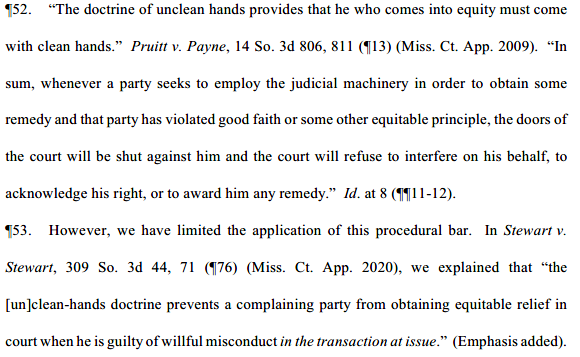
Reversing the chancellor’s findings granting title of real property to one party (Levon) based on findings that Levon had obtained title by adverse possession or by tax sale and that the opposing party (Rosie) had unclean hands, holding that the chancellor erred in granting title to Levon because he failed to prove the elements of adverse possession by clear and convincing evidence, that the tax sale was void due to flawed notice of redemption, and that the doctrine of unclean hands was erroneously applied to bar Rosie’s challenge because Rosie’s conduct was related to a forty-year-old estate case, not the transaction at issue.
(All judges concurred.)

Since accusations of “unclean hands” get thrown around in litigation on occasion, I thought this summary of the equitable doctrine of unclean hands is a useful refresher:

NOTE – As always, but only more so here, if this case applies to your practice you need to read it yourself. There are many details in this forty-page opinion that I have not even attempted to tease apart.


Herron v. Herron, 2021-CA-00090-COA (Civil – Domestic Relations/Constructive Trust/Property Valuation)
Affirming the chancellor’s findings in a divorce action granting a life estate via constructive trust in a home on the marital property to the ex-wife’s mother in assigning value to property awarded to the ex-husband, holding that there was clear and convincing proof that the house was intended to be owned by the mother in a life estate and that there was substantial credible evidence supporting the chancellor’s valuations of the personal property in question.
(All judges concurred.)


Gillespie v. Lamey, 2021-CA-00076-COA (Civil – Personal Injury/Summary Judgment/Duty to Warn)
Affirming summary judgment in favor of a defendant dismissing the plaintiff’s claim for personal injuries sustained when the plaintiff fell through a roof while working on a skylight on the defendant’s property, holding that (1) the plaintiff presented no evidence that the defendant failed to warn the plaintiff of any dangerous condition of which the defendant had actual or constructive knowledge and (2) the allegedly dangerous condition was “intimately connected” to the work he was hired to do.
(Judge Smith did not participate, all other judges concurred.)


Smith v. Richmond, 2020-CP-01064-COA (Civil – Wills, Trusts, and Estates/Civil Procedure)
Dismissing the appeal, holding that the pro se appellant’s attempted appeal of the chancery court’s denial of a Rule 60(b) motion to set aside an interim order, a motion to recuse, and a “motion to change jurisdiction” must be dismissed because each of these motions was an interlocutory order not appealable as of right.
(All judges concurred.)


Wayne v. State, 2021-KA-00084-COA (Criminal – Felony/Rebuttal Evidence/Sufficiency and Weight of Evidence)
Affirming murder conviction, holding that there was no error (1) in allowing the State to recall a State’s witness and introduce and play the defendant’s recorded statement in rebuttal because the recorded statement contradicted the defendant’s trial testimony, (2) in introducing the defendant’s entire statement because it was proper impeachment evidence, or (3) in denying the defendant’s post-trial motion because the evidence was sufficient to support the conviction and that the conviction was not against the weight of the evidence.
(All judges concurred.)


Beale v. State, 2020-KA-00614-COA (Criminal – Felony/Overt Act)
Affirming conviction two counts of attempted murder of two police officers, holding (1) an indictment for the crime of attempted murder does not require the description of an overt act, (2) that two jury instructions did not constitute a constructive amendment to the indictment, and (3) testimony from an officer about what a witness told him at the crime scene was not hearsay because they were not offered to prove the truth of the matter asserted but to explain the next steps in the course of his investigation.
(Judge Westbrooks dissented, joined in part by Judge McDonald. Judge McDonald concurred in part and dissented in part without separate written opinion. Judge Emfinger concurred in part and in the result without separate written opinion. Judge Wilson concurred in result only without separate written opinion. All other judges concurred.)

NOTE – We have gotten an “is the indictment missing an alleged overt act” case in back-to-back hand-down days. In her dissent, Judge Westbrooks’s argues that she is taking a position consistent with the position that Justice Coleman took just last week in Brady v. State (my post here) (opinion link here).


Other Opinions

Durrant Inc. v. Lee County, Mississippi, 2019-CA-01826-COA (denying motion for rehearing)

Bell v. State, 2020-CT-00592-COA (denying motion for rehearing)


Hand Down List

Summaries of the Mississippi Court of Appeals opinions of April 12, 2022

The Mississippi Court of Appeals handed down two opinions today, one criminal and one civil. The criminal opinion affirmed a conviction, finding no merit on a litany of issues. The civil opinion affirmed summary judgment on a breach of contract claim based on a personal guaranty included in a credit application with a business’s supplier.


Barnes v. State, 2021-KA-00404-COA (Criminal – Felony/Hearsay/Jury Instructions/Rule 404(b))
Affirming conviction of two counts of fondling, holding (1) no error in jury instruction re: sufficiency of unsubstantiated/uncorroborated, but not contradicted/discredited, testimony of victim of a sex crime to support guilty verdict; (2) no error in allowing testimony by investigator “based on professional experience” because not expert opinion; (3) error in allowing hearsay was harmless because the same information was also introduced through admissible source; (4) Rule 404(b) objection re: other students who reported misconduct waived because not made contemporaneously and because it showed why the school initiated an investigation; (5) no error in admitting recorded conversations between victim and defendant where intelligible recording was not produced until the first day of trial (at least partially because defense did not request more time to prepare); (6) no error in admitting purported statement of the defendant over discovery violation objection because the statement had produced in discovery and defense counsel admitted being familiar with it; (7) no merit to ineffective assistance of counsel claim; and (8) the evidence was sufficient to support the convictions. The court of appeals invoked the plain error doctrine to remand the case for correction of a scrivener’s error in the sentencing order.
(Judge Westbrooks and Judge McDonald concurred in part and in the result without separate written opinion. Judge McCarty concurred in result only without separate written opinion.)


Devine v. Cardinal Health 110, LLC, 2020-CA-01101-COA (Civil – Contract/Personal Guaranty/Affirmative Defenses)
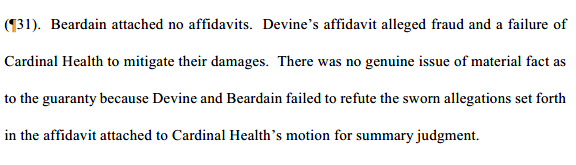
Affirming the circuit court’s grant of summary judgment in favor of the plaintiff/supplier, holding that there was no error in finding that the owners of a company had personally bound themselves to pay their company’s debt to the plaintiff/supplier per the terms of a credit application that contained a personal guaranty. The court of appeals noted that the defendants did not attach affidavits in response to the summary judgment motion that addressed the guaranty:

The court of appeals then held that the plaintiff/supplier–a secured creditor– had no duty to mitigate before filing a lawsuit for damages and that the defendant that asserted fraud in response to the motion for summary judgment had waived that affirmative defense by failing to plead it in his answer to the complaint.
(All judges concurred.)


Other Orders

Hartzler v. Bosarge, 2019-CT-01606 (granting motion to dismiss appeal as interlocutory)

Doe v. Doe, 2020-CA-00853-COA (denying motion for rehearing)
Braswell v. Braswell, 2020-CA-01090-COA (denying motion for rehearing)
Nunn v. State, 2021-TS-01371-COA (granting pro se motion for out-of-time appeal and granting motion to withdraw and substitute counsel)


Hand Down List

Summaries of the Mississippi Supreme Court opinions of March 17, 2022

The folks publishing the hand down lists are not on spring break. There were four opinions today that are must-reads for anyone whose law practice these opinions touch. There is a medical malpractice/expert testimony decision, a dismissal for failure to prosecute decision that is more about the abuse-of-discretion standard of review, a breach of commercial lease opinion, and a will probate opinion.


Claiborne County Hospital v. Truitt, 2020-IA-01017-SCT (Civil – Medical Malpractice/Summary Judgment/Experts)
The plaintiff fell while walking to the restroom to give a urine sample. The plaintiff filed a negligence claim against the hospital, alleging that a nurse failed to assist him to the restroom. The hospital filed a motion for summary judgment on the grounds that the plaintiff lacked medical expert testimony. The plaintiff argued that the layman’s exception applied or, alternatively, that the plaintiff had identified the requisite expert testimony in an interrogatory answer. The circuit court denied the hospital’s motion for summary judgment and the Supreme Court granted interlocutory appeal. The Supreme Court reversed the circuit court and rendered judgment in favor of the hospital, holding that “the layman’s exception does not apply to the facts of this case because Truitt’s claim involves the rendering of medical services and a nurse’s professional judgment for which expert testimony is required.” The Supreme Court also held that the designation via interrogatory answer was insufficient because the “designation does not provide sworn expert testimony” and noting that the plaintiff “only provided the name of his expert and a brief description of the anticipated testimony.”
(All justices concurred)


Leasy v. SW Gaming, LLC, 2019-CT-01505-SCT (Civil – Personal Injury/Failure to Prosecute/Standard of Review)
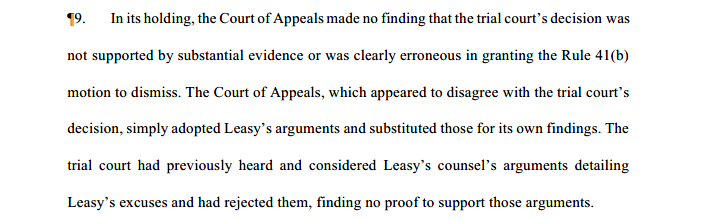
Reversing the Court of Appeals and reinstating the circuit court’s judgment dismissing the plaintiff’s claim for failure to prosecute, holding that the Court of Appeals improperly reweighed the evidence and reaffirming the controlling abuse-of-discretion standard.
(Justice King dissented, joined by Justice Kitchens. Justice Beam did not participate in the decision)
(Note: At the Court of Appeals level, Judge Carlton wrote a dissent that was joined by Judge Wilson)

Practice Point – Standards of review matter! The Mississippi Supreme Court has shown a renewed interest in standards of review. This opinion is more about the standard of review than it is about the failure to prosecute. The Supreme Court described the Court of Appeals’ incorrect application of the standard of review as follows:

The Supreme Court bluntly concluded:


Holcomb, Dunbar, Watts, Best, Masters & Golmon, P.A. v. 400 South Lamar Oxford Mad Hatter Partners, LLC, 2019-CT-01702-SCT (Civil – Real Property/Landlord-Tenant Law/Commercial Real Estate)
Affirming the circuit court’s denial of the tenant’s motion for partial summary judgment seeking a dismissal of the landlord’s claims for back rent, holding that the landlord’s demand for possession and the tenant’s departure from the premises did not prevent the landlord from recovering back rent; affirming the circuit court’s grant of summary judgment to the landlord based upon material breaches by the tenant; affirming the Court of Appeals’ finding that the tenant’s mitigation argument was waived because it was not raised prior to the appeal; affirming the Court of Appeals’ decision granting the landlord’s motion to quash the tenant’s request for records related to a news story a spat between the landlord’s principal and another developer because those records were not relevant to the appeal; and affirming the circuit court’s denial of the tenant’s untimely motion to amend to add claims of libel and libel per se because they were delayed and barred by the one-year statute of limitations.
(All participating justices concurred.)


In the Matter of the Last Will and Testament of Luke Beard, Deceased: Antonio Christmas v. Diane Christmas, 2019-CT-01821-SCT (Civil – Wills, Trusts, and Estates/Probate)
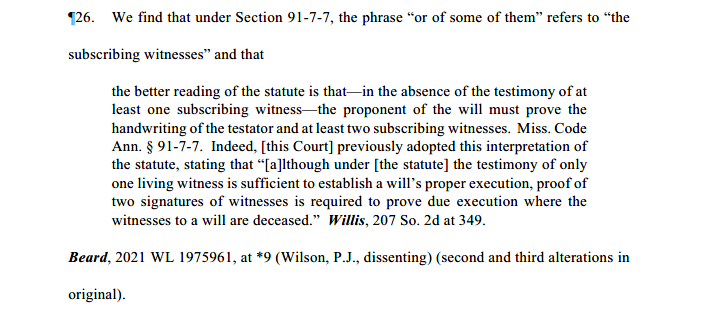
Reversing the court of appeals and reinstating the chancery court’s dismissal of a petition to probate a purported will, holding that in the absence of the testimony of at least one subscribing witness, a proponent of a will must prove the handwriting of the testator and at least two subscribing witnesses. This unanimous, textualist decision centered around whether the phrase “or some of them” in section 91-7-7 referred to the subscribing witnesses or collectively to the testator and the subscribing witnesses. Ultimately, the Supreme Court adopted Judge Wilson’s analysis of the textual quandary from his dissent at the Court of Appeals, holding:


The Mississippi Bar v. Henderson, 2021-BD-01141-SCT (Civil – Bar Matters)
Imposing a reciprocal public censure to an attorney publicly censured in Tennessee and assessing costs.


Other Orders

Dille v. State, 2019-CT-00855-SCT (denying petitions for cert)
Lairy v. Chandler, 2019-CT-01423-SCT (granting petition for cert)
Cork v. State, 2020-KA-00060-SCT (denying pro se motion for rehearing)
Magnolia Health Plan, Inc. v. Mississippi’s Community Health Commissions, 2020-CA-00167-SCT (denying motion for rehearing)

Hand Down List

Summaries of the Mississippi Court of Appeals opinions of March 1, 2022

Today’s court of appeals opinions involve a reputed patent troll, alienation of affection, and a bureaucratic nightmare.


International Association of Certified Home Inspectors and Nick Gromicko v. HomeSafe Inspection, Inc., 2020-CA-00520-COA (Civil – Contract/Misrepresentation/Damages Proof)
Affirming in part and reversing in part the circuit court’s judgment on a jury verdict in a suit that included claims for breach of contract, conversion, and negligent misrepresentation filed by a patent troll holder against a trade association after a deal between the two went poorly. This story began when the patent holder filed a patent infringement suit against a member of the trade association, and the trade association sprang into action and made an effort to strike a deal with the patent holder. The parties reached a deal where patent holder would grant a bulk license to the trade association’s membership to use the patented technology and would agree not to sue any trade association member and, in exchange, the trade association would pay the patent holder a portion of the membership dues it collected. A contract was entered and the a dispute arose about how to carry out the contract that centered around how the license was presented on the trade association’s website. The patent holder filed suit and the jury returned a verdict in favor of the patent holder against the trade association and its founder. The court of appeals made three main holdings. First, the court of appeals held that the patent holder, which had been administratively dissolved by the Secretary of State at the time the contract was entered, had standing to sue because the former entity had been reinstated by the time the lawsuit was filed. Second, the court of appeals held that the patent holder did not prove compensatory damages for breach of contract and conversion with “reasonable certainty” because the damages model used at trial was prepared by unidentified individuals who did not use any recognized methodology and who did not testify at trial. Accordingly, the court of appeals reversed and remanded to the circuit court to determine nominal damages for the breach of contract and for conversion. Third, the court of appeals discussed the difference between a “misrepresentation of fact” and a “promise of future conduct” and held that the trade association’s “lofty promises” made during negotiations were not misrepresentations about then-existing facts and therefore reversed the judgment of liability on the negligent misrepresentation claim and entered judgment in favor of the trade association dismissing that claim.
(All participating judges concurred.)


Dew v. Harris, 2020-CA-01261-COA (Civil – Torts/Alienation of Affection)
Reversing the circuit court’s grant of summary judgment dismissing ex-husband’s alienation of affection lawsuit, holding that there was a genuine dispute over material facts in the form of opposing affidavits and that the trial court had improperly considered the credibility and the weight of the evidence presented during the summary judgment proceedings. This case was remanded for further proceedings.
(All participating judges concurred.)


In the Interest of L.T., K.T., E.T., and S.T.: Mississippi Department of Child Protection Services v. Youth Court of Warren County, Mississippi, 2021-SA-00069-COA (Civil – Domestic Relations/Youth Court)
Reversing the youth court’s decision ordering CPS to pay attorney fees and travel expenses to a minors’ guardian under Rule 11, holding that Rule 11 cannot be used to award sanctions against a party that has not actually filed anything even when another party has endured a “bureaucratic nightmare.”
(All participating judges concurred.)


Other Decisions

Mississippi Department of Economic and Community Development v. General Reinsurance Corporation, 2020-WC-761-COA (denying motion for rehearing).

Bryant v. Bryant, 2020-CA-883-COA (denying motion for rehearing, Barnes and Wilson would grant).


Complete Hand Down List